
100 free spins no deposit in Australia — what the offer is really worth, and where Australian law sits
A “100 free spins, no deposit” offer is the most searched online casino promotion in Australia, and the one with the widest gap between marketing and mathematics. The headline spins are real. So is the wagering multiple, the cashout cap, and the seven-day expiry. So is the fact that every operator offering them to Australian players sits outside Australian law. This page ranks the offshore casinos that run these offers, walks through the terms that decide whether any of those spins reach your pocket, and lays out where the legal line actually sits in 2026.

Data current as of 13 September 2026; bonus terms verified against operator terms pages and the ACMA illegal-gambling register.
Table of Contents
- Why your 100 “free” spins aren’t really free
- 10 offshore casinos ranked by their no-deposit free-spin value in 2026
- RocketPlay
- Fair Go Casino
- SkyCrown
- Bizzo Casino
- Rocket Casino
- Stake
- WinSpirit
- Rainbet
- Royal Reels
- Scream Casino
- The pokies your 100 free spins actually unlock
- Claiming free spins on mobile — what changes and what doesn’t
- New casinos with 100 free spins — fresh bait or a better deal?
- Is it legal? Where Australian law really stands on online casino free spins
- Staying safe — responsible gambling tools and the offshore gap
- How we chose and ranked these casinos
- What your 100 free spins are actually worth — and whether to claim them
- Frequently asked questions
Why your 100 “free” spins aren’t really free
No Australian-licensed online casino exists. The Interactive Gambling Act 2001 prohibits the provision of online casino games, online pokies and in-play betting to anyone in Australia, and the prohibition has no exemption, transition period or back door. Every operator running a “100 free spins, no deposit” promotion to Australian players is doing so from offshore, on a Curaçao or similar licence that has no standing in Australian consumer law. The provider is the one taking the legal risk. The player is not prosecuted for playing, and that asymmetry is the structural reason the offshore free-spin market keeps advertising in Australia.
Once a player understands that frame, the offer itself becomes easier to read. “No deposit” means the casino credits the spins before the player has paid anything in. “Free” is a marketing word. The spins come with a wagering requirement — typically 30× to 60× on the winnings, with 35× to 50× the most common range across the Australian-facing market — and a maximum cashout cap that turns most wins into a small, fixed withdrawal regardless of what the reels actually produce. “No deposit” describes the entry condition. “Free” describes nothing about the cost of converting the bonus to real money.
The arithmetic is the part the marketing keeps off the page. One hundred spins at $0.05 each is $5 of gross value. One hundred spins at $0.10 each is $10. The wagering that follows is calculated on the winnings, not the spin value — so a player who hits a $10 win at a 40× multiple is staring down $400 in required bets before the casino will let a single dollar of it leave. The bonus’s cost is paid in time and turnover, and most players complete that turnover with the winnings gone.
What “no deposit” actually means for Australian players
“No deposit” describes how the spins are funded, not how they end. A no-deposit free-spins bonus is credited to a new account on registration, before any payment instrument has been presented. From the casino’s side, the spins are a marketing cost — an acquisition tool designed to put a real bank account behind a screen and onto the wagering treadmill. From the player’s side, the spins are a chance to try the casino’s pokies library without committing money, and the wagering terms are the cost of converting anything won into withdrawable cash.
The mechanics follow a fixed sequence. Spins are credited on sign-up. They are played on a specific pokie or a small assigned list. Any winnings land in the bonus balance, not the cash balance, and are not withdrawable until the wagering requirement is met. KYC verification — photo ID, proof of address, sometimes a payment-method check — runs before the first withdrawal is approved, and that step is where most no-deposit winnings die. A player who can’t clear KYC has nothing to withdraw even after clearing the wagering.
Game contribution matters because wagering is a turnover figure, not a balance. Pokies contribute 100% of every bet to the wagering requirement. Table games and live casino contribute 0–20%, which is why every NDB offer in the Australian market is locked to pokies. A player who fires up blackjack to “clear” the bonus faster is moving the wagering bar sideways.
Sign-up spins vs bonus-code spins — two paths to the same offer
There are two ways the offer reaches the player. The first is automatic — SkyCrown credits 50 spins on Book of Dead the moment a new account is registered, with no code, no opt-in and no manual step beyond signing up. The second is manual — RocketPlay’s 20 no-deposit spins on Book of Pyramids arrive only after the player has registered through a specific third-party review and clicked a verification link. Both paths deliver a no-deposit offer; the difference is who has to do what to claim it.
The manual path is rarer, and the reason it exists is conversion tracking. An affiliate review can attribute a signup to a specific referrer, and a casino that wants to pay for that traffic will gate the no-deposit bonus behind a verification step the affiliate controls. The cost to the player is a couple of clicks. The benefit to the player is access to a bonus that is not advertised on the operator’s main promotions page.
Neither path delivers a “better” offer in any structural sense. Wagering, cashout cap and expiry are set in the bonus terms regardless of how the spins were claimed. A code-based claim is not a negotiation; it is a different front door to the same back room.
Spin count vs spin value — what 100 spins are actually worth
The headline number a casino leads with is the spin count. The number that decides the offer’s worth is the spin value. A hundred spins at $0.05 each is $5 of gross bonus value; fifty spins at $0.25 each is $12.50, and the smaller offer is worth more than the larger one. The Australian-facing market in 2026 sets most no-deposit spin values between $0.05 and $0.20, and the highest-count offers tend to live at the lower end of that range.
This is the comparison a player should run before chasing the bigger headline. Two offers can both claim to be “free spins no deposit” and one can be worth more than double the other, because the spin value multiplies the count. A bonus advertised as 200 spins at $0.05 is $10 of bonus value. A bonus advertised as 50 spins at $0.25 is $12.50. The same logic applies in reverse: a 100-spin offer at $0.20 is a $20 gross value and is genuinely a more expensive promotion for the operator than a 100-spin offer at $0.05, which is why spin value rarely appears in the headline.
“Twenty spins on a 97% RTP game beats fifty spins on a 90% RTP game. Maths does not care about marketing.”
The same arithmetic applies to the assigned pokie. Two offers of 50 spins at $0.10 each are both $5 of gross value at the spin stage, but the one assigned to a 96.7% RTP pokie returns more of the eventual wagering turnover than the one assigned to a 96.0% pokie. Across the hundreds of dollars in required bets that follow a typical no-deposit win, that 0.7 percentage point compounds into a meaningful difference in expected loss.
Wagering-free spins — the rare offer that lets you keep what you win
A wager-free no-deposit offer is the closest thing the market has to a genuinely free bonus. The winnings from the spins land in the cash balance, withdrawable as soon as KYC is cleared, with no turnover requirement. Wager-free offers are rare because the casino carries the full cost of the bonus with no defence against a player who wins on the first spin and leaves; they tend to appear on low-value spins (often $0.05 or $0.10) with tight cashout caps and short expiry windows.
A standard 40× offer tells a very different story. On a typical no-deposit win of AU$8, a 40× wagering requirement is AU$320 in required bets before the bonus balance is unlocked. The expected loss across that turnover, at a representative 96.5% RTP, is around AU$11.20 — which is more than the AU$8 of winnings the bonus started with, and more than the $5–$10 of gross spin value that funded the bonus in the first place. The bonus costs the player more, on average, than it pays out. The wager-free version of the same offer costs nothing in expected loss; the player either keeps the winnings or doesn’t, on the strength of the reels.
Low-wagering offers — 10× or 20× instead of the standard 35×–50× — sit in the middle. They are not as generous as wager-free, but they reduce the expected loss to a fraction of what a full-multiple offer carries, and they are the right comparison point when a “no deposit” headline is being evaluated.
The cashout cap is the other half of this. A wager-free offer that caps withdrawals at AU$50 is a different promotion from a wager-free offer with no cap, even though the spin terms are identical. The most common cashout caps on Australian-facing no-deposit offers in 2026 sit between AU$50 and AU$200, with AU$100 the most common single figure. The cap is read after the wagering is done.
Real-money wins, cashout caps and the withdrawal wall
A maximum cashout cap is the rule that says: even if you win $500 on your free spins, the casino will only let you withdraw $100 (or $50, or $200, or whatever the cap is set to). The excess is voided. The cap is a separate term from the wagering requirement, and the two interact in a way that consistently catches first-time players off-guard.
Wagering has to be cleared first. Then the cap is applied to what is left. A player who wins $200, completes the wagering, and then tries to withdraw the full $200 will be told the cap is $100, and the remaining $100 will be removed from the balance. The money was never really “theirs” in the first place — it was bonus money with a ceiling attached — but the experience is the same as a withdrawal being refused, and the terms of the offer are the only thing that determines whether the cap is $50, $100, $180, $300 or some other figure.
Fair Go’s no-deposit offers carry a ~A$180 cap regardless of whether the bonus is a $15, $50 or $100 free chip, which is unusually consistent. SkyCrown’s 50-registration-spin offer caps at AU$100. Rocket Casino’s free-spin winnings cap at AU$300, the highest cashout cap in the featured set. RocketPlay’s 20-spin NDB caps at roughly AU$85, a lower figure that reflects the smaller bonus size. The right comparison is not which cap is the most generous in absolute terms, but which cap represents the largest multiple of the offer’s gross spin value, and the operator that pays the highest proportion of the bonus back to the player when they win.
10 offshore casinos ranked by their no-deposit free-spin value in 2026
Every brand on this list is offshore. None holds an Australian licence for online casino gaming, because no such licence exists under the Interactive Gambling Act 2001. The ranking is by offer strength — wagering fairness, cashout cap generosity, and how much of the bonus is actually delivered to a player who wins — not by market share, brand recognition or AU-facing advertising spend. Where a bonus term was not confirmed this run, the cell is left empty rather than estimated; the absence is information.
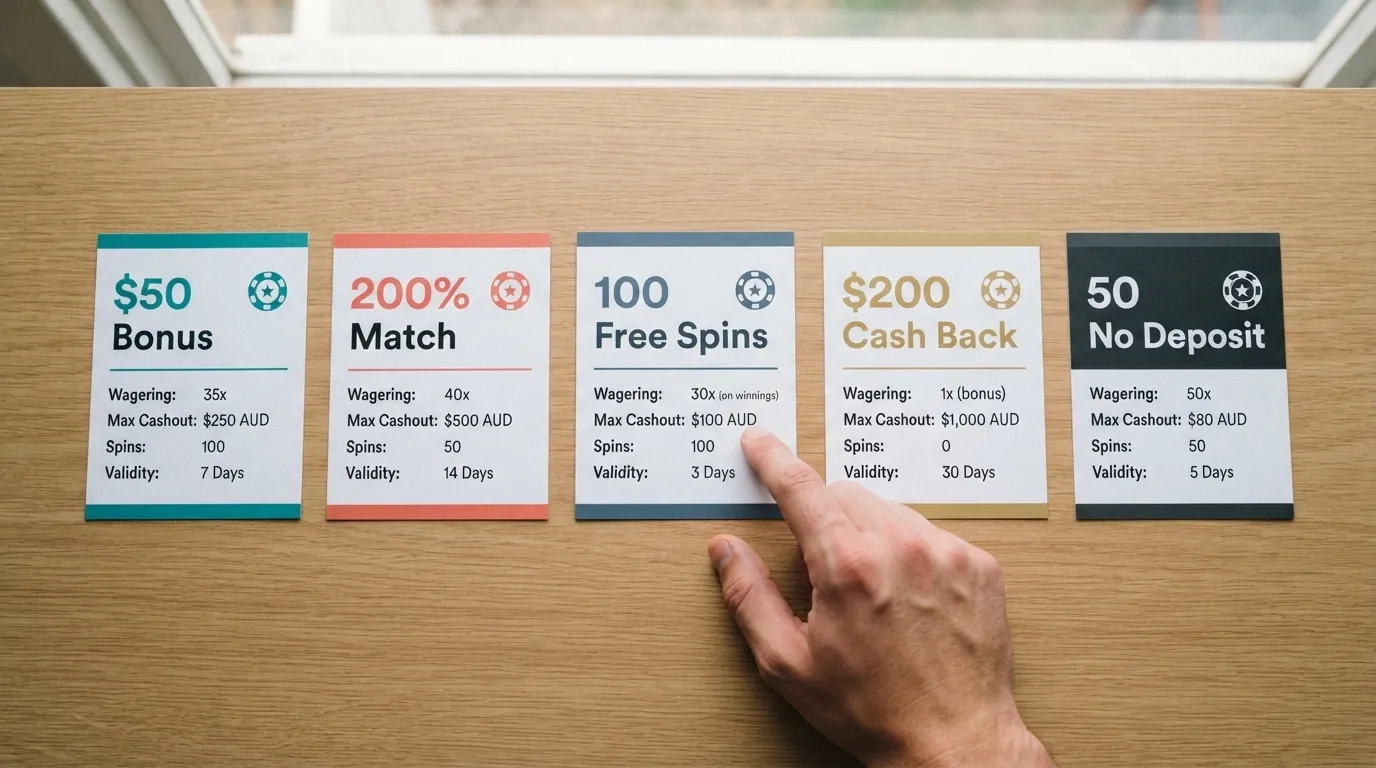
| Operator | No-Deposit Offer | Wagering on Winnings | Max Cashout | Spin Value | Bonus Validity | Licence |
|---|---|---|---|---|---|---|
| RocketPlay | 20 spins (Book of Pyramids, review-verified) | 40× | ~AU$85 | AU$0.10 | 7 days | Offshore (Curaçao) |
| Fair Go Casino | $15–$100 free chip or free spins (varies) | 60× | ~AU$180 | AU$0.10 | 7 days | Offshore |
| SkyCrown | 50 spins (Book of Dead, on registration) | 40× | AU$100 | AU$0.10 | 7 days | Offshore |
| Bizzo Casino | 10–25 spins (varies by promotion) | 40× | AU$100 | AU$0.10–$0.20 | 7 days | Offshore |
| Rocket Casino | Free spins on registration (varies) | 30× | AU$300 | AU$0.10–$0.20 | 7 days | Offshore |
| Stake | — | — | — | — | — | Offshore (Curaçao) |
| WinSpirit | — | — | — | — | — | Offshore |
| Rainbet | — | — | — | — | — | Offshore |
| Royal Reels | — | — | — | — | — | Offshore |
| Scream Casino | — | — | — | — | — | Offshore |
Five of the ten featured operators carry a confirmed no-deposit free-spin offer with terms that can be checked against the operator’s own bonus page. The other five — Stake, WinSpirit, Rainbet, Royal Reels and Scream Casino — sit in the ranking for their AU-facing presence and the welcome-package terms that can be verified, not for a no-deposit offer that surfaced this run. Stake’s promotions are rakeback and VIP-driven; Rainbet and Royal Reels run deposit-gated packages with terms that are publicly available; WinSpirit and Scream Casino’s specific bonus structures were not confirmed against operator terms pages. Their inclusion is a function of the search results, not a verdict on offers no player has yet seen.
How the 10 offers stack up — terms that separate the strong from the weak
The wagering multiple is the single number that decides the offer’s cost. Rocket Casino’s 30× is the lowest in the set and meaningfully cheaper for the player than the 60× Fair Go applies, because the expected loss on a typical no-deposit win at 30× is roughly half the expected loss at 60× on the same turnover. Fair Go’s 60× sits well above the industry average and is the most punishing figure in the table; it is the cost of Fair Go’s free-chip programme, and a player who values their time should read it as the headline term before the dollar amount.
The cashout cap is the second number. Rocket Casino’s AU$300 cap is the highest in the set and the one that does the most to convert a bonus win into a real withdrawal. SkyCrown’s AU$100 and RocketPlay’s ~AU$85 are mid-table and reflect the smaller spin counts and tighter bonus terms those offers carry. The cashout cap matters most when a player wins — which is the least common outcome — so it is a number to read in advance, not a number most players ever reach.
The spin count is the figure the marketing leads with, and it is the figure that tells the player the least. SkyCrown’s 50 registration spins is the largest automatic NDB in the set. RocketPlay’s 20 spins is a smaller bonus, and Bizzo’s 10–25 spins is the most variable. Spin count alone does not determine offer value; spin value multiplies it, and the wagering multiple divides it.
RocketPlay’s no-deposit offer is the most distinctive structural feature in the table. The 20 spins on Book of Pyramids are not automatic on registration; they are earned through a third-party review verification, and that is why the operator can run a smaller, more targeted acquisition bonus without diluting the welcome-package headline. The $5 max bet while wagering is also worth noting — it caps the rate at which a player can grind through the bonus, and the 7-day default expiry is the same clock every operator in this set runs.
RocketPlay
RocketPlay is a multi-provider offshore casino built on a BGaming, Pragmatic Play, NetEnt and Softswiss stack, and its no-deposit offer is the most unusual one in this ranking: 20 free spins on Book of Pyramids, earned by registering through a third-party review and completing a verification step, rather than credited automatically on sign-up. The 40× wagering is the industry standard for the Australian market, the maximum cashout is roughly AU$85 (50 EUR), and the spin value is AU$0.10. Bonus validity runs 7 days, and the default maximum bet while wagering is $5 per spin.
The welcome package overshadows the NDB. A first deposit of at least AU$30 unlocks 100% up to AU$1,000 plus 100 free spins, credited as 20 per day across five days. The wagering on the welcome bonus is 40× on the bonus amount, with the same $5 max-bet rule and the same 7-day clock. The NDB is the entry point; the welcome package is the one the operator is built to convert.
For a player who has never used RocketPlay, the verification-gated NDB is a useful offer to start with — the 20 spins are a no-cost trial of the casino’s pokies library, the assigned pokie is a well-known Pragmatic Play-adjacent title, and the wagering terms match the market average. For a player who has already used the NDB, the welcome package is the comparison to make, and the 40× on a matched deposit is steep by the standard of licensed-AU deposit-match offers even though it is normal for the offshore market. The right read on RocketPlay is that the NDB is a sampler, and the welcome package is the offer a player should only take if they were already planning to deposit at that casino regardless.
Fair Go Casino
Fair Go is the only single-provider casino in this set, running its full pokies library on RealTime Gaming, and the structure of its no-deposit programme is the most punishing in the table. The free chip is generous on paper — $15, $50 or $100 depending on the promotion — but the 60× wagering applied to NDB winnings is well above the industry average of 35×–50×, and the ~A$180 maximum cashout cap is applied uniformly across all chip sizes. A player who hits a $100 win on a $100 free chip cannot withdraw more than A$180 regardless of what the reels produce, and the AU$180 has to be earned through 60× of the winnings in turnover.
The RTG-only library is the trade Fair Go makes. Single-provider casinos have less breadth than multi-provider aggregators, but they have a tighter integration between the bonus engine and the game client, and that is sometimes reflected in smoother claiming and faster bonus-crediting. For a player who is already an RTG fan, Fair Go’s library is familiar territory. For a player who wants the breadth of a Pragmatic Play / NetEnt / Play’n GO stable, the single-provider model is a real constraint.
The 60× wagering is the deciding number. At a representative 96% RTP and a $50 free chip that produces $50 in winnings, the player is looking at $3,000 in required turnover before the bonus is unlocked, with an expected loss of roughly $120 on the wagering alone — more than the $50 chip was worth to begin with. The cap then limits the withdrawal to A$180, which is a tighter ceiling than the AU$300 Rocket Casino runs. Fair Go’s offer is best read as a high-multiple, high-cap, single-library bonus for a player who specifically values RTG pokies and has the bankroll to absorb the expected loss.
SkyCrown
SkyCrown runs the largest automatic no-deposit free-spin offer in the featured set: 50 free spins on Book of Dead, credited to a new account on registration with no code and no verification step. The wagering is 40× on the winnings, the maximum cashout is AU$100, and the spin value is AU$0.10 — a $5 gross bonus before the reels turn. The bonus validity is 7 days, the same clock as the rest of the market.
Book of Dead is one of the most assigned pokies in the no-deposit space, and the reason is structural: it is a high-volatility Play’n GO title with a well-understood RTP and a hit pattern that produces the small, frequent wins that keep a player grinding through wagering without burning through the bankroll too quickly. For a 50-spin offer with a $5 gross value, the volatility profile is the right fit — a low-volatility pokie would produce too many small wins that get wiped out by the wagering turnover, and a high-volatility pokie would produce a single big win and nothing else.
The multi-provider library — BGaming, Pragmatic Play, Play’n GO and others — is the part of SkyCrown that makes the casino more than its NDB. The 50 spins are a one-time acquisition offer; the rest of the library is where a player who has converted into a depositing customer will spend their time. For a player comparing NDBs by headline spin count, SkyCrown is the largest in the set. For a player comparing NDBs by total bonus value, SkyCrown’s $5 gross is mid-table, and the AU$100 cap is mid-table, and the 40× wagering is the industry standard. The right read is that SkyCrown delivers what it advertises, at the market’s standard terms, with the cleanest claiming path of any operator in the set.
Bizzo Casino
Bizzo is a multi-provider offshore aggregator with the most flexible payment setup in the featured set — crypto, PayID and e-wallets all accepted — and a variable no-deposit offer that runs from 10 to 25 free spins depending on the current promotion. The 40× wagering on spin winnings is the industry standard, the AU$100 maximum cashout is the market’s most common single figure, and the spin value sits between AU$0.10 and AU$0.20. Bonus validity is 7 days.
The variable spin count is the distinctive feature. A player who lands on the 25-spin end of the range gets a higher gross bonus value than a player who lands on the 10-spin end, and the same operator can run both offers in the same week depending on the channel through which the player arrived. The right read is that Bizzo’s NDB is a moving offer, and a player who is comparing by exact terms should check the current promotion before claiming rather than relying on a figure from a stale review.
The payment-method flexibility is the other distinctive feature. PayID is an Australian real-time payment rail, and an offshore casino that accepts it is deliberately targeting the AU market; that is a different signal from a casino that only accepts crypto. For a player who values the option to deposit in AUD via PayID rather than converting to BTC or USDT first, Bizzo is one of the cleaner options in the offshore market. For a player who only cares about the NDB, the spin count variability is the deciding factor.
Rocket Casino
Rocket Casino’s no-deposit offer is the standout on terms, even where the spin count is unremarkable. The wagering is 30× on winnings — the lowest in the featured set and a meaningful difference from the 35×–50× most common range. The maximum cashout is AU$300 — the highest in the set. The spin value sits at AU$0.10–AU$0.20, and the bonus validity is 7 days. The exact spin count varies by current promotion, and the lack of a fixed figure is the one weak point in an otherwise strong offer.
The 30× wagering is the headline. On a typical no-deposit win of AU$10, the required turnover at 30× is AU$300 — a 25% reduction from the AU$400 a 40× offer would demand. Across the full set of bonus terms, that 10× saving compounds into a meaningfully lower expected loss, and for a player who plans to clear the wagering rather than forfeit the winnings, it is the single biggest determinant of how much the bonus actually costs.
The AU$300 cashout cap is the second headline. It is the highest in the featured set, double the AU$100 most operators run, and the only cap in the table that allows a player to withdraw a genuinely material amount from a no-deposit bonus win. Combined with the 30× wagering, the Rocket Casino offer is the closest thing in the offshore market to a player-friendly no-deposit structure: cheaper to clear, more generous on the ceiling. The trade-off is that the spin count and assigned pokie vary, and a player who turns up on a low-count, low-value promotion does not get the offer the marketing describes.
Stake
Stake is a Curaçao-licensed offshore casino whose promotional model is built on rakeback and VIP programmes rather than traditional no-deposit welcome bonuses, and the no-deposit free-spin offer that Australian-facing players might be searching for is not something Stake runs in the standard sense. The multi-provider library covers Pragmatic Play, Hacksaw, Nolimit City and others, and the AU-facing presence is real — Stake accepts Australian players, processes AUD deposits, and is one of the larger offshore brands by traffic.
The reason Stake sits in this ranking despite the absence of a confirmed NDB is that the page’s subject is the search for “100 free spins, no deposit” in Australia, and Stake is the kind of brand a searcher will encounter while looking. The honest read is that Stake does not offer what the searcher is looking for. Its promotions are deposit-triggered — funded by the player’s own deposits, with rakeback paid on volume — and its welcome offer, where one exists, is structured differently from the no-deposit free-spin model this page covers.
For a player who has already decided to play at an offshore casino and values Stake’s game library, brand recognition and AUD support, the value is in the deposit-triggered promotions, not a no-deposit NDB. For a player specifically searching for a no-deposit free-spin offer, Stake is not the right destination, and the page’s inclusion is a function of brand recognition rather than offer fit.
WinSpirit
WinSpirit is a multi-provider offshore casino whose welcome package includes free spins as part of a deposit-required offer, and whose no-deposit free-spin offer was not confirmed this run against the operator’s terms page. The library is multi-provider, the welcome structure is deposit-gated, and any specific no-deposit terms — wagering, cashout cap, spin value, validity — are not on a publicly verified source.
The honest read on WinSpirit is that a player searching for a no-deposit free-spin offer should not count on one being available. The welcome package is the operator’s primary acquisition tool, and the NDB is either not currently run, run through a gated channel that did not surface in this run’s search, or run as a short-window promotion that has since closed. Any player who has encountered a WinSpirit NDB via an affiliate link or review should verify the current terms against the operator’s bonus page before claiming, because the absence of a confirmed offer in public sources is itself information.
For a player comparing offshore casinos on the strength of their welcome packages, WinSpirit sits in the same category as the other deposit-gated operators in this list. The right read is to treat the welcome terms as the operator’s primary offer and the NDB — if one exists — as a secondary feature whose current availability should be confirmed at the point of claiming.
Rainbet
Rainbet is a deposit-gated offshore casino whose promotional terms are more restrictive than any other operator in the featured set, and whose exclusion list is the part of the offer a player should read first. The Wager Lock Promotion requires a minimum AU$30 deposit and caps the qualifying deposit at AU$700. The wagering is 40× on bonus funds and free-spin winnings, and the free spins are assigned to Sweet Bonanza. Games with RTP above 97.4% are excluded from the promotion, as are all Hacksaw and Nolimit City titles.
The exclusion list is the headline. Most no-deposit and deposit-bonus offers in the offshore market allow any pokie in the library to contribute to wagering; Rainbet excludes the highest-RTP games, which is a structural reduction in the player’s expected return. A 97.4% RTP pokie excluded from the promotion is exactly the kind of game a player would choose if they were optimising for expected return, and removing it from the eligible list forces play onto lower-RTP titles. The Hacksaw and Nolimit City exclusion is a separate decision — those studios produce high-volatility games with maximum-win ceilings that can produce very large payouts, and excluding them limits the promotion’s upside.
Rainbet’s terms also restrict Australian access via VPN in places, although Australian players reach the site. The right read is that Rainbet is a deposit-gated promotion with a tighter eligibility list than the market average, and a player who is comparing offers should treat the excluded games as a cost, not a footnote. The no-deposit offer was not confirmed this run; Rainbet’s acquisition is built around the Wager Lock Promotion rather than an NDB, and the operator’s ranking on this page reflects the AU-facing presence and the verifiable deposit terms, not a no-deposit offer.
Royal Reels
Royal Reels is a multi-provider offshore casino whose general bonus terms — 30× to 40× wagering, AU$200 maximum cashout, 7 to 14-day validity — were sourced this run from a public comparison table, and whose specific no-deposit free-spin offer was not confirmed against the operator’s own terms page. The library is multi-provider, the welcome offer is deposit-matched, and the absence of a confirmed NDB in this run’s search is the relevant data point for a player searching specifically for a no-deposit offer.
The AU$200 cashout cap is the most distinctive figure in Royal Reels’ confirmed terms. It is higher than the AU$100 most operators run, lower than the AU$300 Rocket Casino offers, and it sits in the middle of the market. A 30×–40× wagering range straddles the industry average. The 7–14-day validity is more generous than the 7-day standard most operators in the set run.
The right read on Royal Reels is that the operator’s general terms suggest a moderately player-friendly structure — competitive wagering, a higher-than-average cashout cap, longer validity — and that any NDB it runs is likely to sit within those parameters. A player who has seen a Royal Reels NDB via an affiliate channel should verify the current terms against the operator’s bonus page before claiming, but the operator’s general structure is a reasonable proxy for what an NDB would look like. The page’s inclusion is on the basis of the verifiable general terms, not a confirmed no-deposit offer.
Scream Casino
Scream Casino is a multi-provider offshore casino whose specific bonus terms — wagering, cashout cap, spin value, validity, NDB availability — were not confirmed this run against the operator’s terms page or any third-party review that satisfied the verification standard. The library is multi-provider, the licence is offshore, and the operator’s ranking on this page reflects its presence in the AU-facing search results rather than any verified offer.
The honest read on Scream Casino is that the operator’s bonus structure is not on the public record in a form this page can verify. A player who has encountered a Scream Casino NDB or welcome offer via an affiliate link should treat the offer with the same caution they would treat any unverified promotion: read the terms on the operator’s own bonus page before claiming, confirm the wagering multiple, the cashout cap, the spin value, the assigned pokie and the validity window, and check that the offer’s headline matches the terms attached to the specific bonus code or claim path being used.
Scream Casino’s inclusion in the ranking is on the basis of the operator’s appearance in the AU-facing search results, not on a verified offer. For a player specifically searching for a confirmed no-deposit free-spin bonus, the verified offers earlier in the ranking are the ones to act on; Scream Casino is the operator to revisit once a verified offer is available.
The pokies your 100 free spins actually unlock
A no-deposit free-spin offer is locked to a specific pokie or a small assigned list, and the assigned game decides what the player is actually playing. A 50-spin offer on a 96.7% RTP pokie is not the same promotion as a 50-spin offer on a 96.0% pokie, and the difference is not a marketing detail. Across the hundreds of dollars in required wagering that a typical no-deposit win generates, a 0.7 percentage point RTP gap compounds into a meaningful difference in expected loss.

Casinos assign specific pokies for three reasons. The first is contractual: the casino has a promotion deal with a studio (Pragmatic Play, Play’n GO, NetEnt) that runs the assigned title at a reduced cost or with a featured placement, and the NDB is built around that deal. The second is volatility: a high-volatility pokie produces larger but rarer wins, which makes the bonus more attractive to players and more expensive for the casino, while a low-volatility pokie produces smaller but more frequent wins, which is easier on the operator’s bankroll. The third is player recognition: a famous title like Book of Dead, Big Bass Bonanza or Starburst converts better than an obscure one, because the player has heard of it and will click through to claim the spins.
The right read for the player is that the assigned pokie is part of the offer, not a footnote. Where the player has a choice of NDBs across multiple operators, the RTP and volatility of the assigned pokie is a tiebreaker worth using, especially when the wagering multiples and cashout caps are similar.
Pokies vs slots — why the Australian name matters
“Pokies” is the Australian term. “Slots” is the international one. They refer to the same games — reel-based, RNG-driven, single-spin wagering products — and the difference is purely linguistic. An Australian player searching for “free spins on slots” and one searching for “free spins on pokies” are searching for the same product, and every offshore casino that targets the AU market labels its game library as “pokies” to match the local vocabulary.
The format that dominates online is the 5-reel video pokie — grid slots with multiple paylines, bonus features, free-spin rounds and increasingly elaborate mechanics. Classic 3-reel pokies still exist but are a niche product. The 5-reel format is what every assigned NDB title in this ranking uses, and it is the format a player should expect when they click through from the bonus terms to the casino’s library.
Pragmatic Play, NetEnt and RTG — the studios behind the spins
Three studios dominate the no-deposit free-spin pool in the Australian market. Pragmatic Play is the largest by assigned spin count — Big Bass Bonanza, Sweet Bonanza, Gates of Olympus and Wolf Gold are all Pragmatic Play titles, and the studio’s high-RTP, high-volatility stable is the most common NDB assignment in 2026. Pragmatic Play’s signature is a high maximum-win ceiling — Sweet Bonanza’s 21,100× is one of the largest in the industry — paired with high volatility that produces long dry spells between payouts.
NetEnt is the second studio by assigned spin count, and its signature is the low-volatility classic. Starburst is the studio’s flagship assigned-spin title, and the 96.09% RTP with low volatility and expanding wilds is the structural opposite of a Pragmatic Play high-volatility pokie. Starburst is the kind of game a casino assigns when it wants the player to grind through wagering without burning through the bankroll too quickly, and it is the most common NDB assignment at casinos that prioritise player retention over headline win potential.
RTG (RealTime Gaming) is the third studio, and it operates differently. RTG is a single-provider studio, and Fair Go is the only RTG-exclusive casino in this set. RTG’s library is smaller than Pragmatic Play’s or NetEnt’s, and its titles are less well-known internationally, but the studio’s bonus engine integration is tight and the games are familiar to long-term Australian pokie players. A multi-provider casino gives the player more choice; an RTG-exclusive casino gives the player a more predictable experience.
RTP and volatility — what the numbers on your assigned pokie mean
RTP is the percentage of all wagered money a pokie returns to players over millions of spins. A 96.5% RTP pokie returns $96.50 of every $100 wagered across the long run, and keeps $3.50 as house edge. The number is calculated over the full lifecycle of the game and is not a prediction of any individual session; a player can hit a $500 win on a 96% pokie or lose $500 on a 97% pokie, and neither outcome contradicts the RTP. What the RTP predicts is the average outcome across enough spins for the maths to settle.
Volatility is the shape of the distribution around that average. A low-volatility pokie produces frequent small wins and few large ones; the bankroll moves slowly and rarely hits zero. A high-volatility pokie produces rare large wins and many small losses or dead spins; the bankroll swings widely and can hit zero before a big win arrives. The two are not interchangeable: a 96% low-volatility pokie plays very differently from a 96% high-volatility pokie, even though the long-term RTP is the same.
For a no-deposit free-spin player, the implications are practical. A 50-spin NDB on a low-volatility pokie will produce a longer, steadier bonus run with a higher chance of clearing the wagering requirement on the original winnings. A 50-spin NDB on a high-volatility pokie will produce a shorter, spikier run with a higher chance of either a large win (capped by the cashout cap) or a quick bust. Neither is “better” in absolute terms; the right choice depends on what the player values. The relevant comparison across operators is the RTP of the assigned pokie, because the RTP difference — 96.7% vs 96.0% — compounds across the wagering turnover in a way the volatility difference does not.
The pokies your spins unlock — RTP and specs
| Pokie Title | RTP | Volatility | Provider | Max Win |
|---|---|---|---|---|
| Big Bass Bonanza | 96.71% | Medium-high (4/5) | Pragmatic Play / Reel Kingdom | 2,100× stake |
| Sweet Bonanza | 96.51% | High | Pragmatic Play | 21,100× stake |
| Starburst | 96.09% | Low | NetEnt | Expanding wilds / respins |
| Gates of Olympus | 96.50% | High | Pragmatic Play | Multiplier scatter mechanic |
| Wolf Gold | 96.01% | Medium | Pragmatic Play | Three jackpot tiers (mini, major, mega) |
The table covers the five pokies most commonly assigned to no-deposit free-spin offers in the Australian market, with the RTP and volatility figures that decide how those spins are likely to play. The RTP range across the five is 0.7 percentage points — a small number in isolation, but a meaningful one across the AU$200–AU$400 of wagering turnover a typical no-deposit win generates. The volatility range is wider: Starburst is the low-volatility outlier, Big Bass Bonanza and Wolf Gold sit in the middle, and Sweet Bonanza and Gates of Olympus are the high-volatility extremes. The right assignment depends on what the bonus terms are optimising for; the right comparison across offers is the one the player makes before they claim.
Claiming free spins on mobile — what changes and what doesn’t
The mobile experience for a no-deposit free-spin claim is functionally identical to the desktop experience. Registration, KYC verification, bonus crediting and wagering all run through the same back-end systems regardless of whether the player is on a phone or a laptop. The terms — wagering multiple, cashout cap, spin value, validity — are set in the bonus conditions and do not change based on the device used to claim.

What changes is the channel. Mobile players are typically the first to receive new bonus codes, and casinos may offer larger or better-aimed promotions to drive app downloads. The offer value is the same; the targeting is more aggressive. A player who sees a “mobile-exclusive” 100-spin offer should read the terms the same way they would read a desktop offer, because the headline bonus is not the relevant comparison — the wagering and the cashout cap are.
Casino apps vs mobile browser — which way to claim
Casino apps are a retention tool, not a better-offer channel. The app download gives the casino a permanent icon on the player’s home screen, push-notification access for bonus expiry reminders, and a more controlled environment for the bonus engine. The trade-off is the app permissions — a casino app can request access to storage, location and other device features that a mobile browser does not need — and the storage cost of keeping the app installed alongside the browser-based account.
The mobile browser is the lower-friction option. A player can register, claim the NDB, complete KYC and start wagering without installing anything, and the browser sandbox limits the casino’s access to device features. For a one-time NDB claim where the player does not plan to return, the browser is the right tool. For a player who plans to deposit and play regularly, the app is a reasonable convenience play — the push notifications for the 7-day bonus expiry are genuinely useful, and the home-screen icon reduces the friction of returning to the casino.
Neither channel changes the offer. The wagering, the cap, the validity — all the same.
New casinos with 100 free spins — fresh bait or a better deal?
New offshore casinos launch with generous no-deposit free-spin offers for one reason: they need a player base. The 100-spin headline is an acquisition cost, designed to put real account holders on the casino’s books in the hope that some fraction of them will convert into depositing customers. Once the player base is large enough, the offer is typically reduced, and the marketing shifts from acquisition to retention.

The implication for the player is that a new casino’s NDB is sometimes better than an established casino’s NDB, and the newness is part of the cost. A brand-new operator has no track record. Its licence jurisdiction is the same Curaçao-or-equivalent every offshore casino runs, but the licence number is younger, the player reviews are fewer, and the ACMA blocking record is shorter. Since enforcement strengthened in 2017, more than 225 illegal services have withdrawn from the Australian market, and a new casino that launches in 2026 may be ACMA-blocked within weeks of going live. A player with a balance on a blocked site has no Australian consumer protection and no ACMA complaints body to escalate to.
The right read is that a new casino’s 100-spin NDB is worth claiming on its terms, not on its novelty. The wagering, the cashout cap, the spin value and the validity need to be checked against the operator’s terms page before the first spin, and the licence needs to be verified against the regulator’s own register. A new casino whose terms beat the established set is worth playing at for the NDB; a new casino whose terms are the same as everyone else’s is worth playing at only if the player is comfortable with the brand-recognition trade-off.
How a new casino’s bonus terms stack up against the established picks
The benchmark the established set in this ranking sets is clear: wagering 30× to 60×, cashout AU$50 to AU$200 (with AU$100 most common), expiry 3 to 7 days (with 24 to 48 hours the tightest end), and spin value AU$0.05 to AU$0.20. A new casino’s NDB should be measured against those ranges, not against its own marketing copy.
A wagering multiple below 30× is unusually player-friendly and worth verifying against the operator’s terms, because the figure is often a typo or a legacy number that has since been replaced. A cashout cap above AU$300 is high enough to be worth confirming in writing, because most operators cap at AU$200 and a higher figure suggests either a more generous operator or a different bonus structure. A validity window shorter than 24 hours is a sign that the operator does not expect the player to clear the wagering and is structurally designed to forfeit the bonus. A validity window longer than 14 days is a sign that the operator is confident the bonus will convert and is not trying to rush the player.
The risk of a new casino is the operational risk. A site that launched in 2026 has not been through a full ACMA enforcement cycle, has not built a player-review base, and has not had time to develop a track record on withdrawal speeds. ACMA has blocked 1,564 illegal gambling and affiliate websites since November 2019, and a new casino that goes live in 2026 is more likely than an established one to be in that 1,564 within the next twelve months. The player should treat the licence as the first filter, the terms as the second, and the brand age as the third — in that order.
Is it legal? Where Australian law really stands on online casino free spins
Online casino gaming is prohibited in Australia. The Interactive Gambling Act 2001 makes it an offence to provide an online casino, online pokies or in-play betting to a person in Australia, and no licence for online casino exists anywhere in the country — not federally, not in any state or territory. The prohibition is structural: the product cannot be licensed here. What the IGA permits is wagering on races and sporting events placed before the event begins, through operators licensed by a state or territory (the Northern Territory Racing and Wagering Commission / Licensing NT is the de facto national licensor for online wagering). What it does not permit is online casino games, online pokies, or in-play sports betting. There is no exception, no transition period, and no carve-out for free spins.

The Australian Communications and Media Authority (ACMA) enforces the prohibition. ACMA investigates complaints, issues formal warnings, refers operators for civil penalty proceedings, and directs Australian ISPs to block illegal sites. Since its first blocking request in November 2019, ACMA has had 1,564 illegal gambling and affiliate websites blocked, and more than 225 illegal services have withdrawn from the Australian market since enforcement strengthened in 2017. The IGA targets the provider of the prohibited service, not the individual player. Australian players are not prosecuted for gambling at offshore sites, and that asymmetry is the structural reason the offshore free-spin market continues to operate in Australia despite the prohibition.
The implication for a player searching for “100 free spins, no deposit” in Australia is that every operator offering the promotion is doing so in violation of Australian law. The risk of that violation is borne by the operator, not by the player, but the consumer-protection gap it creates is borne by the player: no Australian complaints body, no ACMA escalation route, no BetStop coverage, no recourse for a refused withdrawal or a voided win, and the possibility that the site is blocked by an ISP direction at any time with a balance still on it.
Offshore casino licences — what a Curaçao or Malta seal actually means for an Australian player
The offshore licences that AU-facing casinos carry — Curaçao, Malta (MGA), Kahnawake — are real licences in their home jurisdictions. They require the operator to maintain segregated player funds, follow anti-money-laundering procedures, and submit to the licensing authority’s dispute resolution. They do not, in any form, extend to Australian players. ACMA does not recognise them. The Australian Competition and Consumer Commission does not enforce them. An Australian player with a complaint against an offshore casino has to file it with the offshore regulator, in the regulator’s language, under the regulator’s procedural rules.
The practical effect is that an offshore licence is a signal of baseline operational legitimacy, not a guarantee of consumer protection. A Curaçao-licensed casino is more likely to pay out than an unlicensed one, and the Curaçao regulator has improved its enforcement over the last decade. A Malta-licensed casino is held to a higher operational standard, and the MGA’s dispute process is more accessible than Curaçao’s. Neither licence is enforceable from Australia, and the player who has a problem with an offshore casino is, for practical purposes, on their own.
The ACMA enforcement reach is the other side of this. The regulator can direct Australian ISPs to block illegal sites, and those directions are complied with. A site that is ACMA-blocked is unreachable from an Australian IP address without a VPN, and the use of a VPN to access a blocked site is a separate legal question the player should consider. The 1,564 blocked sites include both gambling operators and affiliate pages that advertised them, and the blocking list is updated regularly. A casino that is reachable today can be blocked next month, and a player with a balance on it at the time of the block has no Australian body to escalate to.
The 2026 gambling reform — what changes for free-spin players from January 2027
The Interactive Gambling Amendment (Gambling Reform) Bill 2026 passed Parliament on 19 August 2026, and its measures commence on 1 January 2027. The reform does not legalise online casino gaming; the prohibition stays in place. What it does is strengthen the enforcement and add new restrictions on the licensed wagering market that will, by extension, shape the environment in which offshore free-spin offers are advertised to Australian players.
The advertising restrictions are the most visible change. From 1 January 2027, wagering advertising on television is capped at no more than three ads per hour between 5:00 am and 8:30 pm, with a live-sport blackout from 15 minutes before until 5 minutes after a live event. Wagering ads in sports venues and on uniforms are banned. Athletes, celebrities and influencers are barred from promoting wagering. Radio ads are barred during school drop-off and pick-up times. Broadcasting of sporting odds is banned. Online wagering ads are restricted to logged-in, age-verified users with an opt-out.
The inducement restrictions are the most directly relevant to the offshore market. From 1 January 2027, direct marketing of inducements is prohibited for 14 days after a customer signs up, for three months after a person deregisters from BetStop, and indefinitely for customers identified as at-risk. The rules apply to licensed Australian operators; an offshore casino advertising a welcome bonus to Australians is breaking the underlying prohibition, not merely an advertising rule. The practical effect is that the licensed market will be quieter and the offshore market will not be, which is the structural outcome the reform is designed to produce.
The bank-blocking provision is the most consequential new power. From 1 January 2027, banks and payment providers gain express authority to block transactions to illegal gambling operators, and the framework for them to do so without breaching their own contractual obligations is written into the law. The AdStop (Wagering Advertising Opt-out Register), to be administered by ACMA, is not expected to be operational by 1 January 2027 and is likely to commence on a later day fixed by proclamation. Online keno “pocket pokies” and foreign-matched lotteries are banned from the same date.
The reform is not aimed at the player. The IGA continues to target the provider, not the player, and the player is not prosecuted. What the reform does is reduce the licensed market’s reliance on inducements, restrict the channels through which wagering advertising reaches Australian audiences, and give banks the explicit authority to refuse transactions to illegal operators. The offshore free-spin market sits outside the licensed framework the reform is building, and the reform does not directly restrict it. What it does do is make the licensed market a less attractive comparison point and the offshore market a more isolated one.
The payment ban — why your credit card and crypto won’t work at an offshore casino from June 2024
Credit cards, credit-related products and digital currency (crypto) are banned as payment for online wagering in Australia since 11 June 2024, under the Interactive Gambling Amendment (Credit and Other Measures) Act 2023. The penalties for breaching the ban are up to $247,500. The legal deposit routes for licensed wagering are debit card, bank transfer, PayID/Osko and BPAY.
The ban applies to licensed wagering operators. The Australian banks that process the transactions enforce it on the licensed side, declining credit-card transactions to licensed wagering merchants and flagging crypto purchases that route through Australian exchanges. The offshore side is different. An offshore casino that accepts Visa or Mastercard credit-card deposits is processing those transactions through an offshore payment processor, and the Australian bank’s role is limited to the initial transaction; whether the bank declines it depends on the merchant category code and the bank’s own fraud rules, not on a gambling-specific block.
The practical implication is that the payment ban is a structural signal of the regulatory direction rather than an operational barrier to offshore play. A player who tries to deposit at an offshore casino with an Australian-issued credit card may find the transaction declined at the bank level, but the decline is the bank’s fraud policy rather than a regulatory enforcement action against the player. Crypto deposits route outside the Australian banking system entirely, and the ban is enforceable against the Australian exchange that on-ramps the crypto, not against the player who holds it.
The relevance to a no-deposit free-spin offer is limited by definition: no-deposit means no payment is made. Where the ban bites is at the withdrawal stage — a player who has won on a no-deposit offer and wants to cash out needs a withdrawal method, and the options that are not banned (debit card, bank transfer, PayID, BPAY) are the same options that work for any other transaction. Offshore casinos typically offer a wider range — including crypto and e-wallets — and the choice of withdrawal method is a separate decision from the choice of casino.
Staying safe — responsible gambling tools and the offshore gap
Problem gambling in Australia affects approximately 2.1% of adults — roughly 430,000 people — with the Australian Institute of Health and Welfare putting high-risk gambling at 1.8% in 2022. Those are the headline numbers; the underlying distribution is uneven, and the population most exposed to offshore free-spin marketing is the same population most likely to be on a tight budget and most likely to find a no-deposit offer’s “no risk” framing appealing. The marketing works because the offer is genuinely low-cost to claim; the cost is paid in time, in the wagering turnover, and in the conversion to a depositing customer.
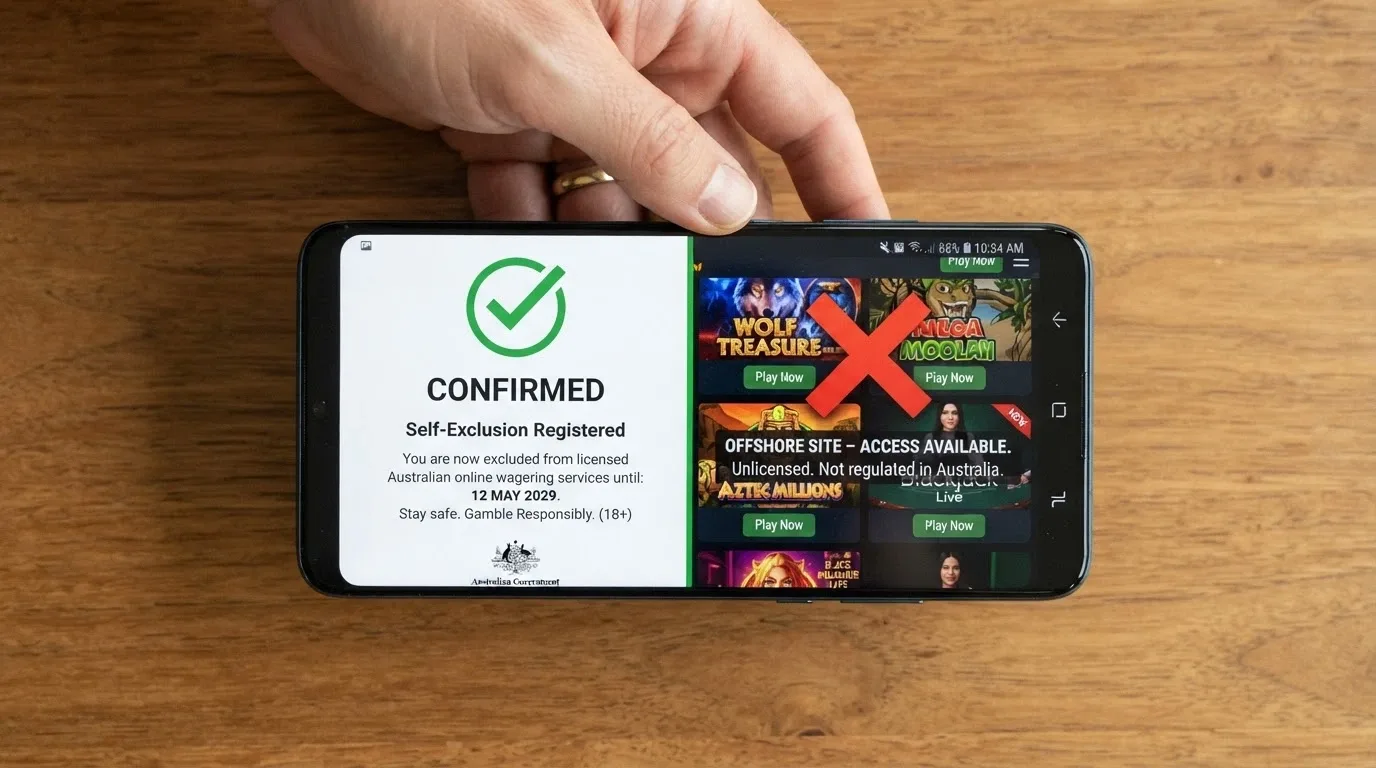
BetStop — the National Self-Exclusion Register — is the Australian government’s primary harm-prevention tool for online gambling. One registration excludes a person from every Australian-licensed online and phone wagering service, with exclusion periods from three months to a lifetime. As at 31 July 2026, BetStop had 67,480 registrations since going live in August 2023, of which 41,290 exclusions were still active. 78% of registrants were under 40, and 38% chose a lifetime exclusion. The demographics reflect the population most at risk and the population most exposed to offshore marketing.
The offshore gap is the structural problem. BetStop binds Australian-licensed wagering services only. An offshore casino is not connected to the register, and a self-excluded person who opens an account at an offshore casino will not be flagged, blocked, or contacted. The exclusion the person thought they had does not apply to the offer the marketing is pushing, and the offshore casino has no obligation to honour the BetStop registration. A person who has self-excluded and then plays at an offshore casino has chosen to bypass their own exclusion, and the register offers no protection against that decision.
The National Gambling Helpline (1800 858 858) is free, confidential and staffed 24 hours a day. Gambling Help Online (gamblinghelponline.org.au) provides online chat and counselling. Both services are funded by the Australian Government Department of Social Services and are available to anyone in Australia, including people who are playing at offshore casinos. The services do not require the person to be BetStop-registered or to have stopped playing; they are there to talk to, and a person who is concerned about their own play or someone else’s is the right person to call.
Wagering records and bonus chasing — when the free spins stop being free
No-deposit free spins are designed to convert a no-cost claim into a depositing customer. The mechanism is the wagering requirement. A player who wins $10 on a no-deposit offer and faces a $400 wagering requirement has two choices: clear the wagering with their own money, or forfeit the winnings. The first option is the one the casino wants, because a player who deposits to clear wagering is a player who has just made their first deposit, and the first deposit is the conversion event the entire NDB programme is built to produce.
The behavioural pattern is well-understood. A player who has already invested an hour clearing the wagering on a $10 win is more likely to deposit to finish the job than a player who is starting from scratch. The sunk-cost logic is “I’ve already done most of the work” and the marginal-cost logic is “it’s only $10 to clear the rest.” Neither logic accounts for the expected value of the bonus, which is negative at standard 40× wagering. The casino is not relying on the player to do the arithmetic; the casino is relying on the player to do the opposite.
The warning signs are consistent across harm-prevention research. Chasing losses — depositing more to recover money lost on bonus play. Depositing to unlock locked winnings — the “just one more deposit” pattern. Losing track of time and spend. Borrowing to fund a deposit. Hiding play from family or friends. Lying about how much has been spent. None of these is a clinical diagnosis, and the page is not the place for one, but each is a reason to call the helpline.
A player who notices any of these patterns in their own play has the option to register with BetStop, and a BetStop registration will block access to every Australian-licensed wagering service. It will not block access to offshore casinos, and the offshore gap means the player has to make the same decision independently. The helpline and Gambling Help Online are the right first contact for anyone who is unsure whether their play has crossed a line.
Where to get help — Australian gambling support at a glance
- National Gambling Helpline: 1800 858 858 — free, confidential, 24/7
- Gambling Help Online: gamblinghelponline.org.au — online chat and counselling
- BetStop — National Self-Exclusion Register: betstop.gov.au — single registration excludes from all licensed Australian wagering
- BetStop covers Australian-licensed wagering only; offshore casinos are not connected and will keep taking a self-excluded person’s money
How we chose and ranked these casinos
The ranking is by offer strength on the terms the operator’s own bonus page or a verified third-party review states — wagering multiple, cashout cap, spin value, validity, eligible pokie, and the presence of a confirmed no-deposit offer. Every brand in the ranking was checked against the official Australian licence framework, and the check confirmed that no online casino licence exists for any of them; every operator is offshore, and every offer this page covers is offered outside Australian consumer law.

The qualitative criteria that ordered the ranking, in the order they were applied: whether a no-deposit free-spin offer for Australian players was confirmed in the operator’s current terms; the wagering multiple applied to free-spin winnings (lower ranked higher); the maximum cashout cap (higher ranked higher); the spin value and assigned pokie (with RTP as a tiebreaker); the bonus validity window (longer ranked higher); the term transparency (publicly stated terms ranked above hidden conditions); and the provider library breadth (multi-provider ranked above single-provider, all else equal). No weightings or scores have been published because the inputs do not carry them; the ranking is editorial, and a different editor would order it differently on the borderline cases.
The sources consulted were operator terms pages, third-party casino review databases, and the ACMA illegal-gambling register. Where an operator’s bonus terms were not confirmed against any of those sources, the cell is empty and the operator’s ranking reflects the verifiable information available. The absence of a confirmed offer is itself a piece of information, and the page does not estimate one in its place.
What your 100 free spins are actually worth — and whether to claim them
A 100-spin no-deposit offer at $0.10 per spin is $10 of gross bonus value. A typical win of $8 on those spins, at the standard 40× wagering, is AU$320 of required turnover before the bonus is unlocked. Across that turnover, at a representative 96.5% RTP, the expected loss is AU$11.20 — more than the $10 the spins were worth to begin with, and more than the $8 the player won off them. The bonus costs the player more, on average, than it pays out, and the cashout cap — AU$50 to AU$200, most commonly AU$100 — means the player who does win cannot withdraw the full amount anyway. The arithmetic is not a secret; it is just rarely written down in the same place as the offer.
The right way to read a no-deposit free-spin offer is as a zero-cost trial of a casino’s pokies library. The player gets to see what the casino’s site looks like, how the bonus engine behaves, what the wagering feels like in practice, and whether the assigned pokie is a game they would choose to play with their own money. None of that costs the player anything if they walk away after the spins are done. The cost starts when the player deposits to clear the wagering on a $10 win, because that is the conversion event the offer was designed to produce, and the expected value of the conversion is negative at standard terms.
The cashout cap is the other number to read in advance. AU$100 is the most common cap, AU$300 the highest in the featured set, AU$85 the most common low end. The cap is the ceiling on the player’s upside, and it is a structural feature of the offer rather than a surprise at the withdrawal stage. A player who wins above the cap loses the excess; a player who reads the cap in advance knows what they are playing for.
The house edge means most players withdraw nothing. The wagering means most players who win forfeit the win rather than clear the turnover. The cashout cap means most players who clear the turnover cannot withdraw the full amount. The compounding of those three factors is why the bonus is offered in the first place: it is a marketing cost designed to produce a converting customer, and the expected-value arithmetic is on the casino’s side. None of that makes the offer a bad deal; it makes the offer what it is. The player who treats it as a free trial of a casino, rather than a path to a payout, is the player who gets the value out of it.
There is no Australian-licensed alternative. The Interactive Gambling Act 2001 prohibits the product. No state or territory issues online casino licences. Every no-deposit free-spin offer an Australian player can claim is offered by an offshore operator outside Australian law, and the IGA’s structural prohibition means that will not change. The page does not recommend any operator; it describes the offers and the terms, and the player who reads the terms before they claim is the player who has the cleanest read on what they are getting into.
Frequently asked questions
Can I really get 100 free spins without depositing any money at an Australian online casino?
Yes, but only at offshore operators — no Australian-licensed online casino exists under the Interactive Gambling Act 2001, so every “no deposit” offer in the Australian market comes from an offshore brand running on a Curaçao or similar licence. The spins are credited on registration at some operators and via a verification step at others, and the wagering terms (typically 30× to 60× on winnings) and a cashout cap (most commonly AU$100) apply regardless of how the spins were claimed.
How long do I have to use my no-deposit free spins before they expire?
Most no-deposit free-spin offers in the Australian-facing market expire in 3 to 7 days, and some tighter promotions expire in 24 to 48 hours. The bonus terms state the validity window, and the clock starts when the spins are credited to the account. Any unplayed spins and any unwagered winnings are forfeited at expiry, so the player should check the validity before the first spin rather than at the end of the window.
How much can I actually withdraw from 100 no-deposit free spins?
The maximum cashout cap on no-deposit free-spin offers in the Australian market is typically AU$50 to AU$200, with AU$100 the most common single figure. Rocket Casino runs the highest cap in the featured set at AU$300; RocketPlay’s review-verified NDB caps at roughly AU$85. Any winnings above the cap are voided after wagering is cleared, and the cap is set in the bonus terms rather than applied at the withdrawal stage.
What does “wagering requirement” mean on a no-deposit free spins bonus?
A wagering requirement is the multiple of the bonus winnings the player must bet before the bonus balance converts to withdrawable cash. A 40× wagering requirement on AU$8 of free-spin winnings is AU$320 in required bets. Pokies contribute 100% of every bet to the wagering requirement; table games typically contribute 0–20%, which is why no-deposit offers are locked to pokies. The expected loss across the wagering turnover, at a 96.5% RTP, is around 3.5% of the turnover itself.
Do I need a bonus code to claim 100 free spins no deposit?
It depends on the operator. Some offers are credited automatically on registration with no code required — SkyCrown’s 50 spins on Book of Dead is the example in this set. Other offers require a bonus code to be entered at registration or in the cashier. A third path, used by RocketPlay, is verification through a third-party review site, where the code is part of the affiliate link rather than a manual entry. None of the three paths delivers a structurally better offer; the wagering and the cashout cap are the same regardless of how the spins were claimed.
What happens if I win big on free spins but the cashout cap is low?
The excess above the cap is voided. If the player wins AU$300, clears the wagering requirement, and the cap is AU$100, only AU$100 is withdrawable and the remaining AU$200 is removed from the balance. The cap is set in the bonus terms and is applied after the wagering is cleared, not at the time of the win. A player who is choosing between two offers with the same wagering but different caps is choosing between two different maximum withdrawals, and the higher cap is the more generous offer in that comparison.