
Real Money Pokies Apps for Australians: What You Can Actually Download in 2026
Australians play real money pokies on mobile apps every day — by the revenue numbers, offshore casino brands pull significant amounts out of phones sitting in the country. Not one of them is licensed to do it. Online casino games and online pokies are prohibited under the Interactive Gambling Act 2001, and the prohibition has no carve-out for an “Australian pokies app”. The page below ranks the ten offshore casino apps Australians actually use, with their legal status laid out rather than dressed up.

Data current as of 13 September 2026, checked against the Australian Communications and Media Authority (ACMA) register and the Northern Territory Racing and Wagering Commission (NTRWC) / Licensing NT public record.
Table of Contents
- Why Every “Australian Pokies App” Is Actually Offshore
- The Pokies Apps That Target Australian Players — Offshore, Unlicensed, and Widely Used
- How Australians Actually Get Pokies Apps — Because the App Store Won’t Help
- The Law Is Clear: Online Pokies Are Illegal to Offer in Australia
- The Pokies App Bonus Looks Big — Until You Read the Fine Print
- Getting Your Money Out Is Harder Than Putting It In
- The Pokies Titles Australians Hunt for on Mobile Apps
- Playing for Free vs Playing for Real — Two Completely Different Experiences
- Staying in Control: Limits, Self-Exclusion and Where to Get Help
- How We Selected and Compared These Pokies Apps
- What Every Australian Pokies Player Needs to Weigh Up
- Frequently Asked Questions
Why Every “Australian Pokies App” Is Actually Offshore
A “real money pokies Australia app” reads like a domestic product, the kind of thing you would expect an Australian operator to publish on the local App Store. The structure of the market makes that reading wrong from the first word. There is no licence for an online casino anywhere in Australia — not federally, not in any state or territory, not for a single one of the ten brands ranked below.
The Interactive Gambling Act 2001, strengthened in 2017, makes it an offence to provide online casino games, online pokies and in-play sports betting to a person in Australia. The Australian Communications and Media Authority (ACMA) enforces the prohibition. As at March 2026, ACMA had directed Australian internet service providers to block 1,564 illegal gambling and affiliate websites, and more than 225 illegal gambling services had withdrawn from the Australian market since the 2017 amendments. ACMA puts it bluntly: a page about “the best licensed online casinos in Australia” describes something that does not exist.
What “app” actually means in this market is also worth pinning down. Real-money casino apps are not distributed through the Google Play Store or Apple’s App Store in Australia. The IGA prohibition reaches the storefronts as much as it reaches the operators — neither Google nor Apple will stock a product that is unlawful to offer. Every AU-facing real money pokies app arrives on an Australian phone through a direct download, not a search and a tap. On Android, that download is an APK file from the operator’s own website, with “Install unknown apps” enabled in settings. On iOS, the App Store will not carry the product at all, so the same operator is reached through a mobile browser instead — sometimes wrapped in a “progressive web app” that adds an icon to the home screen but does not change the legal position underneath it.
The scale of Australian play despite the prohibition is the part the law cannot speak to and the revenue numbers can. By the most recent market snapshot, the top ten offshore casino brands ranked below collectively account for more than 25% of Australian online casino market share by revenue. Australians are downloading, depositing and spinning — they are simply doing it on apps whose servers sit somewhere else.
What “Real Money Pokies App” Actually Means in Australia
A real money pokies app, in the sense an Australian reader means it when they type the phrase into a search box, is a mobile application on which you wager Australian dollars on the outcome of a slot machine, with a balance that can be withdrawn back to an Australian bank account. That is the whole definition, and every app on this page meets it — which is also exactly why none of them is licensed in Australia.
Real-money stakes are the dividing line. Most casino apps, including the ones marketed to Australians, allow free-play or “demo” modes that use virtual credits and pay nothing out. The app store versions, where they exist, generally offer this free-play tier only. Real-money play sits behind a deposit screen and a withdrawal screen, and it is that real-money tier the IGA prohibits an Australian-licensed operator from offering.
The offshore-only reality for cash play is not a grey area or a question of interpretation. The Act targets the provider — not the player. The individual punter is not prosecuted under the IGA. The Act is enforced against the offshore operator offering the service, the Australian ISP carrying the traffic, and the affiliate site advertising it. The practical consequence is that an Australian player deposits into an Australian-dollar-denominated account on a server registered in another jurisdiction, plays pokies denominated in AUD, and withdraws back to an Australian bank account — all of which the operator is licensed to do in its home jurisdiction and none of which the operator is licensed to do in Australia.
The legal position of the individual player is the part of the picture the marketing does not draw down. Playing on an offshore app is not, in itself, a criminal offence for the player. It does, however, leave the player outside every consumer-protection and dispute-resolution framework the Australian system would otherwise provide. There is no Australian complaints body with jurisdiction over an offshore operator, no Australian consumer law that reaches the bonus terms, and no Australian regulator with the power to compel a payout. The ACMA can block the site; it cannot recover your money. That distinction is the centre of the page.
Pokies-Only Apps vs Full Casino Suites — What Australians Actually Use
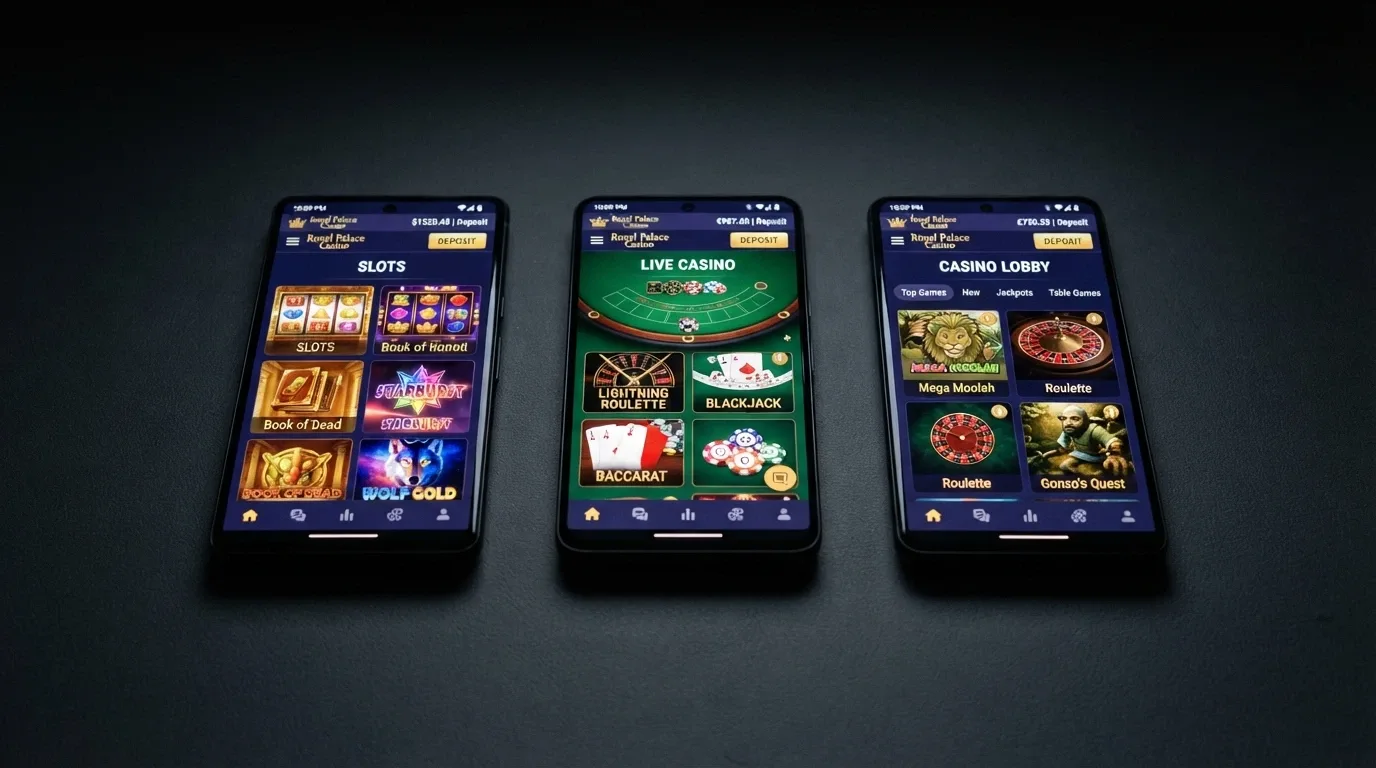
A dedicated pokies-only app — a mobile client whose library is nothing but slot machines, no table games, no live dealer, no sportsbook — is the rarer shape on the AU-facing offshore market. A full casino-suite app, which offers pokies alongside blackjack, roulette, baccarat, live dealer tables and frequently a sportsbook tab, is the dominant one. The ten brands below are all casino-suite operators; pokies sit inside a wider product, not as the entire product.
The two formats differ in obvious ways. A pokies-only app narrows the navigation to reels, jackpots and bonus-buy features; it pushes the player into one genre and rewards attention to that genre. A full casino app spreads the player across game types, with the pokies lobby sitting beside the live dealer tab and the table-games section, and a sportsbook often sitting beside that again for the casino-and-sport hybrids. On a phone screen, both layouts compress to roughly the same touch surface — a thumbnail grid of game tiles, a balance counter at the top, a deposit button somewhere reachable with a thumb.
For Australian players specifically, the casino-suite shape carries one implication worth naming. Cross-sell from pokies to live dealer tables is built into the navigation, not bolted on. A player who came for the pokies ends up one tap from a streamed blackjack table. That is a feature of the product, not a quirk of it, and it is the same reason these apps carry a sportsbook tab: the offshore operator wants every dollar of the player’s entertainment budget, not the slice that fits one genre.
The Pokies Apps That Target Australian Players — Offshore, Unlicensed, and Widely Used
Every operator below is an offshore casino brand targeting Australian mobile players. None can hold an Australian online casino licence, because no such licence exists. The right comparison is not against other Australian casinos — it is against licensed Australian wagering operators, which by law do not offer pokies at all. The “Australian licensed online casino” is a category with zero members, and ranking apps against it would produce a list of zero items. The ranking below is against the actual market: offshore brands that Australian mobile players use, ordered by the strength of their AU presence.
| Operator | AU Legal Status |
|---|---|
| Rocket Play | Offshore — no AU casino licence |
| Skycrown | Offshore — no AU casino licence |
| Royal Reels | Offshore — no AU casino licence |
| WinSpirit | Offshore — no AU casino licence |
| Stake | Offshore — no AU casino licence (casino + sportsbook) |
| Rainbet | Offshore — no AU casino licence |
| Scream Casino | Offshore — no AU casino licence |
| FairGO | Offshore — no AU casino licence |
| Bizzo Casino | Offshore — no AU casino licence |
| Rocket Casino | Offshore — no AU casino licence |
The licensing baseline matters because the AU register that does exist is for a different product. Licensing for online wagering in Australia is state and territory business; the Northern Territory Racing and Wagering Commission (NTRWC), administered through Licensing NT, is the de facto national licensor and its register covers wagering operators — not online casinos. None of the brands above can appear on that register, because none offers a licensable product under Australian law. Where the table above says “offshore”, it means the operator is registered in a jurisdiction outside Australia and licensed by that jurisdiction’s regulator — not licensed in Australia.
What Separates a Worthwhile Offshore Pokies App from the Rest
Because every option on this ranking sits outside Australian consumer protection, the question “is this safe?” stops being a question the regulator answers for you and becomes a question you answer for yourself. The signals worth weighing, in rough order of how much each one costs you if it is missing, are these.
A licence from a recognised offshore jurisdiction is the floor. Curaçao, Malta (MGA), the Isle of Man, Gibraltar and a handful of others run gaming regulators with publicly searchable licence registers and published dispute procedures. The licence is not Australian and does not give you Australian-law recourse, but it does give you a named regulator whose complaints process exists and who can, in the right circumstances, escalate against the operator. A licence from an opaque or unverifiable registry is the equivalent of none.
The game-provider mix and audit certification tell you whether the games are what they say they are. Pokies from established providers — Aristocrat for the Link family, Pragmatic Play, NetEnt, Microgaming, Evolution for live dealer — are independently audited for randomness and payout behaviour. A lobby full of unnamed providers with no audit trail is a lobby where the games can be tuned however the operator likes.
Payment methods that work for Australians are the practical layer. The legal deposit routes for licensed Australian wagering are debit card, bank transfer, PayID/Osko and BPAY. Offshore casinos may accept these, may layer alternatives on top, or may steer the player toward methods a licensed Australian operator cannot lawfully accept — credit cards and crypto in particular. Credit-card and crypto deposits are a clear signal that the operator sits outside the Australian regulatory perimeter: those payment methods have been banned as payment for online wagering in Australia since 11 June 2024.
Player-feedback and track-record signals are the harder ones to read. Long-running forums, independent review sites and complaint histories are the closest thing to a public audit of an offshore operator’s payout behaviour. None of them carry the weight of a regulator’s finding, and several of the larger ones carry their own affiliate conflicts, but the absence of any external discussion at all is itself information.
What no amount of due diligence recovers is the underlying position. ACMA cannot recover a player’s money from an offshore operator, and from 1 January $$CY+1$$ banks and payment providers gain express authority to block transactions to illegal gambling operators. The offshore route is, by construction, the route where the player carries the loss.
Rocket Play
Rocket Play is the largest AU-facing offshore casino brand among the ranked set, and the legal status is exactly the same as the rest: offshore, with no AU casino licence, because no such licence exists for an offshore operator to hold. The product is a casino suite — pokies, table games, live dealer — distributed through the operator’s own website as an APK for Android and a mobile browser flow for iOS, since the App Store will not stock a real-money casino product for the Australian market.
Specific bonus terms, game-provider lists and wagering multiples for Rocket Play could not be independently confirmed for this ranking, and a player who wants current terms needs to read them on the operator’s own site before depositing. What can be said is the shape of the product: a casino-suite lobby weighted toward pokies, with a deposit-match welcome offer, free-spin bundles and reload promotions.
For an Australian player choosing Rocket Play, the calculus is the same as for any offshore operator and unique to none of them. The brand is large enough that its licence jurisdiction, payment methods and complaint history are findable; whether the bonus is worth the turnover it requires is a calculation the player runs against the specific terms on the day of deposit.
Skycrown
Skycrown is another high-traffic offshore casino brand with strong Australian mobile reach, and the same legal status: offshore, no AU casino licence, no path to one. Skycrown operates as a casino suite — pokies plus table games plus live dealer — distributed to Australian phones through the same direct-download channels as the rest of the offshore market.
Operator-specific bonus, provider and wagering details were not independently confirmed for this ranking, and the warning is the same as for the larger names: the headline bonus figure on a Skycrown landing page is not what lands in the player’s balance after the turnover run.
The verdict for a player considering Skycrown is the verdict for the category. The brand is established enough that its track record is at least findable; the absence of an AU licence is not a Skycrown-specific gap but a structural feature of the market.
Royal Reels
Royal Reels is an offshore casino brand with a name that signals its target market: an Australian-facing identity built into the brand itself, with AU-dollar denominated play and AU-friendly payment options prominent in the marketing. The legal status is the same as every other brand in the ranking — offshore, no AU casino licence, because the licence does not exist.
AU-branded offshore operators are a category of their own. The branding tells a player the operator wants their business specifically; it does not change the legal position underneath. A name that reads “Royal Reels” or “FairGO” is a marketing decision aimed at the Australian search query, not a signal that the operator is somehow licensed in Australia. An AU-facing brand is, in fact, an explicit admission that the operator has built its product around the Australian market despite the prohibition.
Specific terms for Royal Reels were not confirmed for this ranking. The verification gap — bonus, providers, wagering — is the same one that applies to the rest of the offshore set, and the same instruction applies: check the operator’s own site before depositing.
WinSpirit
WinSpirit is a mid-tier offshore casino in the Australian market — smaller in scale than Rocket Play or Skycrown by AU-facing revenue, but operating with the same product shape and the same legal status. The offshore, no-AU-licence position is structural: no operator in this market segment can hold an Australian online casino licence, regardless of size.
Operator-specific details were not confirmed for this ranking. The shape of the product — pokies, table games, live dealer, casino-suite navigation — is what can be said, along with the general pattern of deposit-match welcome bonuses, free-spin bundles and reload promotions that the category shares.
For a player who prefers a smaller operator, the tradeoff is clear: less community discussion and a leaner support team, meaning the independent due diligence on payout reliability is more critical here than at the larger brands.
Stake
Stake is the offshore casino-and-sportsbook hybrid in the ranking, and the dual-product shape is the thing that distinguishes it from a pure-play casino app. A Stake player deposits once and reaches a casino tab and a sportsbook tab from the same account balance, with promotions that straddle both — casino free spins on one tab, odds boosts on the other. Stake is also one of the more widely recognised offshore brands among Australian punters, in part because of its sponsorship footprint and its visible presence on cryptocurrency-friendly payment rails.
The legal status is unchanged: offshore, no AU casino licence, no AU sportsbook licence. The sportsbook tab is no more Australian-licensed than the casino tab, because wagering on racing and sport is licensed at state/territory level and the operators licensed to offer it are a different set of brands — SportsBet, bet365, Ladbrokes, Neds and others holding NT or state licences — none of which offer online pokies.
Specific pokies and bonus details for Stake were not confirmed for this ranking. The verdict is the verdict for the category, with one shape-specific note: a player who wants casino and sports betting in one app is closer to that product at Stake than at any other brand in the ranking.
Rainbet
Rainbet is a smaller offshore casino brand in the AU-facing set, ranked here on the strength of its Australian mobile traffic rather than on overall market share. The legal status is the same as the rest: offshore, no AU casino licence, no path to one.
Specific volatile fields for Rainbet — bonus terms, game providers, wagering, withdrawal times — were not confirmed for this ranking. The verification gap is the same one that runs through the offshore set, and the operator’s own site is the only source that can fill it.
For any player eyeing Rainbet, the same advice applies as for the larger offshore set: verify the terms personally, as the limited public discussion of the brand makes tracking its recent payout behaviour more difficult.
Scream Casino
Scream Casino is an offshore casino brand with an AU-facing presence, sitting in the same market segment as the rest of the ranking and carrying the same legal status. The product shape — pokies, table games, live dealer — is the casino-suite shape that dominates the AU-facing offshore market.
Specific bonus and provider details for Scream Casino were not confirmed for this ranking. The verdict is the verdict for the category: an offshore operator whose terms a player needs to verify on the day of deposit.
FairGO
FairGO is an offshore casino explicitly branded for the Australian punter — the name is the marketing decision, with the same AU-facing identity that Royal Reels carries. An AU-branded operator is one that has built its product, its payment options and its customer support around the Australian player specifically, and the brand name is the most visible signal of that orientation.
The legal status is unchanged: offshore, no AU casino licence, because no such licence exists. The AU-facing branding does not move the operator inside the Australian regulatory perimeter; it sits on the outside of it and markets to the inside.
Specific terms for FairGO are not publicly verifiable for this list. The standard warning for offshore brands applies: check the operator’s site directly for bonus details, wagering conditions and withdrawal rules before committing any funds.
Bizzo Casino
Bizzo Casino is a smaller offshore casino in the AU-facing market, with the same legal status as the rest of the ranking. The product is the casino-suite shape — pokies, table games, live dealer — distributed to Australian phones through the same direct-download channels as the larger names.
Specific bonus and game details for Bizzo Casino were not confirmed for this ranking.
Rocket Casino
Rocket Casino is an offshore casino brand that shares a name element with Rocket Play but is a separate operator, and the two should not be confused. Both are offshore, both hold no AU casino licence, and both operate casino-suite products distributed through the standard direct-download channels — but the brand identities, the bonus structures and the game-provider mixes are distinct.
Up-to-date terms for Rocket Casino are not available through independent sources. The same rule holds as for the other offshore operators: verify all bonus, turnover and withdrawal conditions on the casino’s own portal before making a deposit.
How Australians Actually Get Pokies Apps — Because the App Store Won’t Help
The installation path for a real money pokies app on an Australian phone does not run through the App Store or Google Play, because both storefronts refuse to carry a real-money casino product for the Australian market. The Interactive Gambling Act 2001 makes online casino and online pokies prohibited to provide to a person in Australia, and the storefronts enforce the prohibition upstream of the operator — Google and Apple will not stock a product that is unlawful to distribute in the country. The result is a parallel distribution channel that runs directly from the operator’s website to the player’s phone, with no app store intermediary.
The block is enforced at the storefront, not at the device. An Australian iPhone user cannot search the App Store and download a real-money pokies app; an Australian Android user cannot do the same on Google Play. The service itself may also be subject to DNS-level blocking by Australian ISPs at ACMA’s direction, which means that even if a player finds an installer, the domain behind it may resolve to nothing once the ISP’s block list catches up. The ACMA’s blocking record — 1,564 websites blocked since November 2019 — is the standing reminder that the enforcement is active and that the cat-and-mouse game with offshore operators is ongoing.
The security trade-off of installing from outside an official store is the cost of the distribution model. An official app store review catches a meaningful slice of malicious software before it reaches a phone; a direct APK download from an operator’s website catches none of it. The check a player can run themselves — verifying the URL bar, confirming the APK signature where the operator publishes one, scanning the file with a mobile antivirus — replaces a portion of what the App Store review would otherwise provide, but not all of it. The trade-off is structural: a player who wants a real-money pokies app on their phone in Australia is choosing to install software that has not passed through a storefront review.
Android: Sideloading the APK — Because Google Play Won’t Stock It
The Android install path is the more direct of the two. The player visits the offshore casino’s website in a mobile browser, locates the Android download, and downloads an APK file directly. The first install attempt hits a system prompt — “Install unknown apps” — which the player has to allow for the browser being used. Once enabled, the APK installs as if it had come from the Play Store, and the operator’s icon appears on the home screen with a full app experience behind it.
Operators use this distribution model because they have no choice in the Australian market. Google Play enforces the same prohibition on real-money casino apps that the IGA enforces on the providers; an operator that tried to list on Google Play for the Australian market would be removed. The direct-APK distribution is the workaround the industry has standardised on, and the security guidance that goes with it — verify the URL, check the APK signature, scan the file, keep the phone’s OS up to date — is the guidance every Australian player is choosing to follow by using this path.
The alternative on Android — installing through a third-party app store that is not Google Play — exists but adds another layer of distance between the player and the operator. The same security caveats apply, with less certainty about who is signing the APK.
iPhone & iPad: The iOS Workaround Australian Players Rely On
The iOS path is the more constrained one. Apple’s App Store enforcement of the Australian prohibition is tighter than Google’s, and there is no equivalent of the “install unknown apps” prompt that lets a player sideload an installer file from a website. Apple’s iOS does not allow the installation of unvetted software on iPhones and iPads outside the App Store, and the App Store does not carry a real-money casino app for the Australian market.
The workaround iOS players rely on is the mobile browser. The same offshore casino that ships an Android APK ships a responsive mobile website that runs on Safari or Chrome on iOS, with a touch interface that approximates the app experience. Some operators add a “progressive web app” layer that lets the player pin the casino to the home screen with a custom icon, blurring the line between a browser tab and a downloaded app — but the underlying delivery mechanism is still the browser, not a native iOS install.
The experience difference between the iOS browser route and the Android APK route is real, and it cuts mostly in the direction an Australian iPhone user would notice. A native app has tighter integration with the phone — push notifications, biometric login, offline cache for the lobby, smoother animation. A browser experience delivers most of the same functions through web standards but cannot match the integration depth. Whether the difference is decisive depends on what the player opens the app to do; for a quick deposit-and-spin, the mobile browser is close enough; for extended sessions, the native app is the better product. Australian iOS players cannot have the latter for real-money play.
Download, Install and Start Playing — The Real-Money Mobile Flow
The end-to-end mobile flow, once the install hurdle is past, looks the same on both platforms. The player opens the app (or the mobile browser), taps a “Sign Up” or “Register” button, and fills in an account form: email address, password, name, date of birth, country, currency. The Australian dollar is offered as a currency option on every AU-facing offshore brand in the ranking, because pricing in AUD is one of the ways these operators signal that the Australian player is the target.
After registration, the deposit screen presents a set of payment methods. The legal deposit routes for licensed Australian wagering — debit card, bank transfer, PayID/Osko and BPAY — may all be offered, and offshore casinos may layer alternatives on top: e-wallets, prepaid vouchers, and on some brands, crypto. A player who sees credit card or crypto as the only deposit option is looking at a brand that sits outside the Australian regulatory perimeter: those methods have been banned as payment for online wagering in Australia since 11 June 2024, with penalties of up to A$247,500 for an operator that fails to enforce the ban. Credit card and crypto acceptance is not a feature; it is a tell.
From the deposit confirmation, the player reaches the lobby. Pokies sit in a tab, often the default landing tab, with a thumbnail grid of game tiles — Dragon Link, Lightning Link, Buffalo King, Big Bass Bonanza and the progressive-jackpot families are the names that recur. A tap on a tile launches the game in landscape or portrait orientation depending on the title, with a balance counter, a bet-size selector and a spin button. That is the real-money wagering experience on a phone screen, and it is the same experience whether the player reached it through an APK or a mobile browser.
The Law Is Clear: Online Pokies Are Illegal to Offer in Australia
The Interactive Gambling Act 2001 prohibits online casino games, online pokies and in-play sports betting to people in Australia. There is no licence for any of them, anywhere in the country. The Australian Communications and Media Authority (ACMA) enforces the prohibition, and the enforcement record is concrete: 1,564 illegal gambling and affiliate websites blocked as at March 2026, more than 225 illegal gambling services withdrawn from the Australian market since 2017.
| Action | Legal Status |
|---|---|
| Providing online casino games | Prohibited |
| Providing online pokies | Prohibited |
| In-play sports betting | Prohibited |
| Wagering on pre-event sport/racing | Licensable (State/Territory) |
The Act targets the provider, not the individual player. The IGA is enforced against the offshore operator offering the service, the Australian ISP carrying the traffic, and the affiliate advertising it. An Australian punter who downloads an offshore pokies app and deposits into it is not committing an offence. The player is, however, sitting outside every layer of Australian consumer protection the system would otherwise provide.
What “no licence exists” means in practice is the distinction the marketing never draws down. There is no Australian register to check, because there is no licence to be on it. The NTRWC / Licensing NT register covers wagering operators — SportsBet, bet365, Ladbrokes, Neds and others holding NT or state licences — and not online casinos. A player who searches the register for Rocket Play or Skycrown will not find them, because the licence those names would need to be on does not exist.
The Interactive Gambling Act and the ACMA — Who Polices What
The Interactive Gambling Act 2001 was strengthened in 2017, when amendments closed the offshore loopholes the previous enforcement regime had struggled to reach. The amendments gave ACMA formal powers to investigate complaints, issue infringement notices, seek civil penalties, and direct Australian internet service providers to block illegal services. The blocking is DNS-level — an ISP redirects the domain to a server that returns nothing, and the player whose browser hits the blocked address sees the request fail.
The gap between blocking a site and protecting a player’s balance is the part of the enforcement picture ACMA itself names. ACMA can direct a block; ACMA cannot recover a player’s money. A punter whose offshore casino refuses to withdraw, or whose balance disappears when the site goes dark after a blocking request, has no Australian body to complain to and no Australian regulator with the power to compel a payout. The block is an enforcement action against the provider, not a consumer protection action for the player.
The 2026 reform — the Interactive Gambling Amendment (Gambling Reform) Bill 2026 — passed Parliament on 19 August 2026 and its measures commence on 1 January $$CY+1$$. The reform extends ACMA’s reach at the payment layer rather than the blocking layer, and it is the next section’s subject.
What $$CY+1$$ Brings: The Gambling Reform That Changes the Payment Landscape
The 2026 reform tightens the screws on the offshore route from a different angle. From 1 January $$CY+1$$, banks and payment providers in Australia gain express authority to block transactions to illegal gambling operators. A player who has been depositing through a normal Australian bank account into an offshore casino will, on the commencement date, find that bank with a clear statutory basis to decline the transaction. The bank does not need to be persuaded, and the operator does not need to have been blocked at the DNS layer.
The reform also tightens advertising. From 1 January $$CY+1$$, wagering advertising on broadcast is capped at three ads per hour between 6:00 am and 8:30 pm; a live-sport blackout applies from 15 minutes before the event until 5 minutes after it ends; athletes, celebrities and influencers are barred from promoting wagering products. None of these measures affects an offshore casino’s app directly — they are broadcast and online advertising restrictions — but they reshape the marketing environment that funnels Australian players toward offshore brands in the first place.
The inducement rules are the closest the reform comes to the bonus mechanics on this page. From 1 January $$CY+1$$, direct marketing of inducements is prohibited for 14 days after a customer signs up, for three months after a person deregisters from BetStop, and indefinitely for customers identified as at risk of gambling-related harm. The rules govern licensed Australian wagering operators; they do not, on their face, bind an offshore casino. They do, however, sketch the regulated-market standard against which the offshore bonus terms are starkest — a regulated operator cannot market the kind of welcome offer that the offshore casino runs in its first email.
The measures are law but not yet in force. As at the publication date of this page, the current advertising and inducement rules apply; the $$CY+1$$ measures commence on 1 January $$CY+1$$ and apply from that date.
What Happens When an Offshore Casino Refuses to Pay
The complaint path an Australian player would otherwise have — Australian Consumer Law, the relevant state fair-trading body, the ACMA itself — does not exist for an offshore casino dispute. ACMA can block the service; ACMA cannot compel a payout. Australian Consumer Law applies to goods and services supplied in Australia, and an offshore casino’s terms of service routinely specify a non-Australian governing law and a non-Australian jurisdiction for disputes. The practical effect is that an Australian punter whose withdrawal stalls has two formal paths, neither of which carries the force of Australian law.
The first is the operator’s own complaints procedure. Every offshore casino publishes one — a support email, a live chat channel, an escalation tier, and a final response from a complaints team. The procedure works often enough that the largest brands have staff dedicated to keeping it working, because reputation in the player forums is the closest thing to a regulator they answer to. It works less reliably at the smaller brands, where the complaints team is the same support team handling the live chat.
The second is the offshore licence regulator, where the operator is licensed at all. A Curaçao-licensed operator answers to the Curaçao Gaming Control Board in theory, and a Malta-licensed operator to the Malta Gaming Authority. The regulator can, in the right circumstances, mediate or escalate. The path is slow, the language of correspondence may not be English, and the leverage the regulator has over an operator is the leverage of a licence renewal rather than the leverage of a court order. The practical limit of both paths is what they have always been: an offshore casino’s licence is the regulator’s leverage, not the player’s.
A player who has deposited on an offshore casino has, by that act, accepted those limits. The pre-deposit verification step is the cheapest insurance: a small test withdrawal, before any significant balance builds, confirms that the operator pays at all.
The Pokies App Bonus Looks Big — Until You Read the Fine Print
The headline number on a pokies app welcome offer — a “A$2,000 Welcome Bonus” banner, a “200 free spins” tile, a “400% match” headline — is the largest number on the screen and the smallest number in the calculation. The number that determines what the player keeps is the wagering multiple, and it sits two clicks past the banner in the bonus terms.

A wagering requirement is the turnover the player has to run through the casino’s games before the bonus, or the winnings derived from it, becomes withdrawable. A standard wagering multiple on a bonus means a set amount of bets before the bonus converts to cash. A wagering multiple on bonus-plus-deposit means the player has to wager the bonus amount and the deposit that triggered it, doubling the required turnover for the same headline number. The math is the entire fine print, compressed into a single multiplier.
Cashout caps and game weighting are the second and third numbers that shrink the headline. A maximum-cashout cap on a no-deposit bonus limits what can be withdrawn from bonus-derived winnings regardless of how high the balance runs. Game weighting limits what counts toward the wagering requirement: pokies typically contribute 100% of each bet toward the turnover, while table games, live dealer and some high-RTP pokies contribute less or are excluded entirely. A player who tries to clear a bonus on a low-house-edge game often finds that the bets do not count, or count at a percentage, leaving the original requirement unmet.
The validity window — typically 7 to 30 days — is the time limit on the turnover run. Miss the window and the bonus expires, along with any winnings derived from it. The combined pressure of a high wagering multiple, a low game-weighting contribution on the games the player prefers, and a 30-day window is the structural reason most players do not convert a welcome bonus into withdrawable cash.
The AU regulatory context sharpens the contrast. From 1 January $$CY+1$$, inducement marketing is prohibited for 14 days after sign-up at a licensed Australian wagering operator, and indefinitely for customers identified as at-risk. The regulated market has decided that a welcome bonus pushed at a freshly registered customer is a harm to be cooled off, not an opportunity to be seized. The offshore welcome offer is, by the same standard, the product the regulated market has chosen not to allow.
No-Deposit Offers and Free Spins — What “Free” Actually Costs
A no-deposit bonus is the offer the marketing writes largest. The player signs up, the casino credits a small bonus — a typical band — and the player plays without depositing. The bonus is real, the balance is real, the wagering requirement on the winnings is also real. A maximum-cashout cap often limits what can be withdrawn to a figure the player would have been content to deposit to reach.
Free spins are the second shape of the no-deposit gift. The casino credits a number of spins locked to a single title, at a fixed spin value, with the same wagering requirement on whatever the spins win and the same maximum-cashout cap. The “free” in free spins is the spin, not the winnings. A free-spin offer has a nominal value, played on a game the player did not choose, against a turnover requirement on whatever it returns.
The structural reason these offers exist at all is the customer acquisition cost. A no-deposit bonus or a free-spin bundle is the casino’s price of getting an email address and a verified phone number. The wagering requirement and the cashout cap are the casino’s insurance that the price is paid back out of the bonus before any real money leaves the operator’s balance.
Sign-Up and Deposit-Match Bonuses — The Advertised Number vs What You Keep
The deposit-match welcome bonus is the larger shape of the same mechanic. A 100% match up to A$500 means the casino matches the player’s first deposit dollar-for-dollar up to A$500, and the combined bonus-plus-deposit balance is what the player wagers. A 200% match up to A$1,000 multiplies the deposit more aggressively and caps higher, but the wagering requirement is what determines what is actually being offered.
A 35x wagering multiple on the bonus alone — the cleaner version — means a A$500 bonus carries a A$17,500 turnover requirement. A 40x multiple on bonus-plus-deposit means the same A$500 bonus against a A$500 deposit carries a A$40,000 turnover requirement, with the deposit at risk until the requirement is met. The choice of which version applies is the single biggest determinant of whether the bonus is worth claiming.
The expected value of the bonus is the headline amount minus the expected loss over the turnover run at the game’s RTP. On a typical online pokie running at a 96% RTP, the expected loss on A$17,500 of bets is A$700 — meaning the player is paying A$700 of expected loss to clear a A$500 bonus. On bonus-plus-deposit at 40x, the expected loss is closer to A$1,600 against the same A$500 headline. The arithmetic makes most welcome bonuses a poor deal for any player who plans to play through the requirement.
The validity window — typically 30 days for a deposit-match welcome bonus — is the closing constraint. A player who bets conservatively to extend the bankroll through the turnover window often misses it; a player who bets aggressively to clear the requirement faster gives back more in expected loss. Either way, the bonus is a cost to clear, not free money.
Getting Your Money Out Is Harder Than Putting It In
Deposit is one tap on a payment screen and an instant balance update. Withdrawal is a different product. The same casino that credited a deposit in seconds can hold a withdrawal for days, and the gap between the two experiences is where the offshore route shows its friction.
The verification (KYC) hurdle is the universal first step. Before the first withdrawal, the player submits identity documents — a driver’s licence or passport, a proof of address, sometimes a photograph of the payment method used to deposit. The KYC review takes 24 to 72 hours in the typical case, longer when the documents need resubmission. Until the KYC review completes, the withdrawal sits in “pending” status.
The pending/processing window is the second delay. After KYC approval, the withdrawal enters a processing window of 24 to 72 hours during which the operator’s payments team reviews and releases the funds. Some operators expose a “reverse withdrawal” button during this window — a button that lets the player cancel the pending withdrawal and put the money back into the playable balance. The button exists because the operator’s economics are better when the player gambles the balance than when the player withdraws it.
The method mismatch is the third surprise. A player who deposits by debit card often finds that the withdrawal goes back by bank transfer, with the card refund pathway closed. The mismatch is structural — card networks handle deposits more cleanly than refunds — and it adds a layer of time the player did not budget for at the deposit screen.
The Australian payment rules govern a different product. The credit-card and crypto ban effective 11 June 2024 — with penalties of up to A$247,500 for non-enforcement — applies to licensed Australian wagering, not offshore casinos. The offshore operator may still accept credit cards and crypto; doing so is a signal that the operator sits outside the Australian regulatory perimeter, not a feature of the deposit experience.
How Australians Deposit on Offshore Pokies Apps
The funding methods that work for an Australian player on an offshore pokies app split into two layers. The first layer is the methods a licensed Australian operator would also offer: debit card, bank transfer, and increasingly PayID/Osko. The second layer is the methods that signal the operator is outside the Australian rules: credit cards and crypto.
Debit card and bank transfer are the common paths. A debit card deposit is the closest experience to the player tapping on a normal online purchase; the funds land instantly and the casino balance updates. Bank transfer is slower on the deposit side — the player initiates a transfer from their banking app and waits for it to clear — but it works on every device.
PayID/Osko availability at offshore casinos is mixed. PayID is an Australian real-time payment rail; offshore casinos that have integrated it advertise it as an AU-friendly deposit method, and the funds land instantly the way Osko payments do. Offshore casinos that have not integrated it rely on debit card and bank transfer.
The credit-card and crypto red flag is the part of the deposit screen worth reading. An app that offers credit cards or crypto as the primary deposit path is an app outside the Australian regulatory perimeter, because both methods have been banned as payment for online wagering in Australia since 11 June 2024. A licensed Australian operator cannot lawfully offer either. The presence of those methods on the deposit screen is not a feature; it is a tell.
The deposit-screen experience from an Australian bank account is, at the licensed-wagering operators, a debit-card or PayID screen with an Australian dollar amount. At offshore casinos, it is the same kind of screen with an AU-dollar option and, often, a bonus opt-in checkbox or a bonus code field that pre-fills with a promotional string. The mechanics are familiar; the surrounding regulatory frame is the difference.
Withdrawals — Why Getting Paid Takes Longer Than You Expect
The KYC trigger is the first withdrawal’s signature feature. A player who has been depositing for a week and decides to cash out a balance runs into the document request: driver’s licence, proof of address, sometimes a selfie with the document, sometimes a photo of the front of the payment card used to deposit. The review takes 24 to 72 hours, and the withdrawal sits in pending throughout.
The pending/processing window after KYC approval is the second delay. The operator’s payments team reviews the request, confirms the balance is not tied to an unplayed bonus, and releases the funds. The review typically takes another 24 to 72 hours. The total time from withdrawal request to funds in the player’s bank account is commonly 3 to 7 days at an offshore casino, with smaller brands running slower and larger brands running faster.
Reverse-withdrawal buttons during the pending window are the operator’s lever. A player who has requested a A$500 withdrawal can, during the pending period, cancel it and put the A$500 back into the playable balance. The button is exposed in the cashier section; the operator’s marketing will frame it as “flexibility” or “control”. It is both of those things; it is also the lever that turns a withdrawal decision into a continued-play decision.
The method mismatch — deposit by debit card, withdraw by bank transfer — is the last surprise. Card networks handle deposits cleanly but refunds more slowly, and the operator’s payment team may default to a bank-transfer refund regardless of how the player deposited. The player waits an additional 1 to 3 business days for the bank transfer to clear, on top of the pending window that preceded it.
The Pokies Titles Australians Hunt for on Mobile Apps
The search terms Australians type alongside the brand names — “Dragon Link pokies app”, “Lightning pokies app”, “Dragon Cash pokies app” — point at a small set of titles that recur across nearly every AU-facing offshore lobby. The Dragon Link and Lightning Link families, both built on a hold-and-spin mechanic with progressive jackpot tiers, are the named pokies that drive AU app installs. Dragon Cash, from the same design lineage, sits in the same category.

The names recur because the games are recognisable. A player who has spent an hour at a pokies machine in a pub recognises the reel layout, the bonus-round sound and the four-tier jackpot display from a phone screen, and that recognition drives the decision to install. The offshore casinos that surface these titles in their lobby — and most of the major ones do, in some form — capture a significant portion of that player demand.
The progressive-jackpot mechanic is the structural reason the titles recur. A pokies title with a fixed top payout maxes out at the figure on the paytable; a progressive jackpot climbs as players feed the meter, and the headline tier — the “grand” jackpot on a Link title — can reach six and occasionally seven figures. The mechanic turns the pokie into a destination game rather than a session game, and the destination framing is what carries it across to mobile.
The live-dealer tables are the companion product on the same apps. A player who came for the pokies ends up one tap from a streamed blackjack or roulette table, and the cross-sell is built into the navigation. The pokies tab and the live casino tab share the same balance and the same cashier.
Dragon Link, Lightning Link and the Progressive Jackpot Families
The Dragon Link and Lightning Link families share a design lineage: a hold-and-spin feature triggered by six or more scattered orb symbols, a reel respun while the orbs lock in place, and a four-tier progressive — Mini, Minor, Major, Grand — that resets after each hit. The mechanic is the same across the family; the themes vary — African savannah, Chinese mythology, ancient Greek, American Route 66 — but the hold-and-spin feature and the progressive structure are what an Australian player recognises from a pub pokie.
The titles appear across multiple offshore casino apps because the game providers license them widely. The Link family is associated with Aristocrat, the Australian slot manufacturer whose games have been the spine of the pub pokie floor for decades. A player who walks into an offshore lobby and sees Dragon Link tiles will, on most of the major brands, find them available — though the exact RTP, the volatility profile, and the jackpot seed values are specific to each operator’s integration, and none of those specifics were confirmed for this ranking.
The progressive-jackpot tiers — Mini, Minor, Major, Grand — are the four-tier structure that defines the family. The Mini and Minor jackpots are modest, in the tens to low hundreds; the Major jackpot climbs into the thousands and low tens of thousands; the Grand jackpot is the headline number, with the potential for six-figure payouts and occasional seven-figure hits on the most-trafficked titles. The pools climb faster on titles with more active players, which is the structural reason the largest offshore lobbies carry the deepest progressives.
Live Dealer Tables vs RNG — What the Same App Delivers Beyond Pokies
The live casino tab is the second product on every casino-suite app in the ranking, and the format is studio-streamed rather than RNG-driven. A live-dealer blackjack game is a real dealer dealing real cards from a real studio, with the stream embedded in the app and the player’s bets placed on a touch interface that mirrors the on-table layout. The same format covers roulette, baccarat, game-show-style titles and the live-pokies hybrids some providers have started shipping.
The RNG alternative — the random-number-generator table game — sits beside the live tab and offers the same games in a faster, software-driven format with no human dealer. The RNG version is faster per hand, lower in operational cost for the operator, and the format most players encounter first.
The mobile interface is the layer where live casino earns its keep on a phone screen. A studio stream at 60 frames per second, with a touch interface for placing chips and a chat box for talking to the dealer, is a meaningful technical achievement in a mobile browser or an APK, and the providers who do it well — Evolution is the most-cited name in the category — are a quality signal worth weighing.
The cross-sell from pokies to tables is built into the navigation. A player who opened the app for the pokies lobby is one tap from a streamed blackjack table, and the cross-sell is structural rather than incidental: the operator’s revenue per player is higher when the player spends across both verticals than when they stick to one. The Australian-facing lobby design reflects that incentive.
Playing for Free vs Playing for Real — Two Completely Different Experiences
The same pokie runs the same reels, with the same RTP and the same feature frequency, in demo mode and in real-money mode. The reels do not know which balance is behind the spin. What changes between the two is everything the reels do not carry: the wagering requirement on the balance, the cashout cap on the winnings, and the emotional weight of a loss.
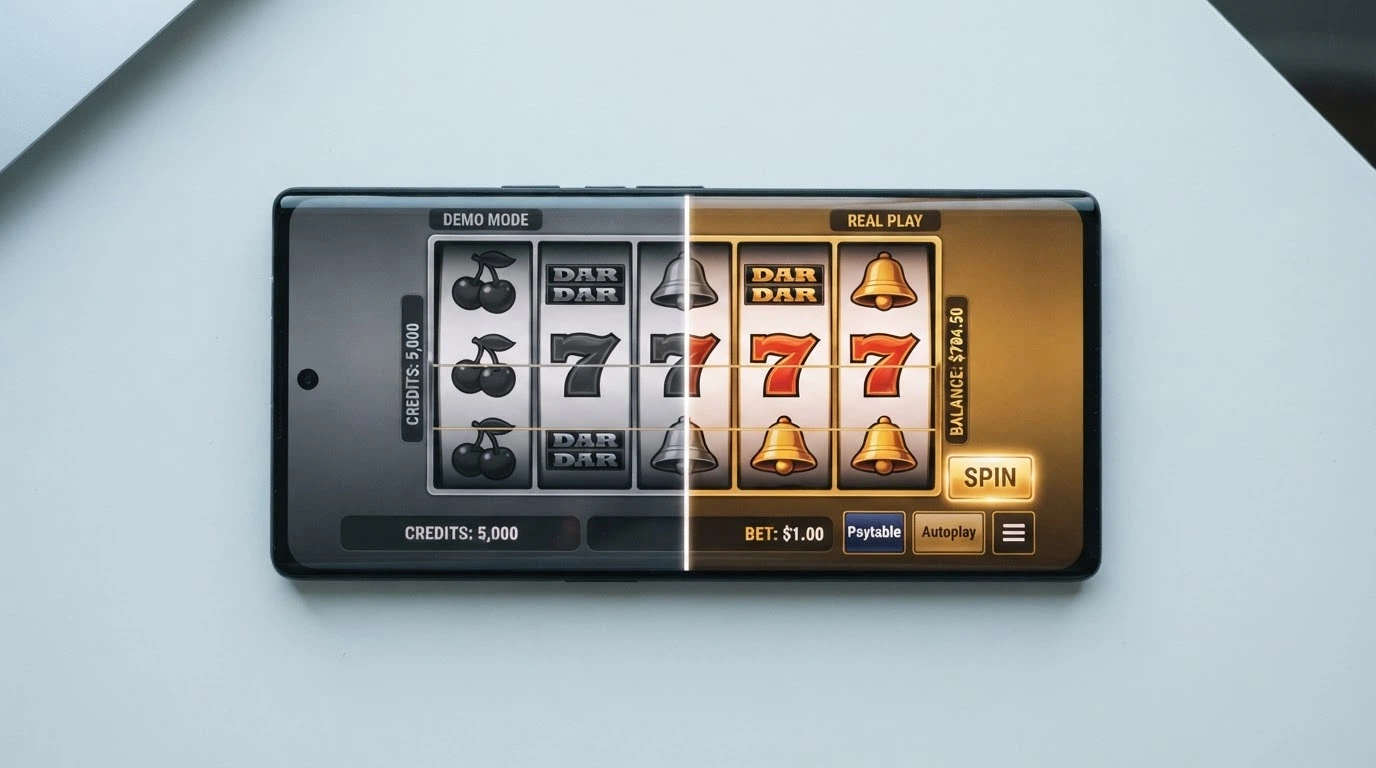
Most offshore casino apps offer a demo mode accessible before or alongside real-money play. The mode uses virtual credits, pays out nothing, and exists to let the player learn the game without risking a deposit. The RNG behaviour is identical — the symbol distribution, the bonus-round trigger rate, the jackpot meter behaviour — but the player experience is not. Demo play carries no wagering requirements, no cashout caps, no loss, and no withdrawal friction.
The strategic gap between play-money and cash spins is where demo mode misleads. A player who learns a pokie in demo mode knows the mechanics — when the bonus round triggers, how the hold-and-spin feature plays out, how the reels behave during a near-miss. None of that knowledge tells the player how they will feel about a A$100 loss, how they will respond to a stalled withdrawal, or whether the bonus terms attached to their deposit are worth the turnover. Those are the real-money experiences demo mode cannot simulate.
The free-play apps that never connect to real money are a different product — apps that publish as “free pokies” in the app stores, with virtual credits and no deposit screen at all. They are not subject to the IGA prohibition because they do not offer real-money play, and they are not the subject of this page.
How Demo Mode Works — And What It Won’t Tell You About Real-Money Play
Demo mode is a toggle inside the game tile. A player taps a pokie in the lobby, selects “Demo” or “Play for Fun” from a popup, and the game launches with a virtual-credit balance — usually A$1,000 or A$5,000 of fake money. The player spins, wins, loses, and the virtual balance updates in real time. When the balance runs out, a button refills it.
What demo mode replicates is everything the game engine knows. The RTP, the volatility, the bonus-round trigger rate, the feature frequency, the jackpot meter behaviour — all of it runs identically. A player who has spent an hour in demo mode on Dragon Link has seen what the game does.
What demo mode cannot replicate is everything outside the game engine. A real-money loss is a different experience from a virtual-credit loss, and the difference is not in the reels. The wagering requirement attached to a real-money balance is a contract the player has signed; the cashout cap is a ceiling that demo play does not enforce; the withdrawal friction is a delay the player cannot rehearse. A player who has decided to deposit based on demo mode alone has decided on half the information.
Staying in Control: Limits, Self-Exclusion and Where to Get Help
The responsible-gambling tools that exist in Australia split into two sets, and the split runs along the same line as the rest of this page: licensed Australian wagering on one side, offshore casinos on the other. BetStop, the National Self-Exclusion Register, sits inside the licensed side. Offshore casinos are not connected to it.
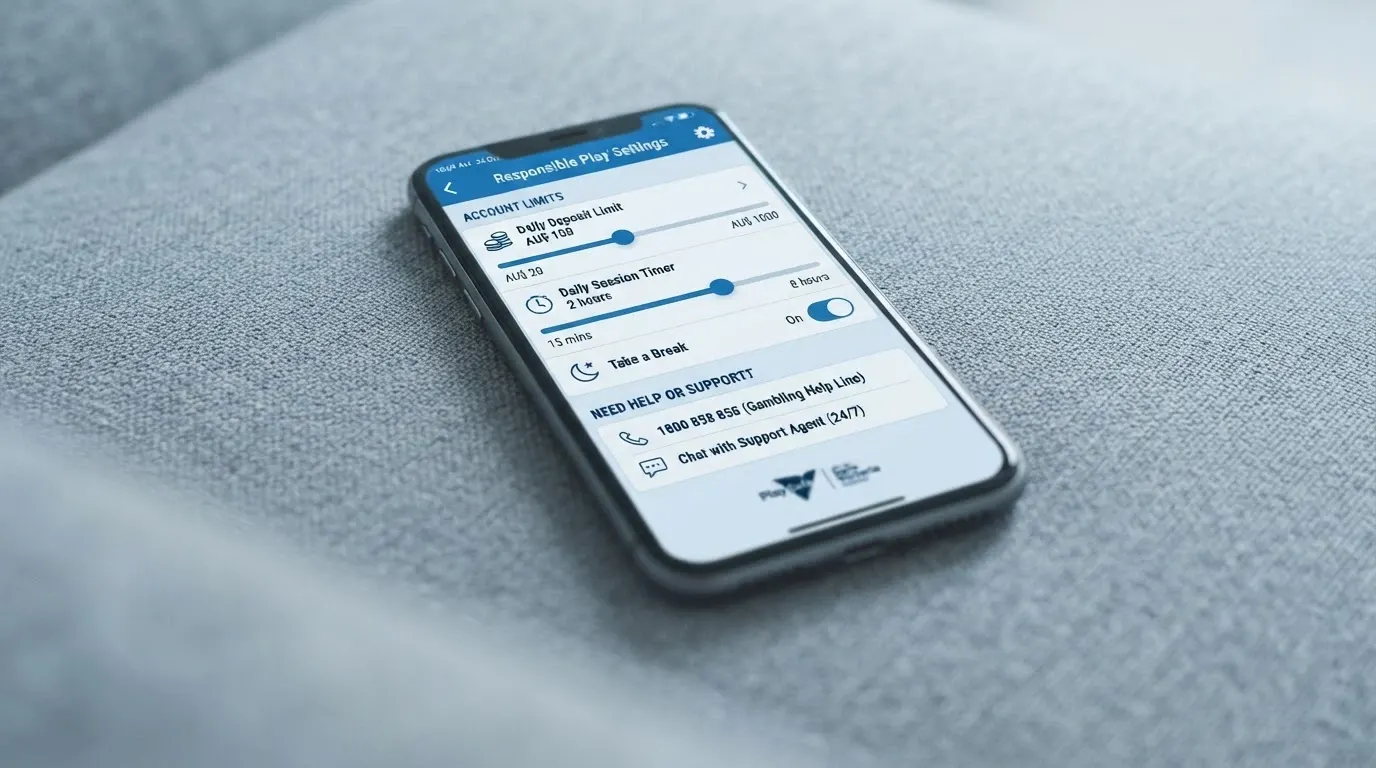
BetStop went live in August 2023, and one registration excludes a person from every Australian-licensed online and phone wagering service. As at 31 July 2026, BetStop had 67,480 registrations, of which 41,290 exclusions were still active; 78% of registrants were under 40 and 38% chose lifetime exclusion. The numbers describe a register that is being used, and being used most heavily by the age group most exposed to offshore marketing.
BetStop binds Australian-licensed wagering services only. An offshore casino is not connected to the register, which means a BetStop registration does not exclude a player from any of the ten brands ranked above. The practical self-exclusion path on the offshore side is operator-by-operator: the player contacts each casino’s support team, requests self-exclusion, and accepts that the request binds only that brand.
The deposit-limit, session-limit and take-a-break tools inside offshore apps are the operator’s own features, with no Australian legal obligation behind them. A player who sets a A$100 daily deposit limit at an offshore casino is depending on the operator to honour the limit. The history of the offshore market is uneven on that front, and the absence of an Australian regulator to enforce the limit is the structural risk.
The National Gambling Helpline — 1800 858 858 — is free, confidential and staffed 24/7. Gambling Help Online at gamblinghelponline.org.au provides online chat and counselling. Both services are free and operate regardless of whether the player is using a licensed Australian operator or an offshore casino.
The prevalence of problem gambling among Australian adults is the figure that frames the rest of the responsible-gambling apparatus. About 2.1% of Australian adults — roughly 430,000 people — experience problem gambling; the Australian Institute of Health and Welfare put high-risk gambling at 1.8% in 2022. The number is small in percentage and large in absolute terms, and the offshore route — where BetStop does not reach and consumer protection does not apply — is where the consequences fall hardest on the player at the margin.
Self-Exclusion That Works — And Self-Exclusion That Doesn’t
The BetStop mechanism, for a player who uses only licensed Australian wagering operators, is one registration and a complete block. The player registers at betstop.gov.au, nominates a self-exclusion period, and every Australian-licensed online and phone wagering service is required to refuse the player’s business for the duration. The legal obligation is on the operator; the player’s job is done at registration.
The offshore reality is different at every layer. An offshore casino is not connected to BetStop, and there is no Australian register that an offshore casino would check against. Self-exclusion at an offshore casino is a request to that specific operator’s support team; the request binds only that brand, and the enforcement depends on the operator’s own procedures. A player who has self-excluded from one offshore casino can deposit at the next one in the ranking without any central system raising a flag.
The practical limit of take-a-break tools on an app with no Australian legal obligation is the constraint. A player who sets a 24-hour take-a-break at an offshore casino has set a software timer on the operator’s app; the timer expires when the operator’s software expires it, and there is no Australian regulator auditing whether the timer works. The tool is the operator’s gesture of good faith, not the Australian system’s enforceable commitment.
The help resources that do not depend on the operator’s software are the right starting point. The National Gambling Helpline (1800 858 858) and Gambling Help Online (gamblinghelponline.org.au) are free, confidential and operate regardless of where the player has been playing. A player who has decided that the gambling has stopped being entertainment has those numbers to call before any further deposit.
How We Selected and Compared These Pokies Apps
The ranking above is built on three inputs: the Australian regulatory framework that defines what “Australian pokies app” can legally mean, the AU-facing market-share snapshot that orders the offshore operators by the strength of their Australian mobile presence, and the licence-status check against the NTRWC / Licensing NT register that confirms none of the operators can hold an Australian online casino licence.
The criteria that ordered the ranking are fit to the topic and legal-status honesty. Fit to the “real money pokies app” topic is the primary sort — operators that Australian mobile players actually use, in the AU-facing offshore segment, ranked by the strength of that AU presence. Legal-status honesty is the framing: every operator is offshore, no operator holds an AU casino licence, and no operator can hold one because no such licence exists. The ranking does not invent weightings, percentages or specifications the inputs do not carry.
The limits of this comparison are honest and worth naming in the open. Operator-specific bonus, provider, wagering and withdrawal specifics could not be independently confirmed for this run, and the table above reflects that gap rather than papering over it. The bonus terms, the game-provider lists, the wagering multiples and the withdrawal times for each operator are the kind of figure that changes weekly and requires the operator’s own site to verify on the day of deposit. A player who treats this page as the final word on operator specifics is reading it wrong; a player who treats it as the framing — what offshore means, what the AU prohibition means, what the ten operators have in common and where they sit in the market — is reading it right.
The NTRWC / Licensing NT register is the licensing reference point that exists. The register covers wagering operators — SportsBet, bet365, Ladbrokes, Neds and others holding NT or state licences — and not online casinos. None of the brands ranked above can appear on it, because the licence those names would need to be on does not exist. The register check is the answer to a question the marketing never asks: “Is this operator licensed in Australia?” The answer, for every brand in the ranking, is no — and the reason is not that the operator failed to apply.
What Every Australian Pokies Player Needs to Weigh Up
The page above has laid out an irreducible set of facts that no bonus banner will tell a reader. No Australian licence exists for any pokies app. Every operator in the ranking is offshore. BetStop does not reach any of them. The ACMA cannot recover a player’s money. From 1 January $$CY+1$$, Australian banks gain express authority to block transactions to illegal gambling operators, and the payment path an Australian player has been using will, on that date, have a clear statutory basis to be declined.
The risk-reward calculus is the player’s to make. An offshore pokies app offers AU-dollar denominated play, a wide pokie library, and bonus terms that are not available at any licensed Australian operator — because licensed Australian operators do not offer online pokies at all. The cost is the absence of every layer of Australian consumer protection, the absence of BetStop, the inability to compel a withdrawal from a foreign jurisdiction, and the possibility of an account freeze at the moment a bank exercises its new blocking authority.
The concrete steps to take before depositing are the part of the calculus that is actionable. Check the operator’s licence jurisdiction — Curaçao, Malta, the Isle of Man, Gibraltar are the names worth recognising; an opaque or unverifiable registry is worth walking away from. Read the bonus terms — the wagering multiple, the game weighting, the validity window, the maximum cashout — before claiming the offer, not after. Test the withdrawal on a small balance before committing a large sum, because the KYC review and the pending window are easier to absorb on a A$50 cashout than on a A$5,000 one. Verify that the deposit screen does not offer credit cards or crypto, because either method signals the operator sits outside the Australian rules.
The help resources, if the gambling stops being entertainment, are the right starting point regardless of where the player has been playing. The National Gambling Helpline — 1800 858 858 — is free, confidential and staffed 24/7. Gambling Help Online at gamblinghelponline.org.au provides online chat and counselling. BetStop, at betstop.gov.au, is the right step for a player who uses any licensed Australian wagering service, and the operator-by-operator self-exclusion request is the right step at any offshore casino the player has used. The help is free, the help is confidential, and the help does not depend on whether the casino honours its own responsible-gambling settings.
The frame this page has tried to draw is the one the marketing will not. A real money pokies app, in Australia in 2026, is an offshore product accessed through a direct download, governed by a foreign jurisdiction’s licence and a foreign jurisdiction’s complaint process, sitting outside every layer of Australian consumer protection. The product is real. The protection is not. A player who goes in with that frame has the information the page was written to provide.
Frequently Asked Questions
What is the best real money pokies app for Australian players in 2026?
No real money pokies app is licensed in Australia — online casino and online pokies are prohibited under the Interactive Gambling Act 2001 — so any ranking compares offshore brands against each other rather than against a licensed Australian alternative. By AU-facing presence, Rocket Play and Skycrown lead the offshore set, followed by Royal Reels, WinSpirit, Stake and the rest of the ten ranked above. None of them carries Australian consumer protection, and the “best” answer depends on which offshore licence jurisdiction, payment method and game-provider mix a player is willing to accept.
Can I get into legal trouble for playing pokies on an app in Australia?
No. The Interactive Gambling Act 2001 targets the provider, not the individual player. An Australian resident who downloads an offshore pokies app, deposits and plays is not prosecuted under the IGA. The enforcement is against the offshore operator offering the service, the Australian ISP carrying the traffic and the affiliate advertising it. The practical risk for the player is not criminal — it is civil: no Australian consumer protection, no Australian complaints body, no ACMA recovery if the operator refuses to pay, and no BetStop coverage.
Are my winnings from an offshore pokies app taxable in Australia?
No, for an ordinary punter. Betting and gambling winnings are not assessable income under section 6-5 of the Income Tax Assessment Act 1997, and gambling losses are not deductible under section 8-1, unless the person is carrying on a business of betting or gambling. No Australian case has held the winnings of an ordinary punter assessable. Operators pay point-of-consumption tax; players do not pay tax on winnings.
Do real money pokies apps accept Australian dollars and PayID?
Most AU-facing offshore casinos offer Australian-dollar-denominated play, and many offer PayID/Osko as a deposit method alongside debit card and bank transfer. What they cannot lawfully offer, under Australian rules, is credit card or crypto as a payment method — those have been banned as payment for online wagering since 11 June 2024. An offshore casino that offers credit cards or crypto as a primary deposit path is sitting outside the Australian regulatory perimeter.
Which pokies apps offer the fastest withdrawals for Australian players?
Operator-specific withdrawal times were not confirmed for this ranking, and the figures change with each operator’s payment-team resourcing. The universal pattern — KYC verification on first cashout, a 24-to-72-hour processing window, and a method mismatch where the withdrawal goes back by bank transfer even when the deposit came in by debit card — applies across the offshore set. The fastest legitimate path is a small test cashout before any large balance builds, at an operator whose licence jurisdiction is a recognised one and whose track record on payout is findable in independent forums.