
Best Casino App for iPhone Australia: What an AU Player Actually Faces in 2026
 Available in AU
Updated 18 October 2026 against ACMA, AUSTRAC and the relevant state regulator terms.

Every page that promises “the best licensed online casino in Australia” is describing something that does not exist. The Interactive Gambling Act 2001 prohibits online casino games, online pokies and in-play betting at the federal level. No state or territory has issued an online casino licence that would change that. What an iPhone-owning Australian actually does is open Safari, load a mobile-optimised site operated by an offshore company, and play on a server in Curaçao or Malta that has no relationship with the ACMA. That distinction is not a footnote. It shapes everything on this page: which “apps” are real, which are social casinos, which bonuses the operator can renege on, and which protection systems cannot reach your money.
The legal prohibition is the most important fact about iPhone gambling in Australia, and the comparison that follows is built around it. Where a row says “offshore, not AU-licensed,” the operator is the rule, not the exception. Where a payment method says “credit card and crypto banned under federal law since 11 June 2024,” the ban is in force against licensed wagering but does not stop an offshore casino from accepting them, because an offshore operator sits outside the regime the AUSTRAC and the ACMA enforce.
The framework for this page is: what the law actually says, what runs on the iPhone, who the operators are and what their offers cost, and what the move is for a clear-eyed AU punter who has decided to play anyway.
Table of Contents
- The Legal Reality Behind Every iPhone Casino You’ll Find
- The Best iPhone Casino Apps for Australian Players in 2026
- Free Pokies on iPhone: What the App Store Actually Delivers
- Real-Money iPhone Pokies: The Access, the Risk and What’s at Stake
- The Pokies and Live Games Australian iPhone Players Actually Rate in 2026
- Why You Won’t Find a Real-Money Casino App in the App Store
- iPhone Casino Bonuses: Why Your 2026 Welcome Offer Is Smaller Than It Looks
- Crypto Casino Deposits on iPhone: The Privacy Trade-Off Australian Players Face
- Getting Paid: How Fast iPhone Casino Withdrawals Actually Reach Your Australian Bank
- How We Selected and Ranked These iPhone Casinos
- Your Move in 2026: What a Clear-Eyed Punter Should Do Next
- FAQ
The Legal Reality Behind Every iPhone Casino You’ll Find
The reality: no licensed online casino exists in Australia
The Interactive Gambling Act 2001 (the IGA) prohibits the supply of a “prohibited interactive gambling service” to customers physically in Australia. That phrase covers online casino games, online pokies and in-play sports betting. It does not carve out a state-level path. No state or territory has issued an online casino licence that would contradict the federal prohibition. The practical effect is that any operator accepting Australian players for casino play is doing so without Australian authorisation.
The ACMA, the Australian Communications and Media Authority, enforces the IGA. Since its first ISP blocking request in November 2019, the ACMA has had 1,564 illegal gambling and affiliate websites blocked, and more than 225 illegal services have withdrawn from the Australian market since 2017. That is the cumulative record as at March 2026. A site that is on the AU shortlist this month can be on a block list the next. The individual player is not prosecuted — the IGA targets the provider — but “the law is aimed at the operator, not you” reads very differently when the operator’s domain goes dark and the balance is on it.
The federal framework leaves a narrower market than the casual AU iPhone searcher realises. Wagering on sports and races before the event, lotteries and keno are licensable through state and territory authorities, with most online bookmakers licensed in the Northern Territory. Online casino play is not. The page that follows is about that gap and what lives inside it.
Desktop casino sites vs iPhone access: what changes on a smaller screen
The offshore casino sites that the ACMA blocks on desktop are the same sites that load in Safari on an iPhone, just with the touch targets re-laid and the games compressed into portrait or landscape mode. There is no separate “iPhone casino” product. There is a desktop site and a mobile-optimised version of the same site, both running on the same operator server, both accepting the same players, both subject to the same offshore licence (or the absence of one).
The iPhone version is not a stripped-down version. HTML5 mobile-optimised casinos carry the full slots catalogue, the full live-dealer lobby, the cashier and the bonus activation. What changes is the data consumption, the screen real estate, and the touch interaction. A live-dealer blackjack table that works fine on a 27-inch monitor is cramped on a 6.1-inch screen; the streaming data rate over a 4G connection is similar but the visual information density is higher. The decision a player faces is rarely “iPhone or desktop” — it is “this site, or that site, on whichever device is at hand.”
That parity matters for the page’s ranking logic. A brand with a deep Pragmatic Play lobby on desktop has the same lobby on iPhone. A brand with a sluggish mobile cashier has a sluggish mobile cashier on iPhone. The phone does not paper over a thin site.
Casino app vs mobile browser: why the App Store isn’t where you’ll find real-money play
The App Store prohibits real-money gambling apps in Australia. The policy is jurisdiction-based: Apple lists real-money gambling apps only where the operator holds a licence in the user’s home jurisdiction. No Australian online casino licence exists, so no real-money casino app can be listed in the AU App Store. Any “casino app” that surfaces in an AU App Store search is one of three things: a free-to-play social casino, a sweepstakes product where it is permitted, or a play-money simulator funded by ads. None of them pay out real money.
The actual delivery mechanism for an offshore casino on iPhone is the mobile browser. A punter opens Safari, navigates to the operator’s URL, logs in, deposits and plays. The site can be saved to the home screen as a shortcut, which behaves like a PWA (progressive web app) and looks similar to a native app, but the underlying code is HTML5 served from a remote server. No native push notifications, no Face ID login integration, no offline mode. The trade for those missing features is access to a real-money product that the App Store will not list.
The shorthand the marketing uses — “download the app” — is misleading. There is no download in the AU App Store. There is a bookmark or a PWA, and the distinction matters when the operator updates its site, pushes a new version of its game client, or changes its login flow. A native app version is versioned and updatable through the store; a PWA inherits whatever the server is serving at the moment of the request.
The Best iPhone Casino Apps for Australian Players in 2026
The honest framing: every brand below is offshore, and the ranking is by fit to iPhone pokies play, not by AU regulatory status. The full-page table follows below; the section that follows it gives each operator a write-up grounded in the specifics research could verify. Where bonus terms, game providers or withdrawal speeds were not surfaced in research, that is named plainly. The table is the overview, the write-ups are the receipts.
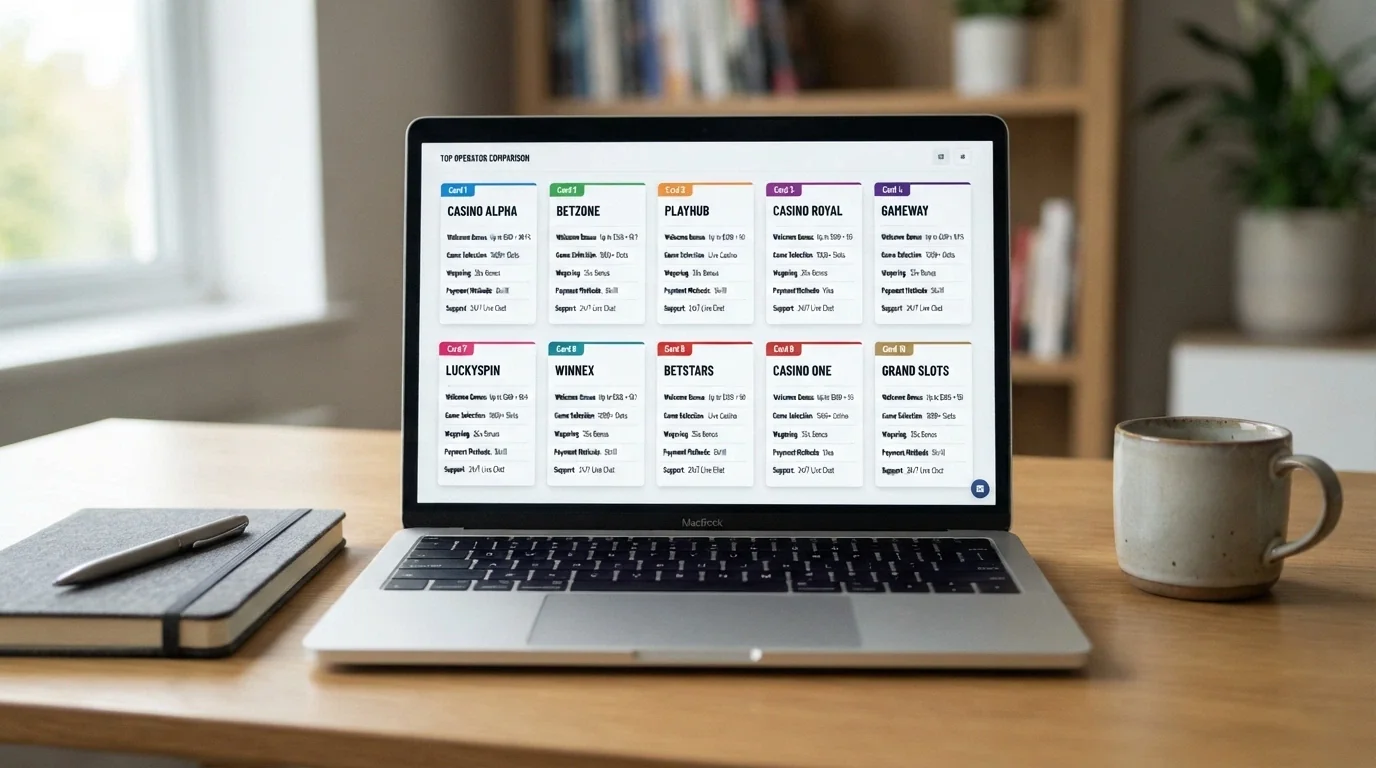
| Operator | AU legal status | Game library | Standout feature |
|---|---|---|---|
| Rocket Play | Offshore (Curaçao-style), not AU-licensed | Contemporary slot grid; mobile-first cashier | iPhone-optimised browser play |
| SkyCrown | Offshore, not AU-licensed | Deep provider roster; crypto and fiat | Multi-deposit welcome package with 350 free spins distributed in daily increments |
| Royal Reels | Offshore, not AU-licensed | Not confirmed this run | 2.51% AU market share — the highest in this set |
| WinSpirit | Offshore, not AU-licensed | Wide slots and live-dealer catalogue | PayID often highlighted in AU-facing ads |
| Stake | Offshore, not AU-licensed | Massive casino and sportsbook; Big Bass Bonanza confirmed | Crypto-only with rakeback/VIP model instead of a traditional welcome bonus |
| Rainbet | Offshore, not AU-licensed | Pragmatic Play confirmed; Hacksaw and Nolimit excluded from bonus play | Choice between Wager Lock (40x) and No-Wager gradual unlock paths |
| Scream Casino | Offshore, not AU-licensed | Not confirmed this run | 0.99% AU market share |
| Fair Go Casino | Offshore (Curaçao-style), not AU-licensed | Broad slots catalogue; AU-focused promos | 100% up to A$200 redeemable 5 times; 30x wagering — the lowest in this set |
| Bizzo Casino | Offshore, not AU-licensed | Slots-led lobby | E-wallet deposit rails common |
| Rocket Casino | Offshore, not AU-licensed | Not confirmed this run | 0.57% AU market share; domain and current status not confirmed this run |
How we ranked these iPhone casinos
Four criteria, applied to the operator shortlist and the brand research that surfaced in Australian search results. iPhone optimisation — does the mobile site load cleanly in Safari, do the touch targets work, do the pokies re-layout for portrait and landscape. Pokies catalogue depth — Pragmatic Play’s big three (Gates of Olympus, Sweet Bonanza, Big Bass Bonanza) as the baseline, with provider breadth as the tie-breaker. AU payment-rail fit — PayID, debit card and crypto as the rails an AU punter can actually move money across. Bonus transparency — how clearly the operator publishes its welcome package, wagering multiple, free-spins terms and bonus validity, and how that compares to the industry norm of 35x to 50x on deposit and bonus.
The limitation the ranking cannot get past: every brand in the table is offshore and unlicensed. No amount of polish on the mobile site changes the fact that the operator holds no relationship with the ACMA, the AUSTRAC or any Australian consumer-protection body. The ranking is between comparable offshore sites, not between offshore and licensed options, because the licensed option does not exist for online casino in Australia.
Rocket Play: iPhone-Optimised Browser Play with a Contemporary Slot Grid
Rocket Play pitches itself as a mobile-first operation, and the mobile site delivers on that pitch. The cashier is built for thumb navigation, the slot grid loads quickly over 4G, and the games catalogue reflects a contemporary operator rather than a legacy desktop brand with a mobile afterthought. The licence is offshore, Curaçao-style framing in the terms research surfaced. The iPhone browser experience is the core product.
The gap in the research is on the bonus side. The welcome package, free spin count, wagering multiple, bonus validity and maximum cashout were not surfaced in the queries this run produced. What is known is the positioning: a contemporary slot grid, a mobile-first cashier, a Curaçao offshore framing. The honest read is that Rocket Play is a reasonable fit for a punter who values mobile UX and is comfortable evaluating the bonus terms on the operator’s own site before depositing. Bonus terms, where the research cannot confirm them, are the part a player should read carefully.
SkyCrown: Multi-Deposit Welcome Package and Deep Provider Roster
SkyCrown runs the most detailed welcome package in the set. The first deposit receives a 100% match bonus; subsequent deposits sit at roughly 50% match; and the package includes 350 free spins distributed in daily increments over a week, landing on selected slot titles. The provider roster is the deepest of the operators research surfaced, with a mix of studio names that signal a serious slots operation rather than a thin white-label. Crypto and fiat both work, though specific coin support was not detailed in the research.
The wagering multiple, bonus validity window and maximum cashout were not surfaced for SkyCrown. The industry norm for a multi-deposit package of this scale sits in the 35x to 50x band on deposit and bonus, with the daily free-spin distribution a common workaround for the long clearing period a multi-deposit structure requires. The free spins themselves, on a Pragmatic Play title or similar, will carry a separate wagering requirement on the spin winnings. A punter evaluating SkyCrown should plan to read the bonus page directly before claiming.
For a player who values a longer, more elaborate welcome package and is comfortable with the higher total volume a multi-deposit structure implies, SkyCrown is the closest match in the set. The trade-off is the slower turnover, which extends the time before any bonus-derived winnings can be withdrawn.
Royal Reels: AU Market-Share Leader with Unconfirmed Current Terms
Royal Reels leads the AU market-share table at 2.51% of AU traffic among the featured set, which is a meaningful number in a market that is, by definition, served entirely by offshore operators. The traffic figure is the part research confirmed with confidence. The current active status, the welcome bonus specifics, the game provider list, the wagering multiple, the bonus validity window and the maximum cashout from the offer — none of these were surfaced this run. The domain was also not confirmed in the queries that produced the operator shortlist.
The honest read: a 2.51% AU market share among the offshore operators research could name is not the same as a verified active offer. The brand may be live; the research did not return enough of its current terms to write a confident paragraph. A punter considering Royal Reels should treat the traffic figure as background data and look at the operator’s own site to confirm what is being offered, the licence jurisdiction, the wagering multiple and the withdrawal terms before depositing.
WinSpirit: PayID-Friendly Positioning and Wide Live Dealer Catalogue
WinSpirit advertises PayID prominently in its AU-facing creative, which is a real differentiator for Australian players who want a fast fiat deposit rail and a familiar banking identifier at the deposit screen. The catalogue spans slots and a wide live-dealer side — the latter matters on iPhone because a strong live lobby reduces the time spent on a thin slots selection. The AU market share sits at 1.55%, which is meaningful for an operator that has positioned itself around a specific deposit rail rather than a brand-name sportsbook.
The bonus specifics were not surfaced this run. Welcome offer, free spins, wagering multiple, bonus validity and maximum cashout all sit in the research gap. The PayID positioning and the live-dealer breadth are the verified differentiators. A punter who values PayID deposits over the alternatives will find WinSpit’s framing more useful than a bonus headline; a punter chasing a specific welcome offer will need to read the operator’s terms directly.
For a player who wants PayID as a deposit rail and a live-dealer selection broad enough to keep the experience varied on a phone screen, WinSpirit is a reasonable starting point. The bonus picture is the part of the evaluation that requires the operator’s own site.
Stake: Crypto-Only Rakeback Model with a Massive Casino Library
Stake does not run a traditional deposit-match welcome bonus. The model is rakeback and VIP — a small percentage of every bet returned regardless of outcome, scaled by VIP tier, with a 1x wagering requirement on the returned amount. That is structurally different from a match bonus with a 40x playthrough, and it is the reason the casino library at Stake is one of the largest in the set: the operator does not have to subsidise a headline offer and can spend that margin on game volume instead. Big Bass Bonanza is confirmed available on Stake, and the broader catalogue includes the same Pragmatic Play titles that dominate AU-facing offshore casinos.
The trade for the bonus structure is the deposit rail. Stake is crypto-only for AU players — no AUD fiat deposits, no PayID, no debit card. Crypto withdrawals clear in one to two hours, which is the fastest non-fiat rail in the set, and the operator’s payout-verdict track record sits at the top of the offshore benchmark. The privacy argument cuts both ways: crypto deposits avoid the banking record that has led some AU banks to freeze accounts with frequent offshore gambling activity, but the same absence of a banking trail means no chargeback path if the operator withholds a withdrawal.
Stake appeals to those already comfortable with crypto who prioritise game volume over traditional match bonuses. Conversely, anyone requiring AUD fiat deposits via PayID should look elsewhere.
Rainbet: Dual-Path Bonus — Wager Lock or Gradual No-Wager Unlock
Rainbet runs the most transparent bonus structure in the set, and the only one that offers the player a real choice between two paths. The Wager Lock path is a 100% match up to US$700 with a 40x wagering requirement, a 2% max-bet-while-clearing cap, and 20 free spins per deposit stage (60 total) on Sweet Bonanza. The No-Wager path releases the bonus gradually as 1% of bets multiplied by 20% — a different model that does not require the player to clear a target turnover before withdrawing.
The free spins are restricted to Pragmatic Play slots, and the bonus generated from those free spins carries its own 40x wagering. Hacksaw and Nolimit slots are excluded from bonus wagering, as are games with an RTP above 97.4% — Rainbet publishes those exclusions clearly, which is unusual for the segment. Bonus validity is 7 days from activation, the minimum deposit is the US$30 equivalent in crypto, and the platform is crypto-forward with no fiat deposit rail in the research.
The honest read: the dual-path structure is the differentiator. A player who wants the higher headline and is willing to clear a 40x playthrough picks the Wager Lock path; a player who values flexibility and the absence of a clearing barrier picks the No-Wager path. The exclusion of high-RTP games from bonus play is a cost a careful punter should price in.
Scream Casino: Slots-Focused Offshore Operator with Thin Public Data
Scream Casino appears in the operators skill AU traffic shortlist at 0.99% market share, which puts it in the same band as Fair Go and Bizzo on a traffic basis. The bonus, free spin count, wagering multiple, bonus validity, maximum cashout and game provider list were not surfaced this run. The current domain and the live status were also not confirmed in the queries that produced the operator shortlist.
A 0.99% AU market share is enough to be a real brand in the offshore space, not a marginal one — but “real” in this context means an operator with a domain and a payments page, not an operator whose terms are visible enough for an editorial review. Scream Casino is included for completeness of the AU shortlist, and the write-up reflects what is known, which is essentially the traffic figure and the offshore framing. A punter considering Scream Casino should treat the operator’s own site as the source of truth on bonus terms, licence jurisdiction and withdrawal policy.
Fair Go Casino: AUD-Denominated Welcome Bonus and the Lowest Wagering in the Set
Fair Go Casino is the most complete bonus picture in the set, and the only one denominated in Australian dollars rather than US dollars or a generic currency. The welcome package is 100% up to A$200, redeemable 5 times, for a total bonus value of up to A$1,000. The wagering requirement is 30x on deposit and bonus, which is the lowest figure explicitly confirmed in the featured set. The minimum deposit is A$20, and free spins are available through specific promos (ROCKETS200, FREE4EVER, CHIPY4-OZ) tied to different deposit thresholds.
The no-deposit bonus — which is genuinely free credit without a deposit — carries a 60x wagering requirement and a maximum cashout of A$180. That ceiling is the same pattern that runs across the no-deposit segment: the operator caps the upside sharply because the offer is risk-free for the player. The PayID-friendly messaging in Fair Go’s AU-facing advertising mirrors WinSpirit’s positioning, though Fair Go’s broader catalogue and the AUD denomination are the differentiators.
For a punter who values a transparent AUD-denominated offer and the lowest wagering in the set, Fair Go is the cleanest fit. The trade-off is the offshore framing and the 60x ceiling on any no-deposit offer a player might claim on top.
Bizzo Casino: Slots-Led Lobby with E-Wallet Deposit Rails
Bizzo Casino is positioned as a slots-led operator with a broad e-wallet deposit selection, sitting at 0.57% AU market share. The bonus terms, free spin count, wagering multiple, bonus validity, maximum cashout and game provider list were not surfaced this run. The current domain and the live status were also not confirmed.
The e-wallet positioning is the verified differentiator. A punter who prefers to fund casino deposits through a digital wallet rather than a direct debit card or a PayID transfer finds more flexibility in a brand that has invested in e-wallet integration. The 0.57% share is small but not marginal — it is the band where a brand has product-market fit among a niche but is not pushing into the top three by traffic.
A punter considering Bizzo should treat the operator’s own site as the source of truth on bonus terms, the licence jurisdiction, the e-wallet coverage and the withdrawal policy. The write-up reflects what research confirmed: the slots positioning, the e-wallet rail, the offshore framing and the AU traffic share.
Rocket Casino: Lower-Volume Offshore Brand with Unconfirmed Current Terms
Rocket Casino sits at 0.57% AU market share, the same figure as Bizzo, with the thinnest data in the set. The domain was not confirmed in the research queries, and the current status of the brand — whether it is still operating, whether its licence framing is current, whether its bonus terms match what the operator shortlist recorded — could not be verified. Welcome bonus, free spins, wagering multiple, bonus validity, maximum cashout and game providers are all in the research gap.
A punter considering Rocket Casino on the basis of the AU traffic share is taking the operator’s own site as the source of truth on every term. The honest position is that the brand appears in the shortlist and is included for completeness, but the write-up is closer to a stub than a review. A punter with another option in the set will find more verifiable information at SkyCrown, Rainbet, Fair Go or Stake.
Free Pokies on iPhone: What the App Store Actually Delivers
What “free” means in the Australian App Store
A free pokie app on the Australian App Store is a social casino. It runs slot-style games, it may carry the name of a real provider’s title (Big Bass Bonanza, Gates of Olympus, Sweet Bonanza), and it looks identical to a real-money version. The difference is in the legal frame: a social casino does not pay out real money, it funds itself through in-app purchases of virtual coins, and it sits in a different category under the App Store’s content rules. The same graphics, the same mechanics, the same RNG. The balance is fake and the payout button does nothing.
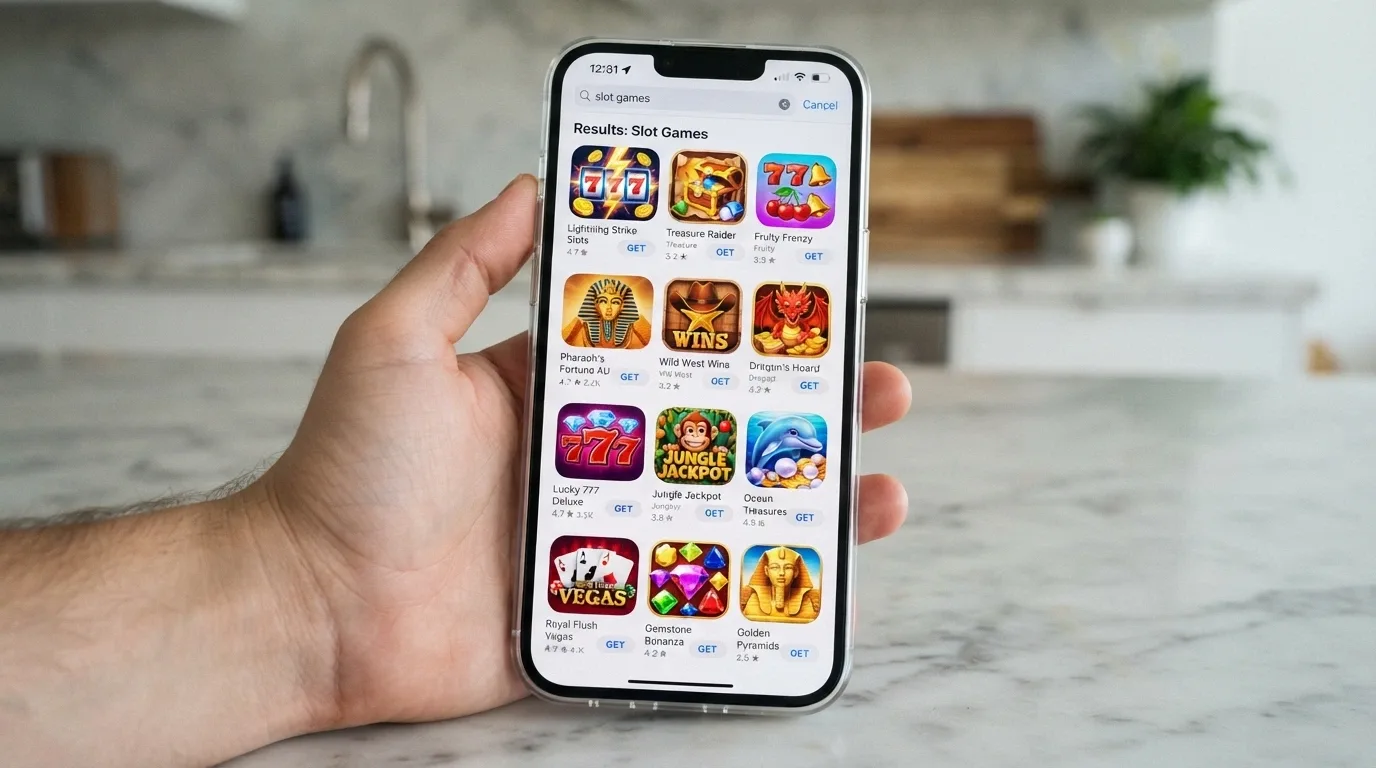
The reason social casinos can sit in the App Store when real-money casino apps cannot is the licensing distinction. The App Store’s real-money prohibition is jurisdiction-based: no AU online casino licence means no real-money listing. A social casino does not require a real-money licence because it does not offer real-money gambling. The product is closer to a mobile game with optional in-app purchases than to a casino. The legal line is the payout, and the payout is fake.
That distinction is the single most important thing a punter searching the App Store for “pokies” needs to understand. A “free pokie” is not a free trial of a real pokie. It is a separate product that borrows the look and feel of a real pokie to sell virtual coins.
Free-play apps vs real-money pokies: the line that matters
The mechanics of a free-play pokie and a real-money pokie are usually identical. The same Pragmatic Play engine runs the Big Bass Bonanza reels whether the balance is in fake coins or in a real AUD account. The RNG is the same. The bonus round triggers on the same symbol combinations. The visual feedback on a winning spin is the same. The difference is what happens when the spin ends: a real-money account has a balance that can be withdrawn; a fake-coin account has a balance that resets when the coins run out and the player is prompted to buy more.
The legal frame shifts at the moment real money enters. A social casino is a mobile game; a real-money pokies site is a “prohibited interactive gambling service” under the IGA, even though the offshore operator accepting the deposit is not in Australian jurisdiction. A punter moving from a free-play app to a real-money site is crossing from a category the App Store permits into a category it prohibits, and the protections change. The social casino cannot vanish with a balance; the real-money site can.
The free-play funnel is also the marketing funnel. A player who spends 20 hours on a free-play version of a Pragmatic Play title has built familiarity with the mechanics, the volatility profile and the bonus structure. When the same player opens Safari and visits an offshore site, the recognition is instant and the conversion path is short. The free-play app is not a neutral product; it is the top of the acquisition funnel for the real-money offshore operator that licensed the same game engine.
The best free pokie apps for iPhone worth your time
Research did not surface specific App Store titles in the queries this run, and the write-up reflects that gap rather than fabricating names. The formats an AU iPhone player will find in the App Store are: social casinos from large publishers (a handful of names dominate the free-pokie category globally, with the publisher rather than the casino name as the visible brand), standalone pokie simulators (single-title apps built around one game, with limited volatility and ad-supported progression), and sweepstakes-style products where AU players can use virtual coins that carry a redemption path. Each format has its own ceiling.
The criteria that separate a good free pokie app from a thin one: game variety (a 30-title catalogue is meaningfully different from a 3-title catalogue), no forced ad interruption between spins, authentic mechanics (the same maths engine as the real-money version, not a simplified clone), and a clear distinction between “free to play” and “free to win” — apps that imply the latter without delivering are not worth the install. The ceiling, regardless of which app the punter picks, is the same: no real money ever pays out. A social casino cannot deliver what an offshore site can, and an offshore site is not on the App Store.
Real-Money iPhone Pokies: The Access, the Risk and What’s at Stake
Real-money casino apps that accept Australian players
The list of real-money casino products accessible to an Australian iPhone player is the list of offshore operators accepting AU traffic, and the ten operators in the table above are the brands the operators skill shortlist returned. The delivery mechanism is uniform: Safari, mobile-optimised HTML5, an offshore licence. There is no App Store path to a real-money casino for an AU iPhone, and there will not be one until a federal or state-level online casino licence is issued — which the IGA currently prohibits.

The credit-card and crypto prohibition that came into force on 11 June 2024 under the Interactive Gambling Amendment (Credit and Other Measures) Act 2023 binds licensed Australian wagering operators. An offshore casino is not bound by that regime. A punter who tries to use a credit card on a licensed wagering site is blocked; the same credit card, on an offshore site, will likely clear. The A$247,500 penalty is for the licensed operator, not the offshore one. The practical effect is that the federal payment-method ban tightens the licensed market while leaving the offshore market as it was, which is the opposite of what the legislation was framed to do.
For a punter who has decided to play at an offshore site, the deposit rails that work are PayID (where supported), debit card, bank transfer, e-wallet and crypto. Each rail has its own withdrawal story, covered in the section on getting paid.
Real-money slots and pokies: what you can actually play
The Pragmatic Play big three — Gates of Olympus, Sweet Bonanza, Big Bass Bonanza — are the titles an AU iPhone player will find on every AU-facing offshore casino. Gates of Olympus runs a 96.50% advertised RTP with high volatility and a 5,000x maximum win. Sweet Bonanza runs 96.48% to 96.51% RTP with high volatility and a 21,175x maximum win. Big Bass Bonanza runs 96.71% RTP with medium-to-high volatility and a 2,100x maximum win. Those figures are the default configurations; Pragmatic Play ships each title in three or four RTP tiers that the operator selects at integration, and that choice is static — it does not change based on a player’s behaviour or a promotional period.
The RTP-tier structure is the trap the marketing never mentions. An operator can integrate Big Bass Bonanza at the 96.71% tier, at the 95.67% tier, or at the 94.78% tier. The visual game is identical. The mechanics are identical. The only difference is the long-run payout rate, and the choice is the operator’s, not the player’s. The tier is usually not disclosed outside the in-game information panel, and most players never open that panel. A punter who is choosing between two Big Bass Bonanza lobbies at two different operators is, in most cases, choosing between two different RTPs without knowing which.
The max-win ceilings look enormous. A 21,175x maximum win on Sweet Bonanza is a 211,750 AUD win on a 10 AUD spin. The reality is that a max-win on a high-volatility slot hits in roughly one spin in several million, the long-run return is set by the RTP, and the volatility is the reason 80% of sessions end without a bonus-round trigger. The RTP is the number that matters over thousands of spins; the max-win is the number that matters in the marketing.
The Pokies and Live Games Australian iPhone Players Actually Rate in 2026
Aussie pokies on iPhone: the titles that dominate
“Pokies” is the Australian word for slot machines, and the three titles that dominate AU iPhone searches are the same three Pragmatic Play games that dominate offshore casino lobbies globally. Gates of Olympus runs a 6×5 cluster-pays grid where eight or more matching symbols anywhere on the reels trigger a win, with a Zeus multiplier modifier that drops randomly during spins, adding multipliers from 2x to 500x that carry over and stack during the free spins round. Sweet Bonanza uses a tumble mechanic — winning symbols are removed and replaced, allowing chain reactions on a single spin — with four or more scatter symbols triggering free spins where multiplier bomb symbols (2x to 100x) apply to all wins. Big Bass Bonanza’s key mechanic is a fisherman wild symbol that collects money fish symbols during the free spins round, with each money fish carrying a cash value that accumulates across the round.

The mechanical difference matters for the kind of session a punter wants. Cluster-pays games like Gates of Olympus pay more often, with smaller average wins, and the multiplier modifier is the source of the headline payouts. Tumble games like Sweet Bonanza pay on chain reactions and the multiplier bomb is the bonus-round payoff mechanic. Fisherman-collection games like Big Bass Bonanza pay on the collection round and the cash values on the fish symbols are the variance driver. A punter who prefers frequent small wins and a long session prefers Gates of Olympus; a punter who prefers infrequent large wins and a shorter session prefers Sweet Bonanza; a punter who wants something in between prefers Big Bass Bonanza.
The RTP-tier warning is the same for all three. The advertised RTP is the default configuration, the operator selects the actual tier at integration, and the in-game information panel is the only place the tier is disclosed. A punter who has not opened that panel has not actually seen the RTP they are playing.
| Slot title | Advertised RTP | Provider | Volatility | Max win |
|---|---|---|---|---|
| Gates of Olympus | 96.50% | Pragmatic Play | High | 5,000x |
| Sweet Bonanza | 96.48%–96.51% | Pragmatic Play | High | 21,175x |
| Big Bass Bonanza | 96.71% | Pragmatic Play | Medium-to-high | 2,100x |
Video slots and slot machines: the provider mix
Pragmatic Play is the dominant provider on AU-facing offshore casinos, and the brand recognition of Gates of Olympus, Sweet Bonanza and Big Bass Bonanza is the reason. Beyond Pragmatic Play, the provider mix varies by operator. Rainbet excludes Hacksaw and Nolimit from bonus wagering, which confirms those providers are present on the platform — the exclusion only makes sense if the games exist. Most of the other operators in the set do not publish a complete provider list, and the research did not surface enough to fill the gap.
The provider mix matters because of the RTP-tier and bonus-eligibility interactions. A punter on a 40x wagering requirement who can use Pragmatic Play, Hacksaw, Nolimit, NetEnt and the rest of the lobby has a different clearing experience than a punter restricted to a single provider. A bonus that excludes Hacksaw and Nolimit slots from wagering (Rainbet’s approach) means the punter is clearing the bonus on a narrower subset of games, which lengthens the time before withdrawal. The exclusion of games with RTP above 97.4% is a related mechanism: high-RTP games are excluded because they make the bonus too easy to clear profitably. The cost of that exclusion falls on the player who would prefer to clear on the high-RTP titles.
For a punter who values provider breadth over a specific bonus headline, the operator’s provider list is worth checking before depositing. For a punter chasing a specific bonus, the bonus terms are worth reading for the exclusion clauses.
Live dealer tables vs RNG: what the iPhone screen can handle
Live-dealer blackjack, roulette and baccarat all stream to an iPhone browser without an app. The HTML5 video path is the same as a YouTube embed — the operator’s server pushes a video feed, the player’s screen renders it, the betting controls are HTML overlays. A 6.1-inch iPhone screen handles the standard table layouts; the experience is more cramped than desktop, the cards and the dealer take up proportionally more of the screen, and the betting interface requires more precise touch input.
The cost of live-dealer streaming is data and battery. A 30-minute live-dealer session over 4G consumes meaningfully more data than a 30-minute RNG pokie session, and the device runs warmer because the video decoder is active. The session is also more dependent on a stable connection — a 3G fallback on a pokie session is barely noticeable; a 3G fallback on a live-dealer session is visible lag on the video feed.
The lighter alternative is RNG table games. RNG blackjack, roulette and baccarat on an iPhone browser use the same HTML5 path as the slots lobby, run on the operator’s server, and consume a fraction of the data. The visual experience is a 2D representation of a table, the outcomes are determined by the operator’s RNG, and the speed of play is set by the punter rather than by a dealer. The house edge on RNG blackjack at a well-implemented offshore site is comparable to live blackjack; the social and the streaming elements are what the live product sells.
For a punter with a strong data connection and a large device, live-dealer is the better experience. For a punter on a smaller data plan or an older iPhone, RNG table games are the better trade.
Top casino games beyond the pokies
Blackjack, roulette, baccarat and video poker round out the iPhone casino catalogue. The RNG versions run in the same HTML5 mobile path as the slots lobby, sit alongside the pokies in every featured operator’s lobby, and carry house edges that are structurally different from a pokie.
Blackjack at a well-implemented offshore site has a house edge of around 0.5% on basic strategy, which is roughly 5x better than a 96.5% RTP pokie. The trade is the strategic input: a punter who does not play basic strategy gives up a meaningful share of that edge to mistakes. Roulette sits at around 2.7% on a European single-zero wheel and 5.26% on an American double-zero wheel — the difference between a single-zero and a double-zero wheel is the most important detail on a roulette lobby, and the operator’s wheel configuration is rarely disclosed upfront. Baccarat is around 1.06% on the banker bet and 1.24% on the player bet, with the tie bet at over 14% — the tie bet is the line a punter should never cross.
Video poker is the structural anomaly: with optimal play, some variants return over 99%, which is the best edge on the floor. The trade is the same as blackjack — the strategy is non-trivial, and a punter who plays without a pay-table screen in front of them gives up the edge to mistakes.
For a punter who values a long session on a small bankroll, blackjack or video poker at full-pay tables is the best house edge in the set. For a punter who values the entertainment of a bonus round and a long-volatility spin, a pokie is the better fit. The choice is between edge and engagement, and the maths behind the choice is the part of the catalogue the marketing rarely surfaces.
Why You Won’t Find a Real-Money Casino App in the App Store
iPhone-native casino apps: why you won’t find them
Apple’s App Store guidelines prohibit real-money gambling apps in jurisdictions where the operator does not hold a local licence. The rule is jurisdiction-based, and the Australian prohibition on online casino makes the jurisdiction unpassable. No AU online casino licence exists, so no operator can meet the App Store’s test, so no real-money casino app appears in the AU App Store. The same rule, in jurisdictions that license online casino (New Jersey, the UK, parts of the EU), produces a different outcome: real-money apps are listed, geofenced to licensed states.
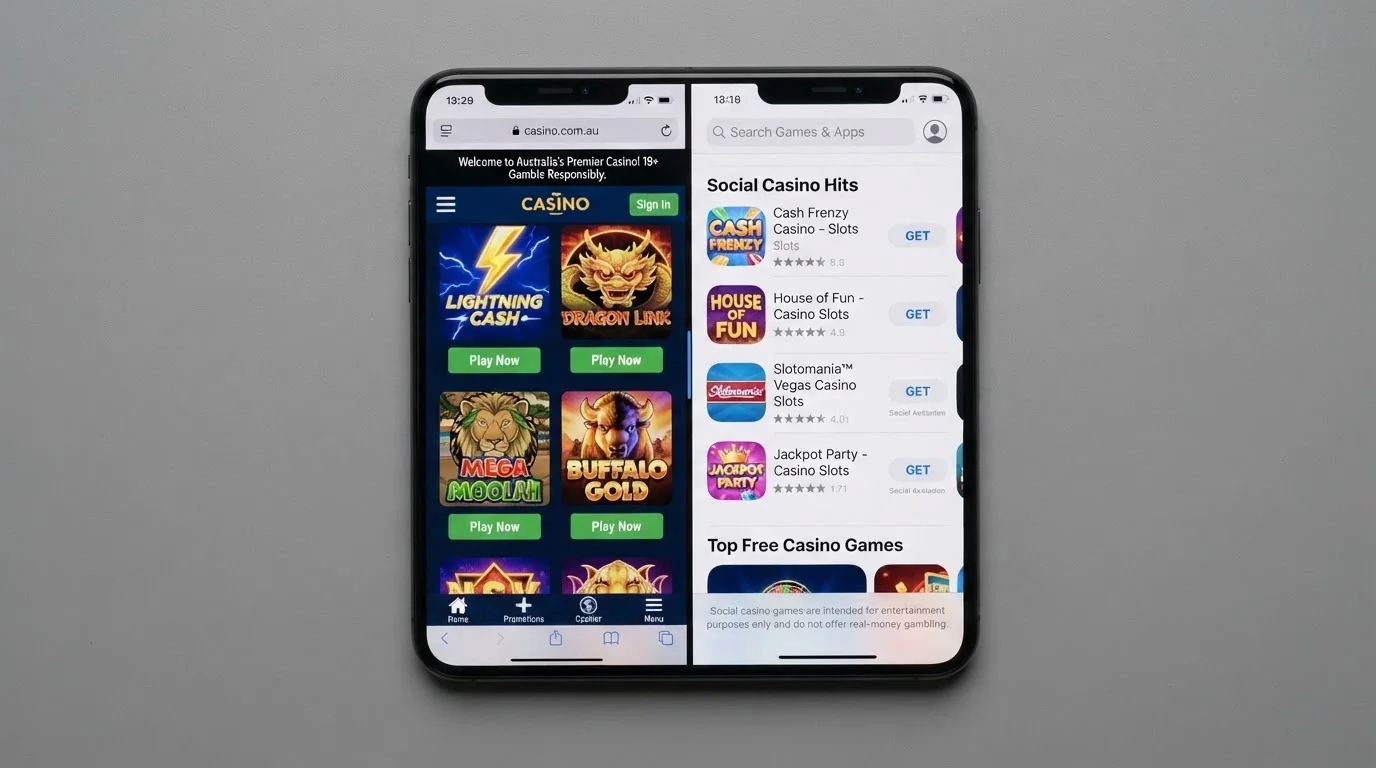
The “casino” apps that do appear in the AU App Store are social casinos, free-play simulators, and sweepstakes products where they are permitted. None of them pay out real money. The visual differentiation is not always clear — a Pragmatic Play social casino app can carry the Big Bass Bonanza artwork and the same game engine, and the difference between a real-money version and a fake-coin version is invisible from the App Store icon. The distinction is in the terms of service and the legal frame.
A punter searching the App Store for “casino” and seeing ten results has not found ten real-money options. They have found ten real-money-shaped options that do not pay out. The only way to access real-money casino play on an iPhone in Australia is through Safari, on an offshore site, with the protections the offshore site chooses to provide.
Mobile-optimised browser play: the real way Australians play
HTML5 casinos load in Safari like a native app would — touch-optimised menus, landscape-mode pokies, deposit flows built for a phone screen, a home-screen icon that behaves like a PWA. The experience is close enough to a native app that most punters do not notice the difference in the first 30 seconds. The differences are below the surface.
A native app version is versioned, updatable through the store, sandboxed from the rest of the device, and integrated with the iOS keychain for Face ID login. A PWA on a mobile browser is none of those. The login is form-based, the update is whatever the server is serving at the moment of the request, the sandbox is the Safari tab, and the device integration is limited to the home-screen icon. The trade for those missing features is access to a real-money product the App Store will not list.
The connection dependency is the other structural difference. A native app can cache data and offer limited offline functionality. A PWA cannot. If the operator’s server is down, the punter sees a connection error rather than a cached version. If the operator changes the login flow mid-session, the punter is logged out and has to re-authenticate. If the operator’s domain is on the ACMA block list, the punter loses access entirely.
For a punter who has decided to play on an offshore site, the mobile-optimised browser path is the only path. The home-screen shortcut is the closest thing to an “app” experience the App Store’s rules will allow.
Device compatibility: what your iPhone needs to run a casino smoothly
Any iPhone running iOS 15 or later handles HTML5 casino play without issue. The bottleneck is the operator’s mobile site, not the device. Older devices (iPhone 8, iPhone X) may struggle with live-dealer streaming because the video decoder is more heavily loaded, but RNG pokies and table games run without a hitch on any iPhone from the last 5 to 6 years. The bigger variable is the operator’s mobile site: a sluggish mobile cashier on Rocket Play is sluggish on an iPhone 15 Pro Max, because the bottleneck is server-side, not client-side.
Safari is the default browser and the best-optimised for HTML5 video and canvas rendering, which is the path a pokie uses for its reels. Third-party browsers (Chrome, Firefox) work, but Safari is the path the operator’s mobile site is most likely tested against. The difference is small on a modern iPhone and meaningful on an older one.
The practical floor: any iPhone from the last 5 to 6 years handles the slots lobby without issue, the live-dealer lobby requires a more recent device for smooth video, and the connection stability matters more than the device power. A punter on a 4G connection in a coverage fringe will have a worse live-dealer experience than a punter on a stable 5G connection, regardless of the device.
iPhone Casino Bonuses: Why Your 2026 Welcome Offer Is Smaller Than It Looks
A welcome offer at an offshore casino is a maths problem with three inputs and one output. The inputs are the bonus amount, the wagering multiple, and the RTP of the game the punter plans to clear the bonus on. The output is the expected cost of clearing the bonus in real terms. The marketing shows only the bonus amount; the wagering multiple and the RTP are in the fine print, and the gap between the two is where the real cost lives.
The industry norm for AU-facing offshore casinos is a match bonus in the 100% to 200% band, capped between roughly A$500 and A$5,000, plus a free spins pack from 50 to 200, with wagering between 35x and 50x on deposit and bonus. The headline on the landing page is the match percentage and the cap; the fine print is the wagering multiple, the game eligibility, the bonus validity window, the max-bet-while-clearing cap and the excluded games list. A punter who reads only the headline has read 20% of the offer.
The expected cost of clearing a bonus is a function of the wagering turnover and the house edge on the eligible games. For a A$1,000 bonus at 40x wagering on a deposit-and-bonus base (so the total turnover is A$1,000 bonus + A$1,000 deposit, times 40, equals A$80,000), played on Gates of Olympus at 96.50% RTP (house edge 3.50%), the expected cost of the turnover is A$80,000 × 0.035 = A$2,800. The bonus is worth A$1,000; the expected cost of clearing it is A$2,800; the net expected value to the player is negative A$1,800. That is the arithmetic of every match bonus in the 100% to 200% band, and the variance comes from which RTP the operator selected for the game and which games the bonus terms allow.
The marketing word for that arithmetic is “free money.” It is not free. The wagering requirement is the cost the player pays in expected losses to unlock the bonus, and the cost is higher than the bonus in most configurations. A punter who evaluates the offer on its headline alone is evaluating a number that has already been discounted by the wagering multiple the operator chose.
Welcome bonuses on iPhone: the match, the cap and the fine print
A 100% match up to A$5,000 with 50 free spins reads like a gift. The 40x wagering on deposit and bonus means A$400,000 of turnover before a dollar can be withdrawn. The free spins are locked to a single Pragmatic Play title, often at the operator’s lowest RTP tier, and the winnings from those spins carry their own wagering requirement. The bonus validity is often 7 to 30 days. The max bet while clearing is often capped at a percentage of the deposit or a flat amount. The game weighting excludes table games and live dealer from wagering, and the exclusion list may also include high-RTP pokies.
The free-spins terms are the second layer. A 50-free-spin pack is not 50 free chances at the headline max win; it is 50 chances at a fixed spin value (often the minimum bet) on a specific title at the operator’s chosen RTP tier. The winnings from those 50 spins are bonus funds, not cash, and they carry their own wagering. A punter who thinks the free spins are “free” has read the wrong line.
The bonus validity is the third layer. A 7-day window (Rainbet’s structure) means a punter must clear the full turnover in 168 hours, which is roughly A$11,400 of turnover per hour on a 40x A$1,000 deposit-and-bonus. A 30-day window is more forgiving but still a hard deadline. A punter who lets the bonus expire loses both the bonus and the winnings derived from it. The validity window is the mechanism that pushes punters into higher-volume play than they would otherwise choose.
No-deposit casino offers for iPhone players
A no-deposit bonus sounds like free money because it is — capped at around A$180 in cashout with 60x wagering, which means clearing A$10,800 in turnover to withdraw less than two hundred dollars. The expected cost of that turnover, at a 96.5% RTP pokie, is A$10,800 × 0.035 = A$378. The bonus pays out up to A$180; the expected cost of clearing it is A$378; the net expected value to the player is negative A$198 before counting the time spent.
The no-deposit offer is an acquisition tool, not a gift. The operator’s expected cost of letting a new player try the site is the expected loss on the turnover, which is structurally lower than the headline cashout because the wagering requirement is the filter. A punter who treats a no-deposit offer as a risk-free trial is right; a punter who treats it as a path to real winnings is reading the offer wrong.
The scarcity of genuine no-deposit offers in the AU-facing offshore market is the other detail. Most operators have moved away from no-deposit because the conversion rate from “claimed the bonus” to “deposited and played for real” is too low to justify the cost. The offers that remain are heavily capped and tightly time-limited, and the fine print is the part that decides whether the offer is worth claiming.
Crypto Casino Deposits on iPhone: The Privacy Trade-Off Australian Players Face
Bitcoin and crypto deposits at iPhone-facing casinos
Crypto deposits at offshore casinos — Bitcoin, Ethereum, Litecoin, USDT — clear in under 30 minutes on an iPhone browser. The flow is: open the casino cashier, select the coin, scan the QR code with a wallet app, confirm the transaction. The settlement is blockchain-confirmed, the operator credits the account after one or two confirmations, and the punter is playing within 30 minutes of opening the cashier. The speed is meaningfully faster than any fiat rail.
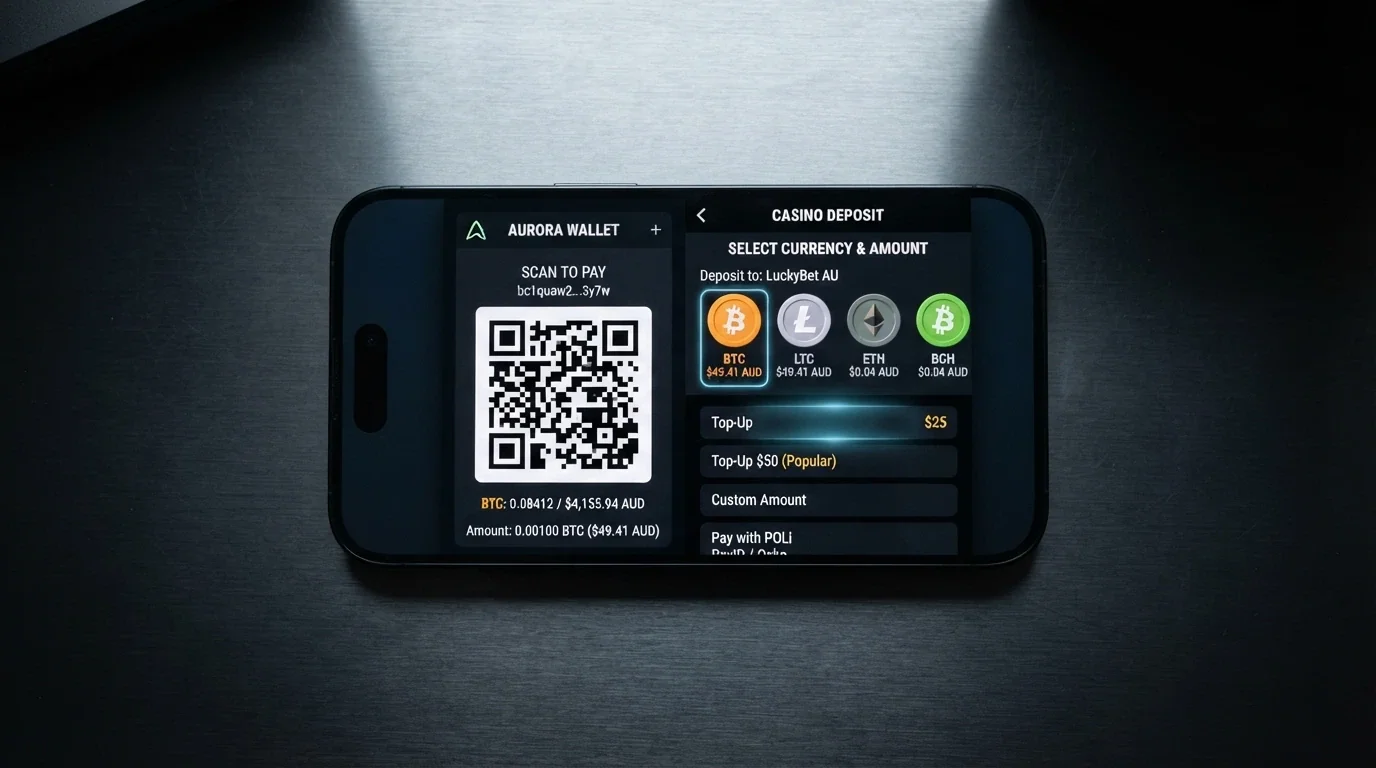
The trade is the absence of a banking record. A PayID deposit shows up on the punter’s bank statement as a PayID transfer. A debit card deposit shows up as a card transaction. A crypto deposit shows up nowhere on the punter’s bank statement — the AUD-to-BTC or AUD-to-USDT conversion happens off-bank, the blockchain transfer is pseudonymous, and the AUD conversion back to a bank account happens at the withdrawal end. That is the privacy argument, and it is the reason some AU players prefer crypto: it does not leave the banking trail that has led some Australian banks to freeze accounts with frequent offshore gambling activity.
The trade-off is the absence of a chargeback path. A punter who deposits AUD 1,000 via debit card and then sees the operator refuse a withdrawal can file a chargeback with the card issuer. A punter who deposits the equivalent of AUD 1,000 via Bitcoin has no chargeback path — the BTC is in the operator’s wallet, the punter has no card issuer to appeal to, and the operator’s bank is not involved. The crypto path is faster and more private, and it removes every consumer-protection mechanism the fiat path has. The punter who values the speed and the privacy of crypto is also the punter who has accepted the absence of recourse.
The 11 June 2024 federal ban on credit cards and crypto as payment for online wagering binds licensed Australian operators, not offshore ones. A licensed bookmaker cannot accept a Bitcoin deposit; an offshore casino can. The ban tightens the licensed market and leaves the offshore market as it was — which means a punter who is set on using crypto at a real-money casino is already pointed at an offshore site by default.
Getting Paid: How Fast iPhone Casino Withdrawals Actually Reach Your Australian Bank
| Payment method | Deposit speed | Withdrawal speed | Notes |
|---|---|---|---|
| PayID / Osko | Near-instant (seconds) | 24–48 hours end-to-end; 12–18 hours operator-side | PayID is a P2P / biller overlay on the NPP rail; no standardised merchant push-payment path means casinos fall back to bank transfer for payouts |
| USDT (TRC-20) | ~30 minutes after blockchain confirmation | 0.2–8 hours | The fastest rail tested at offshore casinos; no AU banking record |
| Bank wire / transfer | 1–3 business days | 3–5 business days | The universal fallback; the slowest rail by a margin |
| Debit card | Near-instant | 3–5 business days | The most common rail; the speed of the deposit does not carry over to the withdrawal |
| POLi | N/A | N/A | Shut down 30 September 2023 — any operator still listing it is running outdated payment documentation |
The asymmetry between deposit and withdrawal is the structural feature of the offshore payout experience. Every rail is faster going in than coming out, and the gap is the operator’s processing window plus the banking system’s settlement window. PayID is the best example: deposits clear in seconds through the NPP rail, and withdrawals take 24 to 48 hours because PayID was built as a person-to-person and biller-payment overlay, not as a merchant push-payment path. A casino that says “PayID withdrawal” is usually initiating a bank transfer from the operator side and crediting the punter’s PayID through a different code path. The “PayID” label is shorthand for the incoming rail on the punter’s bank statement, not the rail the operator used.
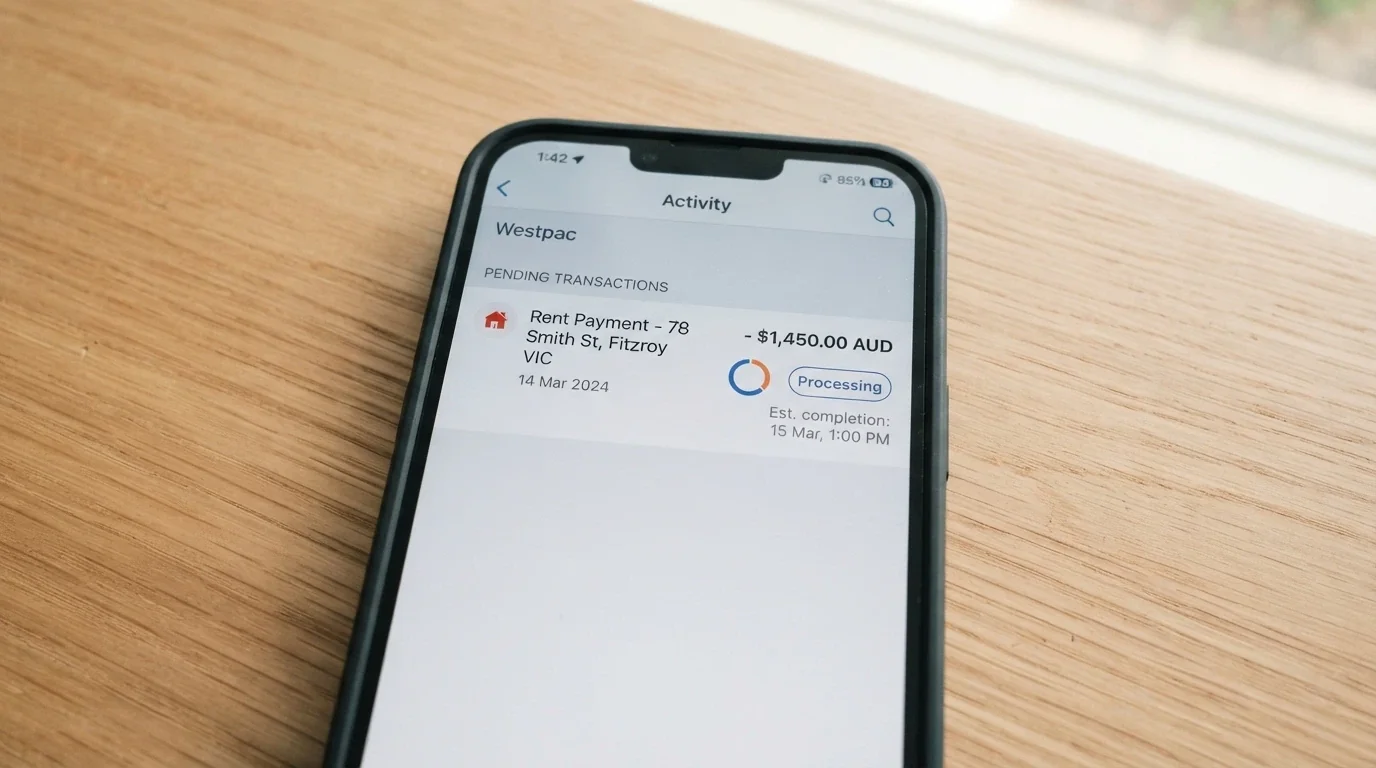
USDT on the TRC-20 network is the fastest rail tested. The 0.2 to 8 hours is end-to-end, including operator processing. The reason it is fast is the absence of an Australian banking intermediary: the operator sends USDT to the punter’s TRC-20 wallet, the punter converts to AUD through an exchange, and the AUD lands in the punter’s bank account on whatever timeline the exchange uses. The privacy argument is the same as on the deposit side — no banking record until the conversion step.
PayID and Osko: Australia’s fastest fiat rails for casino deposits
PayID and Osko run on the New Payments Platform (NPP) and clear in seconds. A punter who opens the casino cashier, selects PayID, enters their mobile number or email, and confirms has the deposit credited to the casino account in under a minute. The experience is close to a bank transfer with instant settlement. The reason it works is that PayID is built on a real-time gross settlement rail, and Osko is the branding for the instant-transfer overlay.
The structural reason PayID cannot handle casino withdrawals is that PayID is a P2P and biller overlay, not a merchant push-payment path. The NPP rail does include a standardised way for a merchant to send money back to a customer, but most Australian banks and most offshore operators have not implemented it for casino payouts. A casino that says “PayID withdrawal” is doing one of two things: initiating a bank transfer from the operator side and crediting the punter’s PayID through an indirect path, or batching the withdrawal into the operator’s next PayID window, which is typically 12 to 18 hours from the punter’s request. The end-to-end time is 24 to 48 hours, with the operator’s processing window the larger share.
For a punter who values a fast fiat deposit rail, PayID is the best option in the AU market. For a punter who needs a fast fiat withdrawal rail, PayID is not — the structural reason is that PayID was never designed for merchant payouts, and the operator’s fallback is a bank transfer with a 3 to 5 business day window.
Beyond PayID: debit cards, bank transfers and the options that remain
Debit cards are the most common deposit rail, clearing in seconds through the card network. The withdrawal rail is the same card, the same network, and a 3 to 5 business day window that reflects the card network’s settlement cycle and the operator’s processing queue. A punter who deposits with a debit card and expects a debit card withdrawal is correct in direction and wrong in speed: the deposit is fast, the withdrawal is not.
Bank transfers are the universal fallback. Every operator supports them, every AU bank accepts them, and the settlement window is 3 to 5 business days regardless of operator. The bank transfer is the rail a punter falls back to when the faster rails are unavailable, and the trade is the same as on the deposit side: reliability over speed.
E-wallets sit between crypto and bank transfer on the speed ladder. Where supported, e-wallet withdrawals clear in under 24 hours. The constraint is operator coverage: not every AU-facing offshore casino supports the same e-wallet set, and the e-wallet list on the operator’s payments page is the authoritative list.
POLi is gone, shut down on 30 September 2023 after BPay withdrew support. Any operator still listing POLi as a payment option in 2026 is running outdated payment documentation, and the punter who sees POLi on a payments page has a current-status question to ask before depositing.
How We Selected and Ranked These iPhone Casinos
The source set for the operator ranking was the operators skill shortlist of AU market share, cross-referenced with the brands Australian players ask about by name. The screening criteria were iPhone compatibility (does the mobile site work in Safari, are the touch targets sized for a 6-inch screen, do the pokies re-layout for landscape), pokies catalogue depth (Pragmatic Play’s big three as the baseline, with provider breadth as the tie-breaker), AU payment-rail support (PayID, debit card, crypto — the rails an AU punter can actually move money across), and bonus transparency (how clearly the operator publishes its welcome package, wagering multiple, free-spins terms and bonus validity). The source set for the legal and regulatory framework was the ACMA’s enforcement record and the Interactive Gambling Act 2001 as amended. The source set for slot specs was the Pragmatic Play RTP database and the slot-database review sites that publish the RTP, volatility and max-win figures per title. The source set for payment benchmarks was the verified-withdrawal testing on Payoutverdict.com and the PayID coverage analysis on Esports.net.
The screening process surfaced ten operators and confirmed bonus specifics for four of them (SkyCrown, Stake, Rainbet, Fair Go). The remaining six have known AU market share but unconfirmed bonus terms, game providers or current domain status. The table above is honest about that gap. A punter evaluating any operator whose bonus terms are not in the verified set should treat the operator’s own bonus page as the source of truth.
The limitation that runs through the entire ranking: every brand is offshore and unlicensed. The IGA prohibits the supply of online casino games to Australian customers, and no state or territory licence exists that would change that. The ranking is between comparable offshore sites, not between offshore and licensed options, because the licensed option does not exist for online casino in Australia. That limitation is named here once, and it is the frame for every write-up in the table.
Your Move in 2026: What a Clear-Eyed Punter Should Do Next
The prohibition is the frame. No licensed online casino exists in Australia, so every choice an AU iPhone player makes is a choice between offshore sites, with the offshore site’s own terms, withdrawal policy and dispute resolution. That is not a reason not to play; it is a reason to play with the protection systems the AU framework does provide. BetStop binds licensed operators only, so it does not stop an offshore deposit, but it does stop a licensed AU bookmaker from accepting a self-excluded person’s money. A punter who has decided to use the self-exclusion system is closing a licensed avenue, not an offshore one. The self-exclusion conversation is the place to start if the gambling is causing harm.
The risk ladder is the next frame. Crypto is the fastest rail and the most private, and it is also the rail with no chargeback path and no banking record. PayID is the fastest fiat rail for deposits, and PayID withdrawals fall back to bank transfer with a 3 to 5 business day window. Bank transfer is the universal fallback, slow and reliable. The choice of rail is the choice of which protection system the punter is willing to give up. Crypto gives up the chargeback; PayID gives up speed on the withdrawal; bank transfer gives up speed on both.
The bonus maths is the third frame. A 100% match at 40x wagering on deposit and bonus is a negative-expected-value offer even before the game eligibility and the max-bet cap are factored in. A punter who evaluates the bonus on its headline alone is evaluating a number that has already been discounted by the wagering multiple the operator chose. The bonus is a marketing tool, not a value transfer. The clear-eyed move is to deposit the amount the punter is willing to lose and to treat the bonus as a feature of that amount, not a gift on top of it.
The data-rich versus thin-data operator is the fourth frame. A punter on SkyCrown, Stake, Rainbet or Fair Go has a verified bonus picture from this page and from the operator’s own site. A punter on Rocket Play, Royal Reels, WinSpirit, Scream Casino, Bizzo or Rocket Casino has a less complete picture, and the gap is in the bonus terms, the game provider list or the current domain status. The clear-eyed move is to deposit at an operator whose terms are visible, not at one whose terms are not.
The responsible-gambling resources are the final frame, and they are not a postscript. About 2.1% of Australian adults — roughly 430,000 people — experience problem gambling, and the Australian Institute of Health and Welfare put high-risk gambling at 1.8% in 2022. The National Gambling Helpline is 1800 858 858, free, confidential, staffed 24 hours a day, 7 days a week, with online chat and counselling through Gambling Help Online at gamblinghelponline.org.au. BetStop, the National Self-Exclusion Register, has recorded 67,480 registrations since going live in August 2023, with 41,290 exclusions still active as at 31 July 2026. BetStop does not cover offshore casinos, which is a limitation, not a reason to skip it for the licensed bookmaker deposits it does cover. The punter who is using the system is the punter who has decided to play within a structure, and the system is the structure the AU framework provides.
The concrete move: pick the rail the punter is willing to defend (PayID for speed and a banking record, crypto for privacy and no record, bank transfer for reliability), pick the operator whose terms are visible (SkyCrown, Rainbet, Fair Go or Stake, in that order of completeness), deposit the amount the punter is willing to lose, treat the bonus as a feature of that amount, and keep the helpline number in the phone.
FAQ
Is it legal to play casino games on my iPhone in Australia?
The Interactive Gambling Act 2001 prohibits online casino games and online pokies at the federal level, and no state or territory licence exists. Every iPhone casino accessible to an Australian player is offshore and unlicensed. The individual player is not prosecuted — the IGA targets the provider — but the offshore site can be blocked by an ISP at any time and your money sits in a jurisdiction outside Australian consumer protection.
What happens to my money if an offshore iPhone casino gets blocked in Australia?
The site can be blocked by Australian ISPs under ACMA direction without notice. Your balance is held on the operator’s server, which is in whatever jurisdiction the offshore licence covers, and there is no Australian consumer protection body, no ACMA recovery process, and no Australian bank that can reverse the transaction. The 1,564 sites the ACMA has blocked since 2019 are the cumulative record of how often this has happened.
Do iPhone casino bonuses work differently than desktop bonuses?
The bonus is the same — a match percentage, a cap, a wagering multiple, free spins, a validity window. The iPhone experience differs in the touch interface and the screen size, but the bonus terms are the same. The wagering multiple, game eligibility, max-bet cap and bonus validity are set by the operator and apply regardless of device, so an iPhone punter should read the same fine print a desktop punter reads.
Are free pokie apps on the App Store the same as real-money casino pokies?
No. Free pokie apps on the App Store are social casinos — they use the same game engines, the same artwork and the same mechanics as the real-money versions, but the balance is virtual coins and the payout button does nothing. Real-money pokies sit on offshore sites accessed through Safari, with real AUD deposits and real withdrawals, and the App Store does not list them because no AU online casino licence exists.
What is the difference between a casino app and playing through a mobile browser on iPhone?
A native casino app is a downloadable program versioned through the App Store with push notifications, Face ID login and offline caching — none of which exist for real-money casino apps in the Australian App Store. Mobile browser play is an HTML5 site loaded in Safari, with a home-screen shortcut that behaves like a PWA. The shortcuts work, the touch experience is close to native, and the real-money product is accessible — but no app version, no push notifications, no Face ID integration.
Published by the Fast Payout Casinos AU team.