A Realistic Breakdown of the $200 No Deposit Offer in Australia
 Available in AU
A $200 no deposit bonus sounds like free money. For an Australian player it rarely is. The headline figure is almost always built from a smaller real offer, and the offer sits on an offshore site that no Australian regulator has licensed. The Interactive Gambling Act 2001 prohibits the provision of online casino games to Australians; every operator carrying a $200 no-deposit pitch is operating outside that framework. The figures and licence claims below were checked against ACMA enforcement records, operator bonus terms pages, and Australian regulatory sources as of 18 October 2026.

The gap between the marketing and the reality is wide enough that a reader who understands the structure can decide quickly whether the offer suits them. This page works through that gap. What the $200 label actually delivers, why the wagering costs what it does, who the named operators are and what their terms really look like, the legal position most bonus pages skip, and the player-protection tools that work and the ones that don’t.
Table of Contents
- Why a $200 no deposit bonus in Australia is rarely what it looks like
- The real types of $200 casino bonuses available to Aussie players
- Where to find a $200 no deposit bonus: operators compared
- How to fund your play: PayID and Australian deposit options
- Online casino in Australia: the legal reality most bonus pages skip
- Playing safely: what responsible gambling actually looks like offshore
- How we evaluated these operators
- Should you chase a $200 no deposit bonus? What the numbers say
- Frequently asked questions about $200 no deposit bonuses in Australia
Why a $200 no deposit bonus in Australia is rarely what it looks like
The $200 no deposit bonus is a marketing ceiling, not a real offer. A genuine standalone $200 no-deposit bonus — where the full amount lands in a player’s account without any deposit — is exceptionally rare in the current Australian market. The realistic ceiling for a no-deposit bonus is closer to A$50 to A$100, and most operators pitching the higher figure use one of three structural tricks to inflate it: a spin pack counted at face value rather than playable value, a multi-deposit welcome package presented as a single no-deposit offer, or a non-withdrawable bonus locked behind turnover conditions that effectively negate the headline. The noise around $200 is loud because the number is round. The substance behind it almost never matches.

What a no deposit bonus actually is
A no-deposit bonus is bonus credit a casino grants a new account without requiring a deposit. The operator uses it as an acquisition cost — a way to put a player in front of real-money games without the player having risked anything yet. The bonus is never a gift in cash. It is almost always bonus money that lives in a separate wallet, playable on selected games, with withdrawal gated behind wagering requirements and a maximum cashout cap. The operator’s incentive is straightforward: a player who likes the games will eventually deposit, and the deposit is where the operator earns. The bonus is the door. The wagering requirement is the catch.
The realistic value of a no-deposit bonus sits well below its headline. The $50 to A$100 ceiling is what an Australian-facing player can typically claim and clear, and even at that level the wagering is heavy: typical requirements run from 30x to 70x the bonus amount. On the largest genuine no-deposit bonuses that do appear, wagering climbs to 50x or 80x. A A$200 no-deposit bonus at 60x wagering means turning over A$12,000 before any withdrawal unlocks. That is the arithmetic most bonus pages skip, and it is the arithmetic the rest of this page runs.
How the headline number gets built — spins versus a cash credit
Two delivery methods produce the $200 headline. The first is a free chip — a single bonus credit of A$200 — which carries a cash credit wagering multiple of 35x to 50x on the bonus amount. The second is a free spin pack — typically 200 spins at A$0.10 per spin, which the marketing counts as A$200 even though the actual playable value is A$20. The two products are not the same thing. 200 free spins at A$0.10 per spin equals A$20 of play, not A$200 — a no-deposit cash bonus of A$200 would be worth roughly ten times more in playable funds.
The wagering math diverges in the same direction. Cash credit bonuses carry 35x to 50x playthrough on the bonus amount; free spins usually carry 30x to 40x on winnings only. A player who wins A$50 from 200 free spins at 35x on winnings must turn over A$1,750 before the A$50 becomes withdrawable. The max cashout ceiling sits on top: A$50 to A$100 is common, and even larger spin packs rarely unlock more than A$200 in cash. The headline figure and the withdrawable figure are two different numbers, and most pages that pitch the $200 figure talk about one while concealing the other.
The real types of $200 casino bonuses available to Aussie players
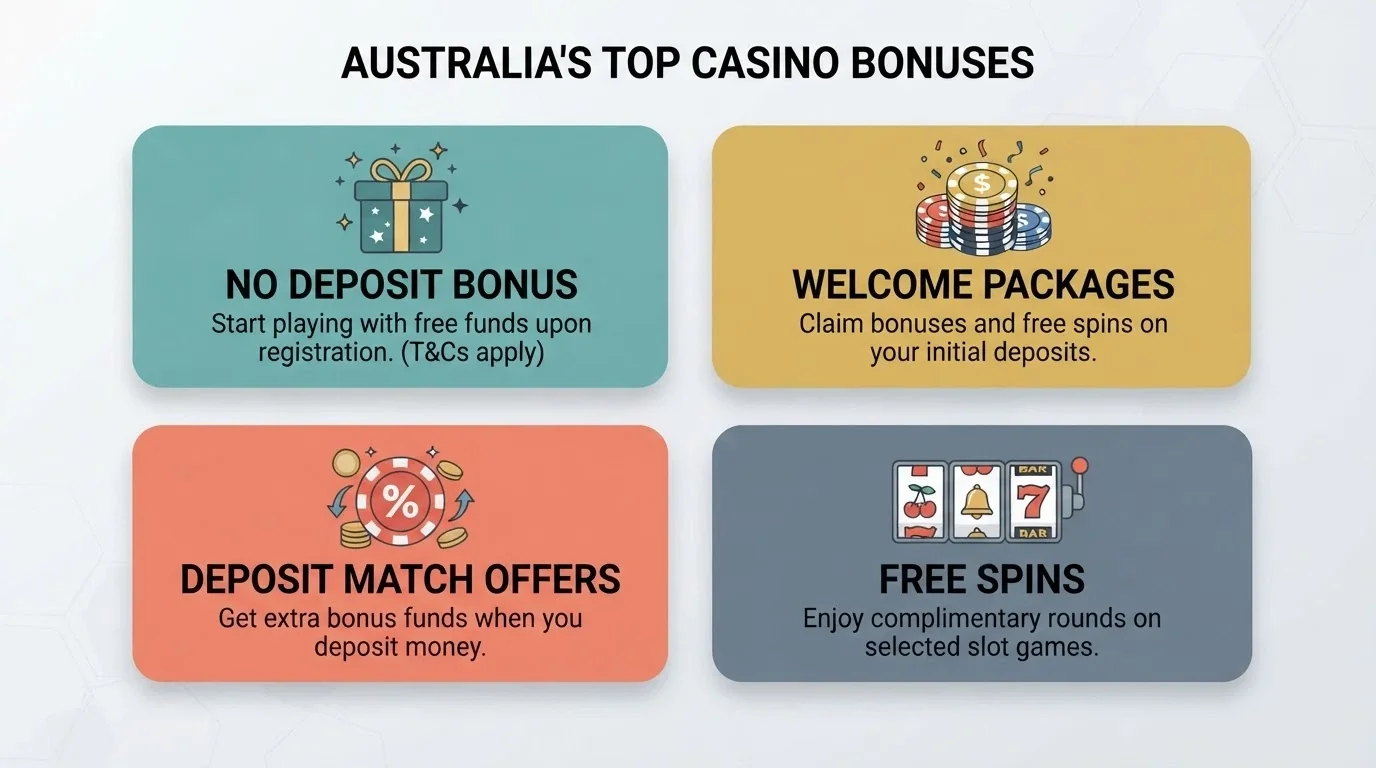
The $200 label is applied across several bonus types, and each has its own mechanics. No-deposit bonuses, welcome packages, deposit-match offers, bonus codes, and free-spin bundles all carry the same figure in marketing material, and each converts to playable value differently. Understanding the type matters more than chasing the headline.
| Bonus Type | Key Mechanics |
|---|---|
| No-Deposit Bonus | Credit granted without requiring a deposit |
| Welcome Package | Tiered credit and spins over multiple deposits |
| Match Bonus | Percentage of deposit added as bonus funds |
| Bonus Code | Token used for tracking or unlocking offers |
| Free Spins | Pre-priced bundles for selected pokies |
The no deposit bonus — claim without paying
The no-deposit bonus is the offer readers came for, and it sits at the bottom of the value stack. Typical wagering runs 30x to 70x the bonus amount, with the largest genuine offers climbing to 50x to 80x. Max cashout commonly sits at A$50 to A$100, extending to A$200 on larger spin packs. Expiry windows are short: 24 to 72 hours on free spins, 7 to 14 days on cash credits. The max bet limit during bonus play is typically A$5 per spin, and exceeding it can void winnings outright. The bonus is real money in the sense that it can be played, but it is not real money in the sense that any of it leaves the casino until the wagering clears and the cap is respected.
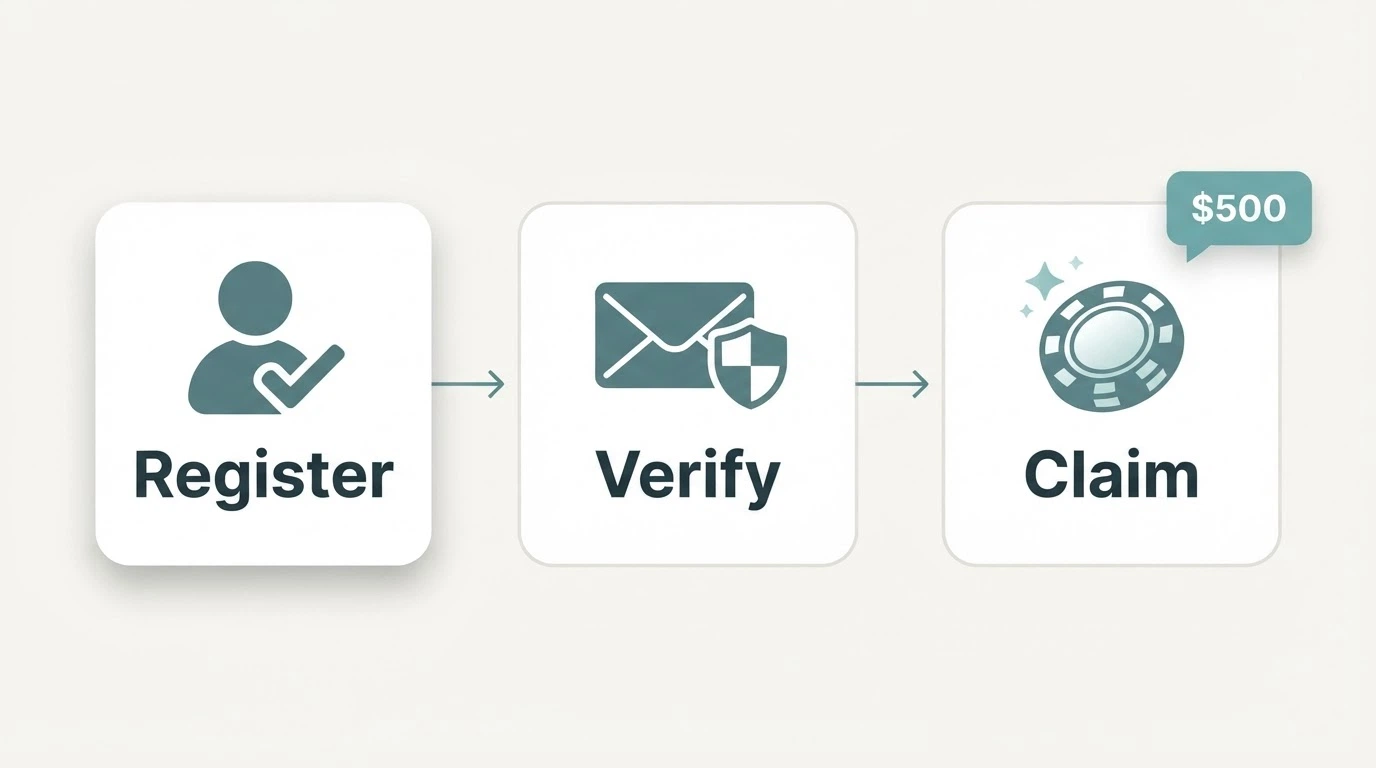
The claim process itself is straightforward. Register an account, verify email or phone, enter a code where one is required, and the bonus credits appear. Clearing the wagering to withdraw is where the time commitment appears. A A$200 bonus at 60x wagering requires A$12,000 in eligible turnover before any withdrawal unlocks, and the cashout cap limits how much of that turnover the player ever sees back. Minutes to claim; hours to clear; capped at withdrawal.
Sign-up and welcome packages — where the $200 number lives
The multi-deposit welcome package is where most $200 headlines originate. A package such as A$1,000 plus 100 free spins across a first deposit is presented as a single bonus when it is actually a tiered structure spread over multiple deposits. The first deposit typically unlocks the headline value, with subsequent deposits carrying lower percentages and smaller spin packs. Rocket Play’s welcome package runs up to A$1,000 plus 100 free spins on a 100% first-deposit match, with 40x wagering on bonus funds, a 5-day validity window, and a max bet of A$7.50 during wagering. SkyCrown’s welcome package runs up to A$8,000 plus 400 free spins across four tiers, with 40x wagering on bonus funds and 30x on free-spin winnings, a 14-day window, and a max bet of A$5.
The structure matters because the wagering applies to the bonus funds only, not to the deposit. A A$1,000 deposit at 100% match produces A$1,000 in real money plus A$1,000 in bonus money; the 40x wagering applies to the A$1,000 bonus, requiring A$40,000 in turnover. That is a meaningful difference from the way some bonus pages present it, and it determines whether the welcome package is worth chasing.
First-deposit and match bonuses — your money, multiplied
A first-deposit match is the simplest bonus structure: the casino adds a percentage of the deposit as bonus funds, with wagering applied to the bonus only. The 100% match is the most common. RocketPlay’s first-deposit offer runs 100% up to A$1,000 with a minimum deposit of A$30, 40x wagering on the bonus portion, and a 5-day validity window. SkyCrown’s structure layers four deposit tiers at 40x on bonus funds across a 14-day window. A bigger match percentage is not always a better deal. The wagering multiple, the cap on bonus funds, and the validity window together determine the real cost of clearing the bonus, and a 200% match at 50x wagering is harder to clear than a 100% match at 35x.
Bonus codes — when you need one and what they unlock
A bonus code is a distribution token, not a value. The code unlocks a specific offer, ties the registration to a particular campaign, and tracks which affiliate or channel brought the player in. Codes appear on operator bonus pages, in affiliate listings, and in promotional emails. The claim flow is the same regardless: register, enter the code during sign-up or before deposit, and the bonus credits to the account. A claim without a valid code either falls back to a default welcome offer or credits nothing — the code is the gate, and the offer behind it carries whatever wagering, cap and expiry the operator has set for that campaign. No individual code value is carried here, because codes are distribution keys rather than dollar values, and the offer each one unlocks is what the player should evaluate.
Pokies bonuses and free spin bundles
Free spins are the dominant pokies incentive. Spin packs are priced at A$0.10 to A$0.20 per spin, with game restrictions narrowing the eligible titles and contribution rates deciding how much of the wagering the spin counts toward. Pokies contribute 100% of wagering; table games contribute 10%; live casino contributes 5%; video poker contributes 5%. A 200-spin bundle at A$0.10 per spin is A$20 of playable value, not A$200. The 30x to 40x wagering on free-spin winnings applies to whatever the spins actually pay out, not to the face value of the bundle. A bundle that pays A$40 in winnings at 35x means A$1,400 in turnover before the A$40 is withdrawable.
Bonus wallet versus real money — what reaches your bank account
The bonus wallet is the locked balance that holds bonus funds, distinct from the real-money balance that holds cash deposits and any winnings not yet attached to a bonus. The two balances operate separately, and the bonus wallet only converts to real money after the wagering requirement clears. A player who plays through the bonus funds, hits wagering completion, and still has bonus money left over forfeits the remainder. The cashout cap is the real ceiling on what reaches the bank account. A A$200 bonus at 50x wagering clears A$10,000 in turnover, and if the cap is A$75, only A$75 of any withdrawable balance ever leaves the casino. The bonus wallet is where the marketing promise lives; the cashout cap is where the real ceiling sits.
Where to find a $200 no deposit bonus: operators compared
The table below compares the ten featured Australian-facing operators by licence jurisdiction. No operator holds an Australian casino licence because no such licence exists; all are offshore, and the comparison is jurisdictional rather than performance-based.

| Operator | Licence Jurisdiction |
|---|---|
| Rocket Play | Curacao |
| SkyCrown | Curacao |
| Royal Reels | Offshore (jurisdiction not confirmed) |
| Stake | Curacao |
| Fair Go | Curacao |
| WinSpirit | Offshore (jurisdiction not confirmed) |
| Rainbet | Offshore (jurisdiction not confirmed) |
| Scream Casino | Offshore (jurisdiction not confirmed) |
| Bizzo Casino | Offshore (jurisdiction not confirmed) |
| Rocket Casino | Offshore (jurisdiction not confirmed) |
Most $200 no-deposit offers to Australian players come from Curacao-licensed sites; fewer MGA-licensed casinos accept Australians due to the IGA. The Curacao licence provides a baseline of regulatory oversight but offers none of the Australian consumer protections that a locally licensed operator would carry, and ACMA enforcement has named specific operators under the same licence groups.
Rocket Play
Rocket Play sits under the Dama N.V. licence group, a Curacao operator whose portfolio ACMA formally warned in Q2 2025. The warning identified Rocket Play as providing an unlicensed regulated interactive gambling service to Australian customers. The welcome package runs up to A$2,000 plus 100 free spins on a 100% first-deposit match, with 40x wagering on bonus funds, a 5-day validity window, and a max bet of A$7.50 during wagering. The minimum deposit to trigger the offer is A$30. The no-deposit bonus carries a max cashout cap of A$75, and the max cashout from free spins on first deposit sits at A$300.
Rocket Play’s terms are documented clearly enough that a player who reads them knows what they are agreeing to. The combination of the ACMA warning and the documented cashout caps means a reader chasing the headline offer is paying in transparency for the offshore status: the offer is real, the limits are stated, and the regulatory position is on the public record. For a player who values knowing the rules before playing, Rocket Play is one of the more legible operators in the Australian-facing offshore market. For a player who wants Australian consumer protection, no offshore operator offers it.
SkyCrown
SkyCrown runs a four-tier welcome package up to A$8,000 plus 400 free spins, with each tier carrying its own deposit and bonus. The wagering structure distinguishes between bonus funds and free-spin winnings: 40x on bonus funds, 30x on free-spin winnings. The 14-day validity window gives more clearance time than Rocket Play’s 5 days, and the max bet during wagering sits at A$5, slightly tighter. Game contribution rates are explicitly stated: pokies 100%, table games 10%, live casino 5%, video poker 5%. The contribution rate structure means a player who tries to clear the bonus on live casino or table games is converting only a fraction of each wager into progress.
SkyCrown’s structure rewards a pokies-focused player with a longer clearance window and a slightly lower wagering load on free-spin winnings. The trade-off is the four-tier structure: the headline A$8,000 figure is the cumulative ceiling across four deposits, not a single-deposit offer, and a player who deposits once and walks away sees only the first tier. For a multi-deposit player who plans to stay, SkyCrown’s terms are among the most clearly stated in the offshore market.
Royal Reels
Royal Reels is an offshore operator without an Australian licence, and bonus terms were not confirmed from public sources this round. The brand carries Australian-facing positioning in the offshore market, and its presence is sufficient to include in the ranking, but the absence of confirmed terms means a player must check the operator’s own website for current bonus details. The same caveat applies across the operator set below — where research did not surface specific terms, the operator’s own bonus page is the live source.
Stake
Stake is a major Curacao-licensed brand with global recognition. It is not licensed in Australia, and its Australian-facing presence sits outside the IGA framework. Bonus terms were not confirmed from public sources this round. Stake’s market position is that of a large, well-known crypto-friendly operator with a broad product range; the offer style varies by promotion and is best checked at the source. The Australian player who recognises the Stake name should treat the recognition as a brand-quality signal rather than a regulatory one — the licence is Curacao, the consumer protection is Curacao, and no Australian complaints body has jurisdiction.
Fair Go
Fair Go is a Curacao-licensed brand powered by RealTime Gaming (RTG) and referenced in Australian player forums. It is not licensed in Australia, and the bonus terms it carries are not confirmed from public sources this round. Fair Go’s niche is the RTG-powered, AU-forum-familiar offshore site; its typical offer style is the cash-deposit welcome package with bonus funds and free spins layered in. The RTG provider means the game library is narrower than multi-provider offshore brands, but it is a familiar library for players who have spent time in AU-focused casino discussions.
WinSpirit
WinSpirit is an offshore operator without an Australian licence. Specific bonus terms were not confirmed from public sources this round, and the operator’s positioning is general offshore. A player evaluating WinSpirit should check the operator’s own website for current bonus terms, since research did not surface detailed figures this run.
Rainbet
Rainbet is an offshore operator without an Australian licence. Specific bonus details were not available for confirmation during this research round. The brand carries Australian-facing positioning, and the offer style is best verified at the source.
Scream Casino
Scream Casino is an offshore operator without an Australian licence. Bonus data remained unconfirmed by public records this round, and the operator’s market positioning is general offshore. As with the other operators in the unconfirmed subset, the live bonus terms sit on the operator’s own website.
Bizzo Casino
Bizzo Casino is an offshore operator without an Australian licence. Current bonus information was not verified via public sources this round. Bizzo’s market presence is general offshore, and the offer structure is best verified at the source.
Rocket Casino
Rocket Casino is an offshore operator distinct from Rocket Play. The name overlap is a common source of confusion; they are separate brands under different licence structures, neither holding an Australian licence. Specific bonus terms for Rocket Casino were not confirmed from public sources this round, and a player who has read the Rocket Play review above should not assume the terms carry across. Check the operator’s own website for the current bonus structure.
How to fund your play: PayID and Australian deposit options
PayID deposits process in under 30 seconds, operate 24/7, and carry zero bank or casino fees. The speed and zero-fee structure make PayID the natural rail for Australian players funding offshore casino play. PayID registrations surpassed 27 million as at March 2026, with the New Payments Platform processing nearly 2 billion real-time transactions annually. The rail is domestic and instant. The casino on the other end of the transfer is still offshore.
PayID deposits at online casinos — fast, with a catch
PayID is an Australian instant-payment rail linked to a phone number, email or ABN, processed through the New Payments Platform. Deposits through PayID land in under 30 seconds at any operator that accepts it, and the bank charges no fee for the transfer. Most Australian banks set PayID daily transfer limits between A$5,000 and A$20,000; major banks CBA and NAB allow up to A$100,000 per day. The ceiling is set by the bank, not by the casino, and a player who wants to deposit more in a single day can split across multiple banks or use a different rail.
The catch is that the payment rail is domestic and the recipient is not. A PayID transfer from an Australian bank to an offshore casino is a real-time transfer to a recipient outside the Australian regulatory perimeter, and the speed of PayID does not change that. The casino that accepts PayID is, by definition, an offshore casino — a domestic Australian-licensed wagering service does not accept PayID for online casino play, because online casino play is not licensed. The instant domestic rail funding an unlicensed offshore product is the structural disconnect that defines the Australian offshore deposit.
Funding pokies play with Australian payment methods
The payment method itself tells a player something about the operator’s regulatory position. Credit cards, credit-related products and digital currency are banned as payment for online wagering since 11 June 2024, with penalties for non-compliance reaching A$247,500. The ban was enacted under the Interactive Gambling Amendment (Credit and Other Measures) Act 2023. An offshore casino that still accepts credit card or crypto deposits from Australian players is operating outside Australian rules, and the payment method is the visible signal.
The legal deposit routes for licensed wagering — debit card, bank transfer, PayID/Osko, BPAY — are the same rails an offshore casino may also accept. The difference is what the rail is paying for. A PayID transfer to a licensed sports book is paying for a legal product. A PayID transfer to an offshore casino is paying for a product the IGA prohibits the operator from offering to Australians. The transfer works; the underlying transaction sits outside Australian consumer protection.
POLi, BPAY and the Australia-specific payment alternatives
POLi is a deposit-only payment method with no withdrawal capability. A POLi deposit lands in the casino account, but winnings must be withdrawn through a different method — typically bank transfer. BPAY processes on bank business days only, with a 1-business-day deposit window and a 3-to-5-business-day withdrawal window. Both methods work for Australian players funding offshore play, and both are slower than PayID on the deposit side. The withdrawal speed is where the difference matters most. A player who wins at an offshore casino using POLi or BPAY will wait 3 to 5 business days for BPAY withdrawals, with no POLi withdrawal path at all.
Online casino in Australia: the legal reality most bonus pages skip
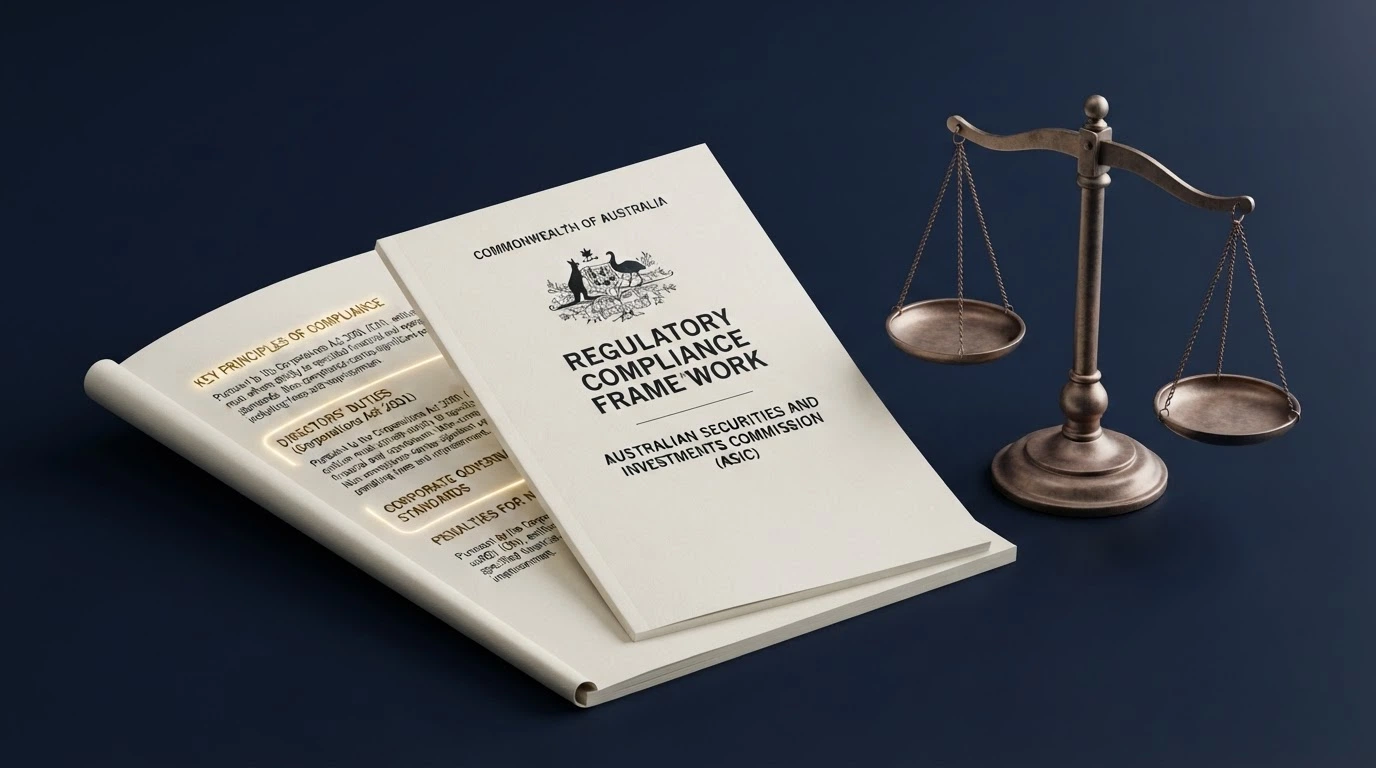
Online casino, online pokies and in-play sports betting are prohibited under the Interactive Gambling Act 2001; there is no licence for online casino anywhere in Australia. The law was passed in 2001 and substantially amended in 2017 to expand the prohibition to online in-play wagering and online wagering on the outcome of a sports event. The Interactive Gambling Amendment (Gambling Reform) Bill 2026 passed Parliament on 19 August 2026, with its measures commencing 1 January 2027.
The Interactive Gambling Act — why online casino is prohibited
The IGA makes it an offence for a provider to offer online casino, online pokies or in-play sports betting to a person in Australia. What is licensed is wagering on races and sport placed before the event begins, lotteries, and keno — through operators licensed by a state or territory. The licensing framework concentrates in the Northern Territory Racing and Wagering Commission, administered through Licensing NT. SportsBet, bet365, Ladbrokes, TAB and similar operators are licensed for pre-event wagering. None of them offers online casino, because online casino is not licensed.
The 2026 reform, commencing 1 January 2027, layers additional restrictions on the licensed wagering market. From that date, wagering advertising on television is capped at 3 ads per hour between 6am and 8:30pm, with a live-sport blackout running 15 minutes before to 5 minutes after each event. Athletes, celebrities and influencers are barred from promoting wagering products. Online wagering ads are limited to logged-in, verified 18+ users with an active opt-out. The same reform grants banks and payment providers express authority to block transactions to illegal gambling operators, which means a PayID or card transfer to an offshore casino is a transaction an Australian bank will have legal grounds to refuse.
The individual player is not prosecuted under the IGA; the Act targets the provider. The consequences for the player sit elsewhere: no Australian consumer protection, no ACMA money recovery, no BetStop coverage, no recourse if an operator refuses withdrawal or voids a win, and the possibility that the site is DNS-blocked with funds still on the account.
ACMA enforcement — 1,564 sites blocked and counting
ACMA has had 1,564 illegal gambling and affiliate websites blocked by Australian ISPs since its first blocking request in November 2019. More than 225 illegal services have withdrawn from the Australian market since enforcement was strengthened in 2017. In the April to June 2025 quarter alone, ACMA completed 20 investigations into 24 gambling sites, found 30 breaches of the IGA, issued 10 formal warnings, and referred 73 websites to ISPs for blocking. The most common breach type is providing a prohibited interactive gambling service, which accounted for 16 of the 30 findings in that quarter.
The formal warnings in Q2 2025 named specific operators. Chestoption was warned for Hell Spin and Vave. Sterplay Holding was warned for Casino Intense. Techno Wave Systems was warned for Bets.io. Hollycorn N.V. was warned for Neospin. Dama N.V. — the same licence group that operates Rocket Play — was warned for Casiny, Rocket Play and Level Up Casino. Gamusoft LP was warned for CSGOFast. Moontain Ltd was warned for Skin.Club. The warnings are public, and a player who searches the operator name against the ACMA register will find the enforcement record.
AUSTRAC and the anti-money-laundering obligations
AUSTRAC is Australia’s anti-money-laundering and counter-terrorism financing regulator, sitting alongside ACMA in the regulatory perimeter. The obligations it enforces apply to gambling service providers, including offshore operators that accept Australian customers: know-your-customer checks, transaction monitoring, suspicious-matter reporting. The framework adds a second regulatory hurdle beyond the IGA prohibition. A player who chooses an offshore operator should understand that AML obligations exist, that the operator’s compliance varies, and that the consequences of non-compliance sit with the operator rather than the player. No operator-specific AML data surfaced this round, so the framework stands qualitatively rather than as a per-operator score.
Licensed offshore versus genuinely legal — what a Curacao licence actually means
The Curacao licence is the dominant regime for Australian-facing casino sites, and it is not an Australian licence. MGA-licensed casinos largely do not accept Australian players because the IGA makes accepting Australian customers a breach of the Maltese framework’s responsible-gambling terms. The Curacao licence provides baseline regulatory oversight, dispute resolution, and a register where a licence number can be verified, but it does not provide Australian consumer protection. There is no Australian complaints body with jurisdiction over a Curacao-licensed operator. ACMA does not recover player funds. BetStop does not extend offshore. A player whose withdrawal is refused or whose winnings are voided has no Australian ombudsman to appeal to and no court with cheap access.
Fake licences are a known risk. Some operators display licence badges without holding the licence, and the only reliable check is the Curacao Gaming Control Board register itself. A player who wants to verify a Curacao licence should look up the licence number on the regulator’s site, not on the operator’s. The check takes minutes and removes one layer of risk.
Playing safely: what responsible gambling actually looks like offshore
About 2.1% of Australian adults — roughly 430,000 people — experience problem gambling, with the Australian Institute of Health and Welfare putting high-risk gambling at 1.8% in 2022. More than 500,000 Australian adults are high-risk gamblers, two-thirds of whom experience financial hardship or mental health conditions. Australians lose approximately A$31.5 billion to the gambling industry each year, a figure that exceeds the federal government’s aged-care spending.

Deposit limits and session controls you can set
Most offshore operators offer deposit caps, session timers, reality checks and take-a-break features at the account level. The tools are voluntary on the operator side and configurable by the player before depositing. Australian-licensed wagering services are required to offer a baseline of player-protection tools under the National Consumer Protection Framework, including deposit limits, activity statements and mandatory break reminders. Offshore operators are not bound by the same framework, and the tools they offer are the ones they choose to implement.
Setting a deposit limit before the first deposit is the one habit that consistently reduces loss. A player who sets a A$50 weekly limit and sticks to it loses no more than A$50 a week. A player who sets no limit will, on average, deposit until they run out of money or until they decide to stop.
BetStop — what it covers and where it falls short
BetStop is the National Self-Exclusion Register, live since August 2023. One registration excludes a person from every Australian-licensed online and phone wagering service. As at 31 July 2026, BetStop reported 67,480 registrations, of which 41,290 exclusions were still active. 80% of registrants are under 40, 46% under 30, and 39% chose a lifetime exclusion. Between the August 2023 launch and 1 December 2025, the register processed more than 53,000 registrations.
The gap is the offshore sector. BetStop binds Australian-licensed wagering services only; an offshore casino is not connected to the register and will continue accepting a self-excluded person’s money. A person who has registered with BetStop and then deposits at an offshore casino has not been excluded from that casino. The self-exclusion is a domestic mechanism, and the offshore product sits outside it.
From 1 January 2027, the 2026 reform strengthens the BetStop perimeter. Direct marketing of inducements is prohibited for 14 days after a customer signs up with a wagering provider, for 3 months after a person deregisters from BetStop, and indefinitely for customers identified as at risk of gambling-related harm. The change tightens the marketing surface around the registered player, but it does not extend the exclusion itself to offshore operators.
Where to get help — Australian support resources
The National Gambling Helpline is 1800 858 858, free, confidential, and staffed 24/7. Online chat and counselling are available through Gambling Help Online at gamblinghelponline.org.au. Gamblers Anonymous Australia runs peer-support meetings. Lifeline, on 13 11 14, provides crisis support. Online gambling accounts for about 45% to 50% of calls to counselling services such as Gambler’s Help, which means the support infrastructure is built for the problem most readers of this page may already be weighing. The help is free, confidential, and available regardless of where the gambling took place.
How we evaluated these operators
The operator set was sourced from research covering Australian-facing offshore casinos that pitch no-deposit bonuses to Australian players. Operators 1 and 2 (Rocket Play and SkyCrown) carry terms confirmed from operator bonus pages and ACMA enforcement records; operators 3 through 10 carry only offshore-status determination and AU-facing market positioning, since the verification queries failed during the research round and detailed terms did not surface.
Each operator was checked against ACMA enforcement records, official licence registers of claimed jurisdictions, and publicly available bonus terms pages. The ranking orders operators by fit to the page’s subject — no-deposit bonuses, AU audience reach — rather than by market share, and the criterion applied is bonus fairness assessed qualitatively: wagering burden, max cashout ceiling, validity window, and term transparency. No operator pays for inclusion or placement on this page.
Should you chase a $200 no deposit bonus? What the numbers say
A genuine $200 no-deposit bonus is exceptionally rare; the realistic ceiling is A$50 to A$100. When a large no-deposit bonus does appear, wagering runs 50x to 80x the bonus amount. Taking the middle of the realistic wagering band of 30x to 70x and the high end at 60x, a A$200 bonus requires A$12,000 in eligible turnover before any withdrawal unlocks. At a A$5 max bet per spin during bonus play, that is 2,400 spins. At a 5-second interval between spins, that is roughly 200 minutes of continuous play — about 3.3 hours — to clear the bonus, assuming the player wagers only the bonus amount and the full A$200 balance survives the wagering window intact.
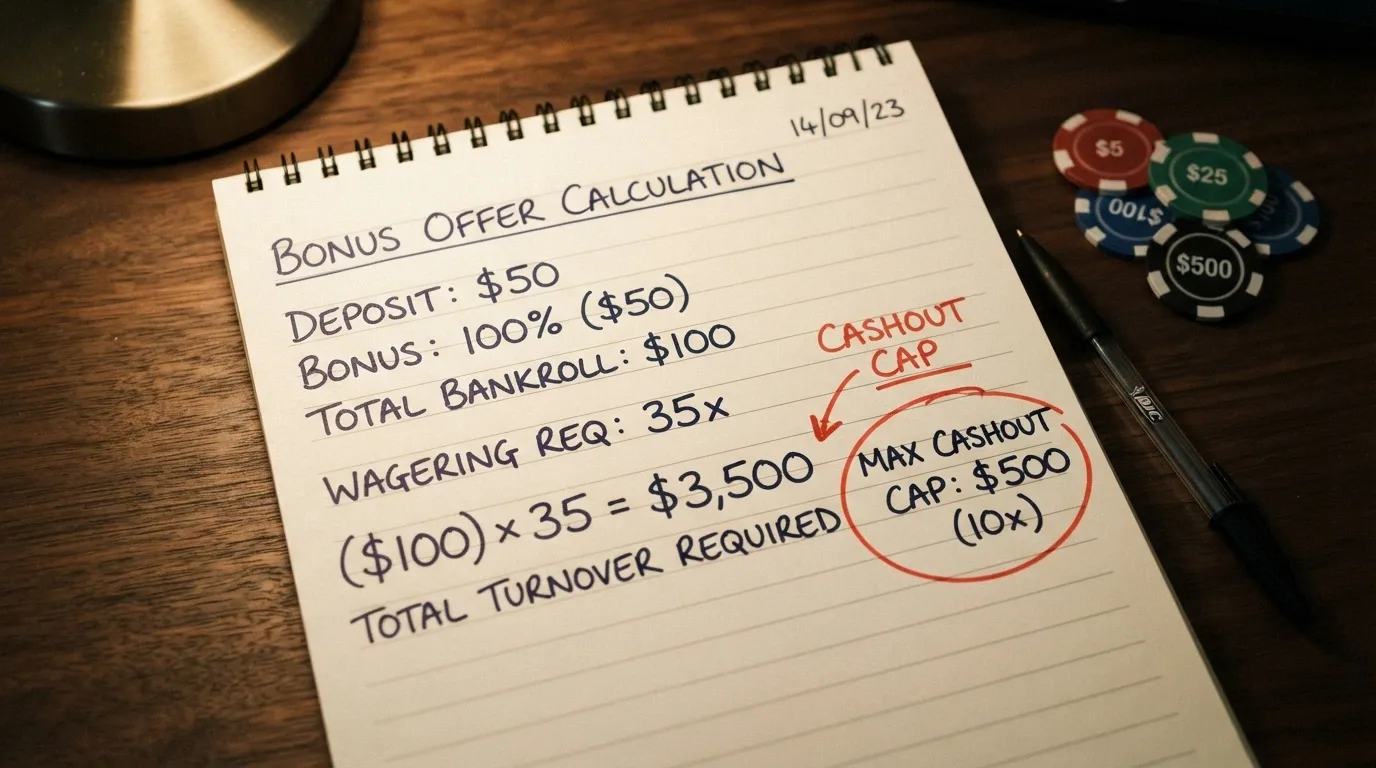
The expected withdrawal is the cashout cap, which sits at A$50 to A$200. The cap is the real ceiling, not the bonus amount. A player who clears A$12,000 in turnover at 60x wagering and hits the A$75 max cashout withdraws A$75 — not A$200. The arithmetic that the marketing invites — a A$200 bonus equals A$200 in winnings — does not survive the terms page.
The test for any no-deposit offer is the cashout cap first, the wagering second, the expiry third. A A$10 bonus at 60x wagering with a A$100 cashout cap is a better offer than a A$200 bonus at 80x with a A$50 cap. The figure on the headline is the marketing. The figure on the cap is the cash.
The decision is straightforward once the structure is clear. If the offer’s wagering, cap and expiry align with what the player can clear in the time and budget available, the bonus is worth claiming. If they do not, the player walks away with a smaller bonus or none at all. The $200 figure is a ceiling the marketing uses. The actual ceiling is the cashout cap, and a player who reads the terms page sees it first.
Frequently asked questions about $200 no deposit bonuses in Australia
Is a $200 no deposit bonus at an Australian online casino real, or is it a marketing figure?
The $200 figure is a marketing ceiling rather than a real cash offer for most Australian-facing casinos. A genuine standalone $200 no-deposit bonus is exceptionally rare; the realistic ceiling for a no-deposit bonus is A$50 to A$100, and the $200 label usually refers to a spin pack or a multi-deposit welcome package presented as a single number.
What wagering requirements should I expect on a $200 no deposit bonus in Australia?
Typical no-deposit bonus wagering runs 30x to 70x the bonus amount. On the largest genuine no-deposit bonuses that do appear, wagering climbs to 50x or 80x. A A$200 bonus at 60x wagering means A$12,000 in eligible turnover before any withdrawal unlocks, and the actual playthrough applies to the bonus amount only.
How much can I actually withdraw from a $200 no deposit bonus after meeting the wagering?
The max cashout cap, not the bonus amount, is the real ceiling. Most no-deposit bonuses cap withdrawal at A$50 to A$100, with larger spin packages extending to A$200. A player who clears the wagering and hits the cap withdraws the cap amount; the remaining bonus value is forfeited under the terms of the offer.
What happens to my money if an offshore casino is blocked by the ACMA?
ACMA blocks sites at the ISP level through DNS and routing restrictions. A block cuts access to the site but does not return funds. A player with money on deposit at a blocked site has no Australian complaints body to appeal to, and recovery depends entirely on the offshore operator’s willingness to process a withdrawal before or after the block takes effect.
Do I have to pay tax on gambling winnings from an online casino in Australia?
Gambling winnings are not assessable income for individual players under section 6-5 of the ITAA 1997, and losses are not deductible under section 8-1 — unless the person carries on a business of betting. The tax treatment applies regardless of whether the casino is licensed in Australia or offshore, since the player-side rules are not jurisdiction-specific.
What is the maximum I can bet per spin while using a no deposit bonus?
A typical max bet limit during bonus play is A$5 per spin, and exceeding it can void winnings outright. Some operators set the limit lower or higher — Rocket Play sets it at A$7.50, SkyCrown at A$5 — and the figure sits in the bonus terms. A player should know the limit before placing the first spin, since a single bet above the limit is enough to disqualify the bonus.
Prepared by the Fast Payout Casinos AU editorial staff.