
What an AU No-Deposit Pokies Bonus Is Really Worth in 2026
A no-deposit pokies bonus lands in front of you like a gift. A small credit appears in your balance or a string of spins arrives before you’ve paid a cent, and the marketing line — “try us for free” — is treated as a fact. Most of what that “free” actually delivers has been stripped out by the time you reach the screen that matters: the withdrawal page.

This page walks the AU no-deposit offer end to end. The arithmetic of a typical bonus. The legal shape of the market you are playing in. The ten operators currently dominating AU no-deposit search results. And the practical choices that follow — what each one is worth, who it suits, and which way the winds are blowing once the 2026 reform lands on 1 January 2027.
Verified 16 October 2026 · Operator licence status checked against the ACMA register and the Interactive Gambling Act 2001.
Table of Contents
- Why “No Deposit” Doesn’t Mean Free Money
- The Real Value of a No-Deposit Bonus in 2026
- Can You Actually Win Real Money Without Depositing?
- PayID Makes Deposits Instant — But the Legal Reality Hasn’t Changed
- Best No-Deposit Pokies Operators Compared: 2026
- New Pokies, New Offers: What’s Fresh in 2026
- Mobile No-Deposit Pokies: Your Browser Beats the App
- Are Online Pokies No-Deposit Bonuses Legal in Australia?
- When the Fun Stops: Responsible Play Resources
- How We Chose and Ranked These Operators
- What Australian Players Should Actually Do About No-Deposit Pokies
- Frequently Asked Questions
Why “No Deposit” Doesn’t Mean Free Money
“No deposit” describes the entry point, not the journey. The bonus itself is a marketing spend by an operator trying to turn you into a depositing customer; the real price is paid in the wagering requirement, the cashout cap, the expiry window, and the verification queue that follows. Roughly 80% of player friction on first withdrawals, by one industry estimate, traces back to leaving KYC until withdrawal time rather than completing it on day one. That friction is built in, not accidental.
The offers cluster into two shapes. Free spins, a fixed bundle at a fixed stake, usually A$0.10 to A$0.20 per spin. And a free chip, a small cash credit sitting in the bonus balance. Both arrive without a deposit. Both convert to withdrawable cash only after the operator’s terms have been satisfied — terms that, in the AU market, run on offshore rules with no Australian complaints body to appeal to.
What a No-Deposit Bonus Actually Means
A no-deposit bonus is credit or spins an AU-facing operator credits to your account without requiring a deposit first. In AU no-deposit search results, the typical offer is small: a free chip of A$5 to A$20 in equivalent value, or a free-spin bundle of 20 to 100 spins at A$0.10 to A$0.20 each. The total real value of a mixed no-deposit offer rarely clears A$25 once eligible titles, stake, and time window are factored in.
The catch lives three doors down from the offer page. The credit carries a wagering requirement — a multiple of the bonus, or of any winnings, that must be played through before a withdrawal is permitted. AU no-deposit offers in 2026 carry wagering in the 30x to 50x range. A A$20 chip at 40x means A$800 of qualifying play before any cash is yours. A A$8 spin win at 35x means A$280 of the same. And on top of that sits a cashout cap, typically A$50 to A$200 for AU offers, that floors how much of your winnings ever converts to a withdrawal at all.
Add an expiry window — most free-spin bundles expire in 3 to 14 days, with some offers giving as little as 24 hours — and the picture sharpens. The offer is engineered to be tried, not to be cleared.
Free Demo Pokies vs Real-Money No-Deposit Play
Demo mode is the closest thing to free the market has. Most AU-facing pokies — including the popular video-slot titles you see in offshore lobbies — can be opened in a “fun” or “demo” mode directly from a provider’s website or from inside an operator’s game window. No deposit. No registration. No win. No loss. The reels spin on the same math, the bonus features trigger the same way, and you can sit in that screen for an hour without anyone asking for your name.

Real-money no-deposit play is a different animal. Registration comes first, then identity verification (KYC) — and KYC is the gate that decides whether your withdrawal ever happens. The 80% friction figure above traces almost entirely to that one delay: a player who defers KYC until the moment they click “withdraw” finds a queue, not a payout. The screen looks the same; the rules have changed.
The question a player is actually asking, then, is what they want out of the session. Demo mode answers “I want to know what this game plays like” with zero cost and zero upside. A no-deposit offer answers “I want a chance at real money without putting my own on the line” — and the math decides whether that answer is honest or not.
How a No-Deposit Sign-Up Bonus Reaches Your Account
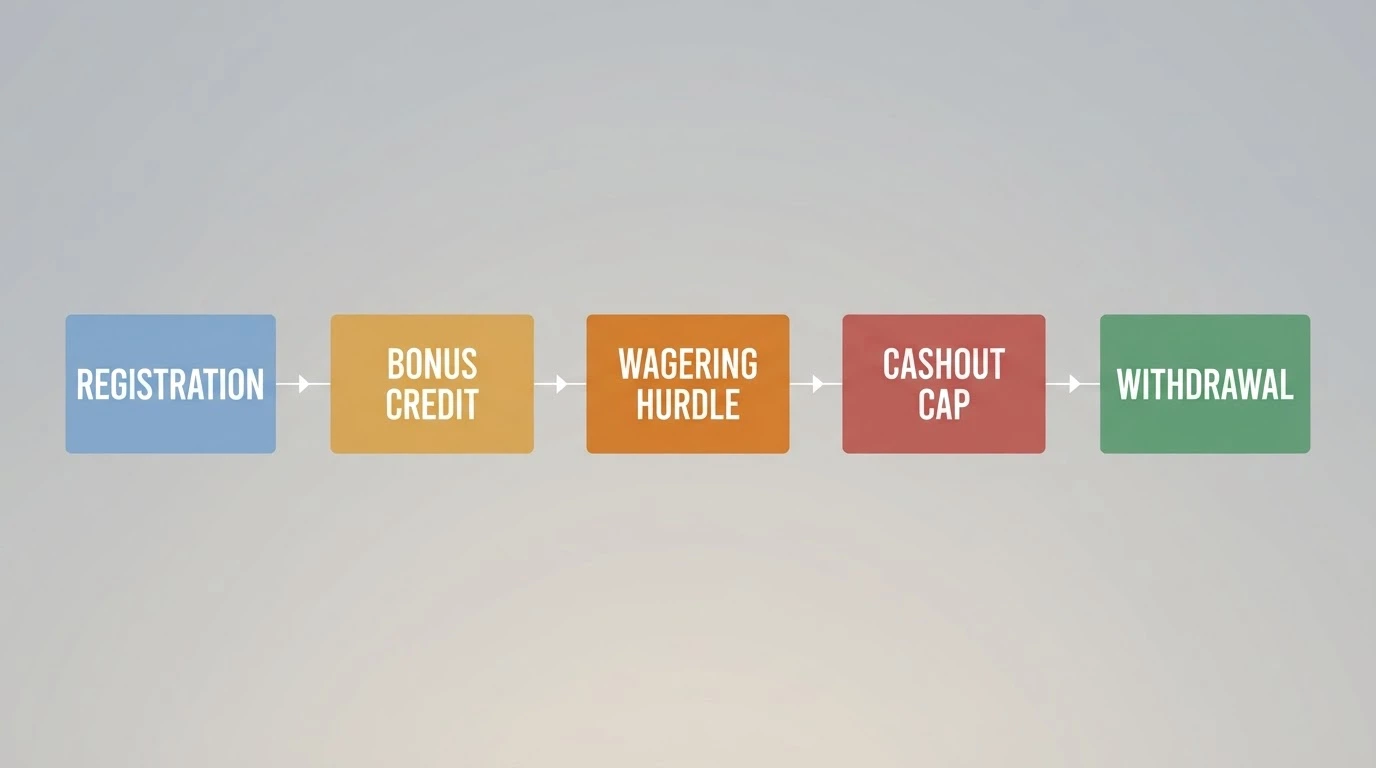
The claim path runs through five gates. First, registration — name, email, password, occasionally a phone number. Second, bonus credit — either automatic on sign-up or triggered by entering a code on the cashier page. Third, play on eligible titles, which the operator restricts to a short list of pokies rather than the full lobby. Fourth, wagering clearance — running the bonus through the required multiple on those titles before any withdrawal unlocks. Fifth, KYC verification — uploading ID, proof of address, and sometimes a payment-method check, with timing that decides whether the withdrawal arrives in three days or three weeks.

The order matters. Operators that credit the bonus automatically are easier to assess; you can see the bonus on the account page and read its wagering requirement before playing. Operators that require a code introduce an extra step where a missed code means no bonus at all. Either way, the gate that decides whether you see your money is KYC, and it is worth completing on day one — uploading your driver’s licence and a recent utility bill the moment the account is open, not the moment you click withdraw.
The Real Value of a No-Deposit Bonus in 2026
The headline figure on a no-deposit offer is the least informative number attached to it. A “A$20 bonus” reads as twenty dollars; a “50 free spins” reads as fifty goes at the reels. The cash that actually reaches a player after wagering, cap, and expiry is a smaller fraction of either, and the gap is what separates a marketing promise from an arithmetic result.

A worked example. Take a A$20 free chip at a 40x wagering multiple, played through at the typical A$0.10 to A$0.20 spin stake, with five seconds between spins. The required turnover is A$20 multiplied by 40, which is A$800 of qualifying play. At A$0.10 a spin that is 8,000 spins; at A$0.20 a spin it is 4,000. At five seconds per spin, the lower-stake path runs to 40,000 seconds, or roughly 11 hours of continuous play; the higher-stake path to 20,000 seconds, or about five and a half hours. That is the time cost of clearing the bonus on its own terms — assuming every spin goes in, every spin counts toward wagering, and nothing on the eligible-title list breaks the assumption.
Spin values for free spins in this market are most commonly A$0.10 or A$0.20 each. Wagering on free-spin offers is typically applied to winnings, not to the face value of the spins themselves. A modest A$8 spin win at 35x wagering produces A$280 of turnover, on which a A$50 to A$100 cashout cap then sits — meaning even a player who runs the math correctly and clears the bonus may convert a balance that looks like A$300 into a withdrawal of A$100 or less.
The table below shows the typical shape of an AU no-deposit offer in 2026. The numbers are market-level norms, not per-operator guarantees; per-operator terms for the operators later in this page were not verifiable this run.
| Bonus Type | Typical Value (AUD) | Wagering Multiple | Max Cashout (AUD) | Typical Expiry |
|---|---|---|---|---|
| Free spins bundle | 20–100 spins (A$0.10–A$0.20 each) | 30x–50x on winnings | A$50–A$100 | 3–14 days (some 24 h) |
| Free chip / bonus cash | A$5–A$20 | 30x–50x on bonus amount | A$50–A$200 | 3–14 days |
Two things stand out from that table. First, the cashout cap is the binding constraint on upside; wagering clears the path, but the cap decides how much of what is left can leave. Second, the expiry window puts the wagering target on a clock — and the clock starts running the moment the bonus credits, not when you start playing.
Free Spins No Deposit: Spin Count, Spin Value and the Catch
Free-spin bundles are the most common AU no-deposit shape, and the one the marketing spends the most energy dressing up. “50 free spins” reads as a present. What it actually is, in plain numbers, is 50 spins at A$0.10 to A$0.20, which is a face value of A$5 to A$10 of slot play. The expected return from that, before any cap or wagering, depends on the title’s RTP — and the title is the operator’s choice, not yours.
The catch runs in two stages. Wagering applies to winnings, not to the spin value: any cash the spins produce must be played through 30x to 50x before it is withdrawable. A small win that looks like A$10 on the balance becomes A$300 to A$500 of required play. And then the cashout cap, typically A$50 to A$100 for free-spin offers, sits on top of the wagering — so the player who runs the bonus to ground may find a balance larger than the cap waiting at the withdrawal page, and the cap is what gets paid out, not the balance.
The eligible-title list adds a third constraint. Operators rarely make their full lobby available to a no-deposit bonus; the offer is usually locked to one or two named pokies, often a popular high-RTP slot, sometimes a newer title the operator wants exposure for. That restriction is a marketing choice, not a regulatory one — and it means the player’s choice of game is removed for the duration of the bonus.
Free Chip / Free Money Bonuses: A$5–A$25 That Isn’t Yours Yet
A free-chip offer looks like cash in the balance. A$10, A$15, sometimes A$20 sitting next to your real-money balance — and a player who doesn’t read the small print may well spend the chip on any game in the lobby before realising that the chip has its own wagering attached.
The mechanics differ from free spins in one key respect: wagering applies to the chip amount itself, not to winnings only. A A$20 chip at 40x wagering is A$800 of required play. A A$10 chip at 50x is A$500. The arithmetic is the same shape as the free-spin math but starting from a smaller stake, and on a wider eligible-title list — usually any pokie in the lobby, sometimes with table games and live casino excluded.
Cashout caps on free-chip offers sit higher than on free spins — typically A$50 to A$200, with A$100 a common middle. A player who clears the wagering on a A$20 chip and lands a balance of A$180 may withdraw A$180 if the cap is set at A$200; the same player on a free-spin offer with a A$100 cap walks away from A$80 of cleared winnings.
The verdict on free chips is closer than the verdict on free spins. The wagering target is heavier in absolute terms, but the eligible-title list is broader and the cashout cap is more generous. The deciding variable is what the player wants to play, because the offer locks the answer.
When the Wagering Requirement Is Zero: Wager-Free No-Deposit Offers
A wager-free no-deposit offer is the cleanest deal the AU market puts in front of a player. What the spins win is the player’s, with no playthrough, no multiple, no qualifying-bet loop. The cap still applies — most wager-free offers carry a cashout ceiling in the A$50 to A$100 range — but the path from win to withdrawal is a straight line.
The rarity is the point. Operators do not give away withdrawable cash without extracting something else in return, and a wager-free no-deposit offer is, by definition, an offer that expects the player to deposit afterwards to extract any further value. When an operator does run one, it is usually a short-window promotion rather than a permanent feature, and it is usually tied to a specific title or a specific sign-up path.
The verification step is the same as for any other offer, and it is where most wager-free NDB claims run aground. The T&Cs may advertise “no wagering” while quietly attaching conditions elsewhere — a maximum stake per spin during the bonus period, a withdrawal-only-on-deposit clause, an excluded-games list for the wager-free portion. Reading the full terms before claiming is not paranoia here; it is the only way to confirm the headline is real.
Can You Actually Win Real Money Without Depositing?
Yes — and the amount that reaches a bank account is a fraction of what the screen shows during play. A player who claims a no-deposit offer, clears the wagering on eligible titles, passes KYC, and falls inside the cashout cap can withdraw real money. The number that arrives is bounded by the cap, by the wagering the player had to clear to reach it, and by the offshore reality of who is paying out.
What the screen does not show is the filter between “balance” and “withdrawable cash.” A player may have a A$240 bonus balance after a lucky run, hit the wagering target, attempt the withdrawal, and have A$100 paid out — the cap, not the balance. A player may pass wagering with a A$60 balance, attempt the withdrawal, and find a KYC re-check needed before funds release, with the verification queue adding days to a process the marketing material called “instant.”
The mechanics are honest in the sense that every condition is published; the terms-and-conditions page of any AU-facing no-deposit operator spells the wagering, the cap, the expiry, and the verification path out in plain language. The friction is in reading them, and in the order in which the conditions bite.
Real-Money Aussie Pokies Titles You Can Play on a No-Deposit Bonus
The eligible-title list on an AU no-deposit offer is the operator’s, not the player’s. Operators restrict no-deposit play to a short list for two reasons: cost control, since a high-RTP, low-volatility slot is cheaper to clear than a high-volatility jackpot title, and product promotion, since a new release gets exposure to every player who claims the bonus. The result is that the same handful of pokies — popular medium-to-high RTP video slots, sometimes a newer release — show up across most no-deposit eligible lists in the AU market.
The restriction matters for the player in two ways. First, the wagering is run on the math of the eligible title, not the math the player might prefer; a high-volatility pokie plays very differently from a low-volatility one, and the eligible list may not include the latter. Second, the bonus-value calculation depends on the title’s RTP, which most no-deposit T&Cs do not publish; a player running the math on “50 free spins” without knowing the underlying game is making a calculation without one of its inputs.
Per-operator eligible-title lists for the operators later in this page were not confirmed in this research, so the specifics of which pokies each one names remain unverified. The market-level pattern — short eligible lists, popular and new-release heavy, with the wagering applied to winnings on those titles — is consistent across the comparison sites reviewed.
From Bonus Win to Bank Balance: The Withdrawal Path
The path from a no-deposit win to a bank balance runs through five gates, and most players meet at least one of them unprepared.
Gate one is wagering clearance. The bonus must be played through the required multiple on eligible titles before any withdrawal unlocks. A player who skips this gate by attempting to withdraw before the wagering target is met gets the withdrawal declined.
Gate two is the cashout cap. The cap is applied at the moment of withdrawal, not at the moment of win. A balance of A$240 cleared at a A$100 cap pays out A$100.
Gate three is KYC verification. The operator asks for ID (driver’s licence or passport), proof of address (utility bill or bank statement, typically under 90 days old), and sometimes a payment-method check (a photo of the card used, with middle digits obscured). Operators that handle KYC efficiently run the check in hours; operators that don’t run it in days, and that is where the eight-in-ten friction figure originates.
Gate four is the deposit question. Some offshore operators will not release a no-deposit win to a player whose account has never made a deposit; the player is asked to make a small “verification deposit” before the withdrawal is processed. This is a market pattern, not an AU regulatory requirement, and it varies operator to operator. The T&Cs spell it out — usually in the bonus-terms section rather than the banking section — but it is one of the more common sources of reader confusion.
Gate five is the payment-method check. The withdrawal method must match the deposit method on most operators; a player who registered without depositing has no deposit method on file, and the operator may default to bank transfer, which adds days and may require additional verification.
The path is not impossible. Thousands of AU players run it cleanly every year. The path is also not the marketing’s “instant” — and a player who plans for the gates, instead of treating them as surprises, is the player who reaches the bank balance.
PayID Makes Deposits Instant — But the Legal Reality Hasn’t Changed
PayID is the AU banking system’s instant-transfer rails: a phone number or email address resolves to a bank account, and the money arrives in seconds. For AU-facing pokies deposits, it is faster than card, simpler than BPAY, and built on infrastructure every Australian already has. PayID deposits at AU-facing operators commonly clear in seconds, often under one minute, which is the single feature that has moved PayID from “alternative” to default for many AU players.
The legal framing around PayID is unchanged. PayID is a payment rail, not a licence. An operator accepting PayID is doing what an operator accepting a card or a bank transfer does — taking money. Whether that operator is allowed to offer online pokies to a person in Australia is a separate question, and the answer is in the Interactive Gambling Act 2001: no, except where the operator holds an Australian licence for the specific product being offered, and no such licence exists for online pokies. PayID’s speed is a feature. It is not a shield.
PayID No-Deposit Bonus Claims: How the Flow Works
The claim path for a PayID-ready operator’s no-deposit bonus runs like every other no-deposit claim: register, claim, play, verify. PayID enters the picture later — when the player is ready to deposit, or when a player wants to withdraw a no-deposit win and is asked to deposit first to enable the payout.
The PayID setup itself is straightforward. The player opens the cashier page, selects PayID, and enters the operator’s PayID handle (usually an email or a phone number published on the deposit page). The player’s banking app prompts for the amount; AU-facing operators typically set the minimum PayID deposit at A$10 and per-transaction maximums at A$5,000 to A$10,000. The transfer clears in seconds. The bonus balance updates within minutes.
The PayID setup is not the no-deposit claim path — the claim path runs through registration and bonus credit, not through the cashier. PayID is the deposit rail the player will use later, when the bonus is cleared and a real-money session begins.
Why Australian Banks Block Some PayID Gambling Payments
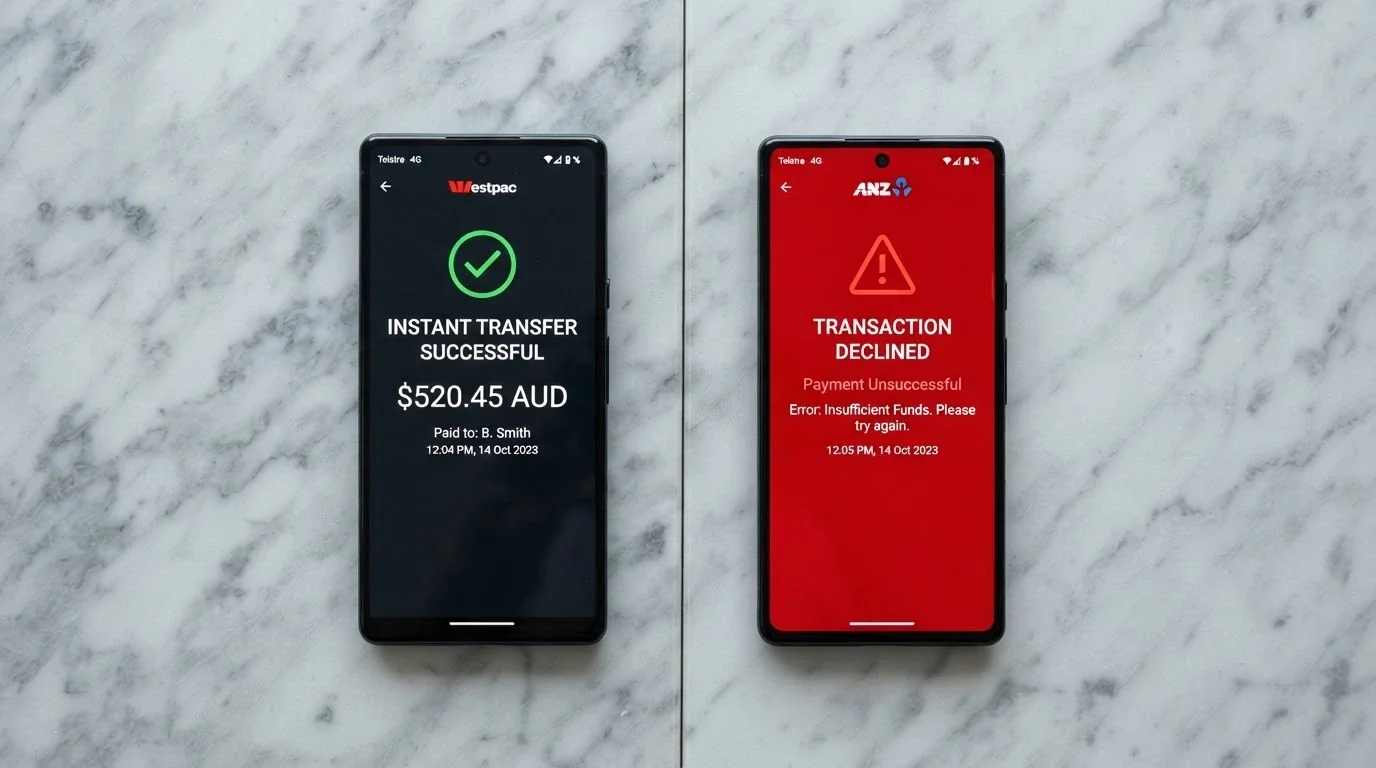
Your bank can see where the money is going. AU banks use merchant-category coding to classify transactions, and offshore-gambling merchant categories are flagged — differently by different banks. CommBank has been the most visible blocker, with reports of offshore-gambling PayID payments filtered or delayed; Westpac’s pattern is similar. NAB and ANZ show lower reported blocking rates than CommBank and Westpac, but the framing there is “lower reported,” not absent.
Daily PayID transfer limits at most AU banks sit in the A$1,000 to A$5,000 range, with some banks willing to raise limits on request. The limits are an individual cap, not a gambling-specific block — but for a player running a larger deposit session, the limit can be the practical constraint.
The rules tighten further from 1 January 2027. The Interactive Gambling Amendment (Gambling Reform) Bill 2026 — introduced on 2 July 2026, passed the House on 18 August 2026 and the Senate on 19 August 2026 — gives AU banks and payment providers express statutory authority to block transactions to illegal gambling operators. The current bank-blocking behaviour is bank policy; from that date it becomes, in addition, a federal mandate. PayID transfers to AU-licensed wagering operators will continue to clear; PayID transfers to offshore casinos will face the legally supported default of a block.
Best No-Deposit Pokies Operators Compared: 2026
Ten operators dominate AU no-deposit search results in 2026. The table below shows them by name and licence status. Every one of them is offshore-licensed — none holds an Australian online casino licence, because no such licence exists. Per-operator no-deposit bonus terms (bonus amount, free-spin count, wagering, cashout cap, expiry, eligible titles) were not verifiable in this run; what is verifiable is that each of them reaches AU traffic for a product Australian providers are prohibited from offering.
| Operator | Licence / Legal Status in Australia |
|---|---|
| Skycrown | Offshore / not AU-licensed for online pokies |
| BitStarz | Offshore / not AU-licensed for online pokies |
| 7Bit Casino | Offshore / not AU-licensed for online pokies |
| KatsuBet | Offshore / not AU-licensed for online pokies |
| Mirax Casino | Offshore / not AU-licensed for online pokies |
| Stay Casino | Offshore / not AU-licensed for online pokies |
| Uptown Pokies | Offshore / not AU-licensed for online pokies |
| Aussie Play | Offshore / not AU-licensed for online pokies |
| Ripper | Offshore / not AU-licensed for online pokies |
| FairGO | Offshore / not AU-licensed for online pokies |
Three things the table does not show matter more than what it does. None of the operators has signed up to BetStop, Australia’s national self-exclusion register, because BetStop binds Australian-licensed services only. None of them is covered by an Australian complaints body — there is no local ombudsman to appeal to if a withdrawal stalls. None of them offers the consumer protections Australian-licensed wagering carries, from credit-card and crypto bans to problem-gambling identification duties. The product is pokies; the protection is none.
Skycrown
Skycrown appears repeatedly in AU no-deposit guides, anchored by an offshore licence rather than an Australian one. The brand has been a recurring name in 2026 search results for AU players searching for no-deposit pokies, and that presence — not any specific bonus we can verify — is what earns it a place here.
What a player can verify before claiming: the licence displayed in the site footer, the bonus T&Cs page, the eligible-title list for the specific promotion being claimed, and the cashout-cap wording. The market-level norms — 30x to 50x wagering, A$50 to A$200 cashout caps, 3 to 14-day expiry windows — apply broadly but not uniformly, and Skycrown’s actual terms are what the T&Cs page says, not what a search result reports.
For a player who has already settled the offshore question and is comparing specific bonus terms across multiple brands, Skycrown is one of the names on the list. For a player looking for AU consumer protection, Skycrown offers none.
BitStarz
BitStarz is one of the more visible names in AU no-deposit roundups, recurring across listicles with a crypto-friendly banking reputation. The brand reaches AU traffic through affiliate channels rather than AU-facing advertising; per-operator bonus specifics were not verified in this run.
The crypto-friendly angle is worth pausing on. Australia’s credit-card and crypto ban for online wagering took effect on 11 June 2024; an operator whose reputation is built around crypto deposits is, by construction, not targeting AU-licensed rails. That targeting is a signal about the operator’s audience — an offshore, crypto-comfortable player — rather than a recommendation. AU players who want crypto rails will find them; AU players who do not should treat the crypto-friendly branding as part of the offshore profile, not a feature in isolation.
BitStarz’s value to the player who values brand longevity over headline bonus size is the public-complaint trail an established operator carries. Reading that trail before claiming is more informative than reading the bonus T&Cs.
7Bit Casino
7Bit Casino surfaces in AU no-deposit roundups with a retro-themed brand identity and an offshore licence. The AU-facing presence is built through affiliate content rather than direct marketing, and per-operator bonus specifics were not confirmed in this run.
The brand’s positioning is the long-tail of the AU NDB market: not the largest offer, not the most established reputation, but a recurring name in guides that drives enough player traffic to keep the search results updated. A player who has seen 7Bit on three different “best of” lists and is curious enough to click is the target reader; whether the specific bonus on offer matches the marketing surrounding it is a question the T&Cs page answers, not the listicle.
7Bit’s place in search results is as a recurring third or fourth comparison brand for a player cross-checking T&Cs. The retro theming is decoration; the licence status is the same as every other operator on this page.
KatsuBet
KatsuBet’s name gives away its positioning: Japanese-themed branding on an offshore-licensed platform. The AU presence is built through the same affiliate-listicle channel as the rest of this list, and per-operator NDB specifics were not verifiable in this run.
The brand competes for a player who has already decided to claim an AU no-deposit bonus and is now choosing between operators whose terms they cannot verify from a search-results page alone. KatsuBet’s value proposition is the same shape as everyone else’s on this list — offshore licence, no AU protection, marketing-led bonus terms — with the visual identity as the only differentiator.
KatsuBet competes on aesthetic grounds for a player who has decided to claim and is choosing on look. For a player who is still in the comparison phase, the licence status and the inability to verify the bonus terms are the deciding factors, and those are uniform across the list.
Mirax Casino
Mirax is a newer entrant among the brands that surface in AU no-deposit search results, with an offshore licence and a presence built through affiliate marketing channels. The shorter operating history means less public complaint data and less brand-trust evidence for a player comparing options; the newer positioning means more aggressive bonus terms, which can cut either way.
A newer brand’s no-deposit offer is more likely to feature generous headline numbers — the operator is buying market share, not defending it. Generous headline numbers are also more likely to come with strings a player doesn’t see until the T&Cs page. The trade-off is real, and it is a trade-off the operator doesn’t surface in the marketing.
Mirax is the newer-name trade-off: more aggressive headline bonuses against a shorter public-complaint track record. A player prioritising payment history over bonus generosity will find older brands more defensible; a player reading the T&Cs carefully will find Mirax’s terms clear.
Stay Casino
Stay Casino appears in AU no-deposit search results with the offshore-licence profile common to this list and a brand identity built around longer-term player retention rather than one-off bonus claims. Per-operator bonus specifics were not verifiable in this run.
The retention-focused positioning is worth noting because it shifts the operator’s incentive: a one-off NDB claim from a player who never deposits is a marketing loss the operator has already absorbed; a player who claims, plays, and deposits is the actual target. The T&Cs on a retention-focused operator tend to be more generous on the deposit side and tighter on the no-deposit side — a pattern, not a rule.
Stay Casino’s retention framing shifts the operator’s incentive in ways that tighten no-deposit terms relative to deposit terms. A player reading the bonus T&Cs in full will see the asymmetry; a player reading only the headline will not.
Uptown Pokies
Uptown Pokies is one of the more explicitly AU-targeted brands on this list — the name tells you the audience — but the targeting is branding, not licensing. The operator is offshore-licensed; AU players are the marketing target because AU is where the traffic is. The Interactive Gambling Act 2001 prohibition applies regardless of how AU-flavoured the site looks.
Uptown’s AU-facing branding means the site’s payment pages, support hours, and promotional calendar are built around Australian time zones and Australian public holidays. That is a convenience. It is not a regulatory status, and it is not a substitute for an Australian licence.
Uptown Pokies is for the AU player who values AU-timezone support and AU-friendly payment pages over offshore brand reputation. The branding is AU-flavoured; the licence is not.
Aussie Play
Aussie Play is the most explicitly AU-named brand on the list — the name says it twice — and is also one of the more aggressive in its AU-facing marketing through affiliate channels. The offshore licence is real; the AU branding is a positioning choice.
The “Aussie” framing is worth pausing on. A brand named for its target market is signalling that the marketing is built around AU players, including AU-friendly payment methods, AU-timezone support, and bonus terms calibrated to AU-facing competitors. It is not signalling that the operator holds an Australian licence, because no Australian online casino licence exists.
Aussie Play’s brand name does the marketing work up front, but the offshore licence does the regulatory work. The two do not match, and a player who treats them as matching is a player who has not read the T&Cs.
Ripper
Ripper carries AU slang in its branding — the name itself is the marketing — and reaches AU no-deposit traffic through the same affiliate-listicle channel as the rest of this page. Per-operator bonus specifics were not verifiable in this run.
The slang-led branding is part of the AU-facing targeting pattern: the brand wants an AU player to feel at home on the site before reading the T&Cs. The T&Cs themselves are not different from any other offshore operator’s — same offshore licence, same wagering requirements in the market-norm range, same cashout caps, same KYC verification queue.
Ripper’s AU-slang branding is part of the AU-facing targeting pattern, and the operator offers the same offshore-licence profile as every other brand on this list. The promise is in the name; the protection is not.
FairGO
FairGO closes the list — the name is a promise, and the brand’s AU-facing marketing leans into that promise heavily. Offshore-licensed, AU-targeted, with per-operator bonus specifics not confirmed in this run.
The “fair go” framing is a positioning choice that resonates with the audience it is reaching, and it is also the most direct test of whether the marketing matches the operating reality. A fair-go operator with transparent T&Cs, fast withdrawals, and reachable support is one thing; a fair-go operator with the same offshore-licence profile as the rest of this list is another. The player who treats the brand promise as a starting hypothesis rather than a fact is the player who reads the T&Cs before claiming.
FairGO’s name is a positioning choice, and the AU-facing marketing leans into it. A player who treats the promise in the name as a hypothesis — and reads the T&Cs and the withdrawal queue before forming a final view — is the player who reaches an honest verdict.
New Pokies, New Offers: What’s Fresh in 2026
AU no-deposit offers rotate faster than almost any other promotion in the iGaming market. A bonus listed on a comparison site in January can be replaced by March, replaced again by June, and gone entirely by September — often with the brand still active, just running a different headline. The reasons are partly commercial (operators refresh bonus terms to keep affiliate content fresh), partly competitive (one brand’s generous offer gets matched and undercut by the next), and partly driven by payment-rail changes (PayID adoption, bank-blocking behaviour, and the 2027 reform timeline all change what an operator can profitably offer).
The signal a player should read is not the freshness of the offer itself but the freshness of the operator’s T&Cs page. A brand that updated its bonus terms last week is a different risk profile from one whose terms page has been unchanged since 2024. The 2027 reform is the bigger disruption: when banks gain express statutory authority to block payments to illegal gambling operators, the offer economics on the offshore side change in ways that will likely accelerate the rotation.
New PayID Pokies with No-Deposit Bonuses
PayID adoption among AU-facing operators has moved from “alternative” to “default” over the past two years. The instant-clear speed is the feature; the AU-bank integration is the structural reason. PayID deposits at AU-facing casinos commonly clear in seconds, often under one minute, with minimum deposits around A$10 and per-transaction maximums at A$5,000 to A$10,000.
New operators launching into the AU market are almost universally PayID-ready from day one; older operators are catching up. The pairing of “new operator” and “PayID + no-deposit offer” is a recurring search-result pattern, and the player evaluating it should treat the PayID speed as a payment-rail feature, not a regulatory signal. PayID does not make the operator AU-licensed; it makes the operator’s deposit queue shorter.
The verification before claiming is the same as for any other operator on this list: read the T&Cs, confirm the wagering multiple, the cashout cap, the eligible titles, the expiry, and the offshore licence status. PayID is the rail; the offer is the offer.
Mobile No-Deposit Pokies: Your Browser Beats the App
Almost no AU-facing no-deposit operator maintains a native iOS or Android app. The Google Play Store and the Apple App Store both enforce policies against real-money gambling apps in jurisdictions where the product is prohibited — which for AU-facing offshore pokies operators means their apps, where they exist, are sideloaded rather than store-distributed, and the user-experience cost of a sideload is high enough that most operators don’t bother.
The browser experience is better for it. AU-facing no-deposit pokies are built as instant-play HTML5 sites, optimised for mobile browsers first and desktop second. The reels spin the same way in Safari on an iPhone as in Chrome on a laptop; the bonus-trigger animations are the same; the cashier page is the same. The only thing a native app would add is a home-screen icon and a slightly faster launch — neither of which justifies the sideload risk.
A player playing on a phone should treat the browser as the intended experience. Bookmark the cashier page rather than the lobby, because the cashier is where the deposit-then-withdraw sequence lives. Complete KYC on the phone on day one — uploading a photo of a driver’s licence is faster from a phone camera than from a desktop scanner. The mobile browser is the platform the operators have built for; the native app is the platform nobody has built.
Are Online Pokies No-Deposit Bonuses Legal in Australia?
The short answer is the provider is breaking Australian law by offering them. The Interactive Gambling Act 2001 makes it an offence for a provider to offer online casino games, online pokies, or in-play sports betting to a person in Australia. No Australian online casino licence exists. The Australian Communications and Media Authority — the ACMA — enforces the prohibition by investigating complaints, issuing formal warnings, running civil-penalty proceedings, and directing Australian ISPs to block illegal sites. Since the ACMA’s first blocking request in November 2019, 1,564 illegal gambling and affiliate websites have been blocked at the ISP level, and more than 225 illegal services have withdrawn from the Australian market since enforcement was strengthened in 2017.
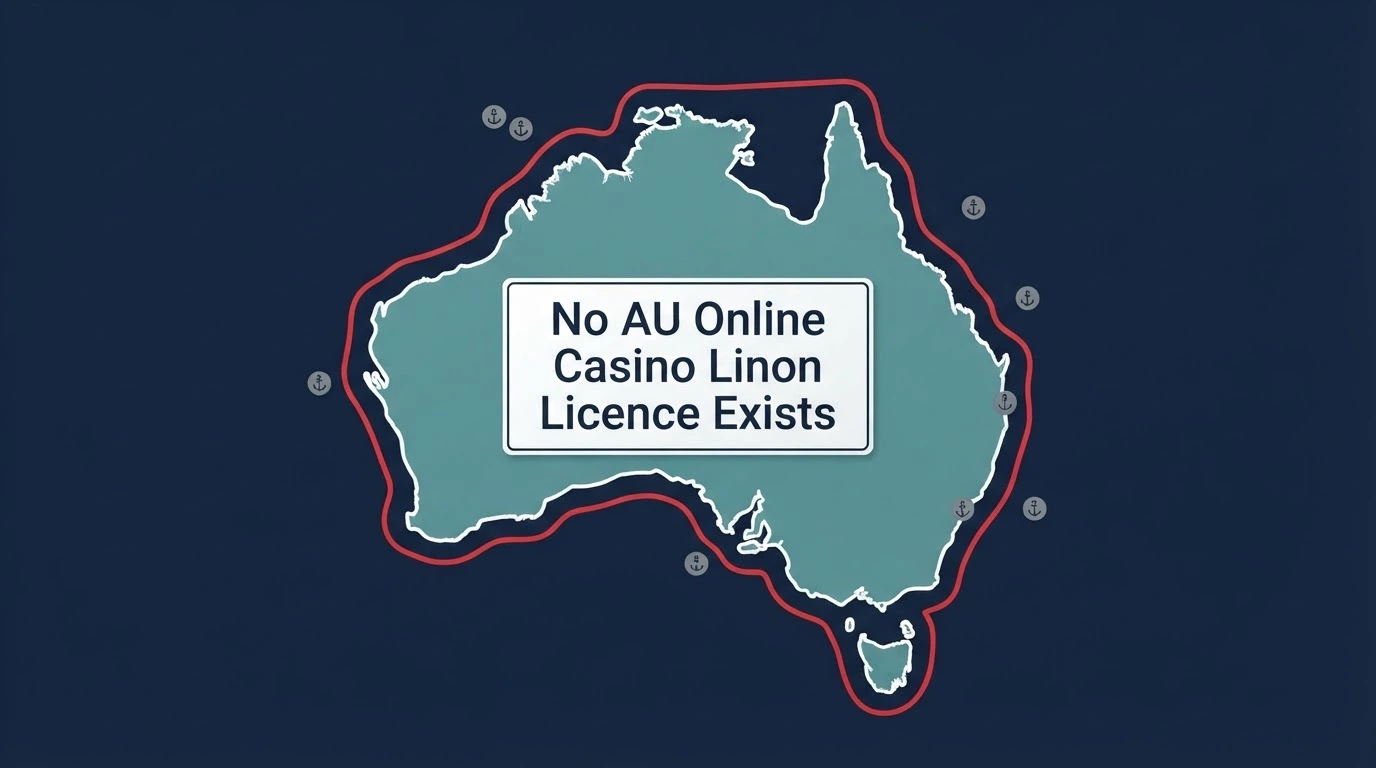
The law targets the provider, not the player. An Australian who plays at an offshore casino is not prosecuted. What the player loses is the consumer protection an AU-licensed operator would carry: no BetStop coverage for the offshore site, no domestic complaints body, no local enforcement if a withdrawal stalls, and no guarantee the site will still be reachable next week. The product itself — online pokies to a person in Australia — is the prohibited service.
Licensed AU Wagering vs Offshore Casino: Know the Difference
One has an NT licence sign on the door, the other has neither a local licence nor a local complaints body — and the product is different too. Licensed Australian wagering — sports betting, racing, lotteries, keno — is run by operators holding state or territory licences, most commonly through Licensing NT and the Northern Territory Racing and Wagering Commission. The product range is narrow on purpose: wagering on races and sport before the event begins, plus lotteries and keno. Online pokies and online casino games are not in that range, because they are not in the licensable product set.
The protections are the reason for the difference. AU-licensed operators must enforce the credit-card and crypto ban that took effect on 11 June 2024. They must connect to BetStop — the national self-exclusion register that, to 31 July 2026, has recorded 67,480 registrations with 41,290 still active. They must offer customer-set deposit limits, activity statements, and problem-gambling identification duties that the offshore market does not match.
An offshore casino offering pokies to an Australian player is offering a prohibited interactive gambling service. The brand may hold a Curaçao or Anjouan licence; that licence authorises it to operate in its own jurisdiction, not in Australia. The product gap — online pokies, here, now — is the gap no licence bridges.
What the 2027 Reform Changes for Australian Players
From 1 January 2027, the net tightens. The Interactive Gambling Amendment (Gambling Reform) Bill 2026 was introduced into Federal Parliament on 2 July 2026, passed the House on 18 August 2026, and the Senate on 19 August 2026. The reforms take effect at the start of 2027 and reach into advertising, banking, inducements, and product scope.
On advertising, the reform caps wagering advertising at three ads per hour between 6:00 am and 8:30 pm, imposes a live-sport blackout from 15 minutes before a live sporting event until 5 minutes after it ends, bans the broadcasting of sporting odds outright, bars athletes, celebrities, and influencers from promoting wagering products, and restricts wagering advertising in sports venues and on player and official uniforms.
On banking, the reform gives AU banks and payment providers express statutory authority to block transactions to illegal gambling operators. PayID transfers that are currently sometimes blocked become, from that date, blocked by default where the recipient is an illegal gambling service. The current bank-blocking behaviour is bank policy; the 2027 change makes it a federal mandate.
On inducements, the reform bans direct marketing of inducements for 14 days after a customer signs up, for three months after a customer deregisters from BetStop, and indefinitely for customers identified as at risk of gambling-related harm. Wagering companies must identify customers showing signs of problem gambling and stop sending them inducements.
On product scope, the reform prohibits foreign-matched lotteries and online keno, with tighter restrictions on trade-promotion gambling services. A new national wagering advertising opt-out register — AdStop — will be administered by the ACMA and funded by a cost-recovery levy on wagering companies.
The combined effect for an AU player: the inducements that drove them to a no-deposit offer in the first place become harder to send; the payment rails they used become harder to clear; and the products some operators cross-sold become prohibited. The legal framing on no-deposit pokies does not change — it was already prohibited — but the friction around the offshore market gets heavier.
When the Fun Stops: Responsible Play Resources
No-deposit bonuses lower the barrier to entry. A player who would not have deposited $20 to try a new casino will claim a $20 free chip or 50 free spins, because the cost is zero. That is exactly why the exit door matters more in this market than in any other. The low friction that makes a no-deposit offer attractive is the same low friction that accelerates the path from “just trying it” to “where did the month go.”
The Australian context is not soft on this. About 2.1% of Australian adults experience problem gambling — roughly 430,000 people — and the Australian Institute of Health and Welfare put high-risk gambling at 1.8% in 2022. These figures pre-date the no-deposit era’s full AU-facing impact; the AIHW is the source, the year is the survey’s, and the order of magnitude is what a reader should hold onto.
The help infrastructure is free, confidential, and available around the clock. The National Gambling Helpline is 1800 858 858. Gambling Help Online — gamblinghelponline.org.au — provides online chat and counselling. Both services are free and confidential, and both are reachable from anywhere in Australia.
BetStop, the national self-exclusion register that went live in August 2023, has recorded 67,480 registrations to 31 July 2026, with 41,290 exclusions still active. 78% of registrants are under 40; 38% have chosen lifetime exclusion. The register binds AU-licensed wagering services only — an offshore casino is not connected to BetStop and will still accept a self-excluded player who seeks it out.
Setting Limits and Spotting the Signs Early
The practical steps a player can take fall into four buckets, and the order matters.
- On AU-licensed wagering services, set deposit limits and time-out periods at the account level on day one, before the first deposit, not after the first session. Activity statements show the running total; reading them is the cheapest signal a player has.
- At offshore casinos, BetStop coverage does not apply. A player who has registered with BetStop is still reachable by offshore operators, which means self-exclusion from offshore requires either not opening an account or contacting each operator directly. The friction is higher; the resolve required is the player’s.
- The early warning signs are spending more than planned, chasing losses, hiding play from family or friends, and feeling anxious when not playing. The four are not diagnostic; they are signals worth taking seriously before they compound.
- Help is one call away. The National Gambling Helpline (1800 858 858) is free, confidential, and available 24/7. Gambling Help Online (gamblinghelponline.org.au) offers online chat and counselling. Both are reachable before a problem becomes a crisis.
The combination of low-friction entry — no-deposit bonuses, instant PayID deposits, browser-based access — and offshore reachability outside BetStop means the responsible-play infrastructure an AU player can lean on is, by design, the licensed-wagering infrastructure. The offshore market has none.
How We Chose and Ranked These Operators
The selection of the ten operators above is based on shared-brand presence across AU no-deposit search results in 2026. Skycrown, 7Bit Casino, BitStarz, KatsuBet, Mirax Casino, Aussie Play, Ripper, Stay Casino, Uptown Pokies, and FairGO surfaced repeatedly across the comparison listicles, best-of guides, and AU-facing bonus pages reviewed for this article. Their inclusion is a search-visibility call, not an endorsement — no operator on this list is recommended as a place to play, and the licence status above is the same for every one of them.
The evaluation framework was intentionally narrow. We verified two things for each operator: that the brand reaches AU traffic for the prohibited product (online pokies), and that the brand is offshore-licensed rather than AU-licensed for that product. We did not verify per-operator bonus terms — bonus amount, free-spin count, wagering multiple, cashout cap, expiry window, eligible titles — because the verification queries for those specifics did not return reliable per-operator data in this run. Where the table above reads “Offshore / not AU-licensed for online pokies,” that is the verified status. Where the operator-specific write-ups refer to bonus norms, those are market-level norms from industry-level data sources, not per-operator confirmations.
A reader should treat the operator write-ups as orientation rather than evaluation. Each block answers two questions: what does the brand position itself as, and what is the verifiable status for an AU player. The answer to the second question is the same in every block. The answer to the first varies by brand.
The honesty of the scope matters. The article carries ten operator write-ups because ten operators dominate AU no-deposit search results, and an AU reader comparing offers will see those ten names. The article does not invent per-operator specifics to make the write-ups feel deeper than the underlying data warrants. The gaps are the page’s honesty.
What Australian Players Should Actually Do About No-Deposit Pokies
Three paths. Each with a different cost, a different upside, and a different reason to choose it. The ranking below is by risk to the player, lowest first.
Path one: play demo only. Demo mode costs nothing, asks nothing, and pays nothing. The reels spin on the same math as the real-money version of the game; the bonus features trigger the same way; the player leaves with no win and no loss. For a player whose goal is to learn what a pokie plays like — volatility, bonus frequency, hit rate — demo mode is the answer, and the answer costs nothing. The path is the lowest-friction option on this page by a wide margin, and the upside is the upside of knowing what you are choosing before you choose it.
Path two: claim a no-deposit bonus with eyes open. The verification checklist is the same regardless of which operator on this list a player is considering. Read the T&Cs page before registering: the wagering multiple, the cashout cap, the expiry window, the eligible-title list, and the offshore-licence disclosure. Confirm the KYC requirements and complete them on day one — uploading ID, proof of address, and a payment-method check at sign-up rather than at withdrawal time is the single biggest friction reducer available. Read the deposit-before-withdrawal clause, because some offshore operators will not release a no-deposit win to an account that has never deposited; the small verification deposit is operator policy, not AU regulation, and it varies brand to brand.
Path three: stick to AU-licensed wagering for real-money play. The product is different — sports and racing, with lotteries and keno, not online pokies — and the consumer protection is different. AU-licensed operators connect to BetStop, enforce the credit-card and crypto ban, offer deposit limits and activity statements, and answer to a domestic regulator. The withdrawal queue is regulated; the offshore casino’s withdrawal queue is not. For a player who wants to play for real money in Australia, the licensed market is the only market that carries the protections an AU player is otherwise giving up.
The honest summary: this page proved that an AU no-deposit pokies bonus is a real offer with a real cost — the wagering, the cap, the expiry, the offshore-licence gap, the missing BetStop coverage — and that the gap between the marketing promise and the withdrawal-screen reality is the gap a player should price in before claiming. The page could not verify per-operator bonus specifics for any of the ten operators on the comparison list, because that data was not reliably available this run. What the page does carry is the legal framing, the operator set, the market-level bonus arithmetic, and the responsible-play infrastructure — and that is what an AU reader needs to make the call.
The call itself is the reader’s. The page’s job was to make it on the basis of what is actually true, not what the marketing wants it to be true on.
Frequently Asked Questions
Can you win real money from free spins no deposit bonuses in Australia?
Yes, but the amount that reaches a bank account is a fraction of what the balance shows during play. A player who clears the wagering on eligible titles, passes KYC verification, and falls inside the cashout cap can withdraw real money. The cap is the binding constraint: most AU free-spin no-deposit offers cap withdrawals at A$50 to A$100, regardless of the balance at the time of the withdrawal request. The product is real; the upside is bounded.
How much is each free spin worth on a no deposit bonus in Australia?
The market norm is A$0.10 to A$0.20 per spin. A 50-spin bundle at A$0.10 is a A$5 face value of slot play; at A$0.20 it is A$10. The face value is not the value the player walks away with — wagering (typically 30x to 50x on winnings) and a cashout cap (typically A$50 to A$100) decide what converts to a withdrawal. The spin value is a starting figure, not an ending one.
What is the usual wagering requirement on Australian no deposit bonus offers?
AU no-deposit offers in 2026 typically carry wagering requirements of 30x to 50x. On free-spin offers, the multiple is applied to winnings; on free-chip offers, it is applied to the bonus amount itself. A A$20 free chip at 40x wagering requires A$800 of qualifying play before any cash is withdrawable — roughly 8,000 spins at A$0.10, or about 11 hours of continuous play at five seconds per spin.
What is the usual max cashout limit on no deposit free spins in Australia?
Most AU no-deposit free-spin offers cap withdrawals at A$50 to A$100. Free-chip offers tend to carry slightly higher caps, in the A$50 to A$200 range. The cap is applied at withdrawal, not at win: a player who clears wagering with a balance above the cap is paid the cap, not the balance.
Do you have to deposit before you can withdraw no deposit winnings?
Sometimes. Some offshore operators will release a no-deposit win to a player whose account has never deposited; others require a small “verification deposit” before processing the withdrawal. The policy is operator-specific, varies brand to brand, and is published in the bonus T&Cs. The deposit is a market pattern, not an AU regulatory requirement, and the T&Cs page of the specific operator is the source that settles the question.
What happens to my money if an offshore casino refuses to pay out in Australia?
There is no Australian complaints body to appeal to. Offshore casinos are not licensed by an Australian regulator, are not connected to BetStop, and are not subject to AU consumer-protection law. A player whose withdrawal stalls at an offshore operator has, in practice, the operator’s own support queue and any public complaint channels indexed online. The Interactive Gambling Act 2001 prohibition targets the provider, not the player — but the same gap that means a player is not prosecuted also means there is no domestic enforcement if the operator does not pay.