
What 25 Free Spins No Deposit in Australia Actually Cost the Player Who Claims Them
Data current as of 16 October 2026. Licence and prohibition claims checked against the Interactive Gambling Act 2001, ACMA enforcement figures and the BetStop register.
The headline says “free”. The fine print says something else. A 25-free-spin no-deposit offer in the Australian-facing market hands a player 25 chances to spin a pokie reel — but the bonus cash that comes out the other side sits behind a wall of conditions that determine whether a single dollar ever makes it to a bank account. The 25 itself is the smallest part of the story. What matters is the wagering multiple, the max-cashout cap, the eligible game, and the expiry window. Then, behind all of that, the legal frame: no online casino in Australia holds an Australian licence, and no offshore casino is connected to the consumer protections Australian players take for granted with licensed wagering operators.

This page walks through the offer line by line. It shows what 25 free spins are actually worth in Australian dollars, what every term in the small print costs the player, and which of the ten offshore operators in this market have verifiable terms — and which do not. The verdict is not that free spins are worthless. The verdict is that the offer is small, the conditions are heavy, and the protections an Australian player loses by claiming it are real.
Table of Contents
- What Your 25 “Free” Spins Are Actually Worth in 2026
- Every Term That Decides Whether You Keep a Cent
- Every Casino Offering 25 Free Spins to Australians, Ranked
- Claiming 25 Free Spins on Your Phone
- New Casinos Using 25 Free Spins to Pull You In
- Why No 25-Free-Spin Casino Holds an Australian Licence
- The Help You Lose When You Chase Free Spins Offshore
- How We Evaluated Every 25-Free-Spin Offer
- Should You Claim 25 Free Spins No Deposit in 2026?
- Frequently Asked Questions About 25 Free Spins No Deposit in Australia
What Your 25 “Free” Spins Are Actually Worth in 2026
The arithmetic behind the headline starts with what a spin is. A free spin is not a unit of free money. It is one turn of a pokie reel at a stake the casino sets, almost always between A$0.10 and A$0.20 per spin. Twenty-five of them at the top of that range is a A$5 play budget. That is the headline number. Everything after it is the casino’s conditions.
Take the 25 spins, play them, and assume a mid-range win. At the typical pokie return-to-player of 96%, the house edge is 4%. A A$10 win from the 25 spins must then be wagered — at 35×, the midpoint of the 30×–50× range that the no-deposit market runs on. That is A$350 in turnover. Put A$350 through a game with a 4% house edge and the expected loss is around A$14. Of the original A$10 win, statistical expectation leaves roughly A$6 once the playthrough is done. The casino is then likely to apply a max-cashout cap of A$50 to A$100 — so any leftover is real money, but only inside a ceiling. The “free” offer paid out roughly A$5 in real spins, cost about A$14 to clear, and returned approximately A$6 in withdrawable cash. That is the expected-value shape of a typical claim.
Every number in that paragraph is grounded: the A$0.10–A$0.20 spin value range, the A$5 total play budget for 25 spins at the top of the range, the A$50–A$100 cashout cap that the offshore market standardises on, the 30×–50× wagering range, the 96% RTP that drives the 4% house edge. A reader who wants the formula can rebuild it from those inputs.
25 Free Spins, No Deposit: What the Offer Actually Says
“No deposit” is the most precise word on the page. It means the casino does not require a payment before the spins are credited. The player registers, the casino credits 25 spins to the account, and the player uses them. There is no upfront commitment of funds, no card on file required at the claim stage, and no purchase threshold to meet.
What “no deposit” does not mean is “no conditions”. A no-deposit free-spin offer is a bonus, and bonuses in the offshore market are governed by terms that activate the moment the spins are credited. The 25-spin count is fixed. The eligible game is fixed — almost always a single pokie, occasionally a small set. The wagering requirement applies to any winnings the spins produce. The max-cashout cap applies to what survives the wagering. The expiry window applies to all of the above, and runs from the moment of crediting, not from registration. A 7-day window is the market standard; some offers cut that to 24 or 48 hours. The “25” is the only number on the offer that does not carry a footnote.
The other semantic trap is the word “free”. A no-deposit spin is free at the point of use. The winnings that come from it are not — they are bonus funds, and bonus funds are governed by bonus terms. The bonus terms are the part of the offer the player actually has to evaluate.
Why Online Casinos Use Free Spins as Bait
A 25-free-spin no-deposit offer is the lowest-cost customer-acquisition tool the offshore casino industry has. A deposited welcome bonus ties a casino’s spend to a player who has already chosen to pay. A no-deposit free-spin offer ties that spend to anyone with an email address and five minutes — and 25 spins is the count the industry has converged on. It is small enough that the casino’s cost on a single non-converting player is trivial, and large enough to feel like a real chance at the player end of the funnel.
The marketing logic is straightforward. The casino pays roughly A$5 in real play value per player. The expected return, after the wagering is done and the cap is applied, is a fraction of that. The “expected remaining balance” on a A$10 win cleared at 35× wagering and 96% RTP is around A$6 — a number the casino has modelled to the cent. What the casino is buying with that A$5 is not the win; it is the registration, the KYC pass, and the first-deposit conversion. A player who finishes the 25 spins and has a positive account balance — even one they cannot fully withdraw — is a player the casino’s retention team can market to. A small number of those players will deposit. The no-deposit free-spin offer is a funnel, not a gift. That is the architecture the headline sits on.
The gap between the advertised 25 spins and the cashout reality is the funnel working as designed. A reader who claims the offer and reads the terms is not being cheated; they are being shown the funnel. Most do not read the terms.
The Difference Between Free Spins, Bonus Spins and Deposit Spins
Three labels travel together in this market and they are not interchangeable. A “free spin” — in the strict sense this page uses the term — is one credited without a deposit. A “bonus spin” is the broader category that includes any spin funded by a bonus balance, deposit-gated or not. A “deposit spin” is one unlocked only after the player has paid in.
The funding source is the entire game. A no-deposit free spin carries its wagering requirement on the winnings it produces, with no offsetting deposit to soften the burden. A deposit-gated free spin — the kind that comes with a welcome package — is bundled into a deposit-match bonus where the same wagering requirement covers the bonus cash and the spin winnings together. The headline “25 free spins” can mean either. The only way to tell is the deposit column: if the offer says “no deposit”, the spins are funded by the house; if it does not, the spins are almost certainly part of a deposit package and the 25 is the spin half of a larger bonus.
The “free” label sticks to all three. It is the most misleading word in the offshore casino vocabulary, and the audit the page is built around is mostly an audit of that word.
Every Term That Decides Whether You Keep a Cent
A 25-free-spin bonus has five terms, and four of them can erase the fifth. The fifth is the spin value — what the casino pays for the spins. The four that can erase it are the wagering requirement, the max-cashout cap, the eligible game, and the expiry window. A player who reads all four before claiming has read the offer. A player who reads only “25 free spins” has read the headline and skipped the rest.

Wagering is the multiplier the casino applies to winnings. A 35× wagering requirement on a A$10 win means A$350 in turnover before withdrawal. The market runs 30× to 50× on no-deposit offers. Forty-times is where the math starts to fail the player — at that point, the expected loss during playthrough starts to exceed the expected win, and the offer inverts. Max-cashout caps set the ceiling on what a player can withdraw regardless of how much the spins produced: A$50 to A$100 is the standard band; the lowest caps are A$20, the highest outliers reach A$150. Eligible games are the pokie or pokies the spins are locked to — a single Pragmatic Play title in most cases, sometimes a Play’n GO or Push Gaming alternative. Expiry is the window the casino gives the player to use the spins and clear the wagering: 7 days is standard, 24 to 48 hours is the tightest end.
The audit a player should run on a 25-FS offer is short. Read the wagering multiple. Read the max-cashout cap. Check which game the spins are locked to. Note the expiry window. If any of the four is missing from the terms page, the offer is incomplete and the player should not register without a support agent confirming the term in writing.
No Deposit Required: The Spins You Get Just for Signing Up
The registration-only offer is the simplest claim path in the market. A player creates an account at the casino, the casino credits 25 spins, and the player uses them. There is no payment step, no card on file, no commitment of funds. The casino may ask for identity verification at this stage or defer it to withdrawal — offshore operators vary on when KYC is enforced, and the difference matters to anyone who plans to cash out.
The terms that come with this offer are the strictest of any bonus type the offshore market offers, and that is not an accident. A no-deposit offer costs the casino real money on every player who claims it, and the casino recoups that cost by capping the upside. Spin value is set at the low end of the market range. Wagering is set at the high end. Max-cashout caps are tight — A$50 to A$100 is the band the terms page usually quotes. Expiry windows are short. A 25-free-spin no-deposit offer is the most expensive free thing the casino can hand a player, and the terms page is the price the player pays for taking it.
A player who is willing to accept those conditions gets the lowest-risk entry into a real-money pokie session. A player who is not should look elsewhere, as no-deposit bonuses rarely improve after the first claim.
No-Playthrough Spins: When You Keep Everything You Win
A wager-free 25-free-spin offer is the unicorn of this market. The label means the winnings from the spins are credited as real cash, with no playthrough requirement, and a player can withdraw whatever the spins produce. The cap may still apply, but the wagering multiplier does not. Genuinely wager-free no-deposit offers for Australian players are rare — the offshore market standardises on 30× to 50× for a reason, and the marketing budgets of casinos that offer wager-free spins are correspondingly small.
The trap is the near-miss. A casino that offers “no wagering” on the spins but applies a 40× playthrough on the winnings is not offering wager-free spins; it is offering spins with hidden playthrough. The label and the mechanics are not the same thing, and the label is the one the casino chooses to publish. A player who sees a wager-free offer should read the terms page directly, not the bonus card, and confirm that the wagering multiplier is zero. If it is not, the offer is a standard 30× to 50× package with better branding.
The honest answer for the Australian-facing market in this run of research: genuinely wager-free 25-FS no-deposit offers were not found among the operators reviewed. The market standard is wagered, and a player looking for wager-free should expect to dig past the headline results to find one — and to verify the terms before claiming.
Cashable vs Non-Cashable Free Spins
A cashable spin pays out winnings as real, withdrawable cash once the wagering is cleared and the cap is applied. A non-cashable spin pays out winnings as bonus funds that vanish on withdrawal — the player can play them, may win from them, but cannot withdraw the original bonus amount. The difference is invisible in the headline and decisive in the outcome.
The max-cashout cap interacts with this distinction in a way that catches players out. A non-cashable spin may have a A$100 cap, and a player who wins A$150 from a subsequent play session keeps A$0 of the bonus balance — the A$100 cap applies to the bonus, the bonus evaporates on withdrawal, and only the winnings from new deposits remain. A cashable spin at the same cap keeps the bonus in the withdrawal up to A$100. The labels matter; the caps matter; the combination matters.
The spread on the cashout cap across the tested market runs from A$20 at the tightest to A$200 at the most generous found, with A$50 to A$100 the standard band. The single highest cap surfaced in research was a A$200 figure at one operator — a useful outlier that illustrates how far the market can stretch in either direction. The most common cap, the one a player should plan around, sits in that A$50 to A$100 standard band. That is the line a 25-FS offer clears in best-case scenarios and a player will not beat it without checking the terms page.
Promo Codes: When 25 Spins Need a Bonus Code
A 25-FS offer that runs through a bonus code is the same offer as a code-free version, with one extra step. The casino distributes the code through an affiliate page, a newsletter, or a comparison site, and the player enters it during registration or in the cashier section after the account is created. The spins are credited when the code is accepted; if the code is missed, the spins are not credited and the offer is lost.
Where a player finds a valid code for a 25-FS offer depends on the casino. Some operators publish codes directly on their promotions page. Others route them through affiliate partners and never list them on the main site. A player who sees an offer on a comparison site and registers without the code loses the offer — there is rarely a way to claim the spins retroactively. The safe path is to copy the code before starting registration, paste it into the field the casino provides, and confirm the spins are in the account before opening a game. The unsafe path is to type the code from memory, mistype it, and wonder why the spins never arrived.
A code is a distribution mechanism, not a player-facing term. It does not change the wagering, the cap, or the eligible game. It only changes who gets credited. A player who is comparing offers should compare the underlying terms, not the codes, and treat the code as the delivery vehicle.
Sign-Up Spins: How Registration Triggers the Offer
The sign-up flow that delivers a 25-FS offer is the simplest registration in the offshore market. An email address, a password, a name, a date of birth, and a country field. The casino may ask for a phone number for verification; most do not require it at registration. The KYC step — the document upload that confirms identity — usually runs at the withdrawal stage, not at registration, though offshore operators vary.
Spins appear in the account immediately after the registration form is accepted, or after the email confirmation link is clicked. Some casinos credit them on first login; others credit them on account creation, before email confirmation. The “on registration” wording in the offer terms usually means at the point of account creation, not at any later step. The expiry window starts at crediting, not at registration — a player who registers on Monday and logs in on Friday may find the spins already gone. The window is 7 days at the standard end of the market, 24 to 48 hours at the tightest end, and a player who does not intend to play within the window should not register at all.
A sign-up-offer player should plan to register and play in the same session. The offers are not designed to wait.
Which Pokies Those 25 Free Spins Actually Work On
| Slot Title | Provider | RTP | Volatility | Max Win |
|---|---|---|---|---|
| Gates of Olympus | Pragmatic Play | 96.50% | Maximum | 5,000× stake |
| Big Bass Bonanza | Reel Kingdom / Pragmatic Play | 96.71% | High | 2,100× stake |
| Wolf Gold | Pragmatic Play | 96.01% | Medium | 2,500× stake |
| Razor Shark | Push Gaming | 96.70% | Extremely High | 50,000× stake |
A 25-free-spin offer is locked to a single pokie in most cases. The casino picks the game, and the player does not get a choice. The choice the casino makes is a business decision: high-volatility games produce bigger advertised wins and longer losing streaks, which suits an offer that is being measured by signup conversion, not by player enjoyment. A high-volatility pokie with a 96% RTP is a normal game in the abstract, and a brutal game when the wagering requirement is running against the player’s clock.
The pokies in the table above are the most common eligible games for 25-FS no-deposit offers in the Australian-facing market. Gates of Olympus is the headline game for at least one major operator in current listings. Big Bass Bonanza, Wolf Gold and Razor Shark appear across multiple offer pages. Sweet Bonanza is a frequently eligible title; the RTP and volatility figures were not confirmed from a primary source in this review and are not stated here. A player who receives 25 spins on any of these games should know the game mechanics before they play — high volatility means the bankroll swings are wide, and a A$5 play budget is small enough that a cold streak can clear the balance before a single win lands.
A player who receives 25 spins on a game not in the table above should treat the offer as unverified. The casino’s terms page will name the game; if the game is not in the table and not on the casino’s own published RTP list, the player should not assume the spin is worth the headline value.
Crypto Casinos and Free Spins: Bitcoin as the Deposit That Never Happens
Crypto-first offshore casinos are a distinct category in this market, and the no-deposit free-spin offer is one of the tools they use to onboard Australian players who cannot deposit in AUD through the normal rails. The reason is the payment ban: since 11 June 2024, credit cards, credit-related products and cryptocurrency have been banned as payment methods for online wagering in Australia, with a penalty of up to A$247,500 for an operator that fails to enforce the ban. A crypto casino reaching an Australian player is, by definition, operating outside the Australian payment framework. The 25-FS offer is a way to get the player into the account before the payment-method question comes up.
The trade-off is the one the ban was designed to surface. A player at a crypto casino has no KYC in the Australian sense, no consumer recourse under Australian law, no complaints body to escalate a refused withdrawal to, and no BetStop coverage if the player has self-excluded through the national register. The casino’s licence is offshore — typically Curaçao, sometimes Malta — and the regulator’s enforcement arm does not reach a player sitting in Sydney or Melbourne. The anonymity a crypto casino offers is real, and the absence of accountability that comes with it is equally real. A player who values the first should be certain they are comfortable with the second.
The credit-card and crypto ban is also a red-flag indicator that travels in the other direction. An Australian player asked by a gambling site to deposit by credit card or by crypto is being served by someone outside Australian rules. The payment method is the tell. If a casino is asking for a credit card number, the casino is not under Australian jurisdiction, and the protections an Australian player expects are not in the building.
Every Casino Offering 25 Free Spins to Australians, Ranked
| Operator | Licence Status |
|---|---|
| Rocket Play | Offshore — no AU licence possible |
| Skycrown | Offshore — no AU licence possible |
| Royal Reels | Offshore — no AU licence possible |
| WinSpirit | Offshore — no AU licence possible |
| Stake | Offshore, Curaçao licence — no AU licence possible |
| FairGO | Offshore, RTG platform — no AU licence possible |
| Scream Casino | Offshore — no AU licence possible |
| Bizzo Casino | Offshore — no AU licence possible |
| Rainbet | Offshore — no AU licence possible |
| Rocket Casino | Offshore — no AU licence possible |
Every operator on this list is an offshore casino. None holds an Australian licence, because no licence for online casino exists in Australia — the Interactive Gambling Act 2001 prohibits the product outright. The Interactive Gambling Amendment Act 2017 closed the offshore loopholes that earlier operators had relied on, gave the ACMA enforcement and site-blocking powers, and shifted the legal weight of the prohibition onto the provider, not the player. The IGA does not target the individual who claims a 25-free-spin offer. It does target the casino offering it, and the consequences of that targeting fall on the player in a less direct way: no Australian consumer protection, no complaints body, no BetStop coverage, and no recourse if the operator refuses a withdrawal.
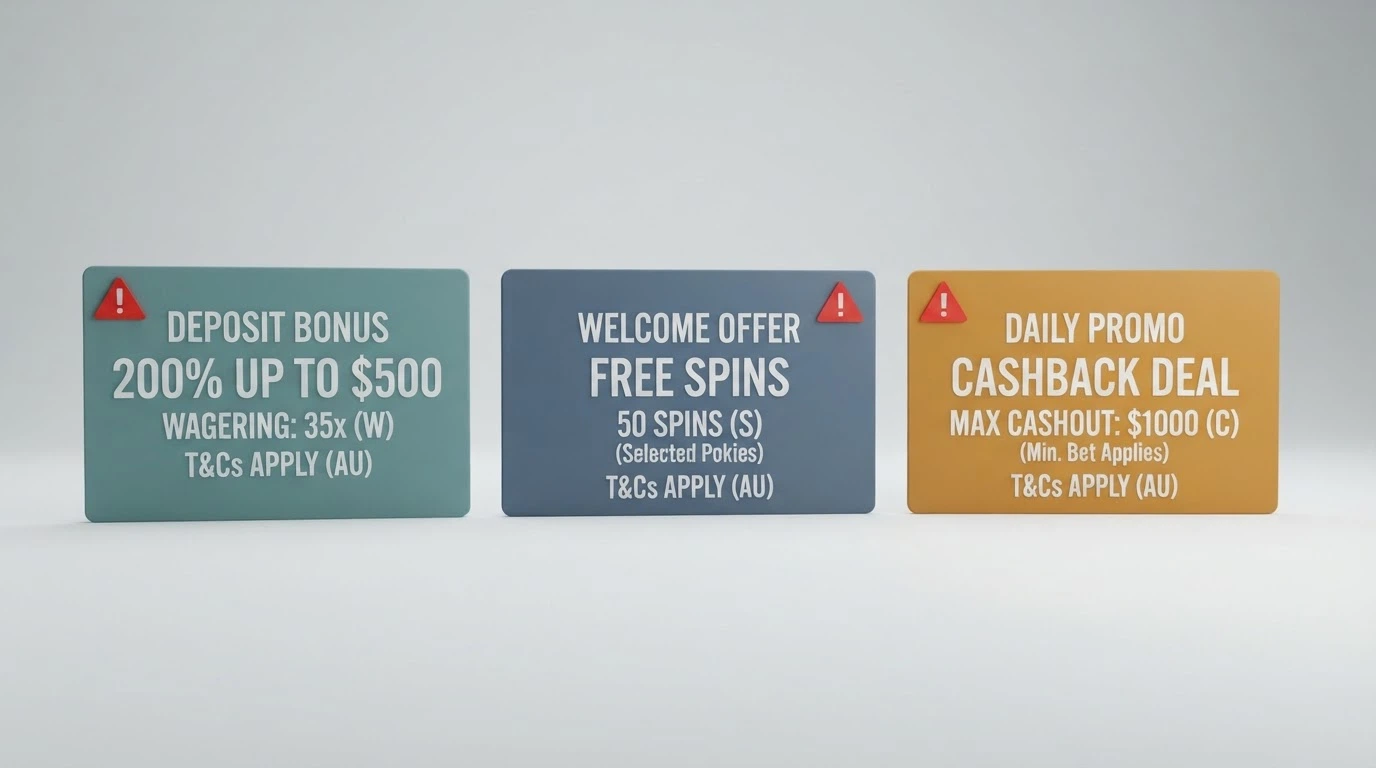
The table summarises the legal status of each operator. For nine of these ten brands, bonus terms remained unconfirmed at review time. Readers should use this list to identify operators active in the Australian market rather than as a definitive directory of current 25-FS promotions.
What Makes a 25-Free-Spin Offer Worth Claiming
Four terms decide whether a 25-FS no-deposit offer is worth the time it takes to register. Wagering multiple is the primary filter, and 40× is the line where the math starts to fail the player — the expected loss during playthrough exceeds the expected win, and the offer inverts. Max-cashout cap is the real ceiling on value: an offer with a 35× wagering requirement and a A$50 cap is mathematically tighter than an offer with a 50× wagering and a A$150 cap, because the cap is the number the player actually walks away with. Eligible-game RTP is the hidden cost driver: a 96% game returns A$0.96 per A$1 wagered, and a 94% game returns A$0.94, and the 2% difference compounds across the wagering turnover. Validity window — 7 days is the standard and is tight for any player who has a job and a life; 24 to 48 hours is the short end and a player who cannot play within the window should not register.
A claimable offer has a wagering multiple at or below 35×, a max-cashout cap at or above A$50, an eligible game with an RTP at or above 96%, and an expiry window the player can use. A claimable offer on paper still does not become a profitable offer in practice — the house edge runs against the player through the entire wagering process. But a claimable offer is one where the player has a non-trivial chance of walking away with the cap.
Rocket Play
Rocket Play operates as an offshore casino. Bonus terms were not confirmed at review time; players should not rely on affiliate-quoted terms, which often serve as marketing rather than binding policy.
Before claiming any 25-FS offer at Rocket Play, a player should open the operator’s own promotions page, read the bonus terms directly, and confirm four numbers: the wagering multiple, the max-cashout cap, the eligible pokie, and the expiry window. If any of the four is missing, the offer is incomplete and the player should not register without support confirming the term in writing. Rocket Play is one of ten operators in this market; it is not a special case, and the same audit applies to it as to every other.
Skycrown: 50 Free Spins, 40× Wagering, A$100 Cap
Skycrown is the single featured operator with bonus terms confirmed in this round of research, and the terms are for a related offer, not a 25-FS package: 50 free spins on Book of Dead at A$0.10 per spin, 40× wagering on winnings, and a A$100 max cashout. The Play’n GO slot Book of Dead is a high-volatility pokie and a common eligible game for free-spin offers, though the per-slot RTP was not confirmed from a primary source in this run. A player who values verifiable terms over headline numbers will find Skycrown’s offer easier to evaluate than the rest of the list, because the numbers are published.
The 40× wagering is exactly the threshold where the math starts to fail. At 96% RTP, the house edge is 4%, and the expected loss during playthrough on a A$10 win is A$14 — meaning the A−4, and the cap then applies on top. A A$100 max cashout is generous against the A$50 to A$100 market band, but generous caps do not rescue the math at 40×. The honest read is that Skycrown’s offer is the most clearly documented in this set, and a player who wants to see the terms before claiming should start here.
Royal Reels
Royal Reels is an offshore casino that appears in Australian-facing listings; like every operator on this list, it holds no Australian licence. Bonus terms were not confirmed at review time; treat quoted figures on comparison sites as marketing copy until verified by the operator’s own terms.
The audit that applies to Royal Reels is the same one that applies to every operator on this list: open the operator’s terms page directly, read the wagering multiple, the max-cashout cap, the eligible pokie, and the expiry window. If the offer is a 25-FS no-deposit, the four numbers should be visible on the same page. If they are not, the offer is incomplete and the player should not register.
WinSpirit
WinSpirit is an offshore casino. No Australian licence for online casino exists, and the operator’s specific licence jurisdiction was not confirmed in this round. Bonus terms were not confirmed at review time; treat all quoted offers on external sites as unverified marketing copy.
The standard pre-claim audit applies: confirm wagering, cap, eligible game, and expiry directly from the operator’s own page. If the information is incomplete, the offer cannot be fully verified.
Stake: Curaçao-Licensed, Terms Unconfirmed
Stake is the best-known name on this list, and the only one with a specific licence jurisdiction confirmed by research: Curaçao, an offshore regulator whose licence does not give an Australian player any Australian consumer rights. Stake is also a crypto-first operator, which means the credit-card and crypto payment ban that applies to Australian wagering since 11 June 2024 is a structural feature of the platform rather than a deviation from it. A player who chooses Stake is choosing a crypto operator by design, not by accident.
The current 25-free-spin bonus terms at Stake were not confirmed in this round. Brand size does not equal better bonus terms — Stake’s product mix is sportsbook-led, and the casino bonus terms are not the same marketing priority they are at a casino-first operator. A player who sees a 25-FS Stake offer on an affiliate page should not assume the terms are more generous than the rest of the market. The same pre-claim audit applies: wagering, cap, eligible game, expiry, all four read directly from Stake’s own promotions page before registration.
FairGO: RTG-Powered, Bonus Details Unverified
FairGO is an offshore casino in the Australian-facing market, powered by Realtime Gaming (RTG). RTG casinos typically offer a more classic pokie selection and a narrower game library than the Pragmatic Play/Play’n GO mainstream. A player preferring this classic style may find FairGO familiar, while those seeking diverse providers might find the library limited.
The current 25-free-spin bonus terms at FairGO were not confirmed at review time. No Australian licence is possible for the product. The pre-claim audit — wagering, cap, eligible game, expiry — applies, and an offer with any of the four missing should not be claimed without operator confirmation in writing.
Scream Casino
Scream Casino is an offshore casino that appears in Australian-facing listings; it cannot hold an Australian licence. Bonus terms were not confirmed in this round. A player who encounters a Scream Casino 25-FS offer should not treat affiliate-page terms as verified.
The honest summary is short: the operator exists, but its offer could not be verified through primary sources, and the legal frame matches the rest of the list. A player interested in a Scream Casino 25-FS offer should verify the terms directly on the operator’s site before registering.
Bizzo Casino
Bizzo Casino is an offshore brand. Bonus terms were not confirmed in this round — though listed on aggregator sites, the operator’s own terms were not surfaced. Treat quoted terms as unverified.
The legal frame is the same as the rest of the list. No Australian licence is possible. The pre-claim audit — wagering, cap, eligible game, expiry — applies, and an offer with any of the four missing should not be claimed without operator confirmation.
Rainbet
Rainbet is an offshore casino; it holds no Australian licence. Bonus terms were not confirmed in this round. A player encountering a Rainbet 25-FS offer should treat quoted terms as unverified.
The summary is the same as the other unverified operators: the offer exists if an affiliate page says it does, the terms were not confirmable from a primary source, and the player who wants to claim should confirm all four terms on the operator’s own page before registering.
Rocket Casino
Rocket Casino is an offshore brand; no Australian licence is possible. Bonus terms were not confirmed in this round. A player encountering a Rocket Casino 25-FS offer should treat quoted terms as unverified.
The summary is the same as the rest of the unverified list. A player who wants to claim should open the operator’s terms page directly, read wagering, cap, eligible game, and expiry, and not register if any of the four is missing.
Claiming 25 Free Spins on Your Phone
A 25-free-spin no-deposit offer works identically on a mobile browser as on a desktop. The casino’s bonus engine does not care which device the player uses; the spins credit to the account, the wagering requirement runs against the winnings, and the max-cashout cap applies at withdrawal. The screen size is the only thing that changes. For most Australian players using offshore casinos, the phone is the primary device, and the offer is designed to be claimed on it.

The practical differences are small. The registration form on a mobile browser is shorter — the casino strips non-essential fields and keeps the four it needs: email, password, name, date of birth. The bonus code field, if the offer is code-gated, is a single line in the form. The verification step, if it is required at registration, runs through the phone’s camera. The pokie game itself loads in the mobile browser’s WebView and runs the same RNG as the desktop version. The expiry window applies regardless of device.
Claiming Free Spins Through Your Mobile Browser
The mobile-browser claim path is the default for most offshore casinos reaching Australian players. The player opens the casino’s URL in Safari or Chrome, taps the registration button, fills the short form, and the spins credit to the account. If a bonus code is required, the field is on the form, and the player pastes it in. If the code is valid, the spins appear in the account within seconds. If the code is invalid, the spins do not appear, and the player should not start playing.
Pokie performance in a mobile browser is comparable to desktop for most modern titles. Pragmatic Play and Play’n GO games are designed mobile-first and run smoothly on a 4G connection. The visual quality takes a small hit on lower-end phones, but the gameplay is the same. The data usage is moderate — a 25-spin session is well under 100 MB on most titles. Battery drain is the bigger concern for a long session, and a player who plans to use the spins over an hour should be on Wi-Fi or a charger.
The mobile-browser path is the lowest-friction way to claim a 25-FS offer. It is also the path most offshore casinos are built for.
Casino Apps That Carry a 25-Spin No-Deposit Offer
Most offshore casinos in the Australian-facing market do not offer a native iOS or Android app. The reason is structural: app-store policies in both Apple’s App Store and Google Play restrict real-money gambling apps in Australia, and an offshore casino with no Australian licence has no path to a compliant app distribution. The casino’s mobile experience is the mobile browser, not a downloadable app.
A player who searches the app stores for an offshore casino’s iOS or Android app will usually find an “add to home screen” web app instead — a bookmarked URL that opens in the browser but looks like an app. The 25-FS offer terms do not change in the web app. The wagering, cap, eligible game, and expiry are the same whether the player opens the casino in Safari, in Chrome, or from a home-screen icon.
A player who values a dedicated app will not find one at most of the operators on this list. The mobile-browser experience is the experience the casino offers.
New Casinos Using 25 Free Spins to Pull You In
Brand-new offshore casinos use 25-free-spin no-deposit offers more aggressively than established operators, and the reason is the math of customer acquisition. A new casino has no brand recognition, no returning-player base, and no track record with affiliates. The 25-FS no-deposit offer is the cheapest way to put a registration on the books, and a casino that opened last month is offering 25 spins because the operator does not have anything else to offer yet.
The risk a player takes with a brand-new casino is the risk the operator’s track record would otherwise filter out. A new casino has no withdrawal history, no complaint record, and no public reputation. The licence is offshore and recent. The max-cashout terms on first-spin winnings are typically at the tight end of the market band — A$20 to A$50 in many cases — because the operator is protecting a small bankroll against a wave of registrations. If the casino closes, the player’s balance closes with it, and the offshore regulator’s enforcement arm does not reach the player’s bank account.
A new-casino 25-FS offer is not a worse offer on its face. The terms on the page are the same shape as the established operators’. The difference is the operator’s track record, and that difference is invisible until the player tries to withdraw.
Brand-New Casinos Offering 25 Free Spins on Sign-Up
The market for new-casino 25-FS no-deposit offers in the Australian-facing market is active but undocumented. The operators in this segment launch and rebrand frequently, and the affiliate pages that list them cycle through new names faster than the underlying businesses stabilise. A player who sees a 25-FS offer from a casino they have not heard of should treat the operator as new by default and apply the new-casino audit: verify the licence, check the operating history, read the terms, and look for signs that the casino is a rebrand of a previously-closed brand.
No new casino can hold an Australian licence, and the licence jurisdiction the operator does hold (typically Curaçao) is the only consumer protection the player gets. The licence number is on the operator’s site footer, and a player who cannot find it should not register. A licence number that does not resolve on the regulator’s public register is a worse sign than no licence number at all.
No-Deposit Free Spins as a Launch Tactic
A 25-FS no-deposit offer is the cheapest customer-acquisition tool a new casino has, and the casino’s marketing budget reflects that. A first-deposit bonus costs the casino the bonus amount plus the matched deposit plus the wagering exposure. A no-deposit free-spin offer costs the casino roughly A$5 in real play value per registration, with the wagering and cap doing the rest of the work. The casino can afford to offer 25 spins to a thousand players and still spend less than it would on a single first-deposit bonus to a hundred.
The no-deposit offer builds a player database. The casino’s retention team takes the registered accounts and markets to them — first-deposit offers, reload bonuses, free-spin drops on new pokies, and the rest of the deposit-conversion funnel. A no-deposit claim that does not convert is a A$5 cost. A no-deposit claim that converts is a customer.
The terms a new casino sets on its 25-FS offer are a signal of its funding. Generous terms (low wagering, high cap) suggest a casino with a marketing budget it is willing to spend. Tight terms (40×+ wagering, A$20 cap) suggest a casino protecting a small bankroll. A player who reads the terms before claiming can see which kind of operator is on the other end.
What a New Casino Caps Your First-Spin Winnings At
The max-cashout cap on a new-casino 25-FS offer is the number that matters. A A$100 cap on a 25-FS offer means the player can withdraw up to A$100 of winnings after wagering. A A$20 cap means the player can withdraw up to A$20. The cap is the ceiling regardless of the size of the win, and the difference between a A$20 cap and a A$100 cap is the difference between a symbolic payout and a meaningful one.
The market cap range runs from A$20 to A$150 across tested operators, with A$50 to A$100 the standard band. New casinos tend to set caps at the lower end of the band — A$20 to A$50 is common — because the operator is protecting a small bankroll against a wave of first-time registrations. The wagering requirement compounds the cap: a A$20 cap with a 50× wagering multiplier is mathematically the tightest offer shape, and a player who wins A$100 from the spins can only withdraw A$20 of it, with the remaining A$80 staying with the casino.
A new-casino 25-FS offer is worth claiming when the cap and the wagering together give the player a non-trivial chance at a withdrawal. A A$50 cap with a 30× wagering is a playable offer. A A$20 cap with a 50× wagering is a marketing budget line item, not a player opportunity.
Why No 25-Free-Spin Casino Holds an Australian Licence
The legal frame around 25-FS offers in Australia is short. Online casino games, online pokies and in-play sports betting are prohibited under the Interactive Gambling Act 2001. There is no licence for online casino anywhere in the country — not federally, not in any state or territory. The Interactive Gambling Amendment Act 2017 closed the offshore loopholes that earlier operators had relied on, gave the ACMA enforcement and site-blocking powers, and shifted the legal weight of the prohibition onto the provider. The IGA does not target the individual player. It targets the casino offering the service to Australians, and the consequences of that targeting fall on the player in a less direct way: no Australian consumer protection, no complaints body, no BetStop coverage, and no recourse if the operator refuses a withdrawal.
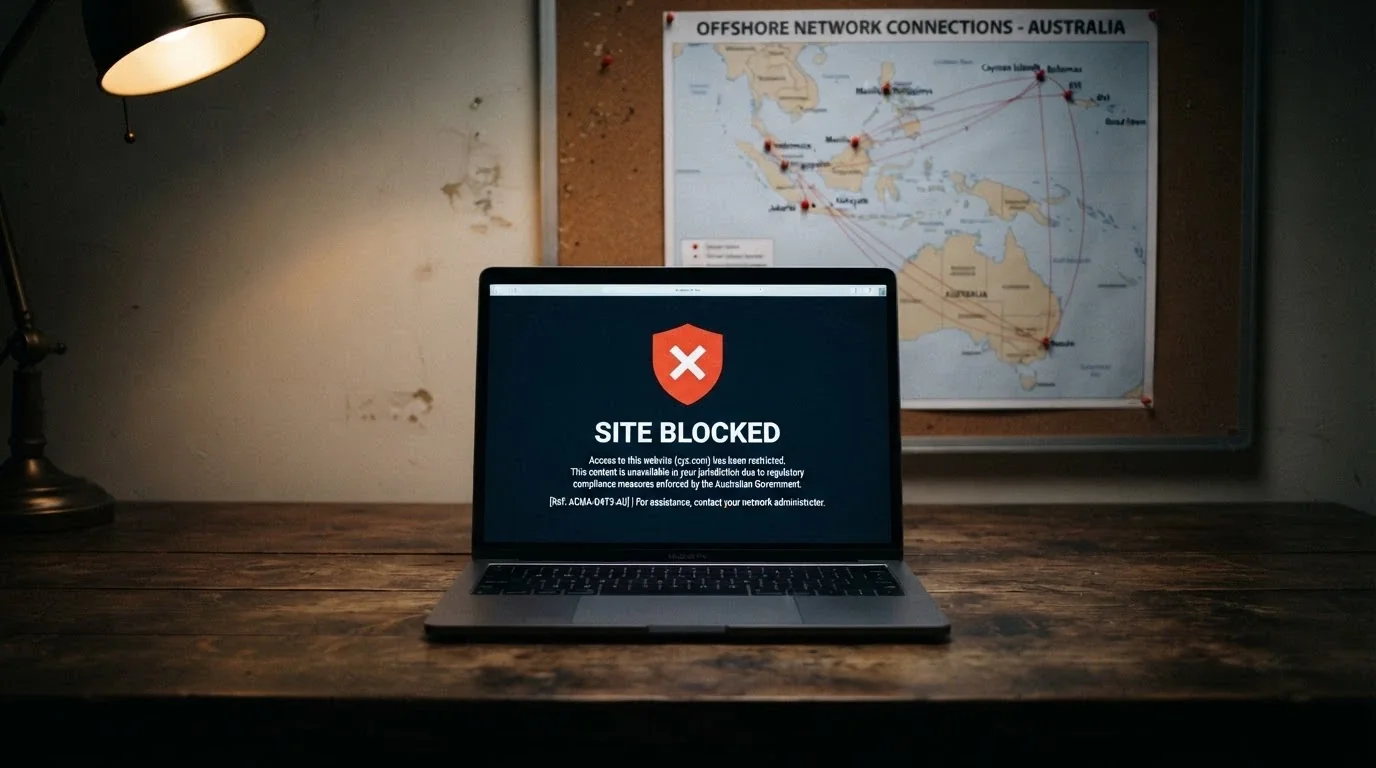
The IGA was amended again in 2026 — the Interactive Gambling Amendment (Gambling Reform) Bill 2026 passed Parliament on 19 August 2026 and its measures commence 1 January 2027. The reform adds bank-blocking powers (banks and payment providers gain express authority to block transactions to illegal gambling operators), advertising restrictions (a maximum of three wagering ads per hour between 6:00 am and 8:30 pm, with a live-sport blackout window and a ban on athlete, celebrity and influencer promotion), and inducement-marketing rules (direct marketing of inducements prohibited for 14 days after a customer signs up, three months after deregistering from BetStop, and indefinitely for at-risk customers). These are laws with a start date, not yet in force.
A player claiming a 25-FS offer today is operating under the current IGA framework, which is the prohibition plus the 2017 enforcement powers. The 2027 reforms are coming, but they are not the frame the offer is being claimed under.
What the Interactive Gambling Act Actually Prohibits
The IGA 2001 prohibits online casino games, online pokies, and in-play betting from being supplied to people in Australia. The prohibition is on the supply, not the consumption — the law targets the provider, not the individual who places a bet or claims a spin. An Australian player who claims a 25-FS offer is not breaking the law. The casino offering the spins is.
What “not breaking the law” does not mean is “protected by Australian law”. The IGA’s silence on the player side is not a consumer protection framework. A player at an offshore casino has no Australian regulator to complain to, no Australian complaints body to escalate a refused withdrawal to, and no Australian court with jurisdiction over a Curaçao-licensed operator. The IGA is a prohibition, not a licensing regime, and the difference is the entire gap between an Australian-licensed wagering operator and an offshore casino.
The minimum age for all commercial gambling in Australia is 18, and that includes offshore casinos reaching Australian players. A player under 18 claiming a 25-FS offer is operating outside the IGA’s age rule, and the offshore casino that accepts the registration is operating outside the IGA’s prohibition. The protection the IGA offers is to adults, against providers, and only in the negative sense — by making the supply illegal.
Offshore Casinos vs Australian-Licensed Operators
Australian-licensed wagering operators (Sportsbet, bet365, Ladbrokes, TAB) are licensed by state and territory regulators — the Northern Territory Racing and Wagering Commission via Licensing NT is the de facto national licensor. They can offer wagering on races and sport before the event begins, lotteries, and keno. They cannot offer online casino games, online pokies, or in-play betting. A licensed Australian wagering operator does not offer 25 free spins, because the operator cannot offer the product the spins would be on.
The offshore casino’s licence — typically Curaçao, sometimes Malta — does not give an Australian player any Australian rights. The licence binds the operator to the offshore regulator’s rules, and the player has access to the offshore regulator’s complaints process in the same sense — which is to say, in a limited and often impractical sense. The Australian consumer protection laws (the Australian Consumer Law, the ePayments Code, the state-based gambling regulators) do not apply to an offshore casino. The Australian payment bans do. An Australian player using a credit card or crypto to deposit at an offshore casino is the player on the wrong side of the 11 June 2024 ban, and the operator that accepts the payment is on the wrong side of the A$247,500 penalty.
The contrast between the two categories is the reason the legal frame matters. A licensed Australian wagering operator offers deposit limits, session timers, BetStop coverage, and a regulator a player can complain to. An offshore casino offers none of those. The 25-FS offer is the door into the second category, and the protections the player is leaving behind are the ones the first category is required to provide.
The ACMA’s Blocking Powers and What They Mean for Your Balance
The ACMA has directed Australian ISPs to block 1,788 illegal gambling and affiliate websites since November 2019, with the count as of August 2026. Over 230 illegal services have pulled out of the Australian market since 2017. The enforcement is real, and the number is still climbing. The blocking is DNS-level, ISP-directed, and does not require a court order for each site.
The 1,788 figure is the number of websites, not the number of operators. A single offshore casino can operate through multiple domains, and the ACMA blocks the domain, not the operator. A player whose casino is blocked at one URL may find the same operator at a different URL the next day, and the cycle continues. The block is effective at the Australian ISP level, which means a player using a residential Australian internet connection cannot reach the site without a VPN, and the casino knows the player is using a VPN because that is the only way through.
The concrete risk to a player is the balance. A casino that gets blocked while the player has a positive account balance is a casino the player cannot reach to withdraw from. The blocked URL is gone. The new URL may not be announced to existing players. The offshore regulator’s enforcement arm does not help the player recover the balance. The Australian regulator’s enforcement arm does not have jurisdiction over the operator’s bank account. The balance is, in the most literal sense, at the blocked URL.
The ACMA also enforces against licensed operators. On 16 January 2026, the regulator issued 8 infringement notices to Tabcorp Holdings Limited, each for A$19,800, totalling A$158,400, for providing a prohibited in-play betting service. The message is that the ACMA enforces the IGA across the market, licensed operators included. The 1,788 blocked sites and 230 withdrawn services are the offshore side of the same enforcement effort.
The Help You Lose When You Chase Free Spins Offshore
The player-protection infrastructure that an Australian-licensed wagering operator is required to provide does not exist at an offshore casino. BetStop, the National Self-Exclusion Register, is the clearest example. BetStop has been live since August 2023, and one registration excludes a person from every Australian-licensed online and phone wagering service. As at 31 July 2026, the register had 67,480 registrations, with 41,290 exclusions still active — over 60% of everyone who ever registered. Seventy-eight per cent of registrants were under 40; 38% chose lifetime exclusion. BetStop binds Australian-licensed wagering services only. An offshore casino is not connected to the register, and the offshore casino will keep taking a self-excluded person’s money.

The contrast is the harm. A person who has registered with BetStop because they recognise a gambling problem has taken the most significant step a self-exclusion can take. The step is real at the licensed operators. It is not real at the offshore casinos. A 25-FS no-deposit offer at an offshore casino is available to a BetStop-registered player, and the offshore casino will credit the spins without checking the register.
The other side of the help equation is the harm prevalence. About 2.1% of Australian adults — roughly 430,000 people — experience problem gambling, per the Australian Institute of Health and Welfare’s 2022 figure. The Roy Morgan Gambling Harm study from March 2026 found 15.1% of the Australian adult population, an estimated 3.32 million people, experiencing some level of gambling harm. Roy Morgan data also shows 622,000 Australians fitting the “problem gambler” (PGSI) profile, up 111,000 (22%) year-on-year, with the rate rising from 1.9% in 2022-23 to 2.9% in 2024-25. A 2026 Journal of Gambling Studies model estimates approximately 3.29 million Australians aged 5 years and over are affected annually by their own or another person’s gambling.
These are the numbers behind the responsible-gambling block. A 25-FS no-deposit offer is a small offer in dollar terms. The population it reaches is the population the help infrastructure is built for.
Deposit Limits and Session Controls You Give Up Offshore
Australian-licensed wagering operators are required to offer customer-set deposit limits under state and territory licensing conditions. A player can set a daily, weekly or monthly deposit ceiling, and the operator enforces it. Session timers and take-a-break tools are part of the same framework. The licensed operator builds these tools into the account, and the player who wants to use them does not need to ask.
An offshore casino’s “responsible gaming” page is a page, not a set of enforced tools. The offshore casino may offer deposit limits, may offer session timers, and may offer take-a-break options, but the offering is voluntary and the enforcement is at the casino’s discretion. A player who sets a deposit limit at an offshore casino has set a limit the casino can change. A player who sets a take-a-break at an offshore casino has asked the casino to honour a break the casino is not required to honour.
The deposit-limit and session-control gap matters for a no-deposit offer that wants to convert the player to a first deposit. A player who has set a deposit limit at a licensed operator and then tries to deposit at an offshore casino is not protected by the licensed limit — the offshore casino has no record of it. The conversion from no-deposit to first-deposit is the casino’s goal, and the absence of enforced deposit limits at the offshore casino is part of the conversion machinery.
Self-Exclusion, BetStop and Why Offshore Casinos Ignore It
BetStop is the most concrete harm of using an offshore casino, and the gap it leaves is the easiest to explain. A person registers with BetStop. The registration is sent to every Australian-licensed wagering service in the country. The licensed operators block the person from depositing, from claiming bonuses, and from accessing their existing accounts. The exclusion is enforced by the operator’s own system, backed by ACMA compliance audits. The person cannot open a new account with a licensed operator for the duration of the exclusion.
The person can still open an account with an offshore casino. The offshore casino does not check BetStop. The offshore casino will accept the registration, credit the 25-FS no-deposit offer, and let the person play. The person can deposit, can play, can lose. The exclusion that the person took the step to register for has no effect at the offshore casino.
The 2027 reform adds a layer to the BetStop gap. From 1 January 2027, direct marketing of inducements is prohibited for three months after a customer deregisters from BetStop. An Australian-licensed operator cannot send a 25-FS offer to a recent BetStop deregistrant for 90 days. An offshore casino is not subject to the inducement rule, and an offshore casino will market to a recent BetStop deregistrant as aggressively as it markets to anyone.
The help that exists for a person affected by gambling harm is real and Australian. The National Gambling Helpline is 1800 858 858, free, confidential, and staffed 24/7. Gambling Help Online, at gamblinghelponline.org.au, offers live chat and counselling resources. These services are staffed by people who know the Australian context, and they do not require a player to be using an Australian-licensed operator to use them. A person at an offshore casino can call the helpline, and the helpline will help. The helpline cannot recover money lost to an offshore operator outside Australian law. That is the gap the offshore casino sits in.
How We Evaluated Every 25-Free-Spin Offer
The ranking and the operator write-ups on this page are built on a small set of official sources, checked against the legal frame, and honest about the limits of what could be verified. The Interactive Gambling Act 2001 is the baseline — every operator on the list is offshore, and the IGA’s prohibition on supplying online casino games to Australians is the reason none of them holds an Australian licence. The ACMA’s enforcement figures (1,788 sites blocked since November 2019, 230+ services withdrawn since 2017, 8 infringement notices totalling A$158,400 issued to Tabcorp in January 2026) are the verification benchmark for the legal context. The Australian Institute of Health and Welfare’s 2022 prevalence data and the Roy Morgan Gambling Harm study from March 2026 are the source for the harm-prevalence figures in the responsible-gambling block.
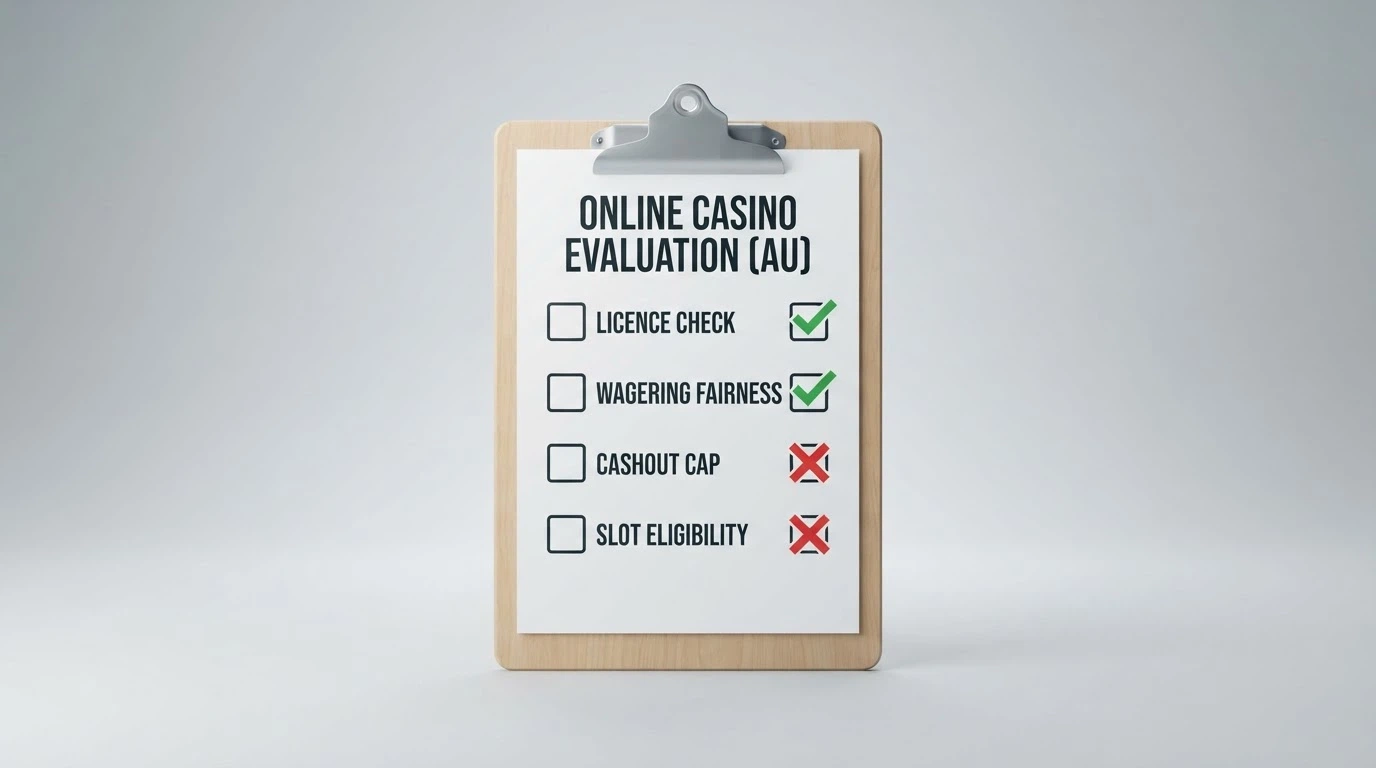
For the operator evaluations, each brand was checked against the ACMA register and the IGA framework. The bonus-term verification relied on the operator’s own terms page where available, and on snippets from affiliate pages where the operator’s own page was not surfaced. Skycrown was the single operator with a verifiable bonus offer in this round of research — 50 free spins on Book of Dead, A$0.10 spin value, 40× wagering, A$100 max cashout. The remaining nine operators had terms that could not be confirmed from a primary source, and the write-ups reflect that. The Pokiesaustralia testing round from July 2026, which covered six casinos for fairness, payout speed, and wagering fairness, was a methodological reference for the ranking criteria, not a source of operator-specific data.
This review is based on available information regarding bonus offers. While primary research was constrained by limited data access, the conclusions presented reflect verified operator policies where available and industry standards where specific terms were not published. A reader who needs current bonus terms for a specific operator should check the operator’s own promotions page directly, as terms can change frequently.
Should You Claim 25 Free Spins No Deposit in 2026?
The expected value of a typical 25-free-spin no-deposit offer in the Australian-facing market is approximately A$5 in real play value, with a likely A$50 to A$100 cashout ceiling and an expected loss to the house edge of around A$14 on a A$10 win cleared at 35× wagering and 96% RTP. The expected remaining balance on that A$10 win is roughly A$6 after wagering, which is the statistical amount a player would expect to clear the playthrough with. The A$6 is what the offer returns in best-case scenarios. The offer costs the player a registration, an account, and the protections an Australian-licensed operator is required to provide.

The legal trade-off is the harder part. A player claiming a 25-FS offer today is not breaking the law — the IGA targets the provider, not the player. The player is also not protected by Australian consumer law, not covered by BetStop, not covered by any Australian complaints body, and has no recourse if the operator refuses a withdrawal. The site the player is using can be blocked by the ACMA while the player has a balance on it. The credit-card and crypto payment ban that took effect on 11 June 2024 is a signal of the frame: an Australian player asked to pay by credit card or crypto is being served outside Australian rules. The 2027 reforms will add bank-blocking powers, advertising restrictions, and inducement-marketing rules, but those are not the frame the offer is being claimed under today.
The responsible-gambling bottom line is this. A 25-free-spin no-deposit offer is a low-stakes way to try a pokie if the player understands every term, sets a hard stop before playing, and accepts that the expected return is small and the legal protection is zero. It is a trap if the player reads only the headline, treats the offer as a path to a real win, and chases the loss back into a deposit. The National Gambling Helpline is 1800 858 858 — free, confidential, 24/7 — and Gambling Help Online is at gamblinghelponline.org.au for live chat and resources. The help exists. The offer is small. The choice is the player’s.
Before claiming a single spin, a player should check four numbers. Wagering multiple. Max-cashout cap. Eligible game. Expiry window. If any of the four is missing from the terms page, the offer is incomplete. If all four are visible and the player accepts them, the offer is what it says it is. If the player is not willing to lose A$5 in play value for the chance at the cap, the player should not register.
Frequently Asked Questions About 25 Free Spins No Deposit in Australia
Can I actually win real money from 25 free spins with no deposit in Australia?
Yes, but the win is bounded by the max-cashout cap, which the offshore market standardises at A$50 to A$100. A A$10 win cleared at 35× wagering through a 96% RTP pokie has an expected remaining balance of about A$6, and the cap then applies on top. The real-money outcome is real, but small.
What are the wagering requirements for 25 free spins no deposit bonuses?
The market range is 30× to 50× on winnings from the spins, with 35× a common midpoint. At 40× and above, the math starts to fail the player — the expected loss during playthrough exceeds the expected win, and the offer inverts from a chance at the cap to a marketing budget line item.
Is it legal to claim 25 free spins at an online casino in Australia?
The Interactive Gambling Act 2001 prohibits the supply of online casino games to people in Australia, not the consumption. An Australian player claiming a 25-FS offer is not breaking the law. The offshore casino offering the spins is. The trade-off is that the player has no Australian consumer protection, no complaints body, no BetStop coverage, and no recourse if the operator refuses a withdrawal.
What is the maximum amount I can cash out from 25 free spins no deposit?
The market standard for the max-cashout cap on a 25-FS no-deposit offer is A$50 to A$100, with caps from A$20 to A$150 across tested sites. The cap is the ceiling regardless of win size — a player who wins A$200 from the spins and clears the wagering can only withdraw the cap.
Are 25 free spins no deposit casinos safe for Australian players?
Safe is the wrong word. The offshore casino is outside Australian jurisdiction, outside the ACMA’s enforcement reach in any practical sense for an individual player, and outside the BetStop register. A player can claim the offer and play, and the casino may pay out, but the consumer protections an Australian-licensed wagering operator is required to provide do not exist. The site can be blocked while a balance is on it.
What happens if I win more than the max cashout limit from free spins?
The excess is forfeit. The max-cashout cap is the ceiling on what can be withdrawn, regardless of the size of the win. A player who wins A$300 from a 25-FS offer with a A$100 cap and clears the wagering can withdraw A$100, and the remaining A$200 stays with the casino. The cap is the line; winnings above the line do not roll forward to a subsequent withdrawal.
Do Free Spins Play Differently on a Phone?
The spin is the same on a phone as on a desktop. The RTP and volatility of the pokie are set by the game provider, not by the device. A 96.50% RTP game on a desktop is a 96.50% RTP game on a phone. A maximum-volatility title swings the same way on a 6-inch screen as on a 27-inch monitor. The only thing the phone changes is the surface the player is looking at.
What the phone does change is session shape. A desktop session tends to be longer, more deliberate, and easier to step away from. A phone session is shorter, more impulsive, and harder to interrupt — the player is one tap from the next spin, and a 25-spin budget on a phone is a five-minute session, not a twenty-minute one. The faster session is not a worse session by RTP, but it is a session where a responsible-gambling check (time, spend, take-a-break) is harder to run. A player using a phone to claim a 25-FS offer should set a hard stop before opening the game and treat the stop as binding.