
No-wager casino bonuses and the offshore reality for Australian players in 2026
A “no wagering” bonus is the closest thing the casino industry has invented to a free lunch. The marketing copy says so, and for once the headline is the deal — anything you win is yours from the first dollar. The catch sits one layer down, in where the bonus comes from and what Australian law lets you do with it. This page is the layer-down read: what a no-wager bonus actually does, why every Australian version of it is offshore, and what the player is trading away when the offshore trade is the only one on offer.

The page is current as of 16 October 2026 and checked against the Australian Communications and Media Authority (ACMA) register of licensed wagering providers, Casino.guru’s Safety Index methodology, and the terms published on each operator’s own site.
Table of Contents
- Why your 2026 no-wager bonus is never truly free
- No-wager bonuses that let you keep what you win
- The offshore casinos Australians actually use for no-wager bonuses in 2026
- The pokies and games where your bonus goes furthest
- Crypto casinos and the payment method Australia already banned
- What Australian law actually says about online casino bonuses
- Staying safe when the safety net stops at the border
- How we selected and ranked these casinos
- What to actually do about no-wager bonuses as an Australian player
- Frequently asked questions about no-wager casino bonuses in Australia
Why your 2026 no-wager bonus is never truly free
A wagering requirement is the small print the casino writes to keep your winnings hostage until you have bet the bonus amount a set number of times over. A no-wager bonus removes that hostage clause. In theory, you walk in, win, and walk out. In practice, three things still pin the player down, and they are the things this page is about.
The first is the no-wager vs low-wager distinction that the marketing copy routinely blurs. A true no-wager offer lets you withdraw any win, no playthrough, no turnover gate. A low-wager offer is still gated — the player must clear some multiple before cashing out, just a smaller one than the standard. The two are not the same product, and the price tag attached to each is not the same.
The second is what the bonus costs the casino, and therefore why it is rare and tightly capped. A no-deposit no-wager bonus pays real cash for nothing in return — the casino’s cost is the bonus itself, plus the cost of every player who hits a lucky streak and walks. Operators who run such offers either cap the payout hard (a maximum-cashout ceiling), or restrict the eligible games, or both. The bonus is free in the colloquial sense and not free to the operator, and the terms show where the bill lands.
The third is the Australian legal frame. The Interactive Gambling Act 2001 makes it an offence to provide online casino games to a person physically in Australia. There is no licence for online casino anywhere in the country, no matter what currency the site accepts or how loudly its branding leans Australian. Every casino a player encounters for a no-wager bonus in 2026 is offshore, unlicensed in Australia, and outside every layer of consumer protection that licensed wagering carries.
What a wagering requirement actually costs you
A wagering requirement — sometimes called a playthrough or turnover multiple — is the number of times you must bet your bonus (and often your deposit too) before the casino lets you withdraw any winnings. A typical welcome bonus of 200% up to A$3,000 might carry a requirement of x35 on bonus plus deposit, which doubles the effective multiple to x70 once the deposit is folded in. The wagering factor does what the marketing does not: it puts a dollar figure on the bonus the player has to put through the games before cashing out.
Take Wager Beat’s headline as the worked example: a 200% welcome bonus to A$3,000, with a x35 wagering factor applied to bonus and deposit together. Deposit A$1,000 and the casino adds A$2,000 of bonus money. The bonus-plus-deposit pool is A$3,000. The wagering target is A$3,000 multiplied by 35, working out at A$105,000 in total bets before any of it becomes withdrawable. On the effective x70 reading, the same target falls out of a slightly different framing — the casino applies x35 to the bonus and x35 to the deposit as two separate counters, both of which must clear, and the player’s total handle has to hit A$105,000 either way.
The dollar figure is almost always larger than a player expects. A A$100 bonus with x35 looks like A$3,500 of bets — manageable on the surface. Fold the deposit in and the same bonus becomes A$7,000 of handle. Stack the same logic on a A$3,000 welcome package and the turnover sits north of A$100,000, which is several thousand spins at standard stake sizes. Most players never finish a turnover that large; the bonus expires, the winnings tied to it disappear with it, and the casino keeps the deposited cash that funded the handle.
This is the cost the no-wager bonus removes. Not the house edge — the house edge is paid on every spin regardless of wagering terms — but the turnover gate that stands between a win and a withdrawal. The bonus becomes a real-money instrument the moment it lands, instead of a locked token that the player must gamble back through.
No-wager vs low-wager: the real-money difference
The cash outcome gap between a no-wager offer and a low-wager one is the entire reason the headline exists. On a no-wager bonus, every dollar you win is yours to withdraw immediately, subject only to standard identity checks and any maximum-cashout cap the operator writes into the terms. On a low-wager bonus, the win sits in a “bonus balance” wallet until the player has bet through the required turnover, and the wallet gets confiscated if the player withdraws before clearing the requirement.
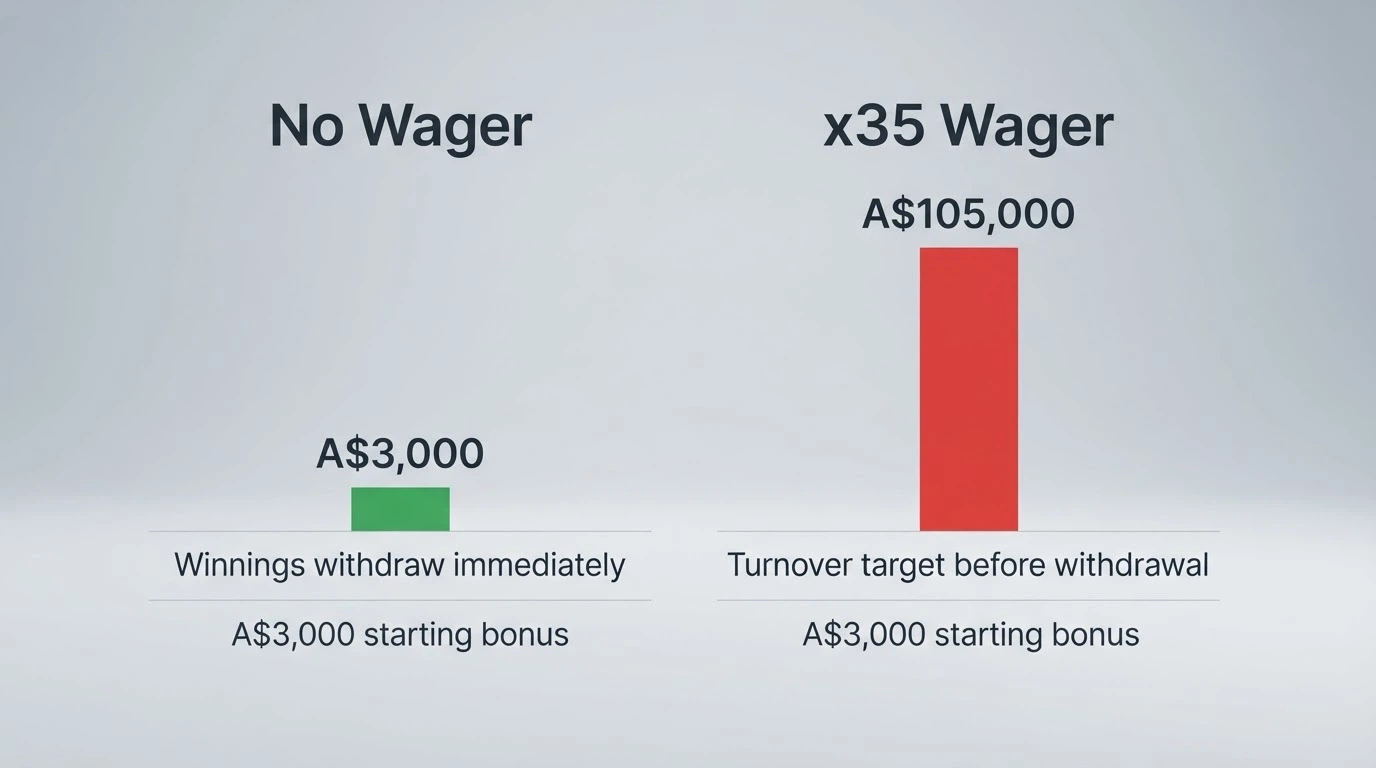
Pull that contrast to the Wager Beat x35-on-bonus-and-deposit reference, where the player’s deposit and bonus are both locked behind a turnover gate and any withdrawal attempt before clearing voids the bonus balance entirely. The same win under a no-wager structure lands in the cash wallet from the first spin. A A$200 win on a no-wager bonus is a A$200 withdrawal. A A$200 win under a x35 structure is a promise of A$200 that the player must turn into A$7,000 of bets before the promise becomes cash.
The difference shows up in the expected-value calculation a sharp player runs before claiming. A no-wager bonus carries the standard house edge and nothing else — the player pays the edge on every spin and keeps the rest. A low-wager bonus carries the same edge plus an expected forfeit cost when the turnover is not cleared: the bonus is lost, the tied winnings go with it, and the player has paid the edge on every spin that contributed to the failed clearance. For most players, who never clear the full turnover on a big welcome package, the forfeit cost is the dominant component of the offer’s real price.
The marketing copy tends to fold both into the same “low wagering” category, which is the move that hides the gap. Read the terms, not the headline.
Where Australian players sit in the no-wager market
Every no-wager casino a search engine returns to an Australian IP is offshore. The IGA 2001 makes it an offence to provide online casino games — pokies, table games, live dealer — to a person in Australia, and no licence for online casino exists in any state or territory. The Australian-licensed wagering market, which sits under the Northern Territory Racing and Wagering Commission for most large online bookmakers, is for race and sport betting only. Sportsbet, TAB, Bet365, Ladbrokes, TABtouch, PointsBet, Neds, Betr, Picklebet and Betfair all hold Australian wagering licences — none of them offers an online casino product, and none of them offers a no-wager bonus.
The offshore casinos that fill the gap are not “Australian casinos without a licence.” They are international operators — licensed in Curaçao, Tobique, Anjouan, Kahnawake or similar — that accept Australian players, accept AUD deposits, and run welcome offers targeting the Australian market. They are legal where they are licensed and not licensed in Australia; they are breaking Australian law by serving Australian customers, though ACMA’s enforcement targets the provider and not the player.
The practical implication is that the entire “no wager casino bonus Australia” search landscape is a market the player enters knowing it sits outside Australian consumer protection. BetStop does not reach it. ACMA cannot recover disputed funds from it. The site’s own regulator (Curaçao, Tobique, Anjouan) is the only place a complaint can be filed, and the quality of those complaint processes varies wildly. A no-wager bonus is a real-money product. The frame around it — the licence, the dispute path, the consumer protections — is not Australian, and the difference matters when something goes wrong.
No-wager bonuses that let you keep what you win
The bonus types an Australian player actually meets, ranked by how often the marketing copy promises “no wagering” and how often the terms deliver.
No-deposit no-wager bonuses: the catch behind the promise
A no-deposit bonus sounds like a free sample — claim it, play it, withdraw what you win. The “no wagering” version tightens the promise by removing the turnover gate, so the player walks away with whatever survives the house edge. It is the rarest bonus in this entire category, and the reason it is rare is the cost to the operator. Every claim is a real-money payout risk with no incoming deposit to balance it, and the operator’s survival depends on capping that risk hard.
The cap is almost always a maximum-cashout ceiling. Wager Beat’s previous no-deposit offering — 15 free spins on Wolf Treasure — carried x50 wagering rather than no wagering, and capped the cashout at A$100. A genuine no-deposit no-wager version of the same shape would either cap cashout at a fraction of what a lucky spin could yield, restrict play to games with a low maximum win, or both. The cap is the clause the player must read, because it decides whether the bonus pays out anything at all.
Verified live no-deposit no-wager offers targeting Australian players were sparse in this round of research. What the search returned was the standard offshore welcome package, the standard deposit-gated structure, and the occasional expired or region-blocked free-spin offer. The honest position: a no-deposit no-wager bonus is not impossible to find, but it is not the menu the Australian-facing offshore market leads with.
No-wager free spins that pay out in real cash
Free spins with no wagering requirements are the cleanest version of the offer type, and the one closest to the marketing promise. The player claims the spins, plays them on the named pokie, and the winnings land in a real-money balance that can be withdrawn subject only to identity checks and any cashout cap the operator writes in.
The mechanics are simple in principle and tight in practice. The operator names the eligible game (often a single pokie), names the spin value (often the pokie’s minimum bet), and writes a cap on how much of the resulting balance can be withdrawn. A clean no-wager free-spins bonus for an Australian player would let them play the spins, win whatever the pokie pays out, and withdraw up to the cap — with no playthrough, no turnover gate, and no requirement to deposit further.
The gap between the ideal and the verified live offer is wider than the marketing suggests. The free-spins bonuses on the offshore sites this page covers generally carry wagering requirements of x30 to x50 on the spin winnings, even when the headline says “free.” The player is asked to bet the spin winnings a set number of times before withdrawal, and the terms sometimes apply the same multiplier to the deposit that funded the spins in the first place. The marketing word “free” sits on top of a small-print structure that looks much like a standard welcome bonus, just smaller.
Welcome and sign-up offers with no wagering
A no-wager welcome package is the largest version of the offer type and the one most players search for — a deposit match where every dollar of winnings is withdrawable from the first spin. In principle the structure is a match percentage (100%, 200%, sometimes 300%) on the first deposit, with the bonus funds either locked until wagering clears or unlocked from the moment they land. The no-wager version is the unlocked version.
The honest market position in 2026: the verified live welcome offers at the offshore casinos an Australian player meets were not no-wager this run. The headline example — Wager Beat’s 200% up to A$3,000 — carries x35 on bonus and deposit, an effective x70 structure that demands over A$100,000 of handle on a A$1,000 deposit before any of it is withdrawable. That is the opposite of a no-wager package, and it is the structure that dominates the offshore welcome market targeting Australia.
The closest the search returned to a true no-wager welcome was a structure where the bonus funds carry no wagering requirement but the deposit does — a partial gate that still ties up part of the bankroll until cleared. Other shapes cap the eligible games to a single pokie, or restrict the bonus to a small percentage of the deposit (25% or 50% rather than the usual 100% or 200%), on the grounds that a smaller bonus costs the operator less to leave open.
How to check whether you can actually keep your winnings
Three clauses in the T&Cs decide whether a no-wager bonus pays out anything, and the player should read all three before depositing.
The first is the maximum-cashout cap. A no-wager bonus that wins a player a A$2,000 balance is not a A$2,000 withdrawal if the cashout cap is A$500 — the rest is forfeit. The cap is the single biggest gap between the marketing word and the actual payout, and the cleanest no-wager bonus is the one with the highest cap, or no cap at all.
The second is game eligibility. Many no-wager bonuses are restricted to a single pokie, or to a small set of pokies nominated by the operator. Play a different game and the bonus is voided; the player keeps the deposit but loses the bonus and any winnings tied to it. The eligible-games list is the second clause to read.
The third is the expiry window. A bonus that expires in 24 hours is a bonus the player cannot realistically use; one that expires in 30 days is workable. The expiry is the third clause to read, and it interacts with the wagering requirement — even on a “no wagering” bonus, the bonus balance may be forfeited if it sits unused past the expiry. Wager Beat’s published structure carries a minimum withdrawal of A$200 and a maximum of A$5,000 per transaction with a 48-hour pending period, which is the kind of cashout channel that decides whether a bonus can be moved at all.
The mechanics: how a bonus gets wagered step by step
A wagering requirement works through a turnover counter the casino runs behind the bonus balance. Every real-money bet the player makes on an eligible game adds to the counter; every withdrawal attempt subtracts the unbet portion of the bonus from the balance. The counter starts when the bonus is claimed, ticks with every spin or hand, and stops — for the purposes of clearing the requirement — when the player has bet through the required multiple.
Contribution percentages shape how fast the counter ticks. Pokies (slots) typically contribute 100% of the stake to the turnover — every A$1 bet on a pokie adds A$1 to the counter. Table games and live dealer games often contribute 10% or 20%, which means a A$1 blackjack bet adds A$0.10 to the counter, and the player must bet ten times as much to clear the same requirement. A few games contribute 0% and are excluded entirely. The contribution table is buried in the bonus terms and is the single biggest determinant of how long the clearance takes.
The wagering clock starts when the bonus is claimed and stops when the requirement is cleared, when the bonus is forfeited (withdrawal attempt, expiry, breach of terms), or when the player switches to a non-eligible game. The casino’s “pending period” on withdrawals — 48 hours at Wager Beat, often 24 to 72 hours elsewhere — sits between the player’s cashout request and the money moving, and it is a separate clock from the wagering clock.
A no-wager bonus skips most of this machinery. The turnover counter never starts because there is no turnover requirement. The bonus funds either land directly in the cash balance, or sit in a separate bonus balance that the player can move to the cash balance on request. The mechanics are simpler, the expiry is shorter, and the only gates that remain are the cashout cap, the eligible-games list, and the standard identity checks.
The offshore casinos Australians actually use for no-wager bonuses in 2026
The ten operators below are the ones an Australian searcher actually meets. They are ranked by AU market share — how much of the Australian-facing offshore search traffic each one captures — not by quality, safety, or value for money. Every one is offshore. None holds an Australian licence, because no such licence exists for online casino.

| Casino | Australian licence | BetStop connected | AU market-share rank |
|---|---|---|---|
| Wager Beat | No | No | #2 |
| Rocket Play | No | No | #3 |
| Skycrown | No | No | #4 |
| Royal Reels | No | No | #9 |
| WinSpirit | No | No | #11 |
| Stake | No | No | #12 |
| Rainbet | No | No | #13 |
| Scream Casino | No | No | #14 |
| FairGO | No | No | #16 |
| Bizzo Casino | No | No | #19 |
A note on the rankings: the #1 slot in the Australian-facing offshore market is held by a casino whose detailed terms were not verified this run. The ten operators above are the ones whose presence in AU search results was confirmed, with the #1 operator excluded for verification reasons rather than omitted by oversight. The market-share figures are from independent traffic tracking and represent the share of Australian IP addresses reaching each operator’s site, not the size of each operator globally.
Wager Beat Casino
Wager Beat is the most-searched no-wager-adjacent brand in the Australian market and the one operator whose terms were verified in detail this run. The licence is the Tobique Gaming Commission in New Brunswick, Canada — a small First Nations regulator with a thin public footprint and limited consumer-recourse infrastructure. Casino.guru’s Safety Index for the operator sits at 3.3 out of 10, in the “Very Low” band.
The welcome bonus is 200% up to A$3,000 on the first deposit, with x35 wagering on bonus and deposit together — an effective x70 structure once both pools are folded in. A A$1,000 deposit yields a A$2,000 bonus and a A$105,000 turnover target before any of it becomes withdrawable. That is not a no-wager offer; it is a heavy-wager offer with a no-wager-friendly headline.
The previous free-spins promotion was 15 no-deposit spins on Wolf Treasure (an Aristocrat pokie popular in the Australian market) with x50 wagering on the spin winnings and a A$100 maximum cashout. That promotion is listed as expired. The operator was founded in 2018 and accepts AUD, EUR, NZD and USD. Deposits start at A$20; withdrawals start at A$200, with a A$5,000 per-transaction cap and a 48-hour pending period; monthly withdrawal limit is A$30,000; no win limit applies.
Verdict: the brand is the most visible in the Australian no-wager search results and the only one whose published terms are honest enough to confirm that its current welcome bonus is not, in fact, a no-wager offer. The headline reads like a no-wager product; the small print reads like a standard heavy-wager one. A player who arrives expecting to keep what they win will spend their welcome package chasing a turnover target they will probably not clear, and the bonus will expire with whatever was tied to it.
Rocket Play
Rocket Play holds a 9.4% share of the Australian-facing offshore search market, the third-largest footprint in the country. Licence, bonus terms, and game-provider details for this operator were not verified this round — our search sweep confirmed the operator’s existence but could not retrieve its specific terms. What is confirmed: the operator is offshore, not Australian-licensed, and not connected to BetStop.
The gap between the operator’s market presence and the verified information on it is itself the practical point. A 9.4% AU share is a real presence — the operator is being found, clicked, and signed up to by Australian players in meaningful numbers — and the absence of verified bonus terms means every player who arrives is reading the site’s own T&Cs without any external benchmark. Read the terms directly before depositing, and treat any “no wagering” headline as a starting point for a small-print read rather than a description of what will actually happen to a winning balance.
Verdict: the operator is significant in the Australian search market and unverified in this round of research. The offshore status is the only fact that does not need verification.
Skycrown
Skycrown holds an 8.55% AU market share, the fourth-largest in the country. We could not verify the specific licence, bonus terms, or game providers during this research. The operator is offshore, holds no Australian licence, and has no BetStop connection.
The Australian-facing presence is large enough that the operator is encountering Australian players in volume, and the verification gap is the same as Rocket Play’s: a player arriving at the site is reading its own T&Cs without any external check. The same advice applies — verify the licence on the regulator’s own register (Curaçao, Anjouan, Tobique or whichever the footer names), read the bonus terms to the cashout cap, and check whether the eligible-games list matches what the player wants to play.
Verdict: large AU footprint, unverified terms, the same offshore caveats as every other operator on this page.
Royal Reels
Royal Reels holds a 2.51% AU market share, the ninth-largest in the country. The operator is smaller than the top three but still well within the top ten. Terms, licence, and game library details for this operator remain unverified in this research.
The market position suggests the operator is being found and tried by enough Australian players to register on traffic-tracking, but the published footprint is thinner than the top three’s. That thinness is not a verdict either way — smaller offshore operators can be safer or less safe than larger ones, and the only honest move without verified terms is to ask the player to check directly.
Verdict: smaller AU footprint, same offshore status, same verification gap.
WinSpirit
WinSpirit holds a 1.55% AU market share, the eleventh-largest. The operator sits just outside the top ten on this page by market presence. Data regarding the operator’s licence, bonus terms, and games was not confirmed for this round.
The position is similar to Royal Reels — a smaller player with a measurable AU footprint and no verified terms in this round. The casino is based offshore, possesses no Australian licence, and is not connected to BetStop.
Verdict: same offshore caveats, smaller AU presence, same verification work for the player to do.
Stake
Stake is the well-known crypto casino brand, operating at Stake.com, with a 1.28% AU market share (twelfth-largest). The operator’s positioning is crypto-native: deposits and withdrawals are processed in Bitcoin, Ethereum, Litecoin and other cryptocurrencies, with fiat onramps in some jurisdictions.
The crypto positioning is the most important fact for an Australian player. Credit cards and cryptocurrency have been banned as payment for online wagering since 11 June 2024 under the Interactive Gambling Amendment (Credit and Other Measures) Act 2023. The ban applies to licensed Australian wagering operators and carries penalties of up to $247,500 for non-compliance. A casino whose core deposit method is cryptocurrency is, by structure, operating outside the Australian payment rules — not because crypto is illegal in Australia, but because using it to fund a gambling account is what the Australian rules specifically prohibit for the licensed market.
Stake is licensed by a regulator outside Australia (the specific licence was not verified this run) and accepts Australian players without holding an Australian licence. The crypto deposit method is the same red flag regardless of whether the bonus carries wagering requirements — a casino asking for Bitcoin is not connected to the Australian banking system, and is not covered by any of the protections the banking system provides.
Verdict: the most distinctive operator on this list by deposit method, and the one whose deposit method is itself the warning. The crypto-native positioning is the structural reason Stake sits outside Australian rules, and the same deposit method that makes it convenient for some players is what disqualifies it from the licensed-wagering protections.
Rainbet
Rainbet holds a 1.28% AU market share (thirteenth-largest), tied with Stake on percentage and one rank behind. Details regarding the licence, bonus terms, and game offerings were not confirmed this time. This operator is offshore, lacks an Australian licence, and is not connected to BetStop.
The shared percentage with Stake is a market-tracking artefact, not a similarity in product. Stake is a large global crypto-native brand; Rainbet is a smaller offshore operator. Both occupy the same rough share of Australian search traffic.
Verdict: smaller AU footprint, same offshore caveats, same verification work for the player to do.
Scream Casino
Scream Casino holds a 0.99% AU market share, the fourteenth-largest. Information concerning the operator’s licence and bonus terms was not confirmed in this pass. The operator’s name does the heavy lifting in branding; the verified footprint is small.
A sub-1% market share is the level at which an operator’s AU presence is a measurable signal rather than a dominant one — the operator is being found, but not by a meaningful fraction of Australian searchers. The same offshore caveats apply, and the same verification advice: check the licence on the regulator’s register, read the bonus terms to the cashout cap, and check the eligible-games list before depositing.
Verdict: small AU footprint, same offshore status, same gap in verified terms.
FairGO
FairGO holds a 0.80% AU market share, the sixteenth-largest. The operator’s name is its pitch — FairGO leans on the Australian “fair go” idiom to position itself as a country-friendly brand. The branding is marketing; the licence is offshore.
The name-game is worth flagging because it is the same play several offshore operators run: a name that sounds Australian, an AUD balance option, an AU-focused bonus schedule. None of it changes the licence status. The operator is offshore, not Australian-licensed, and not connected to BetStop, regardless of how Australian the branding reads.
Verdict: branding leans Australian; licence is offshore; the player should not let the name-brand appeal substitute for a terms-page read.
Bizzo Casino
Bizzo Casino holds a 0.57% AU market share, the nineteenth-largest and the smallest on this list. Licence status and bonus terms for this casino were not confirmed during our latest check. This is an offshore casino without an Australian licence, and it is not connected to BetStop.
A sub-0.6% market share is the smallest AU presence in the featured set. The operator is included because it appears in the AU search results at a measurable rate, not because it dominates the market. The same offshore caveats apply, and the same verification advice.
Verdict: the smallest AU footprint on this page, same offshore status, same gap in verified terms.
Sister casinos and why the same owner runs multiple brands
Several of the operators on this page share licence jurisdictions, game libraries and bonus structures, and a few are owned by the same parent group running multiple brands over the same platform. The offshore playbook is to spin up several near-identical casino fronts — different domain, different colour scheme, different name — over a shared technical backend. The player sees a “new” casino; the underlying operation is unchanged.
The Wager Beat licence, Tobique Gaming Commission in New Brunswick, is an example of the pattern. Tobique is a small First Nations regulator that has licensed a handful of offshore brands, several of which appear in the Australian-facing search results. The pattern is the same for Curaçao, Anjouan and Kahnawake: a single licence covers multiple brands, the brands share bonus templates, and the player who has seen one brand’s T&Cs has seen most of them.
What this means for the player: a “new” casino in the AU search results may be a sister casino to one already on this page. The bonus structure is likely to be similar, the eligible games are likely to overlap, and the licence complaint path is the same regulator. Recognising the platform under a different skin is itself useful information — the player who has read one set of T&Cs in the cluster can apply the same scepticism to the next.
The pokies and games where your bonus goes furthest
Not every game clears a wagering requirement at the same speed, and not every game treats the player’s bankroll the same way. Two mechanics decide where the bonus goes furthest: game contribution percentages (how much of each bet counts toward the turnover counter) and return-to-player percentages (how much of each bet the game returns over the long run).
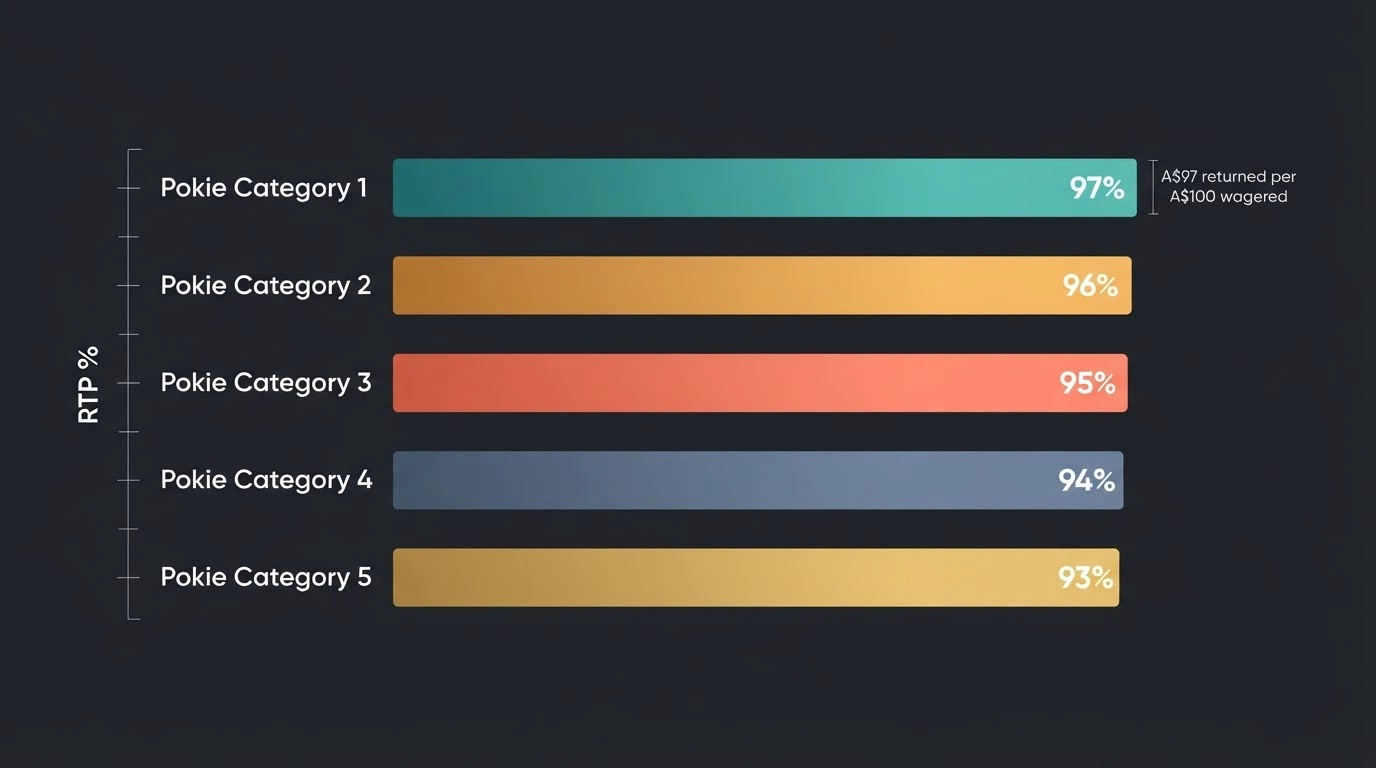
Which pokies give you the best shot at clearing a wagering requirement
Return-to-player — RTP — is the percentage of total stakes a pokie returns to players over a very large number of spins. A 97% RTP pokie returns A$97 for every A$100 wagered, in aggregate, across millions of spins; the house keeps A$3. The figure is an average, not a guarantee for any session, and the gap between 97% and 94% is the gap between a game that costs A$3 per A$100 staked and a game that costs A$6 — twice as much house edge, on the same handle.
Volatility is the second mechanic. A low-volatility pokie returns small wins frequently, which stretches a bankroll through more spins; a high-volatility pokie returns larger wins less frequently, which can empty a bankroll before any win lands. For a player trying to clear a turnover requirement, low volatility is the structural advantage — more spins per A$100 means more chances to land a winning combination before the bonus expires.
Specific per-title RTP figures for the pokies an Australian player encounters on offshore sites were not verified this run. The honest position: read the paytable before depositing, look for the RTP disclosure (most reputable providers print it in the game’s information panel), and prefer high RTP plus low volatility for turnover clearance. The game library at any given offshore casino includes hundreds of titles; the difference between the best and worst RTP in that library is often 5 to 10 percentage points, which is a real-money difference over the kind of handle a wagering requirement demands.
How much you actually need to wager through on slots
The turnover arithmetic is mechanical. Multiply the bonus amount by the wagering factor and you have the total handle required; divide that handle by the average stake per spin and you have the number of spins; multiply the spins by the seconds per spin (typically 3 to 5 seconds for an online pokie) and you have the play time.
The Wager Beat x35-on-bonus-and-deposit structure is the worked example. A A$1,000 deposit unlocks a A$2,000 bonus, yielding a A$3,000 bonus-plus-deposit pool. Multiplied by 35, the turnover target is A$105,000. At a A$1 stake per spin, that is 105,000 spins; at A$5 per spin, 21,000 spins; at A$10 per spin, 10,500 spins. At 5 seconds per spin, the A$1 version works out to about 146 hours of continuous play, which is more than a full week of eight-hour sessions — a workload that explains why most players never clear a turnover that size.
A no-wager bonus removes this arithmetic entirely. There is no turnover target because there is no turnover requirement. The player spins until they decide to stop, withdraws the cash balance, and the play time is bounded only by what they choose to spend. The time saving is the second-order benefit; the first-order benefit is that the bonus winnings are never at risk of being confiscated for non-clearance.
Free-play mode vs real-money no-wager spins
Free-play mode (demo mode) is the operator’s risk-free version of a pokie — the same game, the same mechanics, the same RTP, played with virtual credits that cannot be withdrawn. It is the right tool for evaluating a pokie before depositing: the player learns the bonus features, the volatility pattern, and the rough feel of the game without paying house edge on the spins.
Demo mode is not the same as a no-wager free-spins bonus. The free spins in a no-wager bonus are real-money spins — the stake comes from the operator’s bonus balance, the winnings land in a real-money wallet, and the cashout is subject to the bonus terms. Demo mode has no cashout, no bonus balance, and no terms — it is a preview, not a bonus. A player who evaluates a pokie in demo mode and then claims a no-wager free-spins bonus on the same pokie is using the two tools for the different jobs they were built for.
Demo-mode availability varies by operator and by jurisdiction. Some offshore casinos hide demo mode for players who have signed up but not deposited; others make it freely available. The honest position on the operators in this page’s featured set: demo-mode availability was not verified at the operator level this round, and the player should check the specific game on the specific operator before assuming the preview is accessible.
Crypto casinos and the payment method Australia already banned
The crypto no-wager bonus sits at the intersection of two Australian prohibitions. The first is the IGA 2001 prohibition on providing online casino games to Australians — which every operator on this page is already breaking. The second is the June 2024 ban on credit cards and cryptocurrency as payment for licensed online wagering. The two prohibitions interact: a crypto casino is by definition not a licensed Australian wagering operator, so the crypto ban does not formally apply to it, but the deposit method is the same one the Australian rules specifically prohibit for the licensed market.
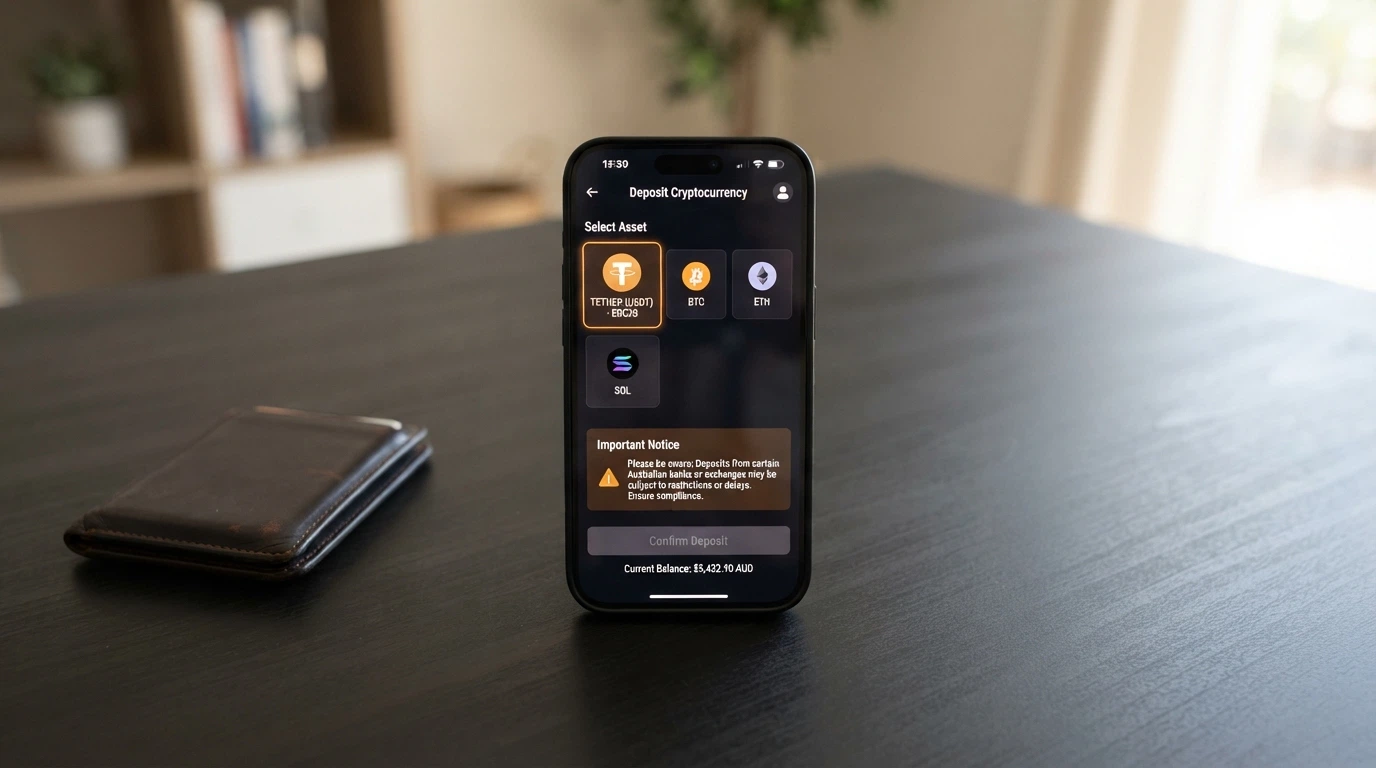
Bitcoin no-wager bonuses and why crypto deposits are a red flag for Australian players
A Bitcoin no-wager bonus is structurally identical to a fiat no-wager bonus, with one practical difference — the deposit is in Bitcoin rather than in AUD. The operator’s bonus terms are the same (or similar), the eligible games are the same, the cashout cap is the same. The difference is the deposit rail, and the deposit rail is the warning.
The warning is that an Australian casino asking for Bitcoin is, by definition, outside the licensed Australian wagering market. Legal deposit routes for licensed Australian wagering operators are debit card, bank transfer, PayID/Osko and BPAY. Cryptocurrency is not on that list. An operator asking for Bitcoin is not asking through the Australian banking system, is not subject to the Australian Know Your Customer rules, and is not covered by the Australian dispute mechanisms. The deposit is anonymous in the sense the Australian rules specifically prohibit: traceable on the blockchain, untraceable through the Australian regulator.
The practical consequence is the structural one. From 1 January 2027, banks and payment providers gain express authority to block transactions to illegal gambling operators. A crypto deposit does not run through a bank at all — it runs through a wallet-to-wallet transfer on a public blockchain — so the bank-blocking power is irrelevant to a crypto casino. The same rule that gives Australian banks a new enforcement tool does not touch the deposit method that distinguishes a crypto casino from a fiat one.
For an Australian player, the takeaway is that crypto deposit is a tell, not a feature. The convenience of anonymous deposits and fast withdrawals is the same convenience that puts the casino outside Australian law. The crypto bonus is a real-money product on an offshore site; the deposit method is the proof of the offshore status.
What Australian law actually says about online casino bonuses
The Interactive Gambling Act 2001 is the statute that makes the entire product category illegal to provide in Australia. Every no-wager casino bonus an Australian player encounters in 2026 is offered by an operator that is breaking Australian law by serving Australian customers, regardless of where the operator is licensed elsewhere.

The Interactive Gambling Act and why online casino is prohibited
The IGA 2001 prohibits the provision of online casino games (pokies, table games, live dealer), online in-play sports betting, and online keno “pocket pokies” to a person physically in Australia. Wagering on races and sport placed before the event begins is permitted and licensable, through operators licensed by a state or territory — most large online bookmakers are licensed by the Northern Territory Racing and Wagering Commission through Licensing NT, the de facto national licensor for the online wagering market. NT licences run for terms of up to 20 years. The two product categories are separate: a licensed Australian bookmaker can offer race and sport wagering and cannot offer online casino games.
The 2017 amendment to the IGA gave ACMA the powers that make the prohibition enforceable: civil penalty proceedings against illegal operators, formal warnings, and the power to direct Australian ISPs to block illegal gambling sites. The 2017 amendment closed the offshore loophole that had allowed international operators to serve Australian customers without consequence. The amendment was the point at which the offshore-only casino market became a market ACMA could actually reach.
The 2026 reform, passed on 19 August 2026 and commencing 1 January 2027, layers additional restrictions on top of the existing prohibition. From the commencement date, wagering advertising on TV is capped at three ads per hour between 5am and 8:30pm; live-sport broadcasts carry a 15-minute-before-to-5-minute-after advertising blackout; radio wagering ads are banned during school drop-off and pick-up; online ads may only be shown to logged-in, verified over-18 users who have not opted out through AdStop; venue advertising and uniform advertising are banned; athletes, celebrities and influencers are barred from promoting wagering products; direct marketing of inducements is banned for 14 days after sign-up, three months after BetStop deregistration, and indefinitely for customers identified as at-risk; foreign-matched lotteries and online keno are banned.
The reform’s stated objective, in the Bills Digest, is to “break the connection between wagering and sport, minimise exposure of children and other vulnerable people to wagering advertising, and reduce its saturation across the internet, radio and television.” The advertising measures are the most visible part, but the bank transaction-blocking powers are the most consequential for the offshore market — they give Australian banks the express authority to refuse to process payments to illegal operators, which is the tool the current system lacks.
BetStop, ACMA and every protection you lose at an offshore casino
| Protection | Licensed AU wagering | Offshore casino (no AU licence) |
|---|---|---|
| BetStop self-exclusion | Yes — single registration covers every AU-licensed service | No — offshore site not connected to the register |
| ACMA complaint and enforcement | Yes — civil penalties, site blocking, formal warnings | No — ACMA cannot recover funds; site may be blocked but player has no Australian recourse |
| Identity verification | Mandatory — KYC required under licence conditions | Varies — some offshore sites verify, some do not |
| Deposit limits (customer-set) | Available under the National Consumer Protection Framework | Varies — depends on the operator’s own policies |
| Activity statements | Mandatory — regular statements issued to the player | Varies — not required under any Australian rule |
| Easy account closing | Mandatory under the National Consumer Protection Framework | Varies — depends on the operator |
| National Gambling Helpline referral | Available — the helpline number is published by the operator | Varies — offshore sites have no obligation to publish |
| Bank transaction blocking (from 1 January 2027) | Available — banks block transactions to illegal operators if signalled | Available for fiat — irrelevant for crypto |
The right column is the gap. A player at an offshore casino forfeits every Australian consumer protection on this list, including the most concrete one: BetStop self-exclusion. BetStop is the National Self-Exclusion Register, live since August 2023, which excludes a person from every Australian-licensed online and phone wagering service in a single registration. As at 31 July 2026, BetStop has 67,480 registrations, of which 41,290 are still active — more than 60% of everyone who ever registered. 78% of registrants were under 40; 38% chose lifetime exclusion. The register binds Australian-licensed wagering services only. An offshore casino does not check the register and will keep taking a self-excluded person’s money, which is the structural reason the offshore gap matters most.
ACMA’s enforcement record is the second layer. Since its first blocking request in November 2019, ACMA has had 1,564 illegal gambling and affiliate websites blocked by Australian ISPs as of March 2026. More than 225 illegal services have withdrawn from the Australian market since 2017. The blocks work at the DNS level for Australian ISPs and are not unbeatable, but they reduce the operator’s reachable audience materially. ACMA’s civil penalty proceedings target the operator, not the player; the player is not prosecuted for using an offshore site. The lack of prosecution is not the same as the presence of protection — ACMA cannot recover a disputed balance from an offshore operator, cannot compel a payout, and cannot enforce an Australian consumer law against an entity licensed in Tobique.
Bank cards, crypto and the payment rules that tell you a site is offshore
The payment method a casino asks for is the fastest way to know whether it operates inside or outside Australian law. The rule: legal deposit routes for licensed Australian wagering operators are debit card, bank transfer, PayID/Osko and BPAY. Credit cards, credit-related products and cryptocurrency are banned as payment for online wagering since 11 June 2024. An operator that fails to enforce the ban faces penalties of up to $247,500.
The practical application: an Australian asked to deposit by credit card or by crypto is being served by someone outside the licensed Australian wagering market. The licensed market runs through the Australian banking system, which is the system that knows the player’s identity and applies the consumer protection framework. An offshore casino asking for crypto runs around that system entirely. The presence of a credit card deposit option is the same tell, though less decisive: some offshore sites accept credit cards as a payment convenience, and the credit card ban applies to the licensed operator that accepts the card, not to the cardholder who uses it.
From 1 January 2027, banks and payment providers gain express authority to block transactions to illegal gambling operators. The rule is the bank-side complement to the ACMA site-blocking power — the operator is blocked at the DNS level, the player is blocked at the transaction level. A player who attempts to deposit at an illegal site from an Australian bank account may have the transaction refused at the bank’s discretion. Crypto deposits are not bank transactions and are not caught by the rule; the structural offshore-ness of a crypto casino is unchanged.
Staying safe when the safety net stops at the border
The Australian responsible-gambling infrastructure is among the strongest in the world. The BetStop register, the National Consumer Protection Framework, the mandatory deposit limits and activity statements, and the National Gambling Helpline form a system that licensed wagering operators must implement. None of it reaches an offshore casino, which is the single most important fact for a player who is choosing where to spend their bankroll.

Deposit limits, time-outs and the tools you can actually use
The National Consumer Protection Framework for Online Wagering includes 10 measures: no line of credit to consumers, mandatory identity verification, restrictions on inducements, easy account closing, customer-set deposit limits, regular activity statements, risk messaging to customers, trained staff, and the National Self-Exclusion Register (BetStop). Every licensed Australian wagering operator must implement every measure. The framework is enforced by state and territory regulators under their own licence conditions; the federal government coordinates through the Department of Social Services.
The deposit limit is the single most useful customer-set tool. A licensed Australian wagering operator must offer every customer a deposit limit they can set themselves — daily, weekly, or monthly — and the operator must enforce it without exception. The activity statement is the second-most-useful: a regular statement of the player’s wagering activity, sent automatically, which gives the player a clear view of what they have spent and what they have lost over the period.
Take-a-break and time-out features are the third tier. A player can self-suspend their account for a defined period (24 hours, a week, a month) without committing to a full BetStop registration. The feature is operator-implemented and varies in quality, but every licensed operator must offer some form of it.
Offshore, the same tools are operator-discretionary. Some offshore casinos offer customer-set deposit limits; some do not. Some offer take-a-break; some do not. The framework does not apply to them, and the player has no Australian complaint path if the operator refuses to honour a self-set limit. The protection gap is structural, not circumstantial — there is no version of the Australian framework that an offshore casino is required to implement.
1800 858 858 and where Australians get gambling help
The National Gambling Helpline is 1800 858 858 — free, confidential, staffed 24 hours a day, every day of the year. Online chat and email counselling are available through Gambling Help Online. The helpline is for any Australian affected by their own gambling or by someone else’s, and the service is funded by the Australian Government and operated by state-based providers.
BetStop is the second help resource — the National Self-Exclusion Register, live since August 2023, which excludes a registered person from every Australian-licensed online and phone wagering service in a single step. As at 31 July 2026, BetStop has 67,480 registrations with 41,290 active exclusions; 78% of registrants are under 40 and 38% have chosen lifetime exclusion. The register binds Australian-licensed wagering services only; an offshore casino does not check it.
The 2026 reform expands specialised financial counselling services for people experiencing gambling-related financial difficulty. The counselling is delivered through the existing financial counselling network and is funded under the reform package.
Harm prevalence in Australia is the scale of the underlying problem: about 2.1% of Australian adults — roughly 430,000 people — experience problem gambling; high-risk gambling sits at 1.8% (Australian Institute of Health and Welfare, 2022). The numbers are a reason the Australian responsible-gambling framework is as strong as it is, and a reason the offshore gap matters — the framework does not reach every Australian who needs it.
How we selected and ranked these casinos
The operators on this page are the ones Australian searchers actually meet when looking for no-wager casino bonuses, ranked by their share of Australian-facing offshore search traffic. The data sources are ACMA’s licence registers (used to confirm no Australian licence exists for any of the operators), Casino.guru’s Safety Index methodology (used to score Wager Beat, the only operator verified in detail this run), independent market-share tracking (used to order the ranking), and the operators’ own terms pages (used for the verified bonus and withdrawal figures).
The criteria that ordered the ranking were AU market presence (the only criterion all ten operators share verifiable data on), transparency of bonus terms (only Wager Beat met the bar for detailed verification this round), and licence status (offshore, not Australian, for all ten — the IGA 2001 prohibits the product category and no Australian licence exists). Safety index, game library, payout speed, and customer service quality were not used to order the ranking because the verification data is missing for nine of the ten operators; including those criteria with that data gap would have produced a ranking driven by completeness rather than by any real quality measure.
The principal limitation: nine of the ten operators could not be verified in detail this round. The Australian-facing offshore search market is large enough that no single research pass can confirm every operator’s terms page, and the round of research this page is built on confirmed Wager Beat’s terms in detail and confirmed the other nine operators’ presence only. The reader should treat the verification gap as a practical to-do list: check the licence on the regulator’s own register, read the bonus terms to the cashout cap, and check the eligible-games list before depositing. The operators’ own terms pages are the primary source for those checks; nothing in this page replaces reading them.
What to actually do about no-wager bonuses as an Australian player
The honest summary of what is available: every no-wager casino bonus an Australian player encounters in 2026 is offered by an offshore operator that is not licensed in Australia, is not connected to BetStop, and is not subject to ACMA enforcement for the player’s benefit. The bonus is a real-money product. The frame around it is not Australian, and the protections that frame would normally provide do not apply. A player who deposits at one of these operators has no Australian complaint path if the operator refuses a withdrawal, voids a win, or closes the account. The site can be blocked at any time, with a balance still on it.
The practical steps a player who still chooses to proceed should take are these. Verify the licence on the regulator’s own register, not on the operator’s footer — Curaçao, Anjouan, Tobique and Kahnawake each publish a public register where the operator’s status can be checked. Read the bonus terms to the cashout cap, the eligible-games list, and the expiry window — those three clauses decide whether a no-wager bonus pays out anything. Set a deposit limit before depositing, on the operator’s own tool if one is offered, and stick to it. Use a payment method that does not require giving the casino more personal information than necessary, and accept that the bank-blocking power from 1 January 2027 may interfere with fiat deposits at illegal sites.
The alternative is licensed Australian wagering. Sportsbet, TAB, Bet365, Ladbrokes, TABtouch, PointsBet, Neds, Betr, Picklebet and Betfair all hold Australian licences for race and sport betting — they are not online casinos and they do not offer no-wager casino bonuses, but they do offer full Australian consumer protection, BetStop coverage, and the National Consumer Protection Framework’s deposit-limit and activity-statement tools. For a player who wants to bet on Australian racing or sport, the licensed market is the only one that protects the bet.
The one takeaway: no bonus is worth betting without a safety net. The safety net is BetStop, the National Consumer Protection Framework, the helpline at 1800 858 858, and the Australian regulator’s enforcement. None of it reaches an offshore casino. A no-wager bonus at an offshore casino is a real-money product on a site that does not check the register, will not enforce the framework, and is not covered by the regulator. The bonus is the same offer the licensed market could not legally make. The player is the one paying for the gap.
Frequently asked questions about no-wager casino bonuses in Australia
What is a no wager casino bonus and how does it work?
A no-wager casino bonus is a promotion where any winnings you generate are yours to withdraw from the first dollar, with no turnover or playthrough requirement to clear first. The bonus funds either land directly in your cash balance or in a separate bonus balance that you can move to cash on request. House edge still applies on every spin — the wagering gate is what disappears, not the casino’s mathematical advantage.
Why do online casinos have wagering requirements on bonuses?
Wagering requirements protect the casino from paying out real cash on bonus funds that the player has not earned through play. Without the gate, a player could deposit, claim a bonus, hit one lucky spin, and withdraw the bonus and the win together. The requirement forces the player to bet through a multiple of the bonus (and often the deposit too) before any of it becomes withdrawable, which is the casino’s structural defence against the bonus being treated as a free withdrawal.
What happens if I use an offshore casino from Australia?
Using an offshore casino from Australia is not a criminal offence for the player — the Interactive Gambling Act 2001 targets the provider, not the customer. But you forfeit every Australian consumer protection: no BetStop coverage, no ACMA dispute path, no National Consumer Protection Framework, and no recourse if the operator refuses a withdrawal. The site can be blocked by Australian ISPs at any time, and a balance on the site at that moment is stranded.
How does BetStop protect Australian gamblers?
BetStop is the National Self-Exclusion Register, live since August 2023, which excludes a registered person from every Australian-licensed online and phone wagering service in a single registration. As at 31 July 2026, it has 67,480 registrations with 41,290 active exclusions. The protection covers licensed Australian wagering only — an offshore casino does not check the register and will keep accepting deposits from a self-excluded person.
What payment methods can I use at licensed Australian wagering operators?
Legal deposit routes for licensed Australian wagering operators are debit card, bank transfer, PayID/Osko and BPAY. Credit cards, credit-related products and cryptocurrency are banned as payment for online wagering since 11 June 2024. An operator asking for credit card or crypto is, by structure, outside the licensed Australian wagering market. Identity verification is required at every licensed operator.
Can I keep what I win from a no wager free spins bonus?
Yes, in principle. A no-wager free-spins bonus pays any winnings into a real-money balance that you can withdraw, subject only to the bonus terms. The three clauses to read are the maximum-cashout cap (which limits how much of the winnings you can actually withdraw), the eligible-games list (which restricts which pokie the spins are valid on), and the expiry window (which sets how long the bonus balance survives before it is forfeited).