
What an Online Pokies No-Deposit Free Spins Bonus Is Worth in Australia This Year
Current as of 16 October 2026 · Operator terms and ACMA enforcement data cross-checked against the ACMA register, operator bonus pages and SlotSpeak’s 2026 audit of advertised offers.

Every advertisement for a no-deposit free-spin bonus at an Australian-facing online pokies site leads with the same number: 50 spins, 100 spins, sometimes “free A$50.” The number is the hook. The number is also the least informative thing about the offer. What decides whether a free-spin package is worth the sign-up, the email address, the KYC upload and the time you spend clearing the bonus, is the wagering multiplier, the maximum cashout cap, and the expiry window. The page below ranks ten offshore operators by those three terms, names the nominated pokies your spins actually unlock, and works through the legal and consumer-protection costs of using a site that holds no Australian licence — because no online casino licence exists in this country, and every offer on the market is provided from offshore under rules the ACMA enforces but the punter pays for.
Table of Contents
- Free Pokies with Free Spins: What You Actually Get Without Spending a Cent
- Why Your 2026 No-Deposit Free Spins Are Worth Less Than They Look
- Side-by-Side: Every No-Deposit Free-Spin Offer We Tested for Australian Players in 2026
- How Free Spins on Online Pokies Actually Work for Australian Players
- PayID Pokies: Why Instant AUD Deposits Come With Offshore Strings Attached
- The Pokies Your Free Spins Unlock — And the Ones That Don’t Count
- Playing Offshore Pokies from Australia in 2026: What the Law Actually Says
- Staying in Control: Responsible Gambling Tools Every Australian Pokies Player Should Know
- How We Picked and Ranked These No-Deposit Free-Spin Offers
- Read the Fine Print, Not the Headline: Making No-Deposit Free Spins Work for You
- Frequently Asked Questions
Free Pokies with Free Spins: What You Actually Get Without Spending a Cent
The phrase “free pokies” does two different jobs in the search results an Australian punter sees. One is a demo-mode teaser, where a casino streams a pokie for fun money so you can learn the reels before risking anything. The other is a no-deposit bonus, where a real-money casino gives you a handful of spins on a nominated game, your winnings land as bonus money, and the bonus comes with conditions the marketing never prints on the front of the pack. Most of the comparison pages in the AU results are aimed at the second group — the transactional-navigational player who wants to know the wagering before they register, not the casual visitor browsing a game for entertainment. That second group is the reader the rest of this page is written for.

A demo spin is honest about what it is. It asks for nothing — no account, no email, no ID — and pays out in a play-money balance that never converts. A no-deposit spin is honest about a different thing: the operator is using the spins to put a real-money account in front of you, and the terms attached to the spins are the price of that account. The marketing gives you a number of spins; the terms page gives you the price. The work the page below does is read the terms page for you, and rank the offers by what the bonus actually costs the punter who claims it.
The two formats share one thing: a browser is all you need. AU-facing offshore casinos run on instant-play, and the play-money demo on a pokie provider’s site works on the same browser tab the real-money casino would. The mobile screen is the desktop screen. No app, no install, no bundled software. The convenience is real, and the convenience is also part of the pitch — it lowers the friction of going from “I was just looking” to “I have an account” to a single tap.
NSW is the largest pokies market in Australia, and the dominant share of “free pokies” search traffic in the country still traces back to a pub or club context — the player who grew up on the local and is now shopping for an online equivalent. The offshore sites are the obvious answer to that search, because they speak the local language (pokies, not slots; punter, not player) and they let you spin from a phone in the same hand that used to feed coins into a machine at the corner. They also offer something a pub machine never did: a free-spin bonus that doesn’t require a single dollar to start. The pub has a loyalty card; the offshore casino has a no-deposit welcome. The math on each is different, and the rest of the page works through the offshore one.
How free-play spins differ from the real thing
A demo spin is a marketing tool the pokie developer publishes so you can feel the game before risking cash. There is no registration, no deposit, no KYC, and the balance resets every time you reload the page. The reels, the bonus rounds and the volatility are real; the money is not. Demo is a test-drive.
A no-deposit free spin is a marketing tool the casino publishes so you can feel a real-money account before funding it. You register, you verify your email, in most cases you upload an ID document before the first withdrawal, and the spins land in your account in a nominated game the operator has chosen. The value of each spin sits in the A$0.10 to A$0.50 band, and the winnings from those spins are credited as bonus money — not withdrawable cash. To convert bonus money to cash, you have to wager it through, and the wagering multiple is the lever that determines what the bonus is actually worth.
The path from one to the other is the point. Demo is free because nobody is paying you; the no-deposit spin is “free” because the casino is paying you in bonus money it controls, with a cashout cap that bounds the house’s worst case and an expiry that bounds your time. The two offers live in different worlds, and the rest of this page is about the second one.
No download, no registration — the instant-play promise
Nearly every AU-facing offshore casino in 2026 runs in a browser tab. No desktop client, no mobile app, no install step. The same is true of the demo pages on a pokie developer’s site, where a free-play version of the same game loads without a sign-up. Instant-play is the shared technical delivery between the two formats, and it is the reason a comparison page can talk about both without changing the device.
The instant-play delivery also collapses the gap between looking and playing. A punter who lands on an operator’s page is a couple of taps from a real-money account, and an account is a couple of taps from a first deposit. The convenience is what makes the no-deposit offer a useful tool for the operator — the friction of saying yes is small enough that “free” stops being a word you weigh and starts being a button you press.
NSW pokies players and what free-play access looks like
NSW is the largest pokies market in the country by machine count and per-capita spend, and the search terms Australian players use reflect that. “Pokies,” not “slots.” “Punter,” not “player.” “TAB” for the licensed bookmaker, and the offshore sites for everything the TAB does not offer. The terms are local, and a comparison page that uses them reads differently to a NSW reader than one that does not.
What differs between a NSW pub machine and an offshore online pokie is the bonus structure, not the game. The pub has a loyalty card; the offshore site has a no-deposit welcome. The pub machine is licensed and inspected by Liquor & Gaming NSW; the offshore site is licensed in Curaçao, Anjouan or Malta, and is not inspected by any Australian authority. The minimum age for both is 18. The math on what a “free” bonus pays out is the rest of the page below.
Why Your 2026 No-Deposit Free Spins Are Worth Less Than They Look
Three terms decide what a no-deposit free-spin package is worth to the punter who claims it: the wagering requirement, the maximum cashout cap, and the bonus expiry window. A fourth term, the maximum bet during wagering, decides whether you keep the bonus you have cleared. None of the four appear on the front of the pack. The marketing leads with the spin count; the fine print leads with the cost.
Across the AU-facing offshore market in 2026, the wagering multiple on no-deposit free-spin winnings sits in a 30× to 50× band — at the upper end of the global range for this product type. The maximum cashout cap is tighter still, generally A$50 to A$200, and the expiry window runs from three to fourteen days, with the stingier operators giving you 24 hours. Those three numbers together are what the rest of this page ranks. A 50-spin offer with a 50× wagering multiplier and a A$50 cashout cap is not the same product as a 50-spin offer with a 40× multiplier and a A$100 cap, even though the headline reads the same.
The standard for game contribution is the silent fourth term. Standard video pokies count 100% of each bet toward clearing the wagering. Progressive jackpot pokies contribute 0% to 10%. Table games contribute 5% to 10%. Live dealer games contribute almost always 0%. The contribution table is below, and it is the reason a free-spin offer locked to a nominated pokie can clear in a fraction of the time the same wagering requirement would take on a live-dealer roulette table.
Wagering requirements — the multiplier that eats your winnings
A 40× wagering requirement on A$50 of winnings means A$2,000 in qualifying bets before a cent of bonus money converts to withdrawable cash. A 50× multiplier on the same A$50 of winnings means A$2,500. The lower the multiplier, the more of the bonus survives to be withdrawn — and because the cashout cap is fixed, the difference between 40× and 50× is the difference between an offer that occasionally pays out its headline cap and one that almost never does.
Spinmama’s no-deposit package illustrates the gap inside the same operator: 40× on the NDB versus 35× on the deposit welcome. The deposit bonus is the cheaper product to clear, and the lower multiplier is the reason. Across the featured set, Jackpot Jill runs the highest NDB wagering at 60× — the stingiest in the table — paired with the lowest spin count (25) and a A$100 cashout cap. The high multiplier is what makes the headline “free spins” feel theoretical on that offer: the volume of betting required to convert a 25-spin win into cash is more than the volume a casual player will run through inside a seven-day window.
The wagering range the market sits inside is 30× to 50× on no-deposit winnings. The 30× end is rare and usually attached to a smaller cashout cap. The 50× end is the working assumption for any operator not actively promoting a more generous offer. The comparison table below maps the wagering to the cap, because the two numbers are read together, not apart.
Max cashout caps — where the fine print caps your payout
The maximum cashout cap is the term the house uses to bound its downside. Anything you win above the cap, after clearing the wagering, is voided. The cap does not say the operator will pay you A$100 — it says the operator will pay you no more than A$100. The two readings are different, and the marketing only ever shows you the first.
Across the featured set, the caps sit in an A$50 to A$200 band. Spinmama and LuckyDreams sit at the floor with A$50 caps. Royal Reels, Jackpot Jill, BitStarz and VegaStars share the joint-highest cap at A$100, and the table below marks which is which. The cap is what the headline “free A$50” or “50 free spins” actually caps out at — never more, and almost always less, because a cap is the maximum, not the typical payout. A punter who clears wagering on a A$50-capped offer walks away with no more than A$50, and on a 100-spin A$0.50 offer the cap is what stops a hot session from paying the headline 100× the spin value.
The cap matters more than the spin count. A 100-spin A$0.10 package with a A$100 cap and a 50× multiplier is a worse offer than a 25-spin A$1 package with a A$100 cap and a 40× multiplier, because the second one costs a quarter of the wagering to clear and pays out the same maximum. The marketing hides this. The table below does not.
Bonus expiry — the clock that kills your bonus before you clear it
The expiry window has two parts. One is the time you have to claim the spins after registering. The other is the time you have to clear the wagering after the spins are credited. Both windows have limits, and a bonus that is not cleared inside the second window is voided — the spins, the winnings and any bonus money derived from them disappear.
The market sits in a 3 to 14 day range, with the 24-hour outliers attached to free-spin packages that double as a first-day marketing push. A A$5 max bet during wagering is the working assumption: any single spin over that limit during the clearing phase voids the bonus. The cap and the wagering together determine what the punter is being asked to do; the expiry is what determines whether the punter has time to do it. An offer with a 50× multiplier and a 24-hour window is, for almost every punter, an offer that pays nothing — because the volume of betting required to clear 50× cannot be run through in 24 hours at any sensible stake size.
The games your spins actually count toward — and the ones that contribute zero
Game contribution is the silent term that decides how fast the wagering clears. Standard video pokies count 100% of each bet toward the requirement, which is the design assumption of every free-spin offer on the market. Other game types contribute a fraction of each bet, or nothing at all, and a punter who switches games during the clearing phase burns time they do not have.
| Game Type | Wagering Contribution |
|---|---|
| Standard video pokies | 100% |
| Progressive jackpot pokies | 0%–10% |
| Table games (roulette, blackjack, baccarat) | 5%–10% |
| Live dealer games | ~0% |
| Video poker (varies by operator) | 5%–20% |
The contribution table is the reason almost every free-spin offer is locked to a single nominated pokie. The operator does not want you playing live-dealer blackjack at 0% contribution while the wagering clock runs. The nominated pokie is the one game where the bonus will actually clear, and the one game the operator is willing to put a free-spin welcome behind.
Side-by-Side: Every No-Deposit Free-Spin Offer We Tested for Australian Players in 2026
The table below ranks the ten offshore operators reviewed on this page by the three terms that decide value: wagering, cashout cap and expiry. Spin count and nominated pokie are listed because the marketing leads with them, but the spin count is the least useful number in the column once the cap and the multiplier sit beside it. A “no confirmed” mark means the running data could not pin down a figure against an operator’s own current terms page; the offer may exist, the offer may not — the page is not in the business of inventing either reading.
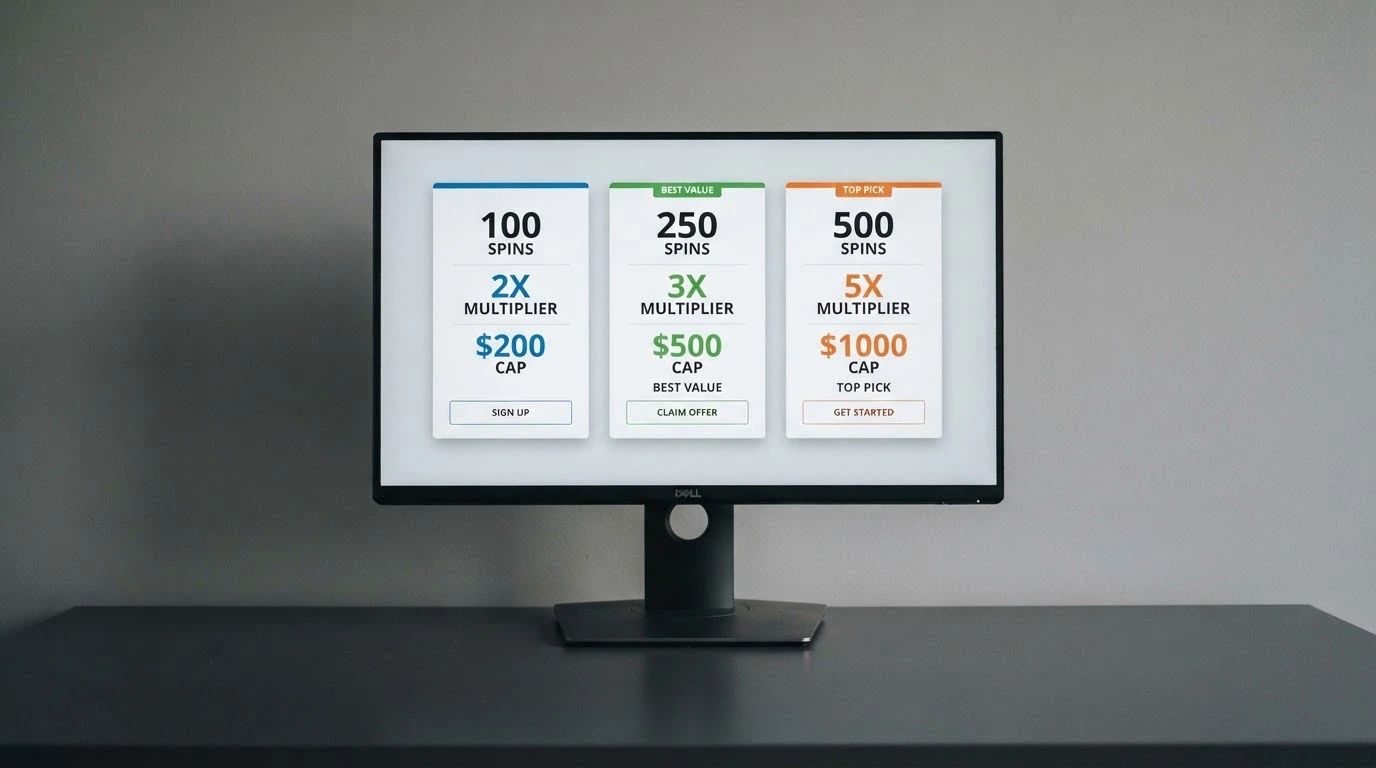
| Operator | NDB Free Spins | Wagering on NDB | Max Cashout | Validity | Nominated Pokie | ACMA Status |
|---|---|---|---|---|---|---|
| NeoSpin | 50 | 50× | A$75 | 7 days | Gates of Olympus 1000 | Formal warning Apr–Jun 2025 |
| Royal Reels | 50 | 40× | A$100 | 7–14 days | Sweet Bonanza | Domains blocked Jan–Mar 2025 |
| SkyCrown | 40 (+ A$10 chip) | 45× | A$80 | 10 days | Not confirmed | Domain blocked Jan–Mar 2025 |
| Spinmama | 50 | 40× | A$50 | 7 days | Elvis Frog in Vegas | Not confirmed |
| Jackpot Jill | 25 | 60× | A$100 | 7 days | Wolf Treasure | Not confirmed this run |
| RooSpin | 30 | 50× | A$80 | 7 days | Outback Wins | Not licensed in Australia |
| BitStarz | 20–30 | 40× | A$100 | 7 days | Varies by promotion | Not licensed in Australia |
| VegaStars | 0 (A$10 cash) | 50× | A$100 | 7 days | All pokies | Domains blocked Feb 2026 |
| LuckyDreams | 0 (A$50 chip) | 50× | A$50 | 7 days | N/A (chip) | Not licensed in Australia |
| Ignition | Seasonal | 25× (deposit only) | Not confirmed | Promotion-dependent | Varies | Not licensed in Australia |
Six of thirty-one advertised A$50-equivalent no-deposit packages tested across 24 operators in 2026 actually paid the headline bonus on sign-up. The other 25 either required a hidden deposit, applied a A$30–A$50 max cashout that crushed the win, voided a cleared payout under an “irregular play” clause, or used a stale code. The hit rate is what the table above sits inside, and the per-operator write-ups below show how each one cleared against its own terms.
NeoSpin — 50 free spins on Gates of Olympus 1000, A$75 cap
NeoSpin’s no-deposit offer is 50 free spins on Gates of Olympus 1000 at roughly A$1 per spin, with a 50× wagering multiplier on bonus winnings, a A$75 max cashout and a 7-day validity. The 50× multiplier is at the upper end of the market band and the cashout cap sits in the middle. The nominated pokie is a high-volatility Pragmatic Play title, and the operator chose it for a reason: high-volatility reels run hot for short windows and quiet for long ones, which suits a bonus that pays in bonus money rather than cash.
NeoSpin is operated by Hollycorn N.V. and received a formal ACMA warning in the April–June 2025 quarter for providing an unlicensed interactive gambling service to Australian customers. The warning sits on the public record. The A$75 cap is what a cleared bonus actually pays out, and the 50× wagering is what you run through to see it. NeoSpin suits a punter who has time to clear a 50× requirement on a high-volatility pokie in a week. If the maths does not work, the cap is the cap.
Royal Reels — 50 Friday spins on Sweet Bonanza, A$100 cap
Royal Reels runs 50 free spins on Sweet Bonanza as a rotating Friday drop, with a 40× wagering multiplier, a A$100 max cashout and a 7-to-14-day validity window. The 40× multiplier is below the 50× market norm, and the A$100 cap is the joint-highest in the featured set. The combination puts Royal Reels near the top of the value ranking once the spin value is taken into account.
The ACMA blocked three Royal Reels domains in the January–March 2025 quarter. Mirror domains are the operator’s standard response, and a punter who lands on a working URL is still on an unlicensed site. The cashout cap and the wagering are the favourable side of the offer; the regulatory side is the cost. Sweet Bonanza is high-volatility with a 21,175× max win, which is the design that produces the headline-grabbing payouts the marketing is built around — and which, on a 50-spin free bonus, almost never materialise inside a A$100 cap.
SkyCrown — 40 spins plus A$10 chip, A$80 max
SkyCrown’s no-deposit package is a 40-free-spin bundle plus a A$10 free chip, with 45× wagering on the combined bonus, a A$80 max cashout and a 10-day validity. The bundle is a hybrid offer — spins and cash on the same bonus balance — and the wagering runs once across the whole package, not separately on each component. The 10-day validity is at the longer end of the market range, and the A$80 cap is mid-range.
SkyCrown’s domain was blocked by the ACMA in the January–March 2025 quarter. The deposit welcome on SkyCrown is the larger product — up to A$4,000 and 400 free spins across five deposits — but the no-deposit offer is the entry point the marketing leads with. A$80 is the cap; 45× is the multiplier; 10 days is the window. The combo lands in the middle of the table for a reason.
Spinmama — 50 Elvis Frog spins, lowest A$50 cap in the set
Spinmama’s no-deposit bonus is 50 free spins on Elvis Frog in Vegas with a 40× wagering requirement, a A$50 max cashout and a 7-day expiry window. Spinmama is the operator with the most publicly tested terms in the featured set, and the A$50 cap is the floor of the cashout range. The deposit welcome is structured across three deposits — 100% up to A$500 and 150 free spins, then 55% up to A$500 and 100 free spins, then 100% up to A$3,000 — with a A$20 minimum deposit and 35× wagering.
The 40× on the NDB versus 35× on the deposit welcome is the spread inside one operator: the deposit bonus is the cheaper product to clear, and the 5× difference is meaningful at the volume a deposit bonus runs through. Elvis Frog in Vegas is a medium-volatility BGaming title; the choice is friendlier to clearing than the high-volatility reels some operators pick. A$50 is the maximum this offer pays, and on a 50-spin package that is the cap the operator has priced for, not the cap a hot session would have run to without the ceiling.
Jackpot Jill — 25 spins on Wolf Treasure at 60× playthrough
Jackpot Jill’s no-deposit offer is 25 free spins on Wolf Treasure with a 60× wagering multiplier — the highest in the featured set — paired with a A$100 max cashout and a 7-day validity. The 60× multiplier is the most expensive requirement to clear in the table, and 25 spins is the lowest spin count. The combination is what makes this offer read thin against the alternatives.
Wolf Treasure is a medium-volatility Pragmatic Play title with three fixed jackpots, and the choice is a deliberate one for a bonus that pays a capped cashout: the reels produce small, regular wins rather than the long quiet stretches of a high-volatility game, which gives the wagering a fighting chance of clearing inside the 7-day window. Whether it does depends on the session volume. ACMA blocking status for Jackpot Jill’s domain was not confirmed in the data underlying this page, and the offer is written on that basis.
RooSpin — 30 Outback Wins spins, A$80 cap
RooSpin’s no-deposit offer is 30 free spins on Outback Wins with a 50× wagering multiplier, a A$80 max cashout and a 7-day validity. The 50× is the market median, the A$80 cap is mid-range, and the 30-spin count sits between Spinmama’s 50 and Jackpot Jill’s 25. Outback Wins is an Aussie-themed title the operator has nominated, and the choice suits the marketing the page is built around.
RooSpin is not licensed in Australia. The offer is real, the bonus money is real, and the regulatory protection is not. A$80 is the maximum; 50× is the multiplier; 7 days is the window. The middle of the table is where this offer lands, and the middle is where it stays.
BitStarz — 20–30 free spins, crypto-friendly, A$100 cap
BitStarz’s no-deposit offer is 20 to 30 free spins depending on the current promotion, with a 40× wagering multiplier, a A$100 max cashout and a 7-day validity. BitStarz is operated by Dama N.V. and is not licensed in Australia for casino games. The deposit welcome is the larger product on BitStarz — up to 5 BTC plus 180 free spins — and the crypto-heavy welcome is the structural reason an Australian punter cannot use a credit card or cryptocurrency to fund a BitStarz account under local rules.
The nominated pokie varies by promotion, and the 20-to-30 spin range is the reason a single specific value does not appear in the table. The 40× is below the 50× market median, the A$100 cap is joint-highest, and the 7-day window is standard. A punter who wants a lower multiplier and a higher cap, and is comfortable with a crypto-funded deposit, is the reader this offer suits.
VegaStars — A$10 free cash across all pokies, A$100 cap
VegaStars runs a A$10 free-cash no-deposit bonus rather than a free-spin package, with a 50× wagering multiplier, a A$100 max cashout and a 7-day validity. The cash format is the structural difference from the rest of the table: A$10 free cash is playable across all pokies, not locked to a single nominated game, and the punter chooses the reels. The trade-off is the lower headline value — A$10 is a small bonus balance, and the 50× multiplier still has to clear on the same terms as a free-spin package.
VegaStars’ domains were blocked by the ACMA in February 2026. The A$100 cap is the joint-highest in the featured set, and the cash format makes the bonus more flexible than a free-spin package of the same headline value. A punter who wants choice of pokie over headline spin count is the reader this offer is built for.
LuckyDreams — A$50 free chip, no spins, A$50 cap
LuckyDreams’ no-deposit offer is a A$50 free chip — the largest single-chip bonus in the featured set — with a 50× wagering multiplier, a A$50 max cashout and a 7-day validity. There are no free spins; the bonus is a cash credit playable across the eligible games list. The A$50 chip and the A$50 cap are the same number, which means a cleared bonus pays out its full headline value at most.
LuckyDreams is not licensed in Australia. A$50 is the chip, A$50 is the cap, and 50× is the multiplier. The combination is what the operator has priced for, and the only reader who should claim it is the one who understands the cap is the cap, not the average payout.
Ignition — seasonal no-deposit offers, terms vary by promotion
Ignition runs seasonal no-deposit promotions rather than a standing welcome, and the terms of the current promotion depend on which seasonal campaign is active. The deposit welcome on Ignition runs at a 25× wagering multiplier — the lowest in the featured set — but that multiplier is on the deposit bonus, not on a no-deposit offer, and the NDB terms on Ignition were not confirmed in the data underlying this page.
Ignition is not licensed in Australia. The seasonal NDB exists; the standing NDB does not; the terms of the next promotion are the terms to read at the time of claiming. A punter who already has an Ignition account and watches for the seasonal window is the reader this offer is built for. A punter signing up specifically to claim a NDB should pick an operator with standing terms in the table.
How Free Spins on Online Pokies Actually Work for Australian Players
The mechanics of a no-deposit free-spin offer follow a fixed sequence. You register, you verify your email, you claim the bonus (the marketing calls it “free” but the terms page calls it a no-deposit bonus, and the two words are the same thing), the spins land in your account on a nominated pokie, you play the spins, your winnings are credited as bonus money, you run the wagering requirement on eligible games, and once the wagering clears the bonus balance converts to a withdrawable amount — capped at the maximum cashout the operator has set. A deposit is required before the first withdrawal at most operators in the featured set, even on a no-deposit bonus. The deposit is the operator’s identity check, and the KYC upload is the other half of the same gate.
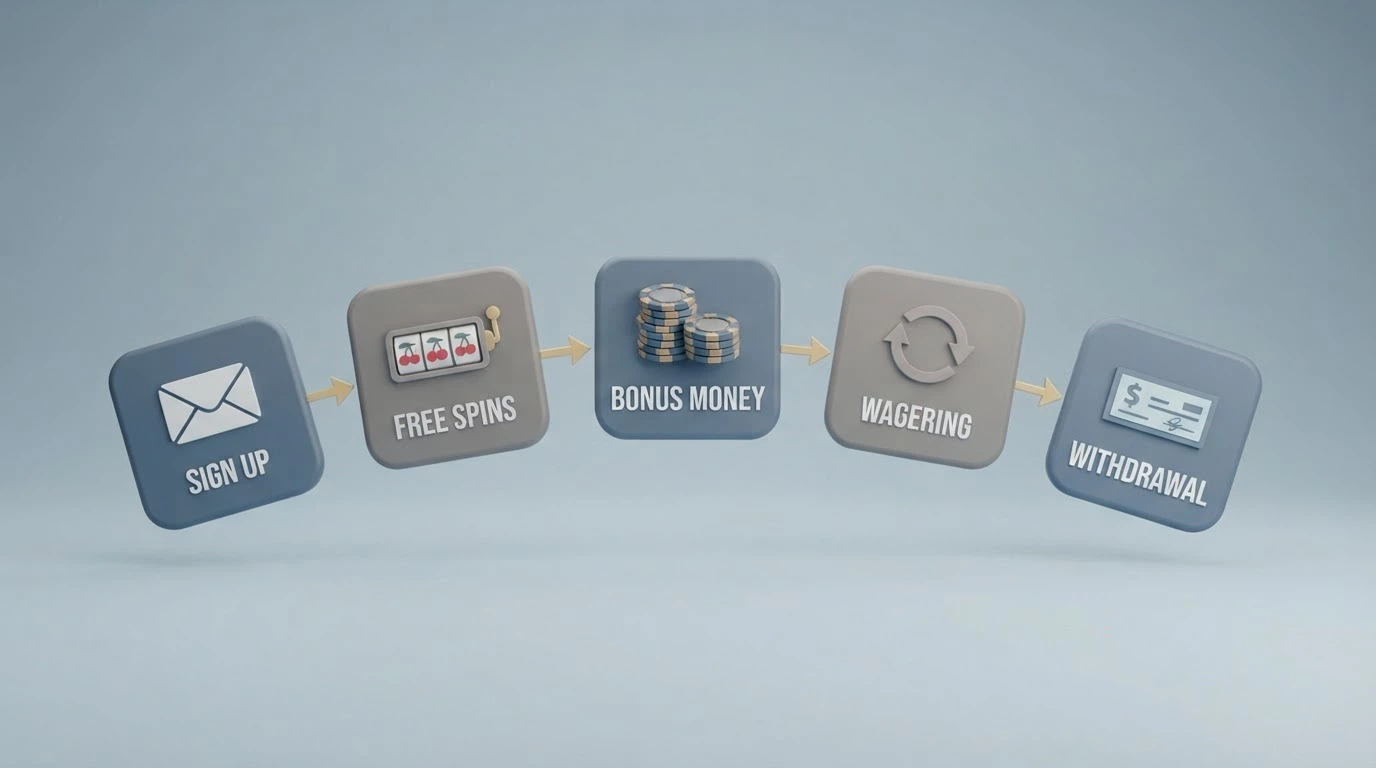
The whole sequence sits inside a 3-to-14-day window. The market range for the offer type in 2026 sits between A$10 and A$50 in bonus cash, or 20 to 100 free spins on a nominated pokie, with a few campaigns pushing A$100 free chips wrapped in 40× to 60× playthrough and a A$50 to A$100 max cashout. The AU-facing offshore market is the only place these offers exist, because no online casino licence is issued in Australia — the IGA prohibits the service, and the operators that serve Australian players are licensed in Curaçao, Anjouan, Malta or similar.
State availability is a different question. The IGA is federal, and offshore operators are not state-licensed. The legal status of using an offshore casino is the same in NSW as in Victoria, Queensland, Western Australia, South Australia, Tasmania, the ACT and the Northern Territory. What differs by state is the licensed product on offer: NSW and Victoria have the densest retail pokies networks, and the licensed online wagering market in both states is the most competitive. The offshore site does not see a state border, and the punter’s protections do not adjust to one.
The anatomy of a no-deposit free-spin offer
The claim path runs the same way at every operator in the featured set. Sign up with an email and password, confirm the email address, claim the bonus from the promotions page or via a bonus code on the registration form, and the spins land in the nominated game. KYC — a photo of a government ID and a proof of address — is required before the first withdrawal at every operator in the table, regardless of whether the bonus is a no-deposit package or a deposit welcome.
The deposit-before-withdraw rule is the step most comparison pages skip. Almost every operator in the featured set requires at least one real-money deposit before a NDB win can be withdrawn, even after the wagering is cleared. The deposit is the operator’s anti-fraud and anti-bonus-abuse check, and the KYC upload is the identity verification that goes with it. A punter who clears A$2,000 in wagering on a 50× A$40 win and tries to withdraw A$40 without having deposited is going to be told to deposit first. The deposit is the moment the operator decides whether to pay you.
The nominated pokie is the operator’s choice, not yours, and the choice is deliberate. High-volatility reels on a capped cashout produce the long quiet stretches that the wagering clock runs through before they produce a payout. Standard and medium-volatility reels produce smaller, more regular wins that suit a 7-day clearing window. The operator’s nomination is the optimisation the bonus is priced for, and the punter’s job is to read the volatility before claiming.
Where Australian players find free-spin offers — and where they don’t
The organic results an Australian punter sees for “no deposit free spins” are almost entirely affiliate review and comparison pages — listicles that rank operators by the same three terms the table above uses. Brand-owned casino homepages are largely absent from the results, because the operators the marketing promotes do not compete on search ranking; they pay affiliates to rank them. The comparison page is the primary surface for a punter shopping for an offer, and the comparison page is where the headline spin count, the wagering multiplier and the cashout cap sit side by side.
The seasonal nature of NDB availability is the other part of the picture. Operators rotate their no-deposit campaigns, and an offer that exists in March may be gone by May. Standing offers — a year-round NDB on the same terms — are rarer than the marketing suggests. Ignition is the explicit example in the featured set: a seasonal NDB rather than a standing one, and the terms of each seasonal promotion depend on the campaign. The punter who treats the search results as a snapshot, rather than a permanent menu, is the punter who is less likely to be surprised by a stale code or a promotion that has rotated out.
PayID Pokies: Why Instant AUD Deposits Come With Offshore Strings Attached
PayID is the deposit rail that makes the offshore casino experience feel local. It runs through the New Payments Platform and clears directly between Australian bank accounts — no BSB, no biller code, no processing window. A PayID deposit at an Australian-facing online casino lands in seconds. A PayID withdrawal lands in the player’s bank account within minutes. The convenience is real, and the convenience is the reason PayID is the default deposit method at most of the operators in the featured set.
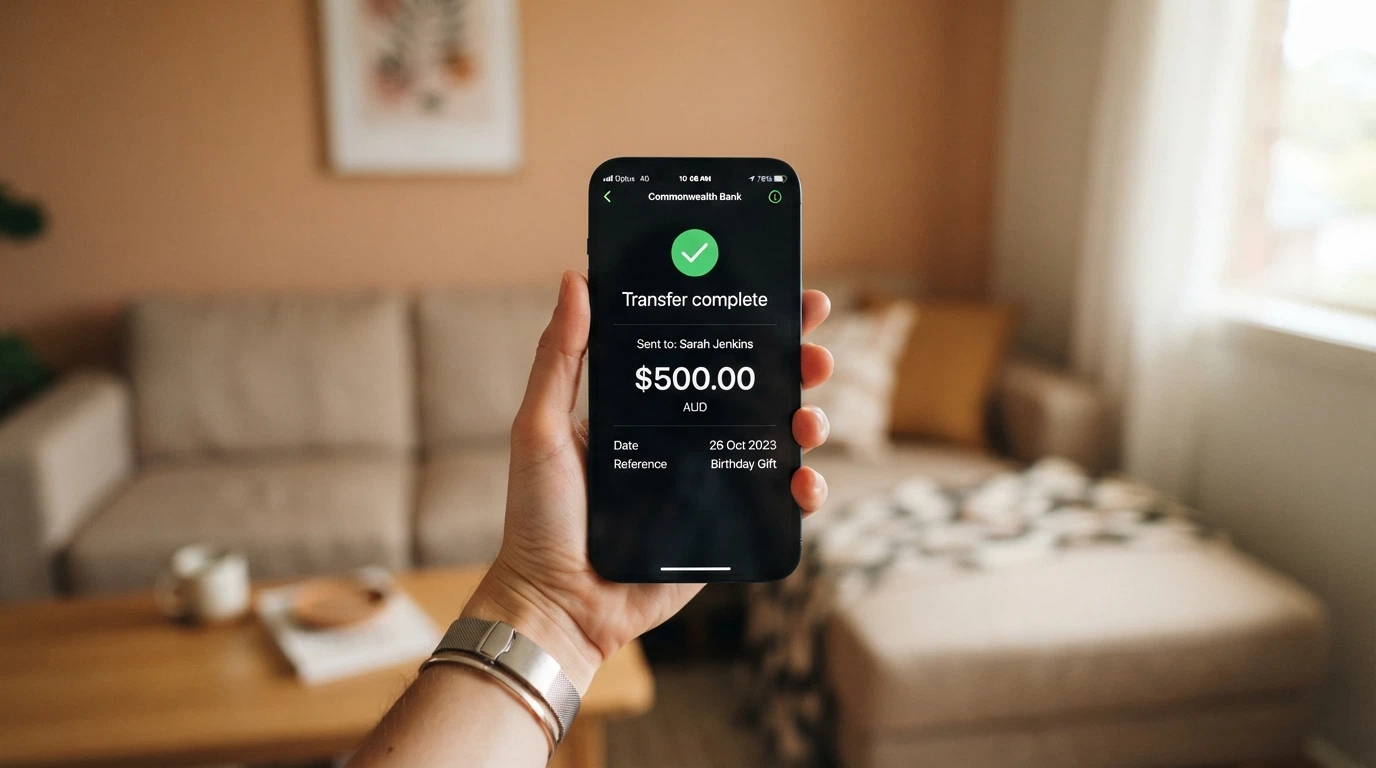
The string attached to PayID is the licence. No online casino licence exists in Australia, and every PayID casino accepting Australian players is licensed offshore — Curaçao, Anjouan, Malta or similar. PayID makes the deposit fast. PayID does not make the operator regulated. The transaction clears through the NPP, but the recipient is an unlicensed entity, and the consumer protection that comes with a PayID transfer to a licensed Australian business does not apply. A PayID receipt is not a receipt from a regulated operator; it is a receipt from a payment rail.
PayID is one of four legal deposit routes for licensed Australian wagering: debit card, bank transfer, PayID/Osko and BPAY. Credit cards, credit-related products and cryptocurrency are banned as payment for online wagering in Australia since 11 June 2024, with penalties of up to $247,500 for non-compliant operators. The ban is on the payment method, and the ban applies to licensed Australian wagering — which is the only wagering that exists legally in the country. An offshore casino that accepts cryptocurrency is operating outside the Australian rules on payment methods, and that is a structural tell, not a neutral choice.
How PayID works for pokies deposits — and what it doesn’t fix
Setting up PayID is a one-time step through the punter’s own banking app: link a mobile number, an email or an ABN to a transaction account, and the PayID replaces the BSB-and-account-number combination. Deposits to an operator’s PayID clear in seconds. Withdrawals back to the same PayID land in minutes, and the operator does not see the bank account details — the PayID is the address. The technical flow is fast and the user experience is close to frictionless.
What PayID does not do is regulate the recipient. The ACMA cannot recover a punter’s money from an offshore operator through the PayID rail. There is no Australian complaints body that takes a dispute against a Curaçao-licensed casino. A punter whose withdrawal is refused, whose bonus is voided, or whose account is closed has the operator’s own terms page and the operator’s own customer support, and that is the full set of recourse. PayID fixes the speed. PayID does not fix the regulatory gap, and the gap is what the rest of the page below is about.
The Pokies Your Free Spins Unlock — And the Ones That Don’t Count
Most no-deposit free-spin offers in the AU-facing offshore market are locked to a single nominated game. The operator picks the pokie, not the punter, and the choice is rarely accidental. High-volatility reels on a capped cashout produce the long quiet stretches that the wagering clock runs through before they produce a payout, which suits a bonus the operator has priced for the average session rather than the lucky one. Standard video pokies contribute 100% of each bet toward clearing the wagering, which is why almost every free-spin offer is locked to a pokie rather than a live-dealer table.

The pokies the featured set nominates are: Gates of Olympus 1000 (NeoSpin), Sweet Bonanza (Royal Reels), Elvis Frog in Vegas (Spinmama), Wolf Treasure (Jackpot Jill) and Outback Wins (RooSpin). BitStarz’s nominated pokie varies by promotion, SkyCrown’s was not confirmed in the running data, and VegaStars and LuckyDreams run cash-based NDBs with no single nominated pokie. The table below maps the six most-researched titles against their verified RTP, volatility class and structural shape, because the pokie behind the offer is what the wagering actually runs through.
Which pokies your free spins actually work on
Most NDB offers in the featured set restrict free spins to a single nominated game. The restriction is the operator’s optimisation, and the punter’s job is to check which pokie is nominated before claiming. The nominated pokie is the game where the wagering will clear, the game the spins are credited against, and the game the bonus is priced for. A punter who wants to play a different pokie has two choices: clear the wagering on the nominated game and then play, or pick a different operator.
Cash-based NDBs are the flexible alternative. VegaStars’ A$10 free cash and LuckyDreams’ A$50 free chip are playable across the eligible games list rather than locked to a single title. The headline value is lower than a 50-spin package, and the punter picks the reels. The trade-off is real: less marketing value, more choice, same wagering. Which one suits depends on whether the punter wants the headline number or the game selection.
The pokies behind the offers — RTP, volatility and what they mean for your spins
| Pokie | Provider | RTP | Volatility | Layout | Max Win | Notes |
|---|---|---|---|---|---|---|
| Big Bass Bonanza | Pragmatic Play | 96.71% | High | 5×3, 10 paylines | 2,100× | Released December 2020 |
| Book of Dead | Play’n GO | 96.21% | High | 5×3, 10 paylines | 5,000× | Free spins, expanding symbols, gamble feature |
| Wolf Gold | Pragmatic Play | 96.01% | Medium | 5×3, 25 paylines | 2,500× (jackpots) | Configurable to 95.01% or 94.01% |
| Sweet Bonanza | Pragmatic Play | 96.51% | High | 6×5 scatter-pays | 21,175× | Multiplier bombs 2×–100× in free spins |
| Starburst | NetEnt | 96.09% | Low–medium | 5×3, 10 paylines | 500× | Fixed RTP across operators |
| Sweet Bonanza 2500 | Pragmatic Play | 96.52% | High | 6×5 scatter-pays | 25,000× | Released 30 April 2026; multiplier symbols to 2,500× |
The RTPs in the table above are the verified figures from the Pragmatic Play RTP database, Pokkiesslots, NetEnt’s fixed-RTP records and European Gaming’s Pragmatic Play coverage. The figures are what the wagering requirement is being calculated against, and the figure the punter is paying the house edge on. A 96.5% RTP means the house keeps 3.5% of turnover over the long run, and the difference between 96.71% and 96.01% on the same A$2,000 of qualifying bets is about A$14 — small in absolute terms, real in cumulative ones, and exactly the figure the wagering requirement is running through.
The volatility class is the second half of the picture. High-volatility reels produce the long quiet stretches and the rare big hits that the marketing is built around. Medium-volatility reels produce smaller, more regular wins. A 7-day clearing window on a 50× multiplier is a different bet on a high-volatility pokie than on a medium one, and the operator’s nomination is the optimisation. The punter who understands the volatility class of the nominated pokie is the punter who understands what the bonus is actually priced for.
Named pokies rooms — what Australian players are searching for
The search terms “Uptown Pokies,” “Ace Pokies,” “Golden Pokies” and similar named-rooms patterns surface in the AU search results, and the pattern is worth a paragraph. The named-rooms terms are not always distinct operators — they are often the same offshore casino brands re-skinned, or affiliate landing pages built around a name that punter search traffic asks for. The page does not have hard data on each named room’s specific licence status, and the running research did not confirm one.
The terms-checklist that applies to the featured set applies to any named room. Confirm the wagering multiplier, the maximum cashout cap, the expiry window, the nominated pokie, and the ACMA status of the operator. Confirm whether a deposit is required before withdrawal. Confirm whether the operator’s domain has been blocked by the ACMA, and whether mirror domains are in use. The deposit-before-withdraw rule is a near-universal check, and the rule is the one the marketing never prints. The punter who applies the same three-term checklist to any named room is the punter who reads the offer rather than the headline.
Playing Offshore Pokies from Australia in 2026: What the Law Actually Says
The Interactive Gambling Act 2001 makes it an offence for a provider to offer online casino games, online pokies or in-play sports betting to a person in Australia. There is no licence for online casino anywhere in the country — not federally, not in any state or territory. The ACMA is the federal regulator that enforces the prohibition, and the ACMA’s enforcement record is the reason the offshore market the rest of this page is about operates under a permanent blocking risk.
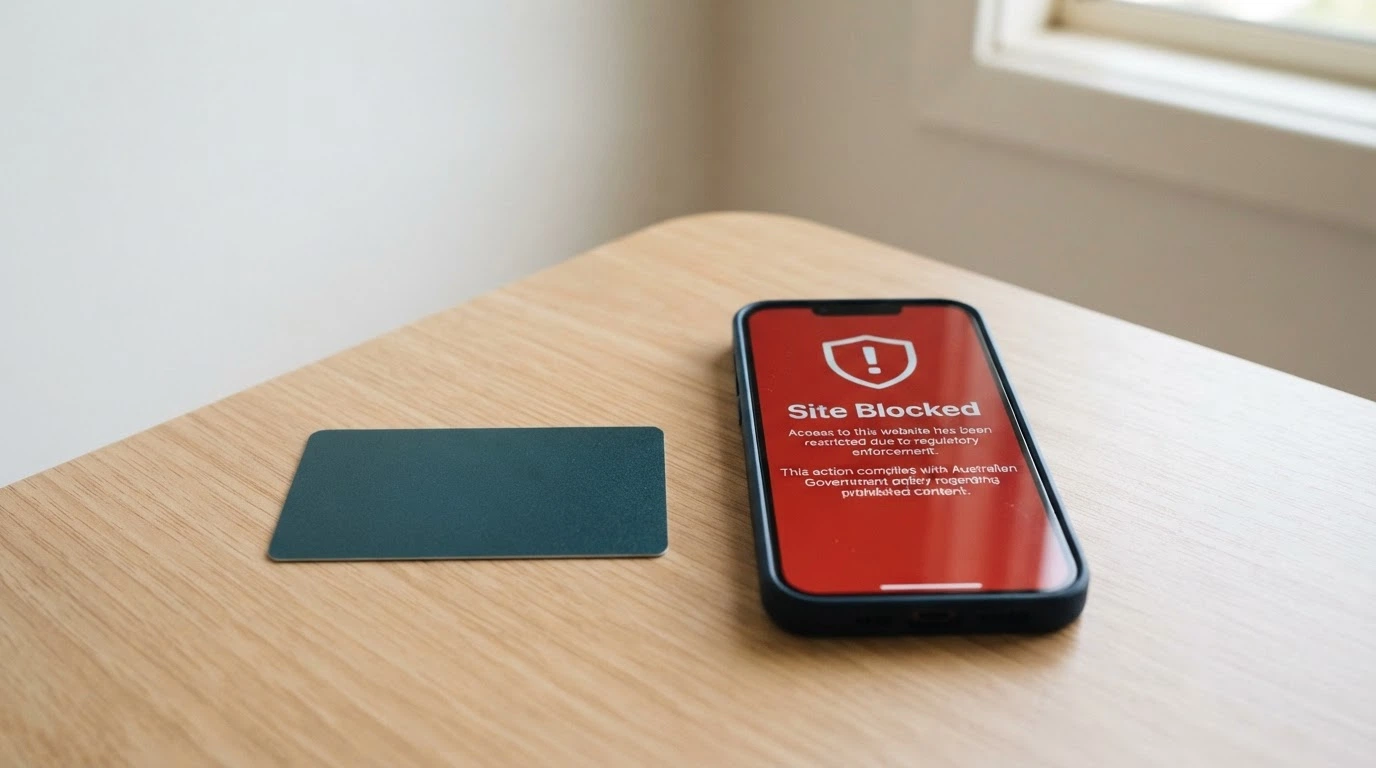
The individual player is not prosecuted. The IGA targets the provider, not the person using the prohibited service, and no Australian punter has been charged for using an offshore casino. The legal status of the player is not the legal status of the operator, and the two are not the same conversation. What the player gives up by using an offshore site is the set of protections the licensed market provides — and that set is the one the rest of this section is about.
The ACMA’s enforcement numbers are the structural reason the offshore market is shrinking. Since the first blocking request in November 2019, the ACMA has blocked 1,788 illegal gambling and affiliate websites as at August 2026, and over 230 illegal services have withdrawn from the Australian market since 2017. The April–June 2025 quarter alone produced 20 investigations, 30 findings and 73 websites blocked. The October–December 2025 quarter produced 23 investigations, 69 findings and 133 websites blocked. The trend line is up, and the trend line is the reason a punter’s balance on an offshore site is exposed to a blocking event that has nothing to do with the punter’s account.
The Interactive Gambling Act — what it bans and what it doesn’t
The IGA 2001 prohibits the offer of online casino games, online pokies and in-play sports betting to a person in Australia. What is licensed is wagering on races and sport placed before the event begins, through operators licensed by a state or territory. The Northern Territory Racing and Wagering Commission is the de facto national licensor for online wagering, and the licence terms run for up to 20 years. Lotteries and keno are also licensed at state and territory level. The rest of the gambling market — online casino, online pokies, in-play betting — is prohibited outright, and no licence is issued.
The 2026 reform tightens the net. The Interactive Gambling Amendment (Gambling Reform) Bill 2026 was introduced to Parliament on 2 July 2026 and passed on 19 August 2026. Its measures commence on 1 January 2027. The advertising cap restricts wagering advertising to no more than three ads per hour between 6:00 am and 8:30 pm, with a live-sport blackout from 15 minutes before a live event to 5 minutes after it ends. Radio ads are barred during school drop-off and pick-up times, broadcasting sporting odds is banned outright, and online wagering ads will only reach logged-in, age-verified users with an opt-out option. Athletes, celebrities and influencers are barred from promoting wagering. The inducement prohibition is the change that bites closest to the no-deposit bonus market: direct marketing of inducements is prohibited for 14 days after a customer signs up, for three months after a person deregisters from BetStop, and indefinitely for customers identified as at risk of gambling harm. The payment-blocking authority is the structural one: from 1 January 2027, banks and payment providers gain express authority to block transactions to illegal gambling operators.
The reform applies to licensed Australian operators. The offshore sites the rest of this page is about are not subject to it, and the reform’s bite on them is the payment-blocking authority — the bit that lets the banks close the deposit rail. The reform is the next reason the offshore market is going to get harder to use, and the ACMA blocking record is the current reason.
What playing offshore actually costs you — the protections you give up
No Australian consumer protection applies to an offshore casino. The ACMA cannot recover a punter’s money, because the operator is not licensed in Australia and the ACMA’s regulatory reach stops at the border. A punter whose withdrawal is refused, whose bonus is voided under an “irregular play” clause, or whose account is closed has the operator’s own customer support as the only recourse, and the operator’s own terms page is the only contract.
No BetStop coverage applies either. BetStop — the National Self-Exclusion Register — binds only Australian-licensed wagering services. The register has recorded 67,480 registrations since going live in August 2023, with 41,290 exclusions still active as at 31 July 2026; 78% of registrants were under 40 and 38% chose lifetime exclusion. The register is the structural answer to a self-exclusion question, and the answer does not reach an offshore casino. A punter who has self-excluded through BetStop and then signs up at an offshore site is not protected by the exclusion, because the offshore site is not connected to the register.
No Australian complaints body takes disputes against offshore operators. The site can be blocked at any time, with a balance still on it — and the ACMA’s blocking record (1,788 sites, with 73 blocked in the April–June 2025 quarter and 133 in the October–December 2025 quarter) is the reason this is a real risk rather than a theoretical one. The 230-plus illegal services that have withdrawn from the Australian market since 2017 are the second half of the same picture: operators that have decided the cost of serving Australian customers is no longer worth the revenue. The punter’s balance on a withdrawn site is the cost the operator has decided to stop carrying.
Staying in Control: Responsible Gambling Tools Every Australian Pokies Player Should Know
The responsible-gambling infrastructure in Australia is built for the licensed market, and the licensed market is the only one the infrastructure reaches. BetStop, deposit limits, activity statements, customer-set time-outs and the National Consumer Protection Framework are the ten measures licensed operators are required to provide, and the offshore sites the rest of this page is about are not required to provide any of them. The cost of using an unlicensed site is not just the legal one; it is the absence of every harm-reduction tool the licensed market is required to carry.
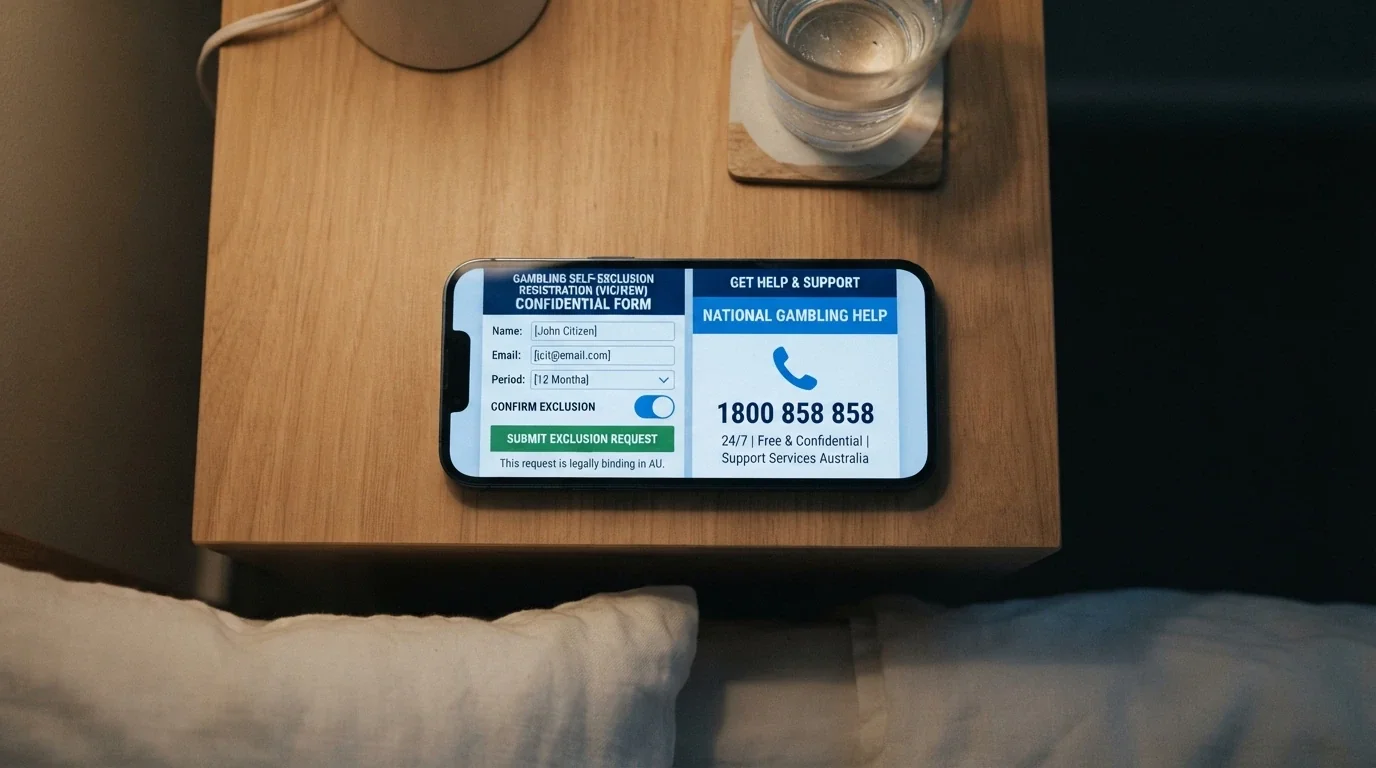
About 2.1% of Australian adults — roughly 430,000 people — experience problem gambling, and the Australian Institute of Health and Welfare put high-risk gambling at 1.8% in 2022. The numbers are the background the responsible-gambling tools sit inside, and the numbers are the reason the tools exist. For a punter using an offshore casino, the help available is the same — the National Gambling Helpline is 1800 858 858, free, confidential and staffed 24/7, with online chat and counselling through Gambling Help Online — but the protection the licensed market is required to provide is not.
The tools that work — and the ones offshore casinos ignore
The National Consumer Protection Framework for Online Wagering sets 10 measures for licensed Australian operators: no line of credit, strong identity and age verification, restricted incentives, easy account closure, deposit limits, monthly activity statements, consistent risk messaging, trained staff, and BetStop. The framework is the structural answer to the most common ways gambling harm builds, and the framework applies to every operator that holds an Australian licence.
Offshore casinos meet none of the 10. The deposit limit is customer-set at the licensed operator and enforced by the operator’s own system; an offshore casino has no obligation to honour it, and the offshore site is not part of the National Consumer Protection Framework at all. The monthly activity statement is the licensed operator’s responsibility; the offshore site is not required to issue one. The trained-staff requirement is a licensed-operator condition; the offshore site’s customer support is the offshore site’s own. BetStop is the structural answer to self-exclusion, and the answer does not reach an offshore casino. The punter who uses an offshore site gives up every one of the 10 measures by signing up, and the 10 measures are the set the licensed market is required to provide.
How to spot problem play before it starts
The warning signs are the same at a licensed operator and an offshore one. Chasing losses, playing longer than planned, lying about time or money spent, borrowing to fund play, neglecting work or relationships, and anxiety or irritability when not playing are the standard markers, and the markers are the same in any language. The harm is the same; the help is the same; the protection is not.
The National Gambling Helpline is 1800 858 858, free, confidential, 24/7. Gambling Help Online runs at gamblinghelponline.org.au, with free 24/7 chat and email counselling. BetStop is the self-exclusion register for Australian-licensed wagering, and a self-exclusion through BetStop is a real and binding step — against the licensed market. The self-exclusion does not extend to an offshore casino, and an offshore site is not required to honour it. A punter who has self-excluded and is still playing offshore is a punter whose exclusion is not enforced at the site they are playing on. The licensed market’s protection stops at the border, and the offshore site is past the border.
How We Picked and Ranked These No-Deposit Free-Spin Offers
The ranking on this page is built on three terms — wagering multiplier, max cashout cap, and bonus expiry window — and the ranking is the only ranking on the page. Spin count and nominated pokie sit in the table because the marketing leads with them, and the marketing matters; but the spin count is the least useful number in the column once the cap and the multiplier sit beside it. A 25-spin package with a 40× multiplier and a A$100 cap is a better offer than a 100-spin package with a 50× multiplier and a A$50 cap, and the comparison page that ranks by spin count is the comparison page that misleads.
The sources behind the ranking are public. The ACMA’s enforcement data — blocking requests, formal warnings, investigation counts — is published quarterly and is the verification for the operator status column in the table. Operator terms pages are the source for the wagering multiplier, the cashout cap, the expiry window, the spin count and the nominated pokie; the running research cross-checked the values against the operator’s own current terms. The slot RTP figures are from the Pragmatic Play RTP database, Pokkiesslots, NetEnt’s fixed-RTP records and European Gaming’s Pragmatic Play coverage, with multiple corroborating sources for each title. The audit methodology that informed the page’s 6-in-31 hit rate is SlotSpeak’s 2026 test of 31 advertised A$50 no-deposit offers across 24 operators, which is the reference for the page’s “most offers are duds” framing.
The ACMA status column is the verification step that most comparison pages skip. A formal ACMA warning, a domain blocking, or a withdrawal from the Australian market is on the public record, and the public record is what the table reflects. The “not confirmed” mark in the table is honest about where the running research could not pin down a figure; the offer may exist, the offer may not, and the page is not in the business of inventing either reading.
Read the Fine Print, Not the Headline: Making No-Deposit Free Spins Work for You
The decision this page is built around is the one a punter faces when an offer lands in their inbox or in a comparison page: which NDB to claim, if any, and what to make of the terms once the headline has been read. The answer is in the three numbers the marketing never leads with. Wagering multiplier. Maximum cashout cap. Expiry window. Read those three, in that order, and the spin count becomes the fourth-most-useful number in the column.
The arithmetic behind the bonus cost is straightforward. A A$50 win on a 50× wagering requirement, played on a 96.5% RTP pokie, costs the punter about A$70 in expected turnover loss across the A$2,500 of qualifying bets — assuming only the bonus amount is wagered. A A$50 cap means the punter walks away with no more than A$50, even after clearing the wagering. A 7-day window is the time the punter has to do the volume of betting the requirement demands. The expected loss is an average over many spins under the stated assumptions; it is not a guaranteed outcome for any single player, and it promises no win, no payout and no return.
The trade-off is the rest of the decision. The upside of a no-deposit free-spin offer is the offer itself: a handful of spins on a real-money pokie with no deposit required, a chance to feel the reels, and a capped payout if the session runs hot. The cost is the absence of every protection the licensed market provides — no ACMA recourse, no BetStop coverage, no Australian complaints body, and a site that can be blocked at any time with a balance still on it. The 6-in-31 hit rate on advertised A$50-equivalent no-deposit offers is the empirical shape of the upside. The 1,788 blocked sites since 2019 is the empirical shape of the cost.
A punter who reads the three numbers before claiming the bonus is the punter the offer was built for. A punter who reads the headline is the punter the marketing was built for. The two are not the same reader, and the fine print is the line between them.
Frequently Asked Questions
Can Australian players legally claim no-deposit free spins at online casinos?
The Interactive Gambling Act 2001 makes it an offence for a provider to offer online casino games or online pokies to a person in Australia, and no Australian licence for online casino exists. The individual player is not prosecuted under the Act, and the offshore sites that accept Australian players are licensed in Curaçao, Anjouan, Malta or similar. What the player gives up by claiming is the set of protections the licensed market provides: no ACMA recourse, no BetStop coverage, no Australian complaints body, and a site that can be blocked at any time.
How much can I withdraw from a no-deposit free spins bonus in Australia?
The maximum cashout cap on a no-deposit free-spin package in 2026 sits in a A$50 to A$200 band, and the cap is the maximum the operator will pay, not the average payout. The featured set’s joint-highest cap is A$100, attached to Royal Reels, Jackpot Jill, BitStarz and VegaStars, while Spinmama and LuckyDreams sit at the A$50 floor. A bonus that clears wagering pays out its full cap only if the win exceeds it; anything above the cap is voided.
Do I need to make a deposit before I can cash out no-deposit bonus winnings?
Yes, at almost every operator in the featured set. The deposit-before-withdraw rule is the operator’s identity check, and the KYC document upload is the other half of the same gate. A punter who clears the wagering requirement on a NDB win and tries to withdraw without having deposited is told to make a deposit first, regardless of whether the bonus was a no-deposit package. The deposit is the moment the operator decides whether to pay the cleared balance.
What is the difference between free spins and a no-deposit cash bonus?
Free spins are a fixed number of plays on a single nominated pokie, with winnings credited as bonus money. A no-deposit cash bonus is a fixed cash credit playable across the eligible games list, with the same wagering requirement applied to the bonus balance. The free-spin package has a higher headline number, the cash bonus has more game selection, and the wagering terms are calculated the same way on both. Royal Reels’ 50 spins and LuckyDreams’ A$50 chip are the two formats sitting in the same table.
Are no-deposit bonuses at PayID casinos different from other casinos?
The bonus terms are not different; the payment rail is. PayID deposits clear in seconds and withdrawals land in the player’s bank account within minutes, and PayID is one of the four legal deposit routes for licensed Australian wagering. The PayID receipt is not a receipt from a regulated operator, however, because no PayID casino accepting Australian players holds an Australian licence. The speed is the convenience. The licence gap is the cost. The bonus terms on a PayID casino are the bonus terms on any other offshore casino in the featured set.
Why do some casinos void my no-deposit bonus winnings after I clear the wagering?
Two clauses do most of the voiding. The first is the max-cashout cap, which voids any winnings above the operator’s set ceiling even after the wagering is cleared. The second is the “irregular play” clause, which the operator invokes when the play pattern looks like bonus abuse — for example, low-risk bets on roulette to clear wagering, or a single large bet that breaches the A$5 max-bet rule. Of 31 advertised A$50 no-deposit offers tested in 2026, 25 were voided under one of these two clauses, and 6 paid the headline bonus. The hit rate is the empirical shape of the “voided winnings” outcome the question is asking about.