
Best Casino in Canberra: Inside the ACT’s Only Licensed Venue
 Available in AU
Canberra is not a casino town. There is no strip, no second licence waiting in the wings, and no online alternative sitting behind a paywall the law recognises. The search for the “best casino in Canberra” has, in practice, only one answer: Casino Canberra at 21 Binara Street, in the heart of Civic. It is the only place in the Australian Capital Territory where you can sit down at a live gaming table, and it has held that monopoly since opening on 29 July 1994.

This page is a full review of that single venue, written for someone weighing whether to go tonight. It covers the gaming floor in detail — 39 tables, 200 electronic gaming machines, the venue’s own Canberra Poker variant, and the only blackjack rules of their kind in the country. It walks through the dining, the function spaces, and the three partner hotels that stand in for the on-site accommodation Casino Canberra does not have. It sets the venue against the bigger Australian casinos — Crown Melbourne, The Star Sydney, and the regional alternatives — to make clear what you gain and what you give up by choosing Civic over Sydney or Melbourne.
A note on the data up front. The information below is current as of 18 October 2026 and was checked against the ACT Gambling and Racing Commission’s public register, the Casino Control Act 2006 and Gaming Machine Act 2004, the venue’s own site, and ACMA enforcement records. Prices, table availability and tournament schedules change faster than a published article can track; the underlying licence position, regulatory caps and game mix do not.
Table of Contents
- Casino Canberra at a glance — the ACT’s only licensed casino
- What you can actually play — 39 tables, 200 machines and a poker lounge
- Where to stay — three partner hotels, zero on-site rooms
- How Casino Canberra measures up against the country’s biggest casinos
- The rules behind the roulette wheel — what ACT law lets you do
- Staying in control — help and harm reduction in the ACT
- How we picked and reviewed — our methodology
- Is Casino Canberra worth your night out?
- Frequently asked questions
Casino Canberra at a glance — the ACT’s only licensed casino
Casino Canberra sits at 21 Binara Street, Canberra ACT 2601, in the city’s central business district. It opened on 29 July 1994 as the first legal casino in the ACT and remains, more than thirty years later, the only venue in the territory licensed to operate gambling tables. The doors open at 12pm and close at 4am, every day of the week, in line with the territory rule that requires all Canberra venues to close for at least five hours in every 24. The phone line is +61 2 6243 3700. The door policy is “No ID, No Entry” — a real one, not a marketing line — meaning anyone who cannot produce identification on request will not pass the threshold. For a CBD venue the size of Casino Canberra, the entrance gating is stricter than many of the bigger state-licensed resorts.
The venue is operated by Casino Canberra Limited, which holds the casino licence under the Casino Control Act 2006. It is owned by Iris Capital, which purchased it from Aquis Entertainment for AU$63 million in a deal completed in January 2023. Aquis had run the venue since 2014, when Hong Kong businessman Tony Fung’s Aquis Group sold it on.
The compact footprint is the defining feature. Casino Canberra is not a resort; it is a gaming floor with two restaurants, two bars, a poker lounge, and a function wing. There is no hotel, no theatre, no auditorium and no retail concourse. What it offers instead is convenience: a walk-up CBD venue for Canberra residents, a familiar room for the city’s conference trade, and a poker and blackjack offering with rules you will not find at any other Australian casino. Whether that is “best” depends on what you came for — and the rest of this page is built around answering that question honestly.
Where it is and how to get there
The address, 21 Binara Street, places the venue on the southern edge of Civic, Canberra’s commercial centre. The building sits on land excised from Glebe Park under a 99-year lease between the casino licensee and the ACT Government, which is why Crowne Plaza Canberra can claim a “peaceful park setting” while being genuinely next door. The National Convention Centre is roughly a six-minute walk, which makes Casino Canberra a viable after-hours option for delegates already in town for an event at the Centre — close enough that the trip is a matter of crossing one or two city blocks, not a separate outing.
Parking and public transport are the practical considerations. The CBD has paid parking within walking distance and ACTION buses running along Northbourne Avenue and City Walk; rideshare pickup is straightforward from Binara Street itself. Visitors driving in from outside the ACT should note that the venue is in the city’s central grid, and that the casino’s own parking arrangements are limited — most patrons use adjacent public car parks or the Crowne Plaza’s secure underground facility, which is accessible to non-guests for a fee. There is no expectation that you arrive in a particular way; there is an expectation that you arrive with identification.
Opening hours and when to visit
Casino Canberra opens at 12pm and closes at 4am, every day. The five-hour closure rule is a territory-wide condition, applied uniformly to gaming venues in the ACT, and Casino Canberra’s 12pm-to-4am window is built around it: the venue must be dark by 4am and cannot reopen before 9am, leaving the early-morning and breakfast hours outside the trading day. The day begins at noon and ends in the small hours.
For most visitors the practical window is the evening. The first two or three hours after opening tend to be quieter, with the floor filling up from around 6pm onwards. Friday and Saturday nights are the busiest, particularly around the poker lounge and the bar areas; weekday evenings are calmer and the table minimums easier to access. Tournament nights — blackjack, mini baccarat and roulette — attract their own crowd and tend to run on a regular schedule posted on the venue’s own site. For a first visit, a weeknight is the easier room to learn: shorter wait at the cashier, more space at the tables, and a better chance of getting a $5 blackjack seat without queueing.
Who owns Casino Canberra — from Aquis to Iris Capital
Casino Canberra’s ownership has turned over twice since 2014. Aquis Entertainment purchased the venue in 2014 from Tony Fung’s Aquis Group, and ran it for the better part of a decade. The company made an unsolicited $330 million bid to redevelop the casino precinct — a project that would have transformed the venue into a much larger integrated resort — but the ACT Government rejected the proposal, and the breakdown in negotiations hinged on a small set of issues that have shaped what Casino Canberra is today.
The first was the legislative framework: under the 2017 amendments, Casino Canberra was eligible to acquire up to 200 poker machines and 60 fully automated table game terminals, subject to redevelopment and harm-minimisation conditions. Aquis wanted 500. The second was land: the Government declined to make additional land available, which closed off several of the larger development options. The result was a venue that gained its 200 EGMs in 2017 but otherwise stayed close to its original footprint.
In January 2023, Aquis sold Casino Canberra to Iris Capital for AU$63 million. Iris Capital is the private investment vehicle of Sydney-based operator Sam Arnaout, and the acquisition added the ACT’s only casino to a portfolio that already includes several pub and hotel operations. The transition came with ongoing financial pressure: Casino Canberra reported a loss of $2,553,772 for the six months to 30 June in the reporting period cited, while talks with the ACT Government about development possibilities continued. As of 2026, the venue remains a compact CBD property with no announced expansion on the same scale as the rejected Aquis bid. The door still says “Casino Canberra.” The website now describes it as “proudly part of the Iris Capital family.”
Dining, bars and what’s on the menu
Two distinct restaurants sit under the one roof. Natural Nine is the refined end of the offering: a pop Chinese restaurant, with a per-head spend of roughly $40–60 and a kitchen open for lunch from 12pm to 2pm and dinner from 6pm to 9pm. The signature dishes are recognisably Chinese-Australian — Black XO Prawns, Spicy Mixed Seafood Hot Pot — and the room itself is set up for a sit-down meal rather than a quick bite. It is the venue to book if a Casino Canberra night out is going to include a proper dinner.

The Onyx Sports Lounge is the other end of the spectrum. Pub classics, big screens for sport, and TAB facilities make it the casual room — the place to watch a match, place a bet between hands, or grab a counter meal without a reservation. The Chandelier Bar and the Onyx Lounge round out the bar offering, with the two spaces described on the venue’s own materials as the more “sophisticated” end of the drinks list. None of these are destination restaurants in the way a Crown or Star complex runs destination restaurants; they are in-venue facilities, sized for the floor they sit next to.
Functions and events at the Lotus Room
Casino Canberra runs four event rooms, with a total capacity of up to 310 attendees. The Lotus Room is the main function space and the one most often booked for large-scale events: corporate presentations, awards nights, Christmas parties, and conferences that want a private room with a bar attached. The Onyx Lounge doubles as a private function space for smaller corporate meetings, with large TV screens and a bar that can be opened for a networking-style event.
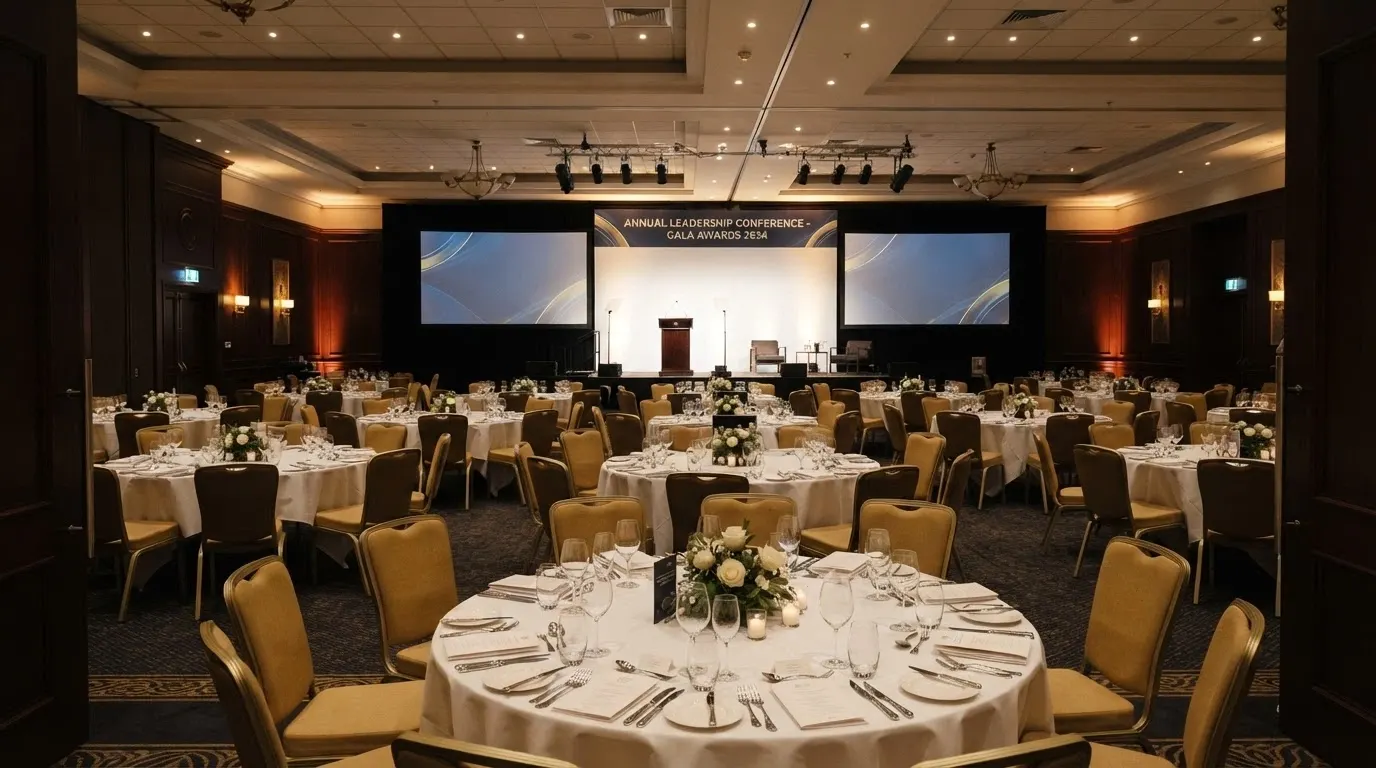
The function wing is not the main reason most visitors come to Casino Canberra, but it is the reason the venue sits on the Canberra MICE (Meetings, Incentives, Conferences and Exhibitions) circuit at all. The proximity to the National Convention Centre — roughly a six-minute walk — means a delegate staying overnight in Civic can step from one venue to the other without leaving the city block. The $750 million Canberra MICE precinct development moving through planning, with a full business case not expected until mid-2028, may eventually change what kind of function space Casino Canberra can offer. For now, the Lotus Room is what it is: a single function venue, well located, and unlikely to surprise anyone booking it.
Contact, membership and entry rules
The main switchboard number is +61 2 6243 3700. The venue operates a “No ID, No Entry” policy at the door, which means a current form of identification — driver’s licence, passport, or government-issued photo card — is required every visit, not just at sign-up. The dress code, where one is enforced, is the standard Australian casino standard of “smart casual” rather than a strict jacket-and-tie rule; the venue does not publish a detailed dress code, and the floor is generally relaxed about it.
Casino Canberra does run a membership programme for regular visitors, with the standard tiered structure of points-based rewards and event invitations that the venue’s own site describes in broad terms. Specific tier thresholds, point values and reward schedules are not published in a form that a one-off visitor can plan around, and they change often enough that a published list ages quickly. For a first-time visitor, the practical entry steps are: bring ID, walk in, register at the desk if you want a player card, and ask at the cashier about tournament entry if that is the night you came for. None of this is hidden or unusual; the venue’s onboarding is more like a hotel than a high-roller room.
What you can actually play — 39 tables, 200 machines and a poker lounge
The gaming floor at Casino Canberra is built around three distinct offerings. There are 39 live gaming tables spread across the main floor, running the full spread of Australian and Asia-Pacific casino games from blackjack to Pai Gow. There is a dedicated poker lounge, hosting the venue’s own Canberra Poker variant alongside conventional poker and a TAB-equipped sports lounge. And there are 200 electronic gaming machines, all of them operating under the most restrictive bet-limit regime of any Australian casino. The mix is unusual: most Australian casino floors of this size run closer to half their gaming revenue from EGMs, but Casino Canberra is — by design and by statute — limited in how those machines can be configured.
The 39 tables cover the standard Australian offering: Blackjack, Baccarat, Roulette, Poker, Pai Gow, Money Wheel, Pontoon, and the venue’s own Canberra Poker. The main floor “hosts over 30 of the world’s most popular table games,” per the venue’s own listing, which sits in the same neighbourhood as the 39-table count once electronic table game terminals are included in the spread. For a CBD venue, that is a serious range; it is also notably narrower than what Crown Melbourne or The Star Sydney run, where a single casino can field several hundred tables.
Table games on the gaming floor
Walk the floor and the standard Australian offering comes first. Blackjack runs on six-deck shoes, with a table structure that runs from low-stakes to mid-stakes rather than from low to high — the lowest-minimum tables cap out at a maximum bet of $500, while the higher-minimum tables go up to $2,000. Baccarat is the standard punto banco format, with mini-baccarat on the floor for faster play and lower minimums. Roulette covers both the single-zero and double-zero wheels depending on the night. Pai Gow, Money Wheel and Pontoon fill out the spread, and the floor also runs electronic table game terminals for visitors who prefer a faster pace or a lower minimum than the live tables offer.
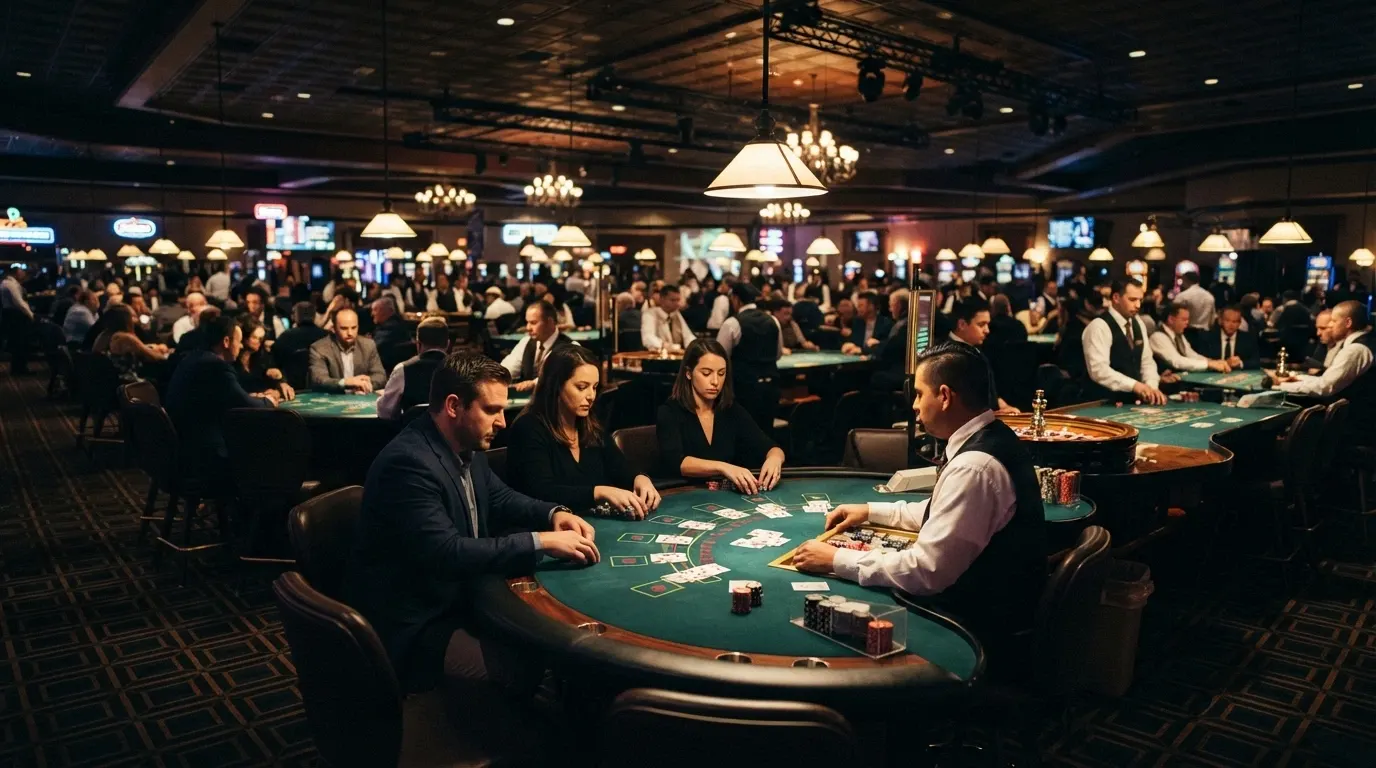
What sets the table offering apart is not the breadth of the menu — most Australian casinos run similar game lists — but the blackjack rule set. Casino Canberra is the only casino in Australia that allows players to split on regular pairs (excluding aces) up to four hands, and the only one that allows doubling down on any two cards. Both moves are common in online blackjack but rare in Australian live-dealer rooms, where most houses restrict splitting to a maximum of three hands and restrict doubling to totals of 9, 10 or 11. A basic-strategy player at Casino Canberra can run a marginally lower house edge than at any other Australian casino as a result. The difference is small — fractions of a percentage point — but on a six-deck shoe it is real, and it is the single most concrete reason a serious blackjack player might choose to drive past The Star Sydney on the way to a Canberra session.
Poker and Canberra Poker — the venue’s own game
The poker lounge is a dedicated room within the venue, separate from the main gaming floor and kitted out with its own tables and a TAB-equipped sports bar adjacent. The headline offering is Canberra Poker, a house variant that runs alongside the conventional poker formats most players will recognise.
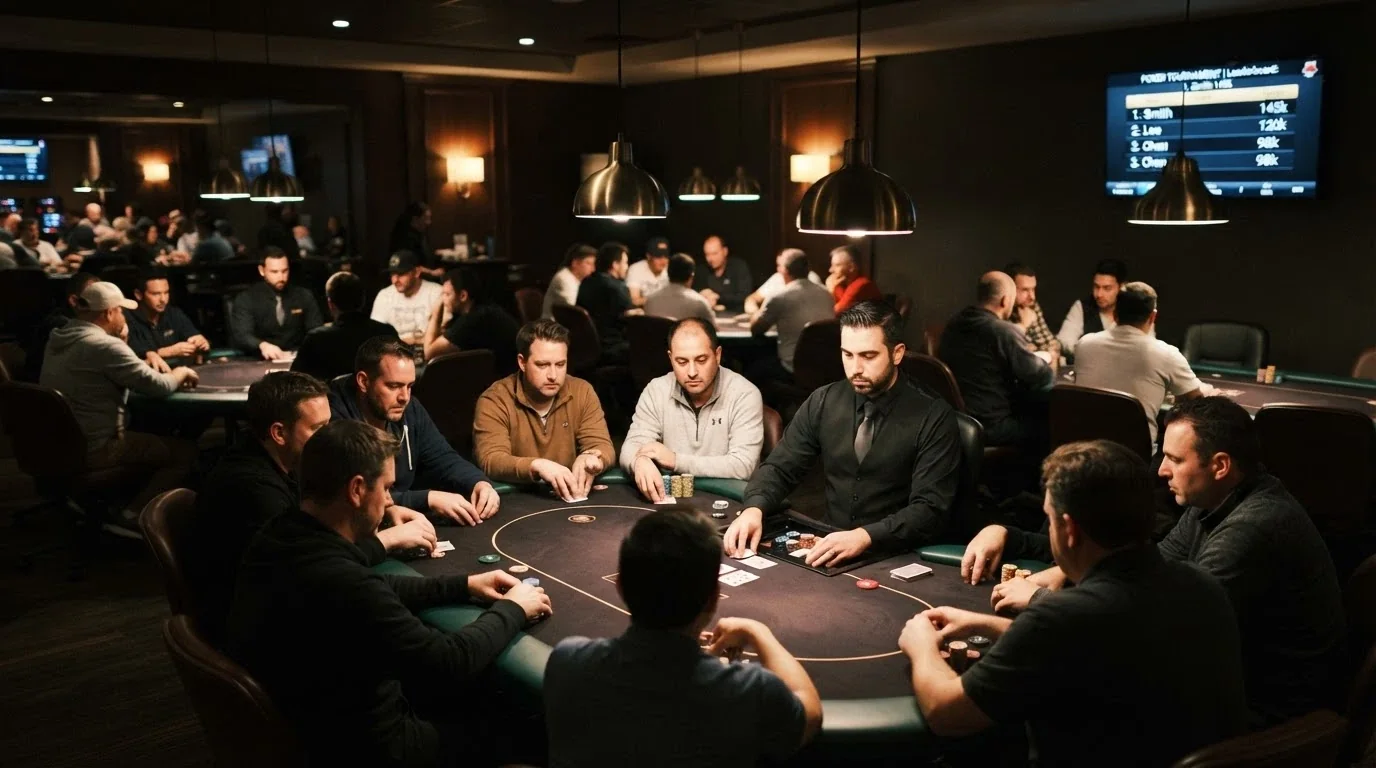
Canberra Poker’s hand payout structure sets it apart. A Royal Flush pays 250:1, a Straight Flush 50:1, Four of a Kind 20:1, a Full House 7:1, a Flush 5:1, a Straight 4:1, Three of a Kind 3:1, and Two Pair 2:1. The Progressive Jackpot side bet runs separately: a Royal Flush takes 100% of the jackpot pool, a Straight Flush takes 10%, with set payouts of $1,250 for Four of a Kind, $375 for a Full House, and $250 for a Flush. The 250:1 top payout on the base game is steep by poker-variant standards, and the Progressive Jackpot is the kind of structure that turns a routine session into a five-figure moment for the right hand on the right night.
For players who prefer conventional poker, the lounge also runs standard formats. Tournament schedules are posted on the venue’s site, with blackjack, mini baccarat and roulette tournaments running on a regular cadence, each with a $3,000 prize pool. The lounge is small relative to a dedicated poker room at one of the bigger casinos, but it is the only dedicated poker room in the ACT.
From a pokies ban to 200 EGMs — the machine story
Casino Canberra’s electronic gaming machine story is unlike any other Australian casino’s. It is the only Australian casino not originally licensed to operate poker machines, and the venue ran without EGMs entirely for more than two decades. The Gaming Machine (Reform) Amendment Act 2015 and the supplementary legislation passed in October 2017 changed that position, making Casino Canberra eligible to acquire up to 200 poker machines and 60 fully automated table game terminals — subject to redevelopment of the site and the adoption of specific harm-minimisation measures. As of 2026, 200 EGMs are operating on the gaming floor.
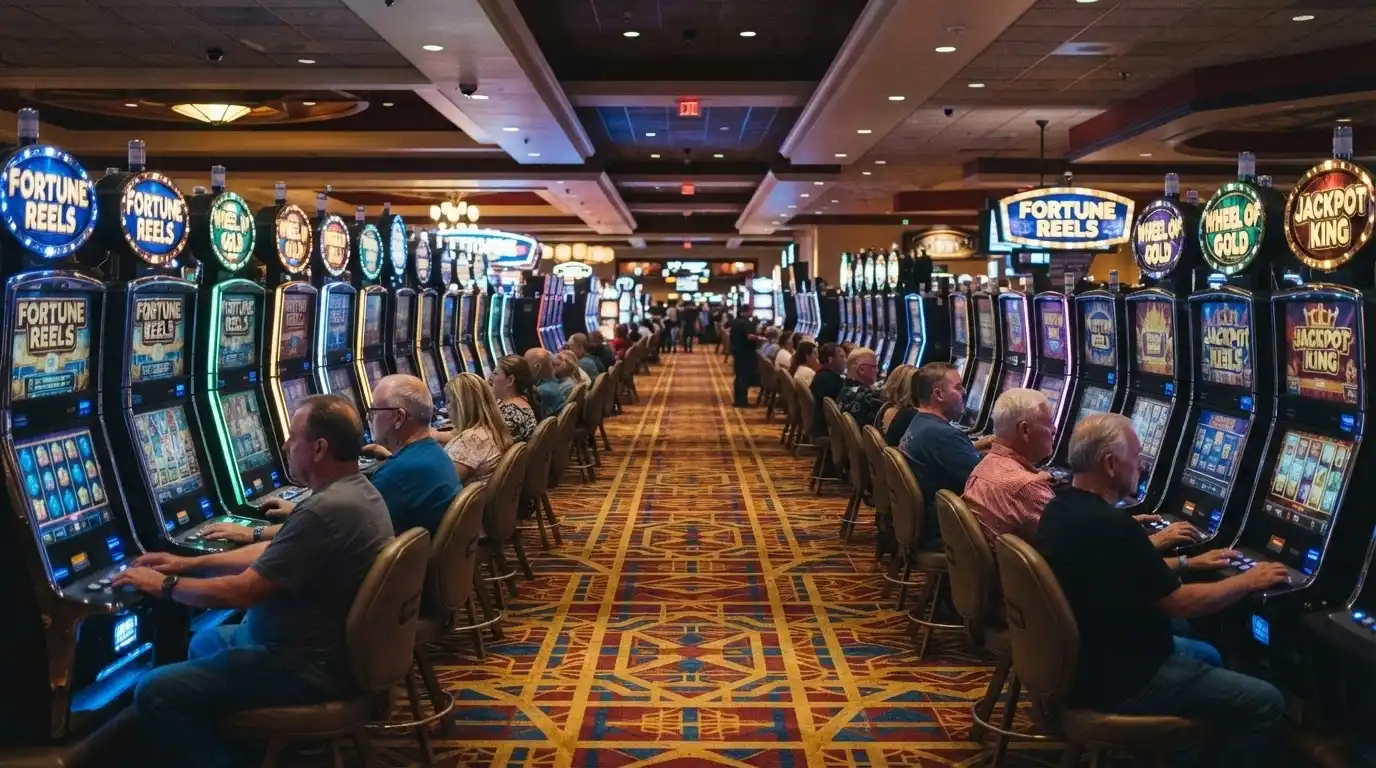
The harm-minimisation conditions attached to those EGMs are the most restrictive in the country. The 2017 legislation mandated a $2 per spin bet limit on the casino’s machines — the lowest in Australia — and required an approved mandatory pre-commitment system before any new EGM could be activated. The maximum bet on a standard ACT gaming machine is $10, and Casino Canberra’s machines are configured within that ceiling. Machines accept $5, $10 and $20 notes only, and the minimum theoretical return to player across the ACT’s gaming machine fleet is 87%. The legislative intent was explicit: in the words of the ACT Legislative Assembly Hansard from 2018, “We also legislated for a $2 per spin bet limit, which is the lowest in the country.”
For a player used to a Crown or Star pokies room, the result is a noticeably tighter machine. The $2 cap and the pre-commitment requirement reshape what a session looks like: max bet is genuinely low, the maximum session loss is bounded in a way it is not at other Australian casinos, and the return-to-player floor is enforced. None of this is a reason to play EGMs at Casino Canberra over a table game. It is a reason to understand that the 200 machines on this floor are a different product from the 2,500-plus machines at Crown Melbourne.
What you’ll spend at the table — limits, rules and payouts
The blackjack table structure at Casino Canberra is split between a low-stakes room and a mid-stakes room. Six tables run a $5 minimum with a $500 maximum; two tables run a $50 minimum with a $2,000 maximum. The six-deck shoe is standard for Australian casino blackjack, and the deal hits on soft 17. The unique rules sit with the player: splitting to four hands on regular pairs, doubling on any two cards. Together, those two rule variations pull the house edge down a measurable amount compared to other Australian casinos. The exact percentage point depends on the strategy profile, but a basic-strategy player is playing one of the cheapest blackjack games in the country.
EGM betting is bounded by the $10 maximum bet on standard ACT machines and the $2 maximum bet on casino EGMs under the 2017 framework. The denomination structure — $5, $10 and $20 notes only — is the standard anti-money-laundering configuration for an Australian casino floor, and the 87% minimum RTP is enforced by the ACT regulator. Winnings over $1,200 are paid by cheque rather than in cash, again as part of the same compliance framework. None of this is unusual for an Australian casino; it is, however, the regime that defines what a session on the 200 machines actually looks like.
Tournament play and the $3,000 prize pools
Casino Canberra runs regular tournaments across three formats: Blackjack Tournaments, Mini Baccarat Tournaments and Roulette Tournaments. Each carries a $3,000 prize pool, with the structure and entry details posted on the venue’s own site. Schedules change, but the tournaments are a regular feature rather than a one-off, and the prize pool — modest by international tournament standards — is meaningful at the venue’s scale and is the kind of structure that rewards a session of focused play rather than a deep-stacked run.
Entry is through the venue’s poker and gaming desks, and the tournament format typically runs across an evening session. For a visitor in town for a single night, the tournaments are worth checking the schedule for in advance; for a local player, they are a regular part of the room’s weekly rhythm.
Where to stay — three partner hotels, zero on-site rooms
Casino Canberra has no hotel, no theatre, no auditorium and no retail. The accommodation question is therefore a partner question, and the venue has three: Crowne Plaza Canberra, Meriton Suites Canberra, and The Sebel Canberra. None of them is on the casino’s own floor plan, and only one of them — Crowne Plaza — is genuinely adjacent. The other two are a short walk or a short drive away, and the choice between them comes down to what kind of room you want rather than which one is closest.
The three-hotel model is the structural difference between Casino Canberra and the bigger Australian resort casinos. Crown Melbourne and The Star Sydney both run on-site hotel towers as part of an integrated resort offering; The Ville Resort-Casino in Townsville, as a smaller regional comparison, also offers rooms on site. Wrest Point in Hobart — Australia’s first legal casino — sits on a combined hotel-casino waterfront site. Casino Canberra is the only Australian casino of any scale that runs without rooms, and the partner-hotel arrangement is the workaround. The arrangement is not broken, but it is one more step in the night, and a visitor expecting to roll out of a restaurant into a hotel lift is going to be rolling out onto Binara Street instead.
| Hotel | Distance to Casino | Key Amenities |
|---|---|---|
| Crowne Plaza | Adjacent | Pool, business centre, fitness centre |
| Meriton Suites | Short distance | Indoor pool & spa, sauna, fitness centre |
| The Sebel | Short walk | Fitness centre, boutique rooms |
| Hotel | Distance to Casino | Key Amenities |
|---|---|---|
| Crowne Plaza | Adjacent | Pool, business centre, fitness centre |
| Meriton Suites | Short distance | Indoor pool & spa, sauna, fitness centre |
| The Sebel | Short walk | Fitness centre, boutique rooms |
| Hotel | Distance to Casino | Key Amenities |
|---|---|---|
| Crowne Plaza | Adjacent | Pool, business centre, fitness centre |
| Meriton Suites | Short distance | Indoor pool & spa, sauna, fitness centre |
| The Sebel | Short walk | Fitness centre, boutique rooms |
Crowne Plaza Canberra — the casino’s neighbour on Glebe Park
Crowne Plaza Canberra sits adjacent to Casino Canberra on the Glebe Park side, separated by a stretch of landscaped park rather than a car park. The practical effect is that a guest at the hotel can walk to the casino in under a minute, which makes it the obvious choice for anyone whose night is built around the gaming floor. The hotel itself runs a 24-hour business centre, an outdoor pool, a fitness centre, and secure underground parking — the standard upper-mid-market CBD offering rather than a luxury property, but well-maintained and consistent with the Crowne Plaza brand.

Two packages anchor the casino-adjacent offering. The Stay & Dine Package bundles an overnight stay with a $100 daily dining credit, which is enough to cover a meal at Natural Nine for two without much supplementing. The Romance in the Capital package is built for a couple’s night out: a bottle of Canberra wine on arrival, buffet breakfast for two, two cocktails and a shared snack, complimentary self-parking, and late checkout until 1pm. Neither package is locked to the casino in a structural sense — the $100 dining credit can be spent at Natural Nine, but it can also be spent at the Onyx Sports Lounge or the bars — and the casino’s involvement is more about proximity than bundled access.
Meriton Suites and The Sebel Canberra
Meriton Suites Canberra is the apartment-style option in the partner set, a short distance from the casino. The configuration is the standard Meriton model: apartment-style rooms with kitchen and laundry facilities, an indoor pool and spa, a sauna, a fitness centre, and 24-hour reception. For a longer stay — a few nights in town for a conference at the National Convention Centre, or a working week in Canberra — Meriton is the partner hotel that most closely replicates a serviced-apartment experience. There is no casino-specific package attached to Meriton in the venue’s published material; the hotel’s general offering and its proximity to the casino are the value proposition.
The Sebel Canberra is the boutique end of the partner set, a short walk from the venue. The property runs a modern fitness centre and compact, contemporary rooms in a style that the Sebel brand uses across its Australian portfolio. It is the smallest and most design-led of the three partners, and the obvious choice for a visitor who wants a quieter room than Crowne Plaza’s more corporate offering without the longer-stay apartment configuration of Meriton. Again, no casino-specific package is published; the value is the walking distance and the room style.
How Casino Canberra measures up against the country’s biggest casinos
| Casino | Licence | Gaming on offer | What sets it apart |
|---|---|---|---|
| Casino Canberra | ACT (Casino Control Act 2006) | 39 tables, 200 EGMs, poker lounge | Only casino in the ACT; $2 max bet on EGMs (lowest in the country); unique blackjack rules |
| Crown Melbourne | Victoria | 2,500+ EGMs, 540+ tables, full resort | Australia’s largest casino complex; benchmark for luxury gaming |
| The Star Sydney | NSW | 1,500+ EGMs, 200+ tables, full resort | Sydney’s main casino; nearest major casino to Canberra (~3 hours drive) |
| The Ville Resort-Casino | Queensland | EGMs, tables, on-site hotel | Regional casino with rooms on site — contrast to Casino Canberra’s no-hotel model |
| Wrest Point Hotel Casino | Tasmania | EGMs, tables, hotel | Australia’s first legal casino (1973); historical bookend to Casino Canberra’s 1994 opening |
Casino Canberra — the ACT’s only licensed casino
The base case is the one already laid out across the first two sections of this page: a compact CBD venue at 21 Binara Street, licensed under the Casino Control Act 2006, with 39 live tables, 200 EGMs under the country’s tightest bet-limit regime, no on-site hotel, and a poker lounge running the venue’s own Canberra Poker variant. The two distinguishing features that the table does not capture are the blackjack rules and the regulatory ceiling. On the first, Casino Canberra runs the only blackjack game in Australia that allows splitting to four hands and doubling on any two cards, which gives a basic-strategy player a lower house edge than they will find at any other Australian casino. On the second, the venue is structurally limited to 200 EGMs by statute, which makes it a different product from the bigger state-licensed resorts and removes a category of high-intensity play those venues still offer.

Crowne Plaza Canberra — comparing the casino’s adjacent partner
Crowne Plaza is the only partner hotel genuinely adjacent to the gaming floor, separated by Glebe Park rather than a city block. The property runs an outdoor pool, a 24-hour business centre, a fitness centre, and secure underground parking, with two published casino-adjacent packages — the Stay & Dine Package and the Romance in the Capital package. As covered in the Where to Stay section, Crowne Plaza is the partner hotel built around the casino experience rather than around an independent visit to Canberra.
Meriton Suites Canberra — apartment-style living near the tables
Meriton Suites is the apartment-style partner, a short distance from the venue. The amenity set — indoor pool and spa, sauna, fitness centre, 24-hour reception — is built around longer stays than a casino night out, and Meriton is the partner most often chosen by conference attendees, working-week visitors, and anyone who wants a kitchen and a laundry alongside the bedroom. The casino is close, but the value proposition is the apartment-style room rather than the casino itself.
The Sebel Canberra — boutique style a short walk away
The Sebel is the boutique partner, a short walk from the venue. The property runs a modern fitness centre and compact, design-led rooms in the style the Sebel brand uses across its Australian portfolio. The Sebel is the partner most often chosen by visitors who want a quieter, more contemporary room than Crowne Plaza’s corporate offering, without the longer-stay apartment configuration of Meriton.
ACT Gambling and Racing Commission — who keeps the casino in check
The ACT Gambling and Racing Commission is the territory regulator that administers the Casino Control Act 2006 and the Gaming Machine Act 2004, and holds the only casino licence in the ACT — held by Casino Canberra Limited. The Commission is led by chief executive Giuseppe Mangeruca. As covered in the regulation section below, the Commission is the body that sets the EGM bet limit, the RTP floor, the pre-commitment rules, and the broader harm-minimisation regime that defines what Casino Canberra’s gaming floor looks like.
ACMA — the federal enforcer blocking illegal gambling sites
The Australian Communications and Media Authority is the federal regulator that enforces the Interactive Gambling Act 2001, which makes online casino, online pokies and in-play sports betting illegal for Australian residents. As of March 2026, ACMA has had 1,564 illegal gambling and affiliate websites blocked by Australian ISPs since November 2019, and more than 225 illegal services have withdrawn from the Australian market since 2017. ACMA’s role is the federal counterpart to the ACT Commission’s: one licenses the legal market, the other blocks the illegal one.
Crown Melbourne — Australia’s biggest casino
Crown Melbourne is the benchmark Australian casino: a vast Victoria-licensed resort complex on the south bank of the Yarra, with 2,500-plus EGMs, more than 540 tables, three hotel towers, dozens of restaurants and a full entertainment calendar. It is the largest casino complex in Australia and the standard against which every other Australian casino is measured, including Casino Canberra. A visitor to Crown gets a resort experience Casino Canberra is not built to deliver.
The Star Sydney — the nearest major casino to Canberra
The Star Sydney is the NSW-licensed main casino in Pyrmont, the closest big-league alternative for a Canberra resident considering an interstate trip. The drive is roughly three hours via the Hume Highway. The Star runs 1,500-plus EGMs, more than 200 tables, two hotel towers and a similar resort offering to Crown. For a Canberra-based player who wants Crown-scale gaming without flying, The Star is the practical answer — and the reason Casino Canberra exists as a local venue rather than a regional destination.
The Ville Resort-Casino — a Queensland resort with rooms on site
The Ville Resort-Casino in Townsville is a Queensland-licensed regional casino that bundles on-site accommodation, restaurants and a marina-side resort experience. The contrast with Casino Canberra is the model: The Ville is what Casino Canberra looks like with rooms attached, scaled for a regional city rather than a national capital. For a visitor weighing regional Australian casino experiences, The Ville is a useful comparison point on accommodation, scale and the role of a casino in a smaller market.
Wrest Point Hotel Casino — where Australian casino history began
Wrest Point Hotel Casino in Hobart opened in 1973 as Australia’s first legal casino, two decades before Casino Canberra opened in 1994. The Tasmania-licensed property combines a gaming floor with a hotel tower on the waterfront, and it sits at the historical starting point of the Australian casino industry. The comparison with Casino Canberra is the era: Wrest Point defined what a casino was in Australia in the 1970s, and Casino Canberra defined what a smaller, more strictly regulated casino could look like in the 1990s.
The rules behind the roulette wheel — what ACT law lets you do
Casino Canberra operates under the Casino Control Act 2006 and, for its electronic gaming machines, the Gaming Machine Act 2004. Both statutes are administered by the ACT Gambling and Racing Commission, which is also the body that issues Casino Canberra Limited’s casino licence. The combination of the two Acts and the Commission’s regulatory practice defines what the gaming floor can and cannot offer — the table limits, the EGM bet ceiling, the payout thresholds, the pre-commitment regime, and the harm-minimisation measures that sit around the gambling product itself.
The broader federal framework matters too. The Interactive Gambling Act 2001 makes online casino, online pokies and in-play sports betting illegal to provide to a person physically in Australia, regardless of where the operator is based. There is no licence for online casino anywhere in the country — not federally, not in any state or territory. Any site offering online casino games to an Australian player is operating outside Australian law, which means outside Australian consumer protection as well. A visitor searching for “best online casino in Canberra” has reached the end of what the licensed Australian market offers: nothing licensed exists, and any answer to the question that names an offshore site is naming an unregulated one.
Who licences Casino Canberra and what the law says
The casino licence for the ACT is held by Casino Canberra Limited, under the Casino Control Act 2006. The Act, last amended on 16 November 2025, is administered by the ACT Gambling and Racing Commission, and sets the conditions under which gambling tables can be operated in the territory. The companion statute is the Gaming Machine Act 2004, which governs EGMs in clubs, hotels and the casino. Together, the two Acts establish the legal framework for every gaming product on the Casino Canberra floor.
The technical standards for the EGMs are set under a national framework rather than an ACT-only one. The Australian/New Zealand Gaming Machine National Standard 12.1 came into effect in the ACT on 12 March 2026, superseding the previous Standard 11.1. The standard covers machine design, metering, software certification, and player-protection features including the pre-commitment system that operates on the Casino Canberra floor. The minimum age for entry is 18, in line with every other Australian jurisdiction.
Bet limits, caps and what the ACT bans
The EGM bet-limit regime at Casino Canberra is the most restrictive in the country. The 2017 legislation set a $2 maximum bet per spin on the casino’s EGMs — the lowest bet ceiling of any Australian casino — and required an approved mandatory pre-commitment system before any new EGM could be activated. Standard ACT gaming machines outside the casino carry a $10 maximum bet; the casino’s machines are configured under the lower ceiling. Machines accept $5, $10 and $20 notes only, the minimum theoretical return to player is 87%, and winnings over $1,200 are paid by cheque rather than in cash.
The broader ACT EGM regime sits underneath the casino-specific rules. The total number of gaming machines across the ACT is capped at 4,000, with authorisations allocated to licensed clubs and hotels rather than to the casino. The ACT Government has committed to reducing EGM authorisations to 1,000 or fewer by 2045, with a current Legislative Assembly target of 3,500 by 1 July 2025 as an interim step. The Independent Inquiry into ACT Clubs, which reported in May 2026, recommended a four-stage, 20-year transition plan to support the sector through the reduction, warning that stripping more poker machines before clubs are properly supported risks closures and a hollowed-out community sector.
Online wagering sits under a different set of rules. Credit cards, credit-related products and cryptocurrency have been banned as payment for online wagering since 11 June 2024, under the Interactive Gambling Amendment (Credit and Other Measures) Act 2023, with penalties of up to $247,500 for operators that breach the rule. From 1 January 2027, banks and payment providers gain express statutory authority to block transactions to illegal gambling operators, which is the federal framework’s answer to the offshore-sites problem the ACMA has been working through since 2017.
Online casino in Australia — why there is no legal option
The Interactive Gambling Act 2001 makes it an offence to provide online casino, online pokies or in-play sports betting to a person in Australia. There is no licence for online casino anywhere in the country. The Act was strengthened by the Interactive Gambling Amendment Act 2017, which expanded the prohibited products and increased ACMA’s enforcement powers. Since its first blocking request in November 2019, ACMA has had 1,564 illegal gambling and affiliate websites blocked by Australian ISPs, and more than 225 illegal services have withdrawn from the Australian market since 2017.
What the prohibition means in practice is asymmetric. Individual players are not prosecuted — the IGA targets the provider, not the customer. What the prohibition does not give an offshore player is any of the protections an Australian-licensed operator would offer: no recourse through ACMA if a withdrawal is withheld, no BetStop coverage, no Australian consumer law protection, and no guarantee the site will still be reachable next week. The site can be blocked at any time, with a balance still sitting on it. The 2026 reform, commencing 1 January 2027, adds express bank-blocking authority, which means a transaction can be declined at the payment stage rather than after the funds have left the account.
A page promising “the best licensed online casinos in Canberra” would be describing something that does not exist. The only legal casino in Canberra is the one at 21 Binara Street, and the only legal way to play it is to walk through the door.
Staying in control — help and harm reduction in the ACT
Gambling harm in the ACT is rising, and the rise is being measured directly. The ACT Gambling and Racing Commission recorded 72,647 gambling harm incidents in 2025–26, an increase of 53.5% from the 47,337 recorded the year before, and more than double the 32,095 recorded in 2023–24. The Commission’s chief executive, Giuseppe Mangeruca, said the rise in reports is “not a bad thing” — a signal that more people are coming forward, that venues and frontline services are recording more consistently, and that the harm-minimisation framework is working as it was designed to.
The drivers of those reports are well documented. Money-seeking behaviour — multiple cash withdrawals in a short period, often in escalating amounts — and high-intensity play, defined as spending more than $300 in a single session, make up the vast majority of incidents reported to the Commission. Both behaviours are visible to venue staff, both are triggers for intervention under the ACT’s responsible-gambling framework, and both are the kind of patterns a player who notices them in their own behaviour can choose to act on before the harm becomes financial or personal.
The national picture sits underneath the ACT data. The Australian Institute of Health and Welfare’s 2022 figures put high-risk gambling at 1.8% of adults, with about 2.1% of Australian adults — roughly 430,000 people — experiencing problem gambling. The ACT’s harm-minimisation regime, the federal prohibition on online casino, and the support services listed below are all built around that prevalence rate.
Gambling harm in the ACT — the numbers behind the headlines
The 53.5% year-on-year increase in harm incident reports is the headline number, and it is worth reading carefully. The Commission’s framing — rising reports are a positive signal — is consistent with how harm-minimisation frameworks are meant to work: more reports mean more people being identified, more venue interventions, more referrals to support services, and more contacts with the helpline. The absolute number, 72,647 incidents in a year, is large, but it is a count of incidents rather than a count of individuals, and a single person can account for multiple reports over a year.
The ACT clubs review, which reported in May 2026, set out a four-stage, 20-year transition plan for the territory’s clubs sector to become smaller and more sustainable as EGM authorisations reduce. The review’s central warning was that reducing poker machine numbers before clubs are properly supported risks closures and a hollowed-out community sector. The transition target — 1,000 or fewer EGMs in the ACT by 2045 — is a long horizon, and the report’s argument is that the path matters as much as the destination.
Where to get help — helplines, self-exclusion and support
The National Gambling Helpline is 1800 858 858, free and confidential, available 24 hours a day, seven days a week. The helpline routes to Gambling Help Online at gamblinghelponline.org.au, which offers live chat, self-help tools and community forums. The ACT Gambling Support Service, also reachable on 1800 858 858, provides free confidential counselling, drop-in groups, and peer support specifically within the territory. None of these services require a referral, and none of them will appear on a phone bill in a way that identifies the caller to anyone else on the account.
BetStop — the National Self-Exclusion Register — is the structural player-protection tool. As at 31 July 2026, BetStop had recorded 67,480 registrations, of which 41,290 exclusions were still active. Seventy-eight per cent of registrants were under 40, and 38 per cent had chosen lifetime exclusion. A single BetStop registration excludes a person from every Australian-licensed online and phone wagering service, and the registration is enforceable against the operator. What BetStop does not do is bind offshore sites: an excluded player can still reach an unlicensed offshore casino, which is one of the reasons the prohibition-and-enforcement framework exists in the first place.
The combination of those three tools — the helpline, the ACT-specific support service, and BetStop — covers most of what a person at any stage of harm needs. The first call is the helpline; the longer-term structure is BetStop; the local face-to-face support is the ACT Gambling Support Service.
How we picked and reviewed — our methodology
The review on this page is built on publicly available sources, cross-checked against the regulatory framework that governs Casino Canberra. No operator on the page has been asked for, or has provided, a promotional placement. The page describes what the venue offers, what the law permits, and what the published data shows; it does not direct a reader to play, recommend a particular offer, or rank venues against each other in a way that picks a winner.
What we checked and how we checked it
The licence position was checked against the ACT Gambling and Racing Commission’s public register, which lists Casino Canberra Limited as the only casino licence holder in the territory. The game counts, table limits, EGM configuration, blackjack rule variations and tournament prize pool figures were cross-referenced across Casino Canberra’s own site, the VisitCanberra attraction listing, the venue’s poker and gaming pages, and independent coverage on Blackjack.com.au. The accommodation details were checked against the partner hotels’ own published material. The regulatory claims were checked against the Casino Control Act 2006, the Gaming Machine Act 2004, the Interactive Gambling Act 2001, and the relevant ACT Legislative Assembly Hansard records. The harm-reduction figures were sourced from the ACT Gambling and Racing Commission’s annual reporting and the Australian Institute of Health and Welfare’s 2022 gambling prevalence data.
Where two sources disagreed on a specific figure, the venue’s own published material was treated as primary, and the discrepancy was either resolved or noted. Where a source flagged an item as uncertain, the uncertainty was carried into the page rather than smoothed over.
Sources and transparency
The primary sources for this page are Casino Canberra’s own site, the ACT Government’s legislation register, the ACT Gambling and Racing Commission’s published materials, the Australian Communications and Media Authority’s enforcement records, and the Australian Institute of Health and Welfare. Secondary sources include Wikipedia, the VisitCanberra attraction listing, Blackjack.com.au, The Canberra Times, region.com.au, and the TTGmice coverage of the Canberra MICE precinct development.
What this review does not cover: real-time tournament schedules, daily table availability, live pricing on partner hotel rooms, and unpublished operator data. All of those change faster than a published article can track, and any specific schedule or price quoted in this page is a snapshot rather than a live commitment. The reader should confirm tournament dates, table minimums and partner-hotel pricing directly with the venue before planning a visit.
Is Casino Canberra worth your night out?
The honest answer is that it depends on what you came for. For a Canberra resident, Casino Canberra is a good local venue with a tighter regulatory regime than any of the bigger Australian casinos and a blackjack game you will not find anywhere else in the country. The $5 minimum tables make it accessible; the $2-per-spin EGM cap and the pre-commitment system make the machines structurally harder to over-spend on than the equivalent product at Crown or The Star; the dining is decent without being destination-grade; and the partner hotels put a bed within walking distance of the floor. For a poker player, the dedicated poker lounge and the Canberra Poker variant are reasons in themselves. For a blackjack player, the rule variations are a measurable edge over every other Australian casino.
For a visitor who came to Canberra for a conference, the venue’s proximity to the National Convention Centre — a six-minute walk — and the partner-hotel arrangement make it a viable after-hours option without committing a whole evening. The Lotus Room is a real function space, not a marketing line. Natural Nine is a proper sit-down Chinese restaurant rather than a buffet. The Onyx Sports Lounge is a pub with sport on the screens and TAB at the bar. None of this is a Crown-scale offering, but it is a workable night.
The case against is straightforward. Casino Canberra has no on-site hotel, which means even the closest partner hotel is a separate booking and a separate check-in. The floor is compact, the table count is modest by interstate standards, and the resort amenities a Crown or Star visitor expects — multiple hotels, a shopping concourse, headline restaurants, a theatre, a day-spa — are simply not there. The financial position is uncertain: the venue has reported losses, the Iris Capital ownership transition is recent, and the larger redevelopment plans that Aquis pursued were rejected by the ACT Government. None of that is a reason not to go, but it is a reason to manage expectations.
The bigger picture is the regulatory one. Casino Canberra is a more strictly controlled casino than its interstate peers. The $2 EGM cap, the 87% RTP floor, the $1,200 cheque threshold, the pre-commitment requirement, and the harm-minimisation regime around the gaming floor are all tighter than the equivalent rules at the bigger Australian venues. For a player who would rather gamble in a venue where the bet ceiling is low, the session is bounded, and the regulator is watching the floor, Casino Canberra is the better venue. For a player who wants the full resort experience, it is not.
The bottom line: if you live in Canberra or are already in town, Casino Canberra is the only licensed casino you can reach, and the gaming product it offers is, in specific ways, better than anything available at the bigger Australian venues. The unique blackjack rules, the dedicated poker lounge, the $5 table minimums, and the regulatory ceiling on the machines are all real advantages. The compact floor, the lack of an on-site hotel, and the modest scale are the trade-offs. Whether the trade is worth it is a question of what kind of night you wanted in the first place.
Frequently asked questions
Does Casino Canberra have poker machines (pokies)?
Yes, 200 of them. Casino Canberra was the only Australian casino not originally licensed for poker machines, but 2017 legislation made it eligible for up to 200 EGMs and 60 automated table game terminals. The casino’s machines operate under a $2-per-spin bet limit — the lowest in the country — with mandatory pre-commitment and a minimum 87% RTP.
Is there a hotel at Casino Canberra?
No. Casino Canberra has no on-site accommodation. The venue partners with three nearby hotels: Crowne Plaza Canberra (adjacent, on Glebe Park), Meriton Suites Canberra, and The Sebel Canberra. Crowne Plaza is the only partner within a one-minute walk of the gaming floor.
What are the minimum and maximum bets at Casino Canberra’s blackjack tables?
Blackjack runs on six-deck shoes. Six tables run a $5 minimum with a $500 maximum bet, and two tables run a $50 minimum with a $2,000 maximum. Casino Canberra is the only Australian casino that allows splitting to four hands on regular pairs and doubling down on any two cards.
Does Casino Canberra run poker or blackjack tournaments?
Yes. The venue runs regular Blackjack Tournaments, Mini Baccarat Tournaments and Roulette Tournaments, each with a $3,000 prize pool. Schedules are posted on the venue’s own site and change over time. The poker lounge also runs conventional poker formats alongside the venue’s own Canberra Poker variant.
What responsible gambling support is available in the ACT?
The National Gambling Helpline is 1800 858 858 — free, confidential and available 24/7. Gambling Help Online at gamblinghelponline.org.au offers live chat, self-help tools and forums. The ACT Gambling Support Service provides free counselling, drop-in groups and peer support on the same number. BetStop, the National Self-Exclusion Register, had 67,480 registrations as at July 2026, of which 41,290 were active exclusions.
Created by the ”Fast Payout Casinos AU” editorial team.