
What an A$5 pokies deposit really costs Australian players in 2026
The $5-deposit pokies headline has become one of the most recycled promises in the search results targeting Australian players. It promises low-risk entry, real-money play and a chance to test a casino without committing a meaningful bankroll. In practice, almost nothing about that promise is true in the way an Australian punter would expect.

At A$0.10 per spin — the genuine floor for a real-money online pokie in 2026 — a five-dollar deposit buys roughly fifty spins. That is about 4.2 minutes of play before the balance hits zero. It is real money, it is withdrawable in principle, and the maths is unforgiving in equal measure.
The pitch lands on Australian shores because Australia’s online casino and pokies market is not what most players assume. No licence exists for online pokies anywhere in the country, federally or in any state or territory. Every casino that takes A$5 from an Australian player is an offshore operator offering a product Australian law expressly prohibits. The Interactive Gambling Act 2001 makes it an offence to provide such a service. The individual player is not prosecuted — the Act targets the provider, not the person — but the player is the one left without any of the consumer protections Australian law would otherwise offer.
This page is a working-through of what a $5 pokies deposit actually delivers in 2026, which offshore casinos genuinely process one, what the bonus structures cost a player with a small bankroll, and what changes in January 2027 when banks gain the express power to block transactions to illegal operators. It is not a steer toward any brand. It is an analysis of a product category whose marketing has run well ahead of the product itself.
Data current as of 3 November 2026 · licence claims verified against the Curaçao Gaming Authority public register
Table of Contents
- Why a $5 pokies deposit in Australia isn’t what the ads promise
- The $5 deposit pokies sites Australians can reach in 2026
- How to actually get $5 into an offshore pokies account
- New $5 deposit pokies sites worth a look in 2026
- Playing $5 deposit pokies on your mobile
- The legal reality: online pokies are prohibited in Australia
- Responsible gambling when playing at offshore pokies sites
- How we picked the $5 deposit pokies sites on this page
- Is a $5 pokies deposit worth it? Our verdict
- Frequently asked questions
Why a $5 pokies deposit in Australia isn’t what the ads promise
The $5-deposit headline is a marketing artefact, not a product. Most sites that advertise it cannot actually process $5 through any rail an Australian punter can realistically use. The ones that can are crypto-only offshore operators, and crypto itself is a banned payment method for Australian online wagering since 11 June 2024.
A 2026 survey of fifteen AU-facing brands found that eight of them quietly enforce a higher minimum deposit for bonus eligibility than for play. A punter depositing A$10 expecting a match bonus finds the bonus was conditional on A$20 from the moment it landed. The minimum advertised for deposit is not the minimum that unlocks what the page is selling.
The honest framing for a $5-deposit pokies site in 2026 comes from one 2026 industry analysis: “There is no honest AU$5 fiat-deposit casino for Australian players in 2026 — the figure is a marketing-industry illusion, not a product.” Every brand on this page gets there through some compromise — a crypto rail that breaks Australian law, a Neosurf voucher that starts at A$10, a card processor whose floor sits at A$20 — and most of the compromise is invisible from the marketing page.
What a $5 deposit actually buys at offshore pokies sites
At A$0.10 per spin — the genuine floor for a real-money pokie bet at offshore sites in 2026 — a five-dollar deposit buys roughly fifty spins. That is about 4.2 minutes of play. The bankroll disappears quickly because the maths does not negotiate. A standard online pokie has a house edge somewhere between three and five per cent per spin, which means a fifty-spin session at A$0.10 is statistically expected to end at A$3.75 to A$4.25. Most sessions will end well before that, because variance eats small balances faster than expected value predicts.
What $5 buys is not the breadth of the casino’s library. It is a window into one game, played at the lowest meaningful stake, with whatever volatility setting the title carries. A high-volatility pokie at A$0.10 will eat the bankroll in fifteen to twenty dead spins before a feature round lands. A low-volatility title will draw out fifty spins across ten or twelve small wins. Neither outcome looks like a casino experience in the way the marketing suggests.
What $5 does buy, uniquely, is the difference between a real-money session and a demo. Free-play demos run on every pokie at every offshore casino, and they offer every feature, every bonus round and every spin a real-money game does — without a cent changing hands. The A$5 buys the only thing the demo cannot: a balance that converts to a real withdrawal when a win lands, however rare that win turns out to be at the lowest stake.
The gap between advertised $5 minimums and what the cashier actually accepts
The advertised deposit minimum at an offshore casino is rarely the deposit minimum the cashier will actually accept. Each payment rail carries its own floor, and almost none of them sit at A$5 for Australian users.
PayID, which has replaced POLi as the dominant AU bank rail for offshore casino deposits, runs on the New Payments Platform. The rail itself imposes no floor — a PayID transfer can be sent for one cent. The casino gate sits at A$20 in most cases, because anti-fraud monitoring flags micro-deposits as a marker of card-testing and bonus abuse. The result is that a player who sees “PayID accepted” and tries to send A$5 will be told the casino’s minimum is higher than the deposit they were trying to make.
Visa and Mastercard sit somewhere between A$10 and A$20 at the payment-processor level. The floor is set by the card processor, not the casino. A site advertising “$5 minimum deposit via card” is misleading in most cases — the casino may accept A$5, but the transaction will not clear the processor’s floor. Both card types are also banned for online wagering under recent Australian legislation, in force since 11 June 2024, with penalties of up to A$247,500 for operators that fail to enforce the ban. A card-accepting casino is, by definition, operating outside Australian rules.
Neosurf is the lowest fiat rail at A$10. The A$5 voucher Australians see in offshore-casino marketing does not exist domestically — it is an EU-only denomination. Brands that accept Neosurf at the A$10 floor include Spin Samurai, 7Bit Casino, PlayAmo, HellSpin, National Casino and Asino.
Crypto is the only rail where a genuine sub-$10 deposit is possible. Stake accepts deposits down to approximately A$0.10 in BTC-equivalent — the lowest real-money deposit at any AU-facing offshore casino in 2026. BC.Game sits around A$1 USDT and Bitcasino.io is close to zero. All three are crypto-only. Crypto is also a banned payment method for online wagering in Australia.
The genuine answer to “where can I deposit A$5” is therefore: nowhere via fiat, and at three crypto-only operators via BTC-equivalent. Every other answer requires raising the deposit to A$10, A$15 or A$20 — and in most cases, accepting that the payment method itself is illegal under Australian law.
Real-money vs demo-mode: what your $5 unlocks
A free-play demo runs on every pokie at every offshore casino in this set. The graphics, the bonus rounds, the volatility, the RTP — the demo presents them in full fidelity, and the player spins without limit, without cost and without consequence. A punter who has only ever played demos is missing one thing: the ability to withdraw.
The A$5 deposit is the entry-level real-money threshold for budget-conscious Australian punters. It is the smallest amount that converts demo play into a session that pays real money on a win and costs real money on a loss. The novelty of that conversion carries psychological weight disproportionate to its dollar value, which is part of why the marketing works as well as it does.
Two limits deserve flagging up front. The first is the withdrawal floor. Most AU-facing offshore casinos set minimum withdrawals between A$25 and A$100 — sometimes higher — which is five to twenty times the A$5 deposit. A player whose entire balance sits at A$5 cannot cash out. They can play, and if a win pushes them above the floor, they can withdraw. A losing session is unrecoverable in cash terms.
The second is the legal context. The player is not prosecuted under the Interactive Gambling Act — the Act targets the provider, not the person. But the player loses every Australian consumer protection in the process. There is no Australian ombudsman, no local complaints body, no BetStop coverage for the site, and no guarantee that the operator will pay out a winning withdrawal. The legal status of the product is something the player cannot change; the legal status of the player is something the Act leaves the player holding.
The $5 deposit pokies sites Australians can reach in 2026
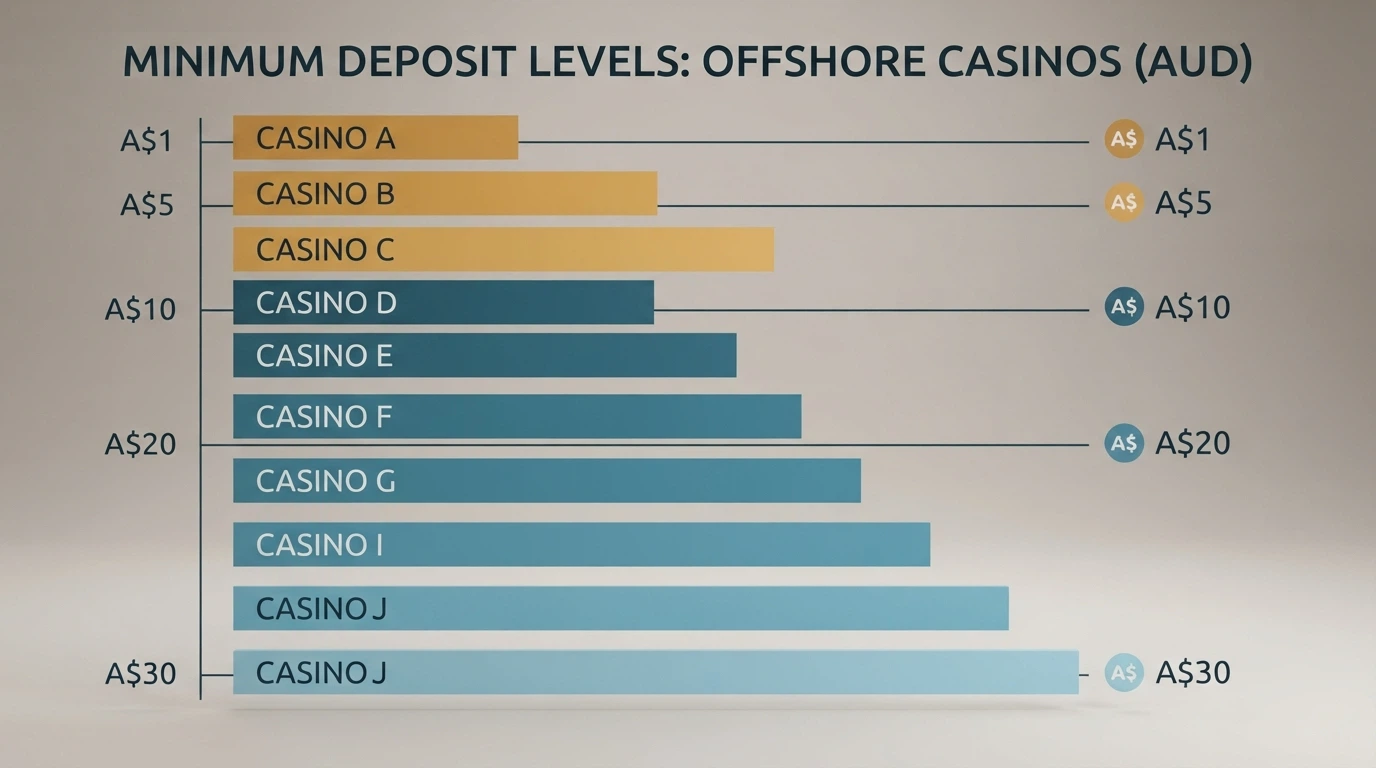
Ten offshore casinos are reviewed below, ranked by how close they come to a genuine $5 deposit. The ones that genuinely process a sub-$10 deposit sit at the top — those are crypto-only. The rest are ordered by minimum-deposit proximity and the bonus value they offer above that floor. Every brand is offshore, every brand operates under a Curaçao licence, and no brand on this page is licensed to offer online pokies to Australians. The Australian licence for online casino does not exist.
| Operator | Licence | Welcome Bonus (First Deposit) | Wagering | Min Deposit for Bonus |
|---|---|---|---|---|
| Stake | Curaçao — no Australian licence | — | — | ~A$0.10 BTC-equivalent |
| SkyCrown | Curaçao — no Australian licence | 120% up to A$1,200 + 125 FS on Wolf Treasure (IGTech) | 40x bonus-only | A$30 |
| Bizzo Casino | Curaçao — no Australian licence | 50% up to A$1,250 + 50–125 FS (tiered) | 40x | A$10–A$25 |
| Rocket Casino | Curaçao — no Australian licence | — | — | A$15 (PayID) |
| Royal Reels | Curaçao — no Australian licence | 100% up to A$500 + 50 FS | 35x bonus-only | A$30 |
| Rocket Play | Curaçao — no Australian licence | 100% up to A$1,000 + 100 FS on Aztec Magic (BGaming) | 40x bonus | A$30 |
| FairGO | Curaçao — no Australian licence | 100% up to A$200 × 5 (total A$1,000) | 30x bonus-only | A$20 |
| Rainbet | Curaçao — no Australian licence | 100% up to $700 + FS on Sweet Bonanza (Pragmatic) | 40x wager-locked | $30 USD |
| WinSpirit | Curaçao — no Australian licence | 200% + 25 FS | 40x | — |
| Scream Casino | Curaçao — no Australian licence | — | 45x (no-deposit FS) | — |
Several rows in this table carry an em dash for one or more cells. Those are gaps in the publicly verifiable data on those specific terms. Welcome bonus terms, free-spin titles, minimum deposit triggers and game-provider lists for WinSpirit, Scream Casino and Rocket Casino could not be verified against the operators’ own published terms in the form a reader can rely on. A dash is the honest answer.
The “Min Deposit for Bonus” column deserves attention. It is consistently higher than the deposit minimum the cashier accepts, and the gap runs from A$5 (Stake) to roughly A$25 (Bizzo). Eight of fifteen AU-facing brands surveyed in 2026 enforce a higher minimum for bonus eligibility than for play — a player depositing the play minimum often finds the bonus they expected was conditional on a larger deposit from the moment it landed. The table above makes the gap visible at the operator level.
Stake: the genuine sub-$5 crypto deposit
Stake accepts deposits down to approximately A$0.10 in BTC-equivalent. That is the lowest genuine real-money deposit any AU-facing offshore casino offers in 2026, and the only operator here that delivers on the $5 promise without qualification. The trade-off is the rail itself: Bitcoin, Ethereum, Litecoin and USDT, all crypto-only, and all prohibited as a payment method for online wagering in Australia since 11 June 2024.
Stake does not run a conventional welcome bonus. The model is rakeback and a VIP system that rewards play volume rather than first-deposit size. For a player depositing A$5 to A$10, that structure is closer to a no-bonus experience than the headline-driven packages at SkyCrown or Rocket Play. The upside is that nothing about the deposit is gated — the player funds the account, plays, and withdraws whatever the balance holds, subject only to the withdrawal floor.
The cost of getting $5 in is the crypto-network fee, not the deposit itself. Bitcoin network fees for a $5 deposit have been measured between A$0.80 and A$3.20 in the same week — a meaningful percentage of the deposit, and a variable one. USDT TRC-20 keeps the fee low and clears withdrawals in 8–18 minutes at most AU-facing offshore sites. The play experience after funding is otherwise unremarkable: Stake is a full crypto casino with the game library expected of the format, and a withdrawal system that pays in the same crypto it received.
Verdict: the only honest answer for a punter who genuinely wants a $5 deposit and accepts the legal exposure of using a banned payment method. The trade-off is not subtle.
SkyCrown: $5 crypto deposits alongside a 450% match package
SkyCrown takes A$5 via USDT TRC-20 — a real crypto deposit at a real-money casino, with the same legal caveats as Stake. The welcome package is the largest in the set by headline value: a 450% match up to A$8,000 plus 400 free spins across four deposits, with the first deposit alone worth 120% up to A$1,200 plus 125 free spins on Wolf Treasure by IGTech. The library holds over 5,000 games from seventy or more providers.
The catch is the bonus trigger. The A$30 minimum for the first bonus is six times the A$5 deposit the cashier will accept, and that gap runs the entire package. A punter who reads the marketing page and deposits A$5 will play real money at A$0.10 per spin and unlock no bonus at all. The 40x bonus-only wagering applies to bonus funds only; free-spin winnings carry their own 40x playthrough. The maximum bet while a bonus is active is A$7.50 per spin, the validity window is fourteen days, and the maximum conversion from bonus to real money is A$5,000 per welcome bonus.
The free-spin schedule is generous in count but uneven in deliverability. The 125 spins on Wolf Treasure come on the first deposit; the rest of the 400 spins distribute across Coin Volcano, 15 Dragon Pearls and Mighty Wild: Panther on deposits two through four. None of those games are household names among Australian punters, and the IGTech label on Wolf Treasure is the only Australian-facing provider on the schedule.
Verdict: a real-money crypto deposit at A$5 is genuinely possible at SkyCrown, but the welcome package the marketing leads with starts six times higher. The library is broad and the headline is high; the value only exists above the A$30 floor.
Bizzo Casino: tiered bonuses near the $5 mark
Bizzo’s minimum deposit sits between A$10 and A$25 depending on the payment method — not A$5, and the casino is not in the running for a genuine $5 play, but it is the closest of any fiat-accepting operator in this set. The welcome package covers four deposits totalling up to A$7,750 plus 175 free spins. The first deposit is tiered: A$25 to A$100 unlocks a 50% match plus 50 free spins, A$100 to A$500 lifts the match to 75% plus 75 free spins, and A$500 to A$2,500 takes it to 125% plus 125 free spins.
The wagering requirement is 40x with a maximum bet of A$6.50 per spin while a bonus is active. The tiered first deposit means the bonus percentage scales with the deposit size rather than rewarding a small bankroll generously — a player depositing A$25 walks away with a smaller percentage match than one depositing A$500. The package is structured for someone willing to commit through four deposits, not for the budget-conscious punter the page’s headline addresses.
The minimum qualifying deposit of A$10–A$25 still leaves Bizzo below the A$30 cluster at SkyCrown, Rocket Play and Royal Reels, but above the A$5–A$15 crypto-friendly cluster at Stake and Rocket Casino. For a player choosing between fiat methods and not willing to use crypto, Bizzo is the lowest-friction option in the set.
Verdict: solid tiered structure, sensible wagering, but the package is built for larger depositors. A punter with A$10 to A$25 is welcome but not the operator’s primary target.
Rocket Casino (Casino Rocket): A$15 PayID minimum
Casino Rocket sits in the middle of the set: a A$15 PayID floor — below the A$20 casino-side PayID gate that most AU-facing operators impose, above the A$5–A$10 cluster at the truly low-deposit end. The welcome bonus terms could not be verified against the operator’s own published terms, and the operator is covered here qualitatively on what is verifiable: the A$15 PayID minimum and the PayID acceptance itself.
PayID withdrawals at AU-facing offshore casinos have been measured at 28 minutes at Goldenbet and 35 minutes at Lucky7, which makes the rail genuinely fast for an Australian punter. Casino Rocket’s A$15 floor suggests a positioning between the A$20-plus cluster and the crypto-friendly operators at the top of the table — closer to budget play than most fiat-accepting brands, but not at the genuine $5 mark.
The trade-off is that the bonus terms, game library, free-spin titles and provider list for Casino Rocket are not verifiable against the operator’s own page in the form a reader can rely on. A punter depositing the A$15 minimum will have a real-money session at PayID speed; what they get beyond that depends on what the casino’s own terms page says on the day they sign up. The information gap is real, and it is the operator’s, not the punter’s, to fill.
Verdict: a sensible middle ground on payment minimums for a player who wants PayID and is not willing to use crypto. The information gap on bonus terms is the one thing to check before funding the account.
Royal Reels: AU-facing brand with 35x wagering and a no-deposit entry
Royal Reels runs a three-deposit welcome pack totalling A$2,500 plus 50 free spins: 100% up to A$500 on the first deposit, 75% up to A$750 on the second, and 100% up to A$1,250 on the third. The wagering requirement is 35x bonus-only — the lowest multiplier in the set after FairGO’s 30x — with a maximum bet of A$5 per spin and a fixed A$0.20 stake on the free spins. The minimum deposit for the welcome match is A$30.
The differentiator is a no-deposit free chip: A$10 credited on signup with no deposit required, carrying 30x wagering on the chip amount. Pokies contribute 100% to the playthrough; table games and live dealer contribute 3%. For a budget-conscious punter the chip is the only path into a real-money session at the operator’s terms without funding the account first — and the maths on what the chip actually costs in time is worth working through.
A A$10 no-deposit chip at 30x wagering means A$300 of required turnover before any of the chip becomes withdrawable cash. At A$0.20 per spin — the fixed stake Royal Reels applies to the bonus — that is 1,500 spins, which at 5 seconds per spin takes 7,500 seconds, or 125 minutes. That is a real grind for a A$10 chip — 2 hours and 5 minutes of play — and it is what the no-deposit bonus actually costs in time. The “free” chip is paid for in hours, not in dollars.
The 35x wagering on the welcome match is the more interesting number. It undercuts SkyCrown’s 40x, Rocket Play’s 40x and WinSpirit’s 40x, while sitting above FairGO’s 30x. For a player working through a bonus who wants the highest chance of clearing, 35x is a real edge.
Verdict: the no-deposit chip is the cheapest path into the operator’s terms for a budget-conscious player, and the welcome package carries the second-lowest wagering in the set. The chip’s actual cost is a lesson in how no-deposit offers work; the welcome match is the more honest value.
Rocket Play: straightforward two-deposit package with a tight clock
Rocket Play runs a two-deposit welcome package: 100% up to A$1,000 plus 100 free spins on the first deposit (minimum A$30), and 100% up to A$1,000 on the second (minimum A$75). The wagering requirement is 40x on the bonus, the maximum bet while a bonus is active is A$7.50 per spin, and the maximum win from the welcome package is A$5,000. The free spins are 100 on Aztec Magic by BGaming, credited 20 per day across five days, with winnings from the spins capped at A$300.
The tight clock is the standout. The bonus validity is five days, which is the shortest window in the set. A punter working through a A$1,000 match at 40x wagering has A$40,000 of required turnover to clear in five days. At A$7.50 per spin, that is roughly 5,334 spins, or 1,067 spins a day, or 44 spins an hour across a 24-hour window. The maths is doable on paper; in practice, five days is shorter than most competitors and rewards the player who plans their playthrough rather than playing casually.
The free-spin cap at A$300 is the other number worth flagging. A player who hits a feature round on Aztec Magic and pulls a large win will see the payout reduced to A$300 at withdrawal. For a low-volatility title like Aztec Magic, the cap is unlikely to bind; for any spin sequence that hits the bonus round hard, the cap is the difference between the win the marketing implied and the win the player actually banks.
Verdict: solid two-deposit structure with a familiar wagering multiplier, but the five-day validity rewards urgency over casual play. The free-spin cap is the kind of term a player notices only after a win.
FairGO: RTG specialist with the set’s lowest wagering and longest validity
FairGO’s welcome package is 100% up to A$200 on each of the first five deposits — A$1,000 total — with a 30x bonus-only wagering requirement and a 30-day validity window. The minimum qualifying deposit is A$20. Both the wagering multiple and the validity are the most player-friendly terms in the featured set: 30x undercuts every other operator on the page, and 30 days is six times Rocket Play’s window.
The trade-off is the library. FairGO runs on RealTime Gaming as the sole provider, with a slot library reported by Slotspeak.net at around 3,400+ titles. That is a meaningful library by RTG standards and a thin one by the standards of multi-provider operators like SkyCrown. A punter who knows what they want from RTG’s catalogue will find it; a punter who wants variety across providers will not.
A$20 minimum for the welcome match is mid-pack. Below Bizzo’s A$10–A$25 range, well below the A$30 cluster, and roughly a third of Rocket Play’s second-deposit trigger. For a budget-conscious player who values clearing speed over game breadth, FairGO is the strongest terms on the page.
Verdict: the set’s most player-friendly bonus terms, paired with a narrower library than its competitors. The right pick for a player who values clearing speed and knows what RTG offers.
Rainbet: wager-locked bonus with Pragmatic free spins
Rainbet’s welcome bonus is a 100% match up to $700 plus free spins on Sweet Bonanza by Pragmatic Games. The minimum qualifying deposit is $30 USD value, the wagering requirement is a 40x wager lock from the first dollar, and the maximum bet while the bonus is active is capped at 2% of the deposit amount. The bonus validity is seven days.
The wager lock is the structural quirk. Rainbet’s bonus activates the wagering requirement from the moment it lands, not after the player has played through the deposit first. The effect is that the deposit amount is also bound by the 40x requirement — a punter depositing $30 to claim a $30 match owes $60 in bonus plus deposit turnover at 40x, which is $2,400 of play before any withdrawal is possible. The 2% max-bet rule scales the ceiling with the deposit, which keeps small depositors from being squeezed by a fixed A$7.50 cap, but does not change the underlying maths: the wagering requirement is twice what an equivalent deposit-only bonus would carry.
The seven-day validity sits between Rocket Play’s five-day window and FairGO’s thirty-day one. The Pragmatic Games label on Sweet Bonanza is the only major provider name attached to a featured bonus in this set, which matters for a player who values the studio’s volatility profile over a multi-provider library.
Verdict: a structural quirk worth understanding before claiming. The 40x applies to bonus and deposit together, not bonus alone, which doubles the effective playthrough for a budget-conscious player.
WinSpirit: 200% match — high headline, thin detail
WinSpirit’s headline is a 200% welcome bonus plus 25 free spins, with 40x wagering. The percentage is the highest in the set — above SkyCrown’s first-deposit 120% and well above the 100% matches at Rocket Play, Royal Reels, FairGO and Rainbet. The headline outpaces the verifiable detail.
What could not be verified against the operator’s own published terms: the minimum qualifying deposit, the bonus validity window, the free-spin title, the full game-provider list and the slot count. A dash in the table above flags the gap. The 200% number is the figure on every comparison page that lists WinSpirit; the surrounding terms that turn the percentage into a usable offer are harder to pin down.
The 40x wagering requirement sits with the middle of the set, not the top and not the bottom. The 25 free spins are a modest add-on. The lack of a confirmed minimum deposit means a punter reading this section cannot tell whether the bonus triggers at A$10, A$20 or A$30 — and that gap is the difference between a usable offer and a marketing claim.
Verdict: the highest percentage in the set, paired with the least verifiable detail. A punter interested in WinSpirit should confirm the missing terms on the operator’s own page before funding the account.
Scream Casino: high-RTP pokies offset steep 45x wagering
Scream Casino runs pokies in the high-90s RTP range and applies 45x wagering to its no-deposit free spins. The trade-off is built into the structure: the higher the return rate on the games, the heavier the playthrough the operator requires on the bonus funds. For a player who targets RTP over clearing speed, the maths can work; for a player who wants to clear a bonus and walk away, it does not.
The welcome bonus terms, the minimum qualifying deposit, the slot count and the full game-provider list could not be verified against the operator’s own published terms. The 45x multiple on the no-deposit free spins is the verified figure; the surrounding offer is not. A dash in the table flags the gap.
The RTP-versus-wagering trade-off is genuine. A pokie running at 97% RTP with 45x wagering on a A$10 no-deposit chip means A$300 of turnover at a 3% house edge, which is roughly A$9 of expected loss — close to the chip’s face value, but below it. A punter who plays a single high-RTP title to clear the bonus comes out marginally ahead on average; a punter who switches between titles loses the RTP edge the structure is built around.
Verdict: the set’s most bonus-friendly mathematics for a player who can stick to a single high-RTP title and clear the playthrough. The information gap on the welcome package means the no-deposit offer is the only verified entry point.
How to actually get $5 into an offshore pokies account
The payment method a punter picks decides whether a $5 deposit is possible at all. Each rail carries its own minimum, its own fee, its own processing speed and its own legal status under Australian law. The table below sets out what each method actually accepts and where it falls short of the $5 promise.
| Payment Method | Accepts A$5? | Real Minimum | Key Limitation |
|---|---|---|---|
| PayID | No | A$20 (casino gate) | Anti-fraud floor at the casino; rail itself has no minimum |
| Visa / Mastercard | No | A$10–A$20 (processor) | Banned for online wagering since 11 June 2024 |
| Neosurf | No | A$10 (A$5 voucher is EU-only) | Voucher purchase fees on top |
| Bitcoin | Yes | ~A$0.10 at Stake | Network fees A$0.80–A$3.20 per deposit; banned payment method under AU law |
| USDT (TRC-20) | Yes | ~A$0.10 at Stake | Banned payment method under AU law |
| Ethereum / Litecoin | Yes | Sub-A$1 at major crypto casinos | Banned payment method under AU law |
The table makes the structure visible. No fiat rail processes A$5 from Australia in 2026 — every one of them gates higher. Crypto processes it, but at the cost of using a payment method prohibited for online wagering under Australian law since 11 June 2024. A punter looking for a clean $5 fiat deposit is looking for a product that does not exist.
The payment method also determines the legal exposure. A punter depositing A$5 via Visa into an offshore casino is using a rail the operator is required to refuse under Australian law. The casino’s acceptance is itself a signal that the operator is not bound by Australian rules. The punter’s recourse in a dispute is the operator’s own complaints process — and the operator is offshore.
PayID and bank transfers: fast rail, high casino gate
PayID runs on the New Payments Platform, the real-time bank-to-bank rail that replaced POLi as the dominant AU deposit method for offshore casinos. The rail itself imposes no floor — a PayID transfer can technically be sent for one cent. The casino gate sits at A$20 at most operators because anti-fraud monitoring flags micro-deposits as a marker of card-testing and bonus abuse.
The trade-off is speed. PayID withdrawals at AU-facing offshore casinos have been tested at 28 minutes at Goldenbet and 35 minutes at Lucky7, which is faster than any other AU-facing rail for an Australian punter. The deposit rail carries the same NPP infrastructure; transfers typically clear within sixty seconds. For a punter who has funded the account and wants to play, PayID is the smoothest fiat experience an Australian can reach.
The A$20 floor kills it for genuine $5 play. A punter looking to deposit A$5 via PayID will be told by the cashier that the operator’s minimum is A$20, regardless of what the marketing page advertised. The “PayID accepted” badge on the homepage refers to the rail; the A$20 figure refers to the casino’s gate. A punter who sees both numbers and assumes they refer to the same deposit is reading the page wrong.
Crypto deposits: the only route to a genuine sub-$10 deposit
Bitcoin and USDT are the only rails where a $5 deposit actually works in 2026. Stake accepts down to approximately A$0.10 BTC-equivalent — the lowest real-money deposit at any AU-facing offshore casino. BC.Game sits around A$1 USDT and Bitcasino.io is close to zero. All three are crypto-only operators, and the deposit flow does not change for an Australian punter: the punter buys crypto on a local or offshore exchange, sends it to the casino’s wallet address, and the balance reflects in seconds.
The fees are the variable cost. Bitcoin network fees for a $5 deposit have been measured at A$0.80 and A$3.20 in the same week — a meaningful percentage of the deposit, and one that swings with the global mempool state. USDT TRC-20 keeps the fee low and clears withdrawals in 8–18 minutes at most AU-facing offshore sites. A punter depositing and withdrawing within the same session in USDT will see roughly A$0.50 to A$2 in network costs on each leg.
The legal status of crypto as a payment for online wagering is settled. The Interactive Gambling Amendment (Credit and Other Measures) Act 2023, in force since 11 June 2024, bans credit cards, credit-related products and digital currency for online wagering. An operator accepting crypto from an Australian customer is by definition operating outside Australian rules. Penalties for non-compliance run to A$247,500. The player’s exposure is different — the Act targets the provider, not the person — but the player loses every Australian consumer protection in the process.
Neosurf, prepaid cards and the A$10 voucher problem
Neosurf is the lowest fiat rail that genuinely works for a small Australian deposit at A$10. The A$5 voucher that appears in offshore-casino marketing does not exist domestically — it is an EU-only denomination, available in France, Germany and other European markets, but not sold at Australian retail. The brands that accept Neosurf at the A$10 floor are Spin Samurai, 7Bit Casino, PlayAmo, HellSpin, National Casino and Asino.
The A$10 figure is the voucher’s purchase price, not the deposit credit. A punter buying a A$10 Neosurf voucher at an Australian retailer pays the face value plus any retail markup, redeems the code at the casino cashier, and the balance reflects within seconds. The casino does not add a fee on top, but the retailer may. A punter depositing A$10 has, in cash terms, paid A$10 to A$11 for the privilege.
Prepaid cards work similarly — Visa or Mastercard prepaid products bought at retail, with the casino processing them as card deposits. The same A$10–A$20 processor floor applies, and the same credit-card ban applies if the prepaid card is credit-linked. A debit-funded prepaid Visa bought with cash is the closest a fiat-only punter gets to a low deposit without crossing into the banned-method territory.
New $5 deposit pokies sites worth a look in 2026
New offshore casinos launch with low-deposit hooks for the same reason any new product launches with an aggressive introductory offer: they need a player base, and the cheapest way to build one is to lower the entry cost. The fresh crop of AU-facing brands in 2026 runs the same playbook at the A$5–A$10 level, with welcome bonuses, free-spin bundles and tiered deposit structures calibrated to the budget-conscious punter the page targets.
The marketing is consistent across the new-casino segment. A new site opens, advertises a $5 minimum deposit, pairs it with a welcome bonus that triggers at a higher figure, and accepts Neosurf at A$10 and PayID at A$20. The terms inside the welcome bonus are usually heavier than the established operators — 40x to 50x wagering, five-to-fourteen-day validity, max-bet caps — because the operator needs a margin to recoup the bonus cost.
What separates the serious new operators from the marketing shells is three things: the licence, the payment methods, and the withdrawal terms. Every brand on this page carries a Curaçao licence and no Australian licence, because no Australian licence for online casino exists. The Curaçao licence is the operator’s only regulatory anchor, and it sits outside any Australian consumer protection framework. A site accepting credit cards or crypto from Australian players is by definition operating outside Australian rules due to federal payment bans. A site with a minimum withdrawal above the deposit minimum is locking in small balances.
First-deposit offers: what a new player actually gets for $5
A $5 first deposit rarely triggers a welcome bonus. The bonus minimum at AU-facing offshore brands sits between A$10 and A$30 — the A$5 deposit is a play minimum, not a bonus minimum, and the gap between the two is one of the most consistent tricks in the offshore-casino marketing playbook. Eight of fifteen brands surveyed in 2026 enforce a higher minimum for bonus eligibility than for play. A punter depositing A$10 expecting a match bonus finds the bonus needed A$20 from the moment it landed.
The alternative at the low end is the no-deposit bonus. Royal Reels runs an A$10 free chip with no deposit required and 30x wagering — a zero-risk entry point that lets a player test the casino’s terms before funding the account. The chip’s face value is real, but its expected value is negative: at 30x wagering on A$10, the chip requires A$300 of turnover, which is about 2.1 hours of play at A$0.20 per spin. The “free” chip is paid for in time, and the same pattern holds across the no-deposit-bonus category industry-wide.
For a punter who wants the welcome bonus, the floor at A$10–A$30 is the price of admission. A $5 deposit plays real money at A$0.10 per spin; the welcome bonus plays the same games with bonus funds bound by 35x to 45x wagering. The two are different products and the casino is clear about which one the punter has paid for.
How to vet a new offshore casino before depositing $5
A new casino’s licence, payment methods and withdrawal terms tell a punter more than its welcome-bonus headline. Three checks before funding an account:
First, the Curaçao licence status. A real Curaçao licence number on the operator’s footer, with a register entry at the Curaçao Gaming Authority that names the same operating company, is the baseline. A licence number that does not resolve, or an operating company whose name does not match the licence holder, is a signal to walk away.
Second, the payment methods. A site accepting credit cards from Australian players is operating outside Australian rules under the 11 June 2024 ban. A site accepting crypto is the same — banned since 11 June 2024 for online wagering. A site accepting only Neosurf, PayID and standard debit rails sits in a less clear-cut position, but the IGA prohibition applies regardless of the rail.
Third, the withdrawal terms. The minimum withdrawal at most AU-facing offshore casinos is A$25–A$100 — five to twenty times the A$5 deposit. A punter depositing A$5 needs the balance to clear the withdrawal floor before cashing out, and a low-volatility session at A$0.10 per spin will rarely hit that threshold. The withdrawal floor is the trap the marketing page does not mention.
Playing $5 deposit pokies on your mobile
Every offshore casino in this set works on a mobile browser. The deposit flow on a phone screen is the same as on desktop — PayID, Neosurf, crypto — and the game library is the same, with the same minimum stakes, the same RTPs and the same wagering requirements. A punter who has played at a desktop browser will find nothing new on a mobile browser beyond the screen size.
No operator-specific mobile app differences are publicly documented. The offshore-casino market broadly does not push dedicated apps through the Australian App Store or Google Play stores, because the apps would fall outside the platform providers’ content policies on real-money gambling. Browser-based play is the norm; an app download from an offshore casino sits outside the Australian app-store regulatory framework, and the player installs it at their own discretion.
Mobile pokies apps vs browser play at $5 minimums
Dedicated casino apps are rare among offshore operators serving Australia. The few that exist tend to be wrappers around the mobile-browser experience, with the same login, the same deposit flow, the same games. The deposit minimums do not change across devices — the A$20 PayID gate at most operators sits at A$20 on the phone as well, and the A$5 to A$10 crypto cluster at Stake, BC.Game and Bitcasino.io sits at the same floor on every screen.
Game availability is broadly the same on mobile and desktop. The HTML5 titles that dominate the offshore library — BGaming, Pragmatic Games, Booongo, IGTech, Voltent — are designed mobile-first and run without a separate download. A punter who has played a title on desktop will recognise it instantly on a phone, with the same paytable, the same bonus features and the same RTP. The only difference is the tap target on smaller reels, which slows the spin cadence for players used to a mouse click.
Browser-based play is the dominant offshore casino model, and the $5 deposit question has the same answer on every screen size: nowhere via fiat, at three crypto-only operators via BTC-equivalent, and at the legal cost of using a payment method banned for Australian online wagering.
The legal reality: online pokies are prohibited in Australia
Every $5-deposit pokies site targeting Australians is an offshore operator offering a product that Australian law expressly prohibits. The Interactive Gambling Act 2001 makes it an offence to provide a prohibited interactive gambling service to a person in Australia — and online casino games, online pokies and in-play sports betting are all prohibited interactive gambling services. There is no licence for online casino anywhere in Australia, federally or in any state or territory. The ACMA is the federal regulator enforcing the prohibition, and it has had 1,564 illegal gambling and affiliate websites blocked since November 2019, with more than 225 illegal services withdrawn from the Australian market since enforcement was strengthened in 2017.

What IS licensable in Australia is wagering on races and sport placed before the event begins, lotteries and keno — through operators licensed by a state or territory. The Northern Territory Racing and Wagering Commission, through Licensing NT, is the de facto national licensor for online wagering, with licences running up to twenty years. The minimum age for any commercial gambling in Australia is eighteen.
The player is not the one on the wrong side of the law. The IGA targets the provider, not the person. The punter is, however, the one left holding every risk that flows from the offshore status: no Australian consumer protection, no Australian complaints body, no BetStop coverage, no recourse if the operator refuses a withdrawal or voids a win. A site can be blocked at any time with a balance on it. The legal status of the product does not change because the player has a small bankroll.
The Interactive Gambling Act and what it actually bans
The Interactive Gambling Act 2001 prohibits the provision of online casino games, online pokies and in-play sports betting to anyone in Australia. The Interactive Gambling Amendment Act 2017 closed the loopholes offshore operators had used, gave ACMA its enforcement and blocking powers, and turned the prohibition from a paper rule into an active regulatory practice. What was added in 2023 — the Interactive Gambling Amendment (Credit and Other Measures) Act 2023 — banned credit cards, credit-related products and digital currency as payment for online wagering, in force since 11 June 2024, with penalties of up to A$247,500 for operators that fail to enforce the ban.
The Act targets the provider, not the player. An individual Australian punter playing at an offshore casino is not prosecuted. The provider is the one facing civil penalty proceedings, formal warnings and ACMA-directed ISP blocks. The asymmetry is deliberate: the regulator’s view is that the harm is best cut off at supply, not at demand. The player’s exposure is commercial, not criminal — the punter cannot be jailed for playing, but cannot be helped by any Australian body when an offshore operator refuses to pay out.
State and territory licensing exists for sports and race wagering only. The Northern Territory Racing and Wagering Commission, through Licensing NT, issues licences for online wagering operators that can run for up to twenty years. The licensable products are wagering on races and sport before the event begins, lotteries and keno. Online casino games and online pokies are not on that list. A punter looking for an Australian-licensed online pokies product is looking for a product the country has chosen not to legalise.
What the 2026 gambling reform changes for Australian punters
The Interactive Gambling Amendment (Gambling Reform) Bill 2026 passed Parliament on 19 August 2026 and its measures commence on 1 January 2027. From that date, banks and payment providers gain express authority to block transactions to illegal gambling operators. A punter funding an offshore casino account via PayID or card may find the transaction refused by their bank, not by the casino. The change is structural: the choke point moves from the casino’s cashier to the punter’s own bank, and the punter’s ability to deposit at an offshore casino narrows accordingly.
The reform also tightens advertising. Wagering advertising on television is restricted to no more than three ads per hour between 5 am and 8:30 pm. Live-sport coverage carries a blackout from 15 minutes before to 5 minutes after the event. Athletes, celebrities and influencers are barred from promoting wagering products. Radio advertising during school commute times is barred, and broadcasting sporting odds is banned. AdStop — the Wagering Advertising Opt-out Register — lets Australians opt out of wagering advertising entirely.
On the inducement side, direct marketing of inducements is prohibited for fourteen days after a customer signs up, for three months after a person deregisters from BetStop, and indefinitely for customers identified as at risk of gambling-related harm. The cooling-off periods are designed to break the post-signup bonus chase that offshore brands run at Australian players — and they apply to licensed Australian wagering operators, not to offshore casinos.
Offshore casinos: what Australian law means for your money
An offshore casino can refuse a withdrawal, void a win, or vanish — and no Australian regulator, complaints body or consumer-protection statute can help the punter recover the funds. The Interactive Gambling Act 2001 targets the provider, but the consumer protection the Act removes by leaving the product unlicensed runs in the same direction as the prohibition: Australian law does not reach the offshore operator, and the offshore operator’s terms are the only terms that apply.
BetStop does not cover offshore casinos. BetStop is the National Self-Exclusion Register, live since 21 August 2023, with 59,830 registrations by 31 March 2026 and 37,247 active exclusions. One registration excludes a person from every Australian-licensed online and phone wagering service. The register binds Australian-licensed operators only — and there is no Australian-licensed online casino to bind. An offshore casino is not connected to the register, and a self-excluded Australian punter can still deposit and play at any offshore casino.
ACMA’s blocking record is the other number that shapes the punter’s risk. Since November 2019, ACMA has directed Australian ISPs to block 1,564 illegal gambling and affiliate websites. More than 225 illegal services have withdrawn from the Australian market since enforcement was strengthened in 2017. A site that is reachable today can be blocked tomorrow, with a balance on it, and the punter’s only recourse is the operator’s own complaints process — which sits in the operator’s home jurisdiction, under the operator’s home law, with whatever consumer-protection regime that jurisdiction provides.
A site accepting credit cards or crypto from Australian players is operating outside Australian rules. The payment method itself is the red flag: those methods are banned for online wagering, with operators facing penalties of up to A$247,500. An operator that accepts either is signalling that the Australian rules do not bind it. The punter funding the account through those rails is using a payment method that is itself prohibited.
Responsible gambling when playing at offshore pokies sites
Offshore casinos sit outside every Australian player-protection system. BetStop does not reach them, deposit limits are not enforced by any Australian regulator, and the tools that exist are the ones the player sets for themselves. The choice to play offshore is the choice to leave the Australian safety net behind.

The numbers behind that choice are sobering. About 3.32 million Australians — 15.1% of adults — are experiencing some level of gambling harm, according to Roy Morgan data from March 2026. About 2.1% of adults, or roughly 430,000 people, experience problem gambling directly. ANU POLIS data from January 2025 puts risky gambling on the Problem Gambling Severity Index at 19.4% — up from 13.7% in 2024, and almost double the rate seen during COVID-19 lockdowns in 2020–2021. The annual health loss from gambling harm in Australian adults is estimated at over 400,000 Years Lived with Disability, per a 2026 model in the Journal of Gambling Studies.
Help is free, confidential and available around the clock. The National Gambling Helpline is 1800 858 858, staffed 24 hours a day, 7 days a week. Gambling Help Online — gamblinghelponline.org.au — runs online chat and counselling. Both services are funded by the Australian government and operate independently of any casino or wagering provider.
BetStop and the offshore gap: what self-exclusion does not cover
BetStop is Australia’s strongest player-protection tool. One registration excludes a person from every Australian-licensed online and phone wagering service in the country, for a minimum period of three months and up to a lifetime. The mechanics are tight: the punter registers, the wagering operators bind themselves to the exclusion, and any breach is an offence under the IGA.
The gap is offshore. BetStop binds Australian-licensed wagering services only — and there is no Australian-licensed online casino to bind. An offshore casino is not connected to the register. A self-excluded Australian punter can still deposit and play at any offshore casino. The protection that BetStop offers against licensed wagering does not extend to the product the page is about.
The coverage gap shows in the numbers. By 31 July 2026, BetStop had 67,480 registrations, with 41,290 active exclusions. Seventy-eight per cent of registrants were under 40; thirty-eight per cent chose lifetime exclusion. Against the population the register is designed for — the estimated 400,000 high-risk gamblers in Australia, per Dr Kei Sakata of the Australian Gambling Research Centre — the active exclusion count sits at roughly 30,000, or 7.5%. The register reaches a fraction of the population it was built for, and the population it does not reach includes every punter who plays offshore.
The 2026 reform adds a three-month post-deregistration inducement ban from 1 January 2027, designed to break the bonus-chase pattern that follows a BetStop deregistration. The ban applies to licensed Australian wagering operators, not to offshore casinos.
Practical deposit controls and help resources for Australian punters
When the operator will not impose a limit and no regulator oversees the site, the player has to set the boundaries. Three practical controls work regardless of whether the casino is licensed.
First, a session timer. Most offshore casinos offer a take-a-break or session-length tool inside the responsible-gambling section of the account dashboard. Set it before depositing. The tool is operator-side and can be reset by the player — which means it works only as a self-imposed commitment, not as an enforced limit.
Second, a deposit ceiling at the bank. PayID and card deposits can be rate-limited or blocked at the bank level. From 1 January 2027, banks gain express authority to block transactions to illegal gambling operators, but the punter does not need to wait for the reform — a request to the bank to block gambling-related transactions works today.
Third, a self-exclusion that reaches the offshore sites. BetStop does not, but individual offshore operators offer their own self-exclusion tools. The catch is that exclusion is operator-side and does not bind the next brand. A punter serious about exclusion needs to combine every operator-side tool with the bank-level block and, if necessary, the support of Gambling Help Online to enforce the boundary from the outside.
The harm data is the context for taking those steps. About 56.1% of Australians who gamble now do so mainly online, per the ANU 2025 study — a substantial shift toward the offshore product category. The PGSI rate of 19.4% in 2025, almost double the 2024 rate, suggests the harms are rising with the channel. A punter setting boundaries at an offshore casino is not being paranoid — they are matching the scale of the risk with the scale of the controls.
The help lines are open. The National Gambling Helpline — 1800 858 858 — is free, confidential and available 24 hours a day. Gambling Help Online — gamblinghelponline.org.au — runs online chat and counselling. The 2026 reform adds AdStop, the wagering advertising opt-out register, from 1 January 2027. None of these services turns the punter away for using an offshore site.
How we picked the $5 deposit pokies sites on this page
Every operator on this page was checked against four criteria: proximity to a genuine $5 deposit, the bonus terms and wagering requirements attached to that deposit, the licence status of the operator, and the payment methods available to Australian players.
Proximity to a genuine $5 deposit is the ranking principle. The operators that accept sub-A$10 crypto deposits — Stake, and the wider BC.Game / Bitcasino.io cluster — sit at the top of the ranking because they are the only brands that genuinely process a $5 deposit. The operators that take A$5 via USDT TRC-20 but gate the welcome bonus at A$30 — SkyCrown — sit below the genuinely $5-accepting operators but above the A$10-plus cluster. The A$15-to-A$30 cluster rounds out the middle and bottom of the ranking.
Bonus terms and wagering requirements are the second criterion. A 30x or 35x bonus-only wagering requirement — FairGO’s 30x, Royal Reels’ 35x — outranks a 40x to 45x requirement on the same deposit size, because the lower multiple gives the player a higher chance of clearing the bonus. Bonus validity matters: a five-day window (Rocket Play) is a tighter clock than a thirty-day window (FairGO), and the difference changes how a casual player experiences the offer.
Licence status is the third criterion. Every operator on this page carries a Curaçao licence and no Australian licence, because no Australian licence for online casino exists. The licence column in the ranking table records the Curaçao registration and flags the absence of an Australian licence explicitly. A Curaçao licence is the regulatory anchor; an Australian licence is not on offer.
Payment methods are the fourth criterion. The payment rail determines whether a $5 deposit is possible, and each rail carries its own legal status under Australian law. PayID at A$20 and Neosurf at A$10 are the fiat floors; crypto at sub-A$10 is the genuine $5 route, but crypto is a banned payment method for online wagering under Australian law since 11 June 2024. The legal status of each rail is part of the criterion, not an afterthought.
What the methodology does not do is weight the criteria against each other. There is no score, no percentage and no rating — the ranking is a proximity order against the page’s subject, not a quality judgement across operators. A punter reading the table gets a sense of which brand is closest to a $5 deposit; the punter’s own bankroll, jurisdiction and risk tolerance decide which brand is right for them.
Is a $5 pokies deposit worth it? Our verdict
A $5 deposit at an offshore pokies site buys roughly fifty spins at A$0.10 each — about five minutes of real-money play before the balance hits zero. The minimum withdrawal at most operators sits at A$25 to A$100, which is five to twenty times the deposit, so a losing session is unrecoverable in cash terms and a winning session needs to clear the floor before the punter can cash out. The marketing sells a low-risk entry; the product delivers a high-friction cash-out.

The legal context is the harder fact. Every $5-deposit pokies site targeting Australians is offshore, operating outside Australian law, and offering a product the Interactive Gambling Act 2001 expressly prohibits. The punter is not prosecuted — the Act targets the provider — but the punter loses every Australian consumer protection in the process. There is no Australian ombudsman, no local complaints body, no BetStop coverage and no recourse if the operator refuses a withdrawal or voids a win. The site can be blocked at any time with a balance on it.
The genuine low-deposit option, for a punter who accepts the legal exposure, is crypto. Stake, BC.Game and Bitcasino.io process deposits in BTC-equivalent from A$0.10 up. The network fees run from A$0.80 to A$3.20 per deposit in Bitcoin, lower in USDT TRC-20. The payment method itself is banned for online wagering under Australian law since 11 June 2024, and the punter’s recourse in a dispute is the operator’s own terms.
The honest alternative for a budget-conscious Australian punter weighing real-money pokies against the rest of the gambling landscape is a state-or-territory-licensed wagering product. Sports and race wagering, lotteries and keno are licensable in Australia; online casino games and online pokies are not. A punter who wants a real-money session with Australian consumer protection and BetStop coverage chooses one of the licensable products. A punter who wants online pokies accepts the offshore route, with every protection that route removes.
The $5 deposit headline sells a product that barely exists on any honest reading. The arithmetic is unfriendly, the legal context is hostile and the consumer-protection picture is empty. The honest read for a punter weighing a $5 deposit is the one the marketing page will not write.
Frequently asked questions
Can I really deposit just A$5 at an Australian online pokies site?
Only at three crypto-only offshore operators — Stake, BC.Game and Bitcasino.io — via Bitcoin or USDT. No fiat rail processes A$5 from Australia in 2026: PayID gates at A$20, Neosurf at A$10, cards at A$10–A$20. Crypto is also a banned wagering payment method under Australian law since 11 June 2024.
What is the minimum withdrawal amount at $5 deposit pokies sites?
Minimum withdrawals at most AU-facing offshore casinos sit between A$25 and A$100 — five to twenty times the A$5 deposit. A punter whose entire balance is A$5 cannot cash out below the floor. A losing session is unrecoverable in cash terms; a winning session must clear A$25–A$100 before withdrawal is possible. The floor is the trap the marketing page does not mention.
Are credit cards accepted for $5 pokies deposits in Australia?
No. Credit cards and credit-related products have been banned as payment for online wagering since 11 June 2024 under federal legislation. Penalties for operators that accept them run to A$247,500. A site accepting credit cards from Australian players is operating outside Australian rules.
Are crypto deposits the best way to fund a $5 pokies account?
Crypto is the only rail that genuinely processes a $5 deposit from Australia in 2026 — Stake accepts down to about A$0.10 BTC-equivalent. The trade-offs: Bitcoin network fees swing from A$0.80 to A$3.20 in a single week, and crypto is a banned wagering payment method under Australian law since 11 June 2024.
What happens to my money if a $5 deposit offshore pokies site gets blocked by the ACMA?
ACMA has directed Australian ISPs to block 1,564 illegal gambling sites since November 2019. When a site is blocked, customers lose access but the balance stays with the offshore operator. The punter’s only recourse is the operator’s complaints process — there is no Australian consumer protection that can force a payout, and ACMA does not hold customer funds.