
The Real Numbers Behind “Highest Payout” at Australian-Facing Online Casinos in 2026
Every affiliate page on this subject opens with a ranked table and a promise. This one opens with the constraint that makes the promise strange: no online casino operating in or from Australia holds an Australian licence. Not one. Not because they failed some test, but because the licence does not exist. The Interactive Gambling Act 2001 (IGA) prohibits the provision of online casino games to people physically in Australia, and the Commonwealth has never issued a licence for the product. Every brand you find in a “best payout casino Australia” list is an offshore operator running on its own house rules, with no Australian consumer protection, no connection to BetStop, and no recourse for an Australian player whose withdrawal stalls or never arrives.

That changes what “highest payout” means. A 99% return-to-player figure is only useful if the casino actually pays it. A fast advertised withdrawal time is only useful if the site is still accessible when you try to cash out. A welcome bonus of A$8,000 with 35x wagering is only useful if the operator exists next month and honours its terms. The arithmetic below is real and verifiable. The legal and operational context around it is the part the competing pages skip, and it is the part an Australian reader needs before depositing anywhere.
Verified as of 22 November 2026 against ACMA enforcement data, BetStop register figures and the National Gambling Helpline roster.
Table of Contents
- What “High Payout” Actually Means at an Unlicensed Casino
- Online Pokies with the Strongest RTP Figures That Accept Australian Players in 2026
- Where the Best Returns Sit Across Casino Game Categories
- Ten Casino Sites Australian Players Search For Compared by What the Data Actually Shows
- What Australian Gambling Law Actually Says About Offshore Casino Sites
- RG Infrastructure and Real Harm: Playing with a Safety Net Offshore Operators Ignore
- How We Evaluated and Ranked Every Brand on This Page
- Your Move When Every Casino Option Sits Outside Australian Law
- Frequently Asked Questions
What “High Payout” Actually Means at an Unlicensed Casino
Three numbers define what an Australian player gets back from any online casino: the return-to-player percentage of the games, the house edge that runs underneath it, and how fast winnings actually leave the platform. None of these is what an offshore homepage advertises, and none of them is what most comparison articles measure.
RTP and House Edge: The Two Numbers That Define Your Return
Return-to-player (RTP) is the share of every dollar wagered that a game returns to players across millions of spins. A pokie with 97% RTP returns $97 for every $100 wagered on average; the house edge is the inverse, 3% in that case. Both are statistical averages over a very large sample. They say nothing about what any single session of fifty or five hundred spins will return, and they are calculated in the long run, not the short one.
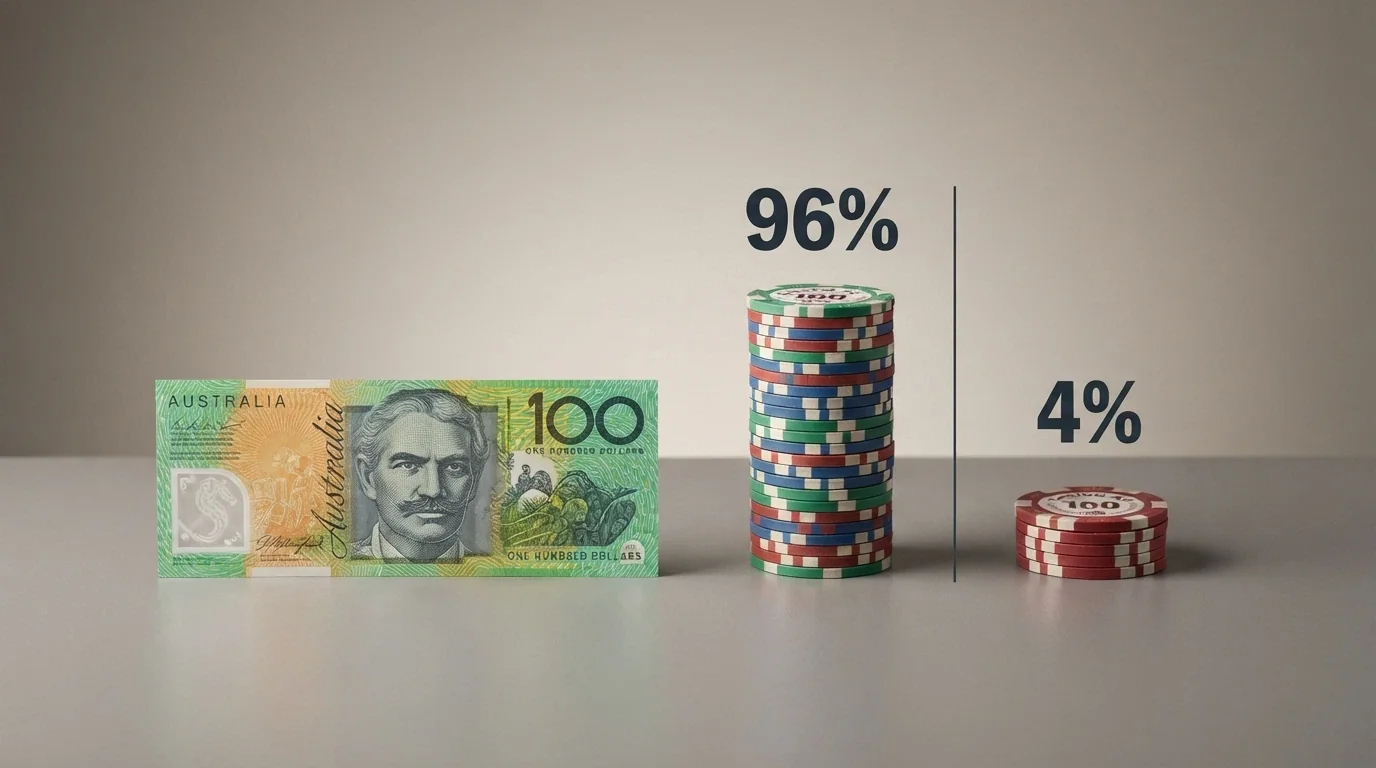
This is why the marketing claim “96% RTP!” on a homepage is a partial truth at best. It does not mean a player who wagers A$100 in a session walks away with A$96. Across millions of spins the figure holds. Across one evening it does not, and the difference between those two frames is where most player disappointment lives. The honest framing is: a 97% pokie keeps A$3 of every A$100 wagered on average, and a 95% pokie keeps A$5. Over five hundred A$1 spins, the gap between those two titles is A$10 in expected loss. It is not a fortune, but it is a number a player can feel across a session.
Why Withdrawal Speed Decides Whether a High Payout Actually Reaches You
An RTP figure describes what the game returns in theory. A withdrawal time describes what the player actually receives in practice, and the two numbers sit at opposite ends of a long process. Across the operators reviewed here, withdrawal requests during business hours are typically processed within 2–4 hours. Skrill and Neteller completions run 0–24 hours. Bank transfers are the slow lane, at 3–5 business days and sometimes stretching to seven.
That gap between advertised speed and real experience widens at offshore operators with no Australian licence. If a Curacao-licensed brand declines a withdrawal on a bonus-term technicality, an Australian player has no local regulator to complain to, no Australian consumer law to fall back on, and no chargeback route through a debit card issuer. The site can be blocked by an ISP at any time, with a balance still on it. The “high payout” in the brand name is only the payout the operator chooses to make.
Audit Certificates: The One Document That Separates a Real RTP from a Marketing Claim
The practical test of any claimed payout percentage is whether an independent testing lab has certified it. The major labs (eCOGRA, GLI, iTech Labs) audit random-number-generator systems and verify that the published RTP matches observed game output over millions of simulated spins. A footer badge from one of these bodies is the only evidence an operator has done the work the claim implies. The practical step for a player is to find the badge in the footer, click through to the certificate, and confirm the game titles and RTP figures listed there match what the casino is actually serving.
If an operator will not show audit certificates, that 99% claim is just marketing noise. Three things to look for: a current certificate dated within the last twelve months, a list of tested games rather than a generic “all games tested” line, and a lab name that resolves to a real testing body when searched. A footer badge without a working link, or a link that resolves to a generic page rather than a per-game report, is the most common dodge in the offshore market.
Online Pokies with the Strongest RTP Figures That Accept Australian Players in 2026
Pokies dominate Australian-facing casino lobbies for a reason that has nothing to do with payout: they are the most promoted, the most visible, and the easiest game to launch with a single tap. The payout picture among them is genuinely uneven, and a small set of titles sits well above the rest. The table below covers the verified figures, sorted by RTP from highest to lowest, with the provider, volatility and maximum win where research has confirmed them.
The Highest-RTP Pokies by the Numbers
| Pokie | Provider | RTP | Volatility | Max Win |
|---|---|---|---|---|
| Mega Joker | NetEnt | 99.00% | Medium | 2,000x |
| Book of 99 | Relax Gaming | 99.00% | Medium-High | 4,500x |
| 1429 Uncharted Seas | Thunderkick | 98.60% | — | — |
| Big Bass Bonanza | Pragmatic Play | 96.71% | High | 2,100x |
| Gates of Olympus | Pragmatic Play | 96.50% | High | 5,000x |
| Colt Lightning Inferno | Play’n GO | 96.20% | High | 50,000x |
| Gnaw’n Gold | Play’n GO | 96.24% | High | 40,000x |
| Neon Villains DoubleMax | Yggdrasil | 96.00% | Super High | 25,000x |
Mega Joker deserves a closer look because its 99.00% RTP applies only in Supermeter mode. Base game returns sit between 76.9% and 85.1%, which is below the pokie average. A player who loads Mega Joker expecting 99% and plays base rounds will see a much worse return than the headline figure implies. Book of 99, by contrast, runs at 99.00% across the full game. Colt Lightning Inferno and Gnaw’n Gold sit lower on RTP but offer enormous max multipliers (50,000x and 40,000x respectively), which is the trade-off a high-volatility pokie makes: smaller expected return per spin, larger ceiling per spin.

Where volatility is not stated, research did not provide a verified figure. That is a real gap rather than an oversight; volatility ratings vary between review sites, and an unverified label is worse than no label.
Why One Provider’s Pokies Consistently Return More Than Another’s
The provider layer matters as much as the title layer. NetEnt averages 97.1% RTP across its full catalogue, the highest among major providers tested. Playtech follows at 96.8%, Thunderkick at 96.5%, Pragmatic Play at 96.2%. That spread is wider than it looks. Across one thousand A$1 spins on a NetEnt title versus a Pragmatic Play title at the spread’s edges, the expected return difference is roughly A$9 — enough to cover a lunch, not enough to notice in a single session, but consistent enough to matter over months of play.
The “Big 5” providers dominating Australian-facing lobbies are Pragmatic Play, IGTech, Nolimit City, 3 Oaks Gaming and Hacksaw Gaming, collectively accounting for 80% of all winning spins in the market. Pragmatic Play is the most visible name on casino homepages; Nolimit City and Hacksaw are the high-volatility specialists driving recent bonus-buy and extreme-volatility trends. A lobby that is heavy on Pragmatic Play and light on NetEnt is not necessarily a worse lobby, but it is a different shape — slightly lower average RTP, much wider variance per session.
The Same Pokie, a Different RTP: What Casinos Never Advertise
Gates of Olympus is the clearest illustration. The same game is available at 96.50% RTP at one casino and 94.50% at another, and the reels look and play identically in both cases. The version loaded is set by the operator, not by Pragmatic Play, and the player has no way to tell from the game screen alone. A 2-percentage-point RTP gap on Gates of Olympus across a session of five hundred A$1 spins is A$10 in expected loss — the same magnitude as the gap between a top-tier and a mid-tier pokie in the table above.
This is why a lobby containing several verified 96%–97% pokies is more useful than one headline 99% title surrounded by lower-return versions. A casino can stock Mega Joker at 99% and stock everything else at 94%, and the homepage will still advertise “99% RTP” as a feature. The figure is true for the one title and misleading for the rest. The check is in the in-game info screen, usually a small “i” or hamburger icon. The RTP listed there is the version actually loaded, and it is the only number that matters for that session.
Demo Mode: Test a Pokie’s RTP Without Risking a Cent
Demo play lets a player load a pokie in fun mode, with virtual balance and no real-money stake. The value is twofold: the game info screen reveals which RTP version is loaded, and the session lets a player feel volatility and hit frequency without risk. Blood Suckers (NetEnt) is widely cited for its 35%+ hit frequency and is the kind of title that rewards longer demo sessions before committing real funds — the low variance and steady small wins are easier to confirm in practice than to read about.
The catch is that demo access varies by operator and by jurisdiction. Some offshore sites require account registration before demo play is unlocked; others serve it instantly. A player who wants to verify RTP versions across multiple casinos should expect to register at several before getting a clear picture, and should treat the registration step itself as a signal — operators that gate demo play behind extensive personal-data collection are also the ones likely to demand the same at withdrawal.
Where the Best Returns Sit Across Casino Game Categories
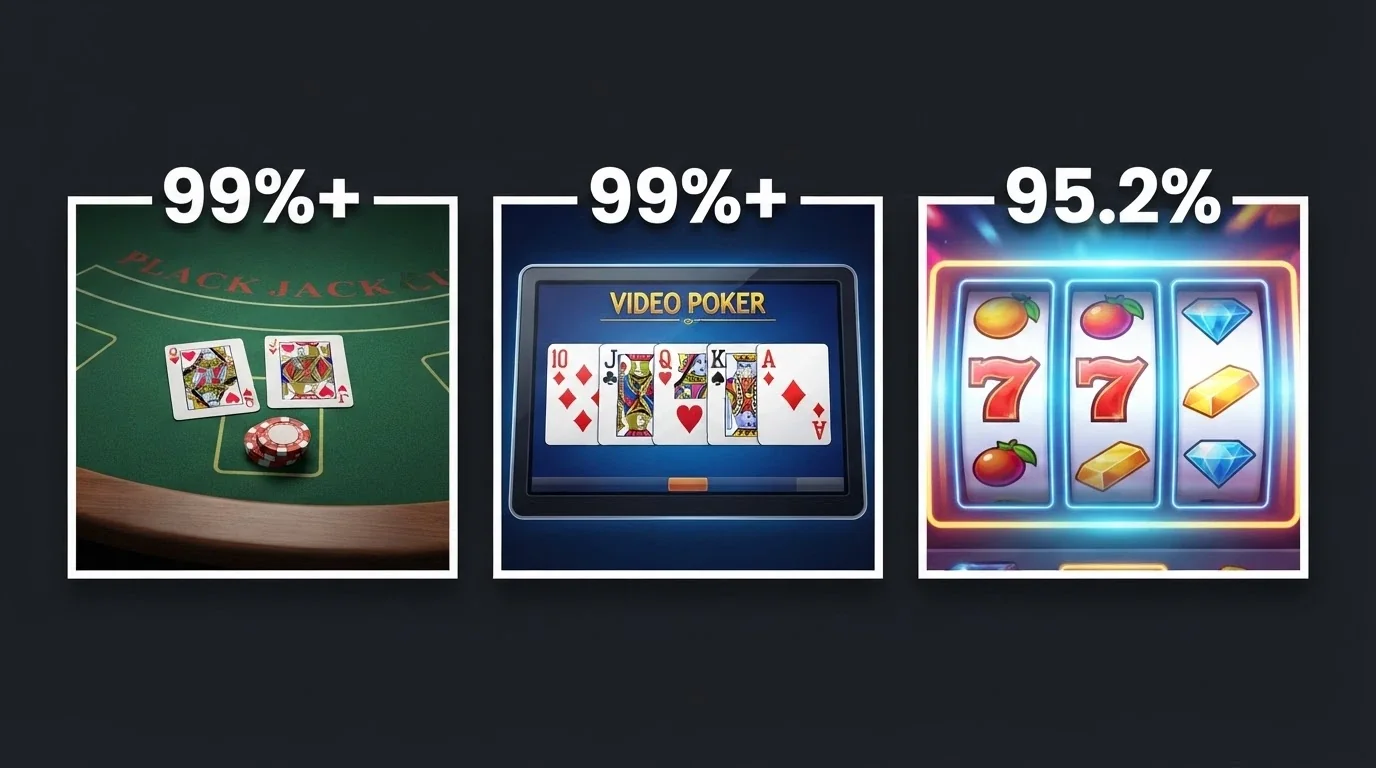
The game a player picks matters more than the casino they pick it at. Across the tested Australian-facing market, blackjack and video poker consistently deliver 99%+ RTP with optimal strategy. Pokies averaged 95.2%. The site-wide average sits at 95.8% — a useful headline number that conceals a 4-percentage-point spread between the best and worst game categories inside the same lobby.
Blackjack and Video Poker: The 99%-Plus Return Games
Blackjack with basic strategy returns above 99% on most rule sets. The exact figure depends on whether the dealer hits or stands on soft 17, whether doubling after split is allowed, and how many decks are in play — but a player using correct basic strategy on a standard ruleset will see a house edge under 1%. Video poker runs a similar profile: Jacks or Better at full pay (9/6) returns 99.54% with optimal play. The qualifier is “optimal,” which means a player who knows the strategy chart for the variant they are playing.
Both games are scarce in offshore lobbies compared to pokies. The reason is straightforward: a blackjack or video poker session at optimal play is hard for the house to profit from, so these titles are buried under thousands of pokie tiles. A player who specifically wants the 99%-plus return has to search for the game by name, often filtering by provider, and is unlikely to encounter the title on a casino’s homepage.
Pokies vs Table Games: The RTP Numbers Side by Side
| Game Type | Typical RTP | House Edge |
|---|---|---|
| Blackjack (basic strategy) | 99%+ | Under 1% |
| Video Poker (optimal play) | 99%+ | Under 1% |
| Pokies (tested AU-facing) | 95.2% | 4.8% |
| Site-wide average | n/a | 4.2% |
The 4.8% house edge on pokies is the cost a player pays for the convenience of tapping a spin button. On a session of five hundred A$1 spins, the expected loss at the pokie average is A$24. On a comparable session at a blackjack table with A$1 bets and basic strategy, the expected loss is under A$5. The gap is not subtle, and it is the gap most players never notice because they are not comparing across categories.
Why Most Players Pick the Games That Pay the Least
The reason is structural, not personal. Pokies are the most promoted, most visible and most abundant game type in every offshore lobby. Welcome-bonus wagering rules typically count pokie spins at 100% toward turnover but count table-game wagers at 10% or exclude them entirely. A player working through a bonus is steered toward pokies by the terms, not by choice. The convenience gap — one tap for a spin versus learning a basic-strategy chart — closes the deal for most players.
The result is a market in which the games with the worst expected return get the most play, and the games with the best expected return sit mostly unused. None of this is a casino conspiracy; it is the alignment of marketing, bonus design and convenience around the highest-margin product. A player who understands the alignment can choose differently; most do not, and that is why the pokie-heavy lobby is the dominant shape of every offshore site.
Ten Casino Sites Australian Players Search For Compared by What the Data Actually Shows
The table below covers the ten brands Australian players most commonly encounter. Every cell carries either a verified figure or the em-dash no-data marker. Where research provided no verifiable specifics for an operator this cycle, the cell stays empty rather than guessing. A thin honest table is worth more than a padded one with invented numbers — a reader using this comparison to decide where to deposit needs to know what is verified and what is not.

| Casino | AU Licence Status |
|---|---|
| SkyCrown | Offshore — no AU licence |
| Wild Fortune | Offshore — no AU licence |
| Hell Spin | Offshore — no AU licence |
| Rocket Play | Offshore — no AU licence |
| Royal Reels | Offshore — no AU licence |
| Stake | Offshore — no AU licence |
| FairGO | Offshore — no AU licence |
| WinSpirit | Offshore — no AU licence |
| Bizzo Casino | Offshore — no AU licence |
| Scream Casino | Offshore — no AU licence |
How to Read This Comparison When the Data Is Uneven
The column above is the only one that is full for every operator, and it is the one that matters most. Every brand on this list is offshore and unlicensed in Australia; the rest of the comparison — bonus amounts, wagering multiples, withdrawal speeds, game-provider rosters — is uneven, with verified specifics for three operators and status-only data for seven. The absence of data is itself a finding. An operator whose bonus terms, licence jurisdiction and RTP certification cannot be independently verified by the time this article was prepared is an operator a player should treat with extra caution.
The table is a starting point, not a ranking. Where verified data exists, the operator write-ups below cover the specifics. Where it does not, the write-up says so plainly and lists what a player should check independently — licence jurisdiction, bonus terms, RTP certification, withdrawal track record — before depositing. A reader who wants a final ranking rather than a starting point is asking the wrong question, because the data does not support one.
SkyCrown
SkyCrown’s headline offer is the largest among the operators with verified data: an A$8,000 welcome package plus 400 free spins distributed across the first four deposits, 100 spins per tier. The 35x wagering multiple applies to free-spin winnings, with each spin valued at A$0.20. Pragmatic Play and NetEnt appear in the confirmed provider list, which puts the two biggest pokie catalogues within reach.
The package total is generous on paper, and a player working through it should expect roughly 35x turnover on the free-spin portion alone — at A$0.20 per spin across 400 spins, that is A$2,800 of qualifying wager before withdrawal. The brand remains offshore and unlicensed in Australia, and an Australian player has no local recourse if a withdrawal stalls. For a player who specifically wants Pragmatic Play and NetEnt pokies in one lobby and is comfortable operating outside Australian consumer protection, the offer is large; for everyone else, the absence of a licence is the deciding fact.
Wild Fortune
Wild Fortune’s offer is unusual in the offshore market for a reason research has verified on the bonus terms page: the 250 free spins carry 0x wagering on winnings. Free-spin winnings are credited as real cash with no wagering requirement. That is the line that sets this operator apart from most competitors in the same segment. The deposit bonus itself runs 40x to 45x on bonus funds, with a 7-day validity after activation and an A$30 minimum deposit. The welcome package totals 225% match up to CA$7,500 across three deposits. NetEnt, Play’n GO and Pragmatic Play appear in the confirmed provider list.
The split structure is worth understanding. The free-spin portion is genuinely low-friction — what you win is yours. The deposit bonus portion is high-friction in the standard offshore pattern: 40x to 45x turnover on bonus funds within seven days is a heavy lift, and a player who deposits the minimum and plays casually will not clear it. For an Australian player who wants the no-wagering free-spin component specifically, this is the standout among featured operators; for someone chasing the headline match percentage, the wagering on the deposit side tempers the appeal.
Hell Spin
Hell Spin carries the only confirmed no-deposit bonus for Australian accounts among the featured operators. The welcome offer is a 100% match up to A$500 plus 50 free spins on selected slots, with 30x wagering on deposit plus bonus. The no-deposit component is 15 free spins credited to Australian accounts, with 40x wagering and an A$75 maximum cashout cap. The activation window is 3 days; the wagering fulfilment window is 7 days.
The A$75 cashout cap is the number that defines this offer. A player who wins anything from the no-deposit spins above A$75 keeps only A$75 — the rest is forfeited. The cap is not unusual for a no-deposit bonus, but it is the figure a player should know before claiming: a 40x turnover on A$75 of withdrawable winnings means A$3,000 of qualifying wagers to clear, against a 7-day window. For a player willing to play through those terms, the no-deposit entry is real money on the table; for everyone else, the cap turns a win into a smaller win.
Rocket Play
Rocket Play is a brand Australian players often encounter. The offshore status is verified: no Australian licence, no Australian regulatory oversight, no connection to BetStop. Beyond that, welcome-bonus terms, licence jurisdiction, game-provider roster and RTP certification were not available for independent verification at the time of this review.
For an Australian player considering Rocket Play, the practical step is to verify the same things independently before depositing: the licence jurisdiction (Curacao, Anjouan, Tobique and similar bodies are common offshore hosts), the bonus terms with attention to wagering multiples and max-cashout caps, the RTP certification badge and whether it resolves to a current audit report, and the withdrawal track record from player forums independent of the operator’s own marketing. None of those checks are difficult; all of them are essential at an unvetted brand.
Royal Reels
Royal Reels carries an Australian-themed brand name, which is a marketing choice rather than a regulatory one. The offshore status is confirmed: no Australian licence exists for online casino, and the Australian-themed branding does not change that. No verified bonus terms, licence jurisdiction or game-provider roster were available this review cycle.
The practical read is that an Australian-facing brand name signals the operator is targeting Australian players — which is exactly the conduct the Interactive Gambling Act prohibits. The branding does not indicate licensing, regulatory oversight or any form of Australian consumer protection. An Australian player who deposits here has no local recourse if a withdrawal is declined, no BetStop coverage, and no guarantee the site will be accessible next month. The name is a promise; the licence is what backs it, and there is none.
Stake
Stake is the globally recognised crypto-native operator in this list. The brand’s core identity is built around cryptocurrency deposits and instant withdrawals — a model that sits in direct tension with Australian payment law. Credit cards, credit-related products and digital currency (crypto) have been banned as payment for online wagering since 11 June 2024, with penalties up to A$247,500 for non-compliance. The bank-and-payment-provider authority to block transactions to illegal gambling operators takes effect from 1 January 2027.
For an Australian player, the tension is sharp. A crypto-native operator accepting deposits from Australian players in crypto is operating outside the payment rules Australian law sets. The penalties attach to the provider, not the player, but the practical effect is that any Australian depositing in crypto at an unlicensed casino is using a payment method the Australian government has explicitly prohibited for online wagering. No verified bonus data or licence jurisdiction was available this cycle for Stake beyond the offshore status.
FairGO
FairGO is a brand name that promises fairness to Australian players. The offshore status is confirmed. No verified bonus terms, licence jurisdiction or game-provider roster were available this review cycle, and the brand name is a marketing claim rather than a regulatory certification.
The fairness promise in the name is the kind of phrasing affiliate sites use to suggest trust without offering evidence. Australian regulatory bodies do not certify offshore operators, and no Australian licence covers any of the brands on this list. An Australian player who reads “FairGO” as a guarantee of fair treatment is reading more into the name than the licence supports. Verify the licence jurisdiction independently; verify the audit certificate; verify the withdrawal terms before depositing.
WinSpirit
WinSpirit carries the highest uncertainty of any brand on this list. Offshore status is confirmed. No verified terms of any kind were available this review cycle — no bonus data, no licence jurisdiction, no game-provider roster, no RTP certification.
The practical risk of depositing at a completely unvetted operator is straightforward: no verified consumer protection, no Australian recourse if a withdrawal is refused, no guarantee the site remains accessible, and no documented basis for the brand’s payout claims. An Australian player should approach WinSpirit with extra caution and verify licence terms and RTP independently before committing funds. If the verification cannot be done — if the operator does not publish a current audit certificate or a verifiable licence number — the absence of that information is the answer.
Bizzo Casino
Bizzo Casino is a brand Australian players encounter. Offshore status is confirmed. No verified bonus terms, licence jurisdiction, game-provider roster or RTP certification were available this review cycle.
The same due-diligence checklist applies: licence jurisdiction, bonus terms, RTP certification and withdrawal track record are all things an Australian player should verify independently before depositing. The absence of that information in a review of this kind is not proof of bad practice, but it is the absence of the evidence that would let a player trust the brand without checking. At an unvetted offshore operator, the player is the only auditor.
Scream Casino
Scream Casino rounds out the ten featured brands and represents the residual uncertainty in the Australian-facing market. Offshore status is confirmed. No verified data of any kind was available this review cycle.
The general caution for unvetted operators applies in full: verify the licence, verify the audit certificate, verify the bonus terms, verify the withdrawal track record from independent player reports. If any of those checks fail — if the licence jurisdiction cannot be confirmed, if the audit certificate is missing or expired, if the bonus terms carry impossible wagering multiples or punitive max-cashout caps — the appropriate response is to deposit elsewhere. The Australian-facing market is large enough that an unvetted operator is never the only option.
What Australian Gambling Law Actually Says About Offshore Casino Sites
The law is the part this article opens with because every other section depends on it. An Australian player reading the operator write-ups above needs to know why every one of them is offshore, why the licence column is uniformly empty, and what protections the Australian framework does and does not provide.
The Interactive Gambling Act: What Section 15 Actually Prohibits
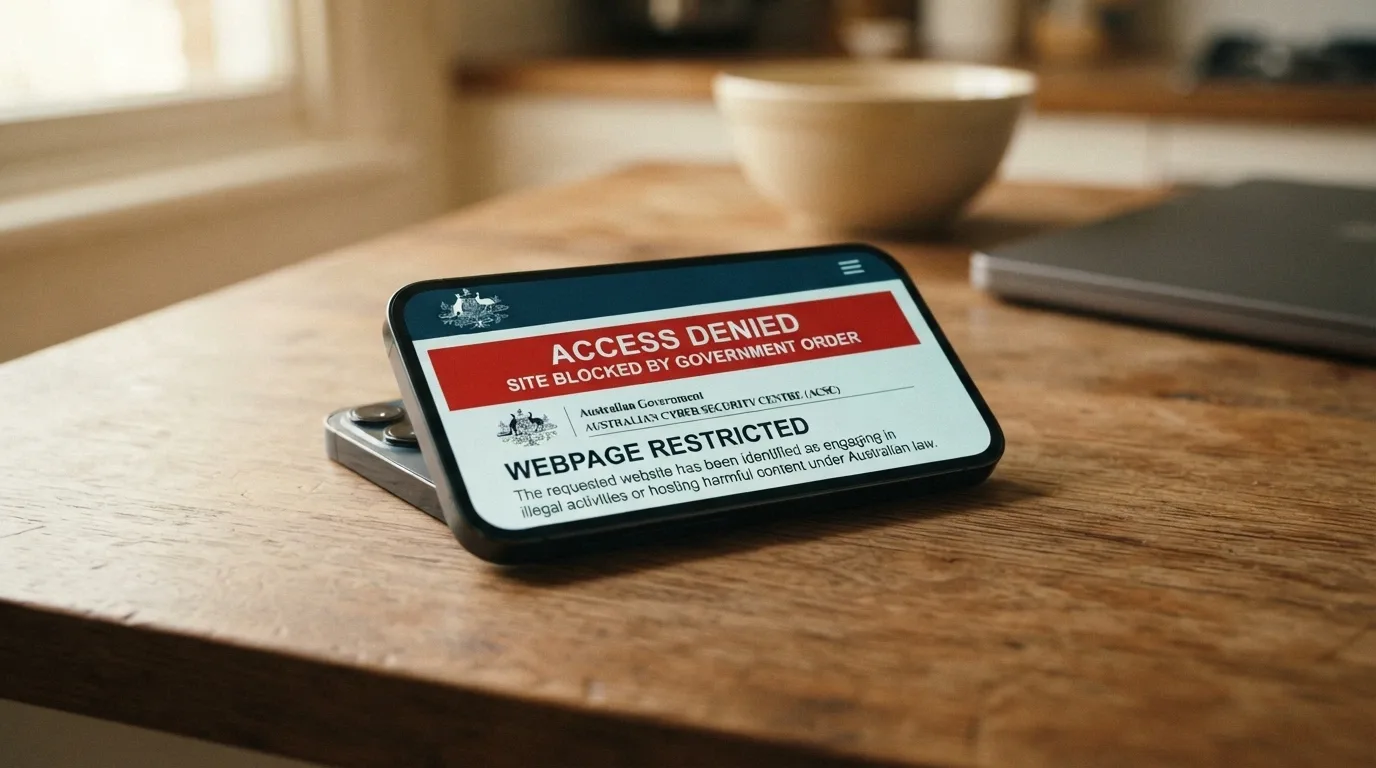
Section 15 of the Interactive Gambling Act 2001 prohibits the provision of online casino games, online pokies and in-play sports betting to people physically in Australia. The 2017 amendment closed the loopholes offshore operators had been using and gave the Australian Communications and Media Authority (ACMA) enforcement and site-blocking powers. There is no federal licence for online casino anywhere in Australia, and no state or territory has issued one. Providing a prohibited interactive gambling service to a person in Australia is the offence; the IGA targets the provider, not the individual player.
That distinction matters. An Australian who plays at an offshore casino is not personally committing an offence. The operator providing the service is. The practical consequence for the player is the absence of consumer protection: no Australian regulator to complain to, no Australian consumer law to invoke, no local dispute resolution, and no guarantee the site will still be reachable next week.
ACMA Enforcement: 1,564 Sites Blocked and 225 Services Gone
Since its first blocking request in November 2019, ACMA has had 1,564 illegal gambling and affiliate websites blocked by Australian ISPs as of March 2026. More than 225 illegal services have withdrawn from the Australian market since 2017 enforcement was strengthened. The number grows by the month, and any of the casinos on the comparison table above could join the list at any time — with player balances still on them.
From 1 January 2027, banks and payment providers gain express authority to block transactions to illegal gambling operators. That is the most significant enforcement expansion since the 2017 amendment: it moves the choke point from ISP-level site blocking to financial-level transaction blocking. An offshore casino that survives ACMA’s site-blocking may not survive a bank’s transaction block, and an Australian player whose deposit is refused at the bank has no path forward.
Credit Cards and Crypto Are Banned: What That Tells You About an Operator
Credit cards, credit-related products and digital currency (crypto) are banned as payment for online wagering since 11 June 2024 under the Interactive Gambling Amendment (Credit and Other Measures) Act 2023. Penalties for non-compliance reach A$247,500. The legal deposit routes for licensed wagering are debit card, bank transfer, PayID/Osko and BPAY — all of which require identity verification.
The practical signal: an offshore casino asking an Australian player for credit card or crypto deposits is operating outside Australian rules. The penalty attaches to the operator, but the player should read the payment-method list as a tell. An operator that accepts the methods Australian law prohibits is an operator that has decided Australian rules do not apply to it. That decision cuts both ways: it cuts toward easy deposits and fast withdrawals, and it cuts toward no recourse if something goes wrong.
What the 2026 Gambling Reform Changes for Bonuses and Advertising
The Interactive Gambling Amendment (Gambling Reform) Bill 2026 passed Parliament on 19 August 2026, and its measures commence on 1 January 2027. The headline changes are a cap of three wagering advertisements per hour between 6:00 am and 8:30 pm, a live-sport blackout for wagering ads, and a ban on athletes, celebrities and influencers promoting wagering products.
The change most relevant to this page is the inducement restriction. From 1 January 2027, direct marketing of inducements — sign-up bonuses, referral offers, “free bet” promotions — is prohibited for 14 days after a customer signs up, for three months after a person deregisters from BetStop, and indefinitely for customers identified as at risk of gambling-related harm. The rules apply to licensed Australian wagering operators, but they signal the regulatory direction the Commonwealth is moving. An offshore casino targeting Australian players with welcome bonuses is operating against the grain of a regulatory framework that is tightening, not loosening.
RG Infrastructure and Real Harm: Playing with a Safety Net Offshore Operators Ignore
The responsible-gambling infrastructure Australia has built does not reach an offshore casino. BetStop, the National Gambling Helpline, the harm-prevalence data — all of it applies to licensed Australian wagering operators. An Australian playing at an offshore site has the helpline and the help resources, but none of the self-exclusion coverage, the activity-statement protections or the operator-level deposit-limit enforcement that BetStop provides.
BetStop: The Self-Exclusion Register That Stops at the Australian Border
BetStop, the National Self-Exclusion Register, launched on 21 August 2023. One registration excludes a person from every Australian-licensed online and phone wagering service. As of 31 March 2026, 59,830 people had registered and 37,247 had active exclusions. BetStop binds approximately 150 Australian-licensed wagering providers — and an offshore casino is not connected.
The coverage gap is total. Self-exclusion on BetStop means nothing to a Curacao-licensed brand. A player who has registered for self-exclusion because their gambling has become harmful, and who then opens an account at an offshore casino, has no Australian-system protection at that site. The exclusion period runs from a minimum of 3 months up to a lifetime, and a person cannot apply to be removed in the first three months. The protection is real and serious — and it stops at the border.
The Real Harm Numbers: 3.32 Million Australians Affected
As of March 2026, 13.0% of the Australian population — an estimated 2,857,000 people — were experiencing some form of gambling harm from their own gambling behaviours. Another 5.4% (1,177,000 people) were experiencing harm from other people’s gambling. In total, 15.1% of Australians — 3.32 million people — were experiencing some form of gambling harm. A model-based national estimate puts the annual affected population at approximately 3.29 million Australians aged five and over, including approximately 1.38 million affected others, with an annual health loss of over 400,000 Years Lived with Disability.
The help infrastructure is real and it is free. The National Gambling Helpline is 1800 858 858 — free, confidential, staffed 24 hours a day, seven days a week. Gambling Help Online at gamblinghelponline.org.au provides 24/7 chat and email counselling, self-assessment tools and information on treatment services. These resources apply to any Australian experiencing gambling harm, regardless of whether the gambling happens at a licensed wagering operator, an offshore casino, a pub pokies room or a land-based casino.
Practical Limits You Can Set Even at an Unlicensed Operator
Offshore casinos are not connected to BetStop, but most offer their own responsible-gambling tools inside the player account. The features to look for: deposit-limit settings (daily, weekly or monthly), session-time reminders and reality-check pop-ups, activity-statement access that tracks deposits, withdrawals and net position over time, take-a-break options (typically 24 hours to several weeks) and self-exclusion options within the individual operator’s platform. None of these are BetStop; none are enforceable by an Australian regulator; all of them are tools a player can use voluntarily.
The practical test is whether the tools are easy to find in account settings and whether they take effect immediately. A deposit limit buried three menus deep, or a “cooling off” period that requires email support to activate, is a tool designed to discourage use. A deposit limit visible on the account dashboard that takes effect the moment it is set is a tool designed to be used. The difference is in the friction, and a player who wants genuine protection should choose the operator with less of it.
How We Evaluated and Ranked Every Brand on This Page
The figures in this article come from three source categories. Regulatory data — ACMA blocking counts, BetStop registration figures, the Gambling Reform Bill details, the credit-card and crypto ban effective date — comes from official Australian sources: ACMA, the Federal Register of Legislation, the Department of Social Services, and Gambling Help Online. Game and provider data — RTP figures, volatility ratings, max wins, catalogue averages — comes from the Australian-facing pokie and casino review archive. Operator-specific data — bonus terms, wagering multiples, free-spin structures, minimum deposits, validity windows — comes from operator bonus-terms pages where verifiable.
The criteria that ordered the operator write-ups were verified data first, status next. SkyCrown, Wild Fortune and Hell Spin carry verified bonus specifics; the other seven carry offshore status only, and the write-ups state that plainly rather than padding them with unverified figures. No numerical weighting was invented: the order reflects the depth of verifiable information available for each operator this review cycle, not a score.
The limits of the available data are stated at the point they matter. Where research returned no verifiable figure, the no-data marker or a qualitative sentence is used in its place. Where an operator’s licence jurisdiction, game-provider roster or RTP certification could not be confirmed, the write-up names what a player should check independently. The article does not present unverified claims as verified ones; it presents the absence of verification as the finding it is.
Your Move When Every Casino Option Sits Outside Australian Law
The arithmetic on the page is real. The 99% RTP of Mega Joker in Supermeter mode is real. The 0x wagering on Wild Fortune’s free spins is real. The A$75 cashout cap on Hell Spin’s no-deposit bonus is real. None of it changes the legal frame: every casino on this list is offshore, unlicensed in Australia, and unconnected to BetStop. An Australian player who deposits at any of them has no Australian consumer protection, no local dispute resolution, and no guarantee the site will remain accessible.

The choice every Australian reader of this page faces is not which offshore casino pays the most. It is whether to play at an offshore casino at all. For a player who decides yes, the figures above give a real basis for choosing between them — Wild Fortune’s free-spin structure is genuinely different from the standard offshore pattern, Hell Spin offers the only confirmed no-deposit entry for Australian accounts, and SkyCrown’s package is the largest. For a player who decides no, the licensed Australian market offers pre-event sports and race wagering with full consumer protection, BetStop coverage and Australian dispute resolution — though no online casino games.
Whichever way the choice lands, the help infrastructure is the same. The National Gambling Helpline is 1800 858 858, free and confidential, 24 hours a day. Gambling Help Online at gamblinghelponline.org.au provides chat and email counselling around the clock. The figures on this page are designed to help a reader make an informed decision; the help lines exist for the readers who find the decision harder than the arithmetic suggests.
Frequently Asked Questions
What happens if an offshore casino refuses to pay out my winnings?
An Australian player has no local regulator to appeal to. ACMA enforces the prohibition on the provider, not disputes between provider and player, and the Interactive Gambling Act does not establish a consumer-protection mechanism for offshore winnings. The practical options are limited: a chargeback through a debit card issuer (unavailable for credit cards, which are banned), a complaint to the operator’s offshore licence body (typically Curacao or Anjouan, with limited enforcement track record), and reliance on the operator’s own goodwill.
Can Australian players get no-deposit bonuses and are they worth claiming?
Hell Spin is the only featured operator with a confirmed no-deposit offer for Australian accounts: 15 free spins with 40x wagering and an A$75 maximum cashout cap. The cap is the defining number — any winnings above A$75 are forfeited. Against a 7-day wagering window, a player who wins and wants to withdraw faces A$3,000 of qualifying wagers on A$75 of withdrawable funds. The entry is real money on the table, but the cap turns most outcomes into smaller wins.
Do I pay tax on online casino winnings in Australia?
No. Gambling and betting winnings are not assessable income for the player under section 6-5 of the ITAA 1997, and gambling losses are not deductible under section 8-1 — unless the person is carrying on a business of betting or gambling, which is a high threshold. Professional poker players and full-time sports bettors can be treated as carrying on a business; recreational players at any casino on this list are not. The ATO guidance at IT 2655 covers the position.
Are PayID and crypto both usable for casino deposits from Australia?
PayID/Osko is a legal deposit method for licensed Australian wagering. Crypto is not — credit cards, credit-related products and digital currency have been banned as payment for online wagering since 11 June 2024, with penalties up to A$247,500 for non-compliance. An offshore casino accepting crypto from an Australian player is accepting a payment method Australian law prohibits for online wagering. Debit card, bank transfer, PayID/Osko and BPAY are the legal routes for licensed wagering; none of them apply at an offshore casino, which sits outside the licensed framework entirely.
How fast can Australian players withdraw winnings and which payment methods work best?
Across the operators reviewed, withdrawal requests during business hours are typically processed within 2–4 hours. Skrill and Neteller completions run 0–24 hours. Bank transfers are the slowest at 3–5 business days, sometimes stretching to seven. The fastest methods (e-wallets, crypto at operators that accept it) are also the ones with the least Australian-law protection. A bank transfer through a debit card rails takes longer but is auditable through the Australian bank if a dispute arises.
What should I check in the bonus terms before claiming a welcome offer?
Four things, in this order: the wagering multiple (35x on bonus funds is standard at most offshore operators, with the Wild Fortune 0x on free-spin winnings the standout exception); the validity window (7 days on the Wild Fortune deposit bonus is short against the 30-day industry norm); the maximum cashout cap (Hell Spin’s A$75 cap on no-deposit free spins is the figure that defines the offer); and the game-weighting (pokie spins typically count 100% toward turnover, table games 10% or excluded). The headline percentage match is the least important number on the page.