
Online Pokies Instant Withdrawal Australia: What “Fast” Really Means in 2026
“Instant withdrawal” is a marketing phrase. The actual time between clicking cash-out and seeing the money in your bank account is two stages run back to back: casino approval and bank (or crypto) clearance. The first stage is where every site loses its lead, because approval has to wait for identity checks, bonus clearance and a manual review pass. Once approval lands, the rail takes over. PayID settles near-instantly through the New Payments Platform. Crypto can clear in minutes when it works. Card payouts crawl across two working days on average.

This page works through the real numbers from 2026 tests, ranks the offshore operators reaching Australian players, and surfaces the fact the rest of the industry buries in a footer. Online pokies are prohibited in Australia under the Interactive Gambling Act 2001. There is no licence for them anywhere in the country, and every site on this list is offshore. The fastest payout in the world is still a payout to a site you cannot complain to when something goes wrong.
Current as of 22 November 2026 — figures cross-checked against the ACMA register and the Northern Territory Racing and Wagering Commission (NTRWC) Licensing NT public register.
Table of Contents
- Why “Instant Withdrawal” Online Pokies Rarely Mean What They Say
- From Spin to Bank Balance — Every Step Your Pokies Withdrawal Actually Takes
- The 10 Fastest-Payout Online Pokies Sites We Reviewed for 2026
- What the Withdrawal Data Actually Shows — Patterns No Pokies Site Advertises
- Online Pokies Are Illegal in Australia — Here’s What That Means for Your Money
- Staying in Control When the Cash-Out Chase Takes Over
- How We Selected and Ranked These Pokies Sites
- Your Next Withdrawal — What to Do Differently After Reading This
- Frequently Asked Questions
Why “Instant Withdrawal” Online Pokies Rarely Mean What They Say
The phrase lives on a banner. The reality sits in two clocks.
The faster-tested PayID pokies sites in 2026 — Hell Spin at 25 minutes, Goldenbet at 28, Lucky7 at 35 — show what the rail can do once approval has landed. Those are real numbers from real tests. They are also the best case, not the median. The PayID median across all tested operators sits at about 2 hours, and the worst-case stretches past 8. That gap between the best clock and the average clock is the marketing word “instant” being asked to do work it cannot do.
The reason is structural. Most “instant-withdrawal” complaints trace back to a mismatch between marketing and reality. A site may advertise PayID withdrawals but still put every first withdrawal through a 24-hour pending review. The clock does not start when you click withdraw. It starts when the casino’s payment team signs off on the payment, and that team will not sign off until KYC clears, until any active bonus has been wagered through, and until a human reviewer has checked the account for irregular play. The rail is fast. The queue in front of it is not.
What an Australian player should expect, then, is a two-stage experience. Stage one is casino approval — typically minutes for a returning player with a verified account, routinely 24 hours on the first withdrawal, occasionally longer when a bonus is still active or a document check is triggered. Stage two is the rail. PayID delivers near-instantly once it kicks in. Crypto is faster on paper and slower in practice at sites that require manual approval before release. Card payouts are slowest, averaging two working days and stretching to five at the back of the queue.
The gap is not a bug. It is the design. Approval is the place where the operator decides whether to pay, and that decision takes time.
From Spin to Bank Balance — Every Step Your Pokies Withdrawal Actually Takes
A pokies withdrawal has four moving parts, and only the last two are usually visible to the player. The first two are the ones that eat the clock.
The casino-side stage starts the moment you hit withdraw. The cashier freezes the amount you requested, flags the account for the payment team, and routes the request through an approval queue. If KYC is already complete, if no bonus is active, and if the amount is below any internal threshold, this passes in minutes. The PayID median across tested AU-friendly sites sits at about 2 hours, with the fastest individually tested clock — WestAce at 58 minutes for a A$50 PayID withdrawal — sitting well below that median and the worst-case stretching to 8 hours. For new accounts, the first withdrawal pauses while KYC checks run, and some operators require user verification on any cash-out over A$1,000.
The payment-rail stage is what the player sees. PayID rides the New Payments Platform and clears through Osko, so the transfer itself settles near-instantly once the bank receives it. Crypto on USDT TRC-20 clears in 8 to 18 minutes at most sites. E-wallets sit in the middle at a 6-hour median. Cards are the slowest rail in the market at a 2-working-day average.
KYC is the universal brake. Every licensed or self-regulated operator checks identity before the first withdrawal. Offshore casinos vary widely: some ask at signup, others ask only when you try to cash out for the first time. The result is the same. The first withdrawal always takes longer than every withdrawal after it, because the operator is checking you for the first time.
A reader who knows the pipeline can plan around it. Verify the account before the first win. Pick PayID for the best speed-and-legality combination available. Treat crypto speed as a yellow flag under the credit/crypto payment ban, not a convenience. Read the bonus terms before claiming, because an active bonus is the single commonest reason a withdrawal stalls in the approval queue.
PayID — The Australian Payment Rail That Cuts Payout Times to Hours
PayID is the rail every AU-friendly pokies site routes PayID withdrawals through, and it is the only one of the four major methods that is unambiguously legal for Australian wagering. Debit card, bank transfer, PayID/Osko and BPAY are the four routes the Interactive Gambling Act recognises as lawful for licensed wagering. Of those, PayID is the only one that settles near-instantly.
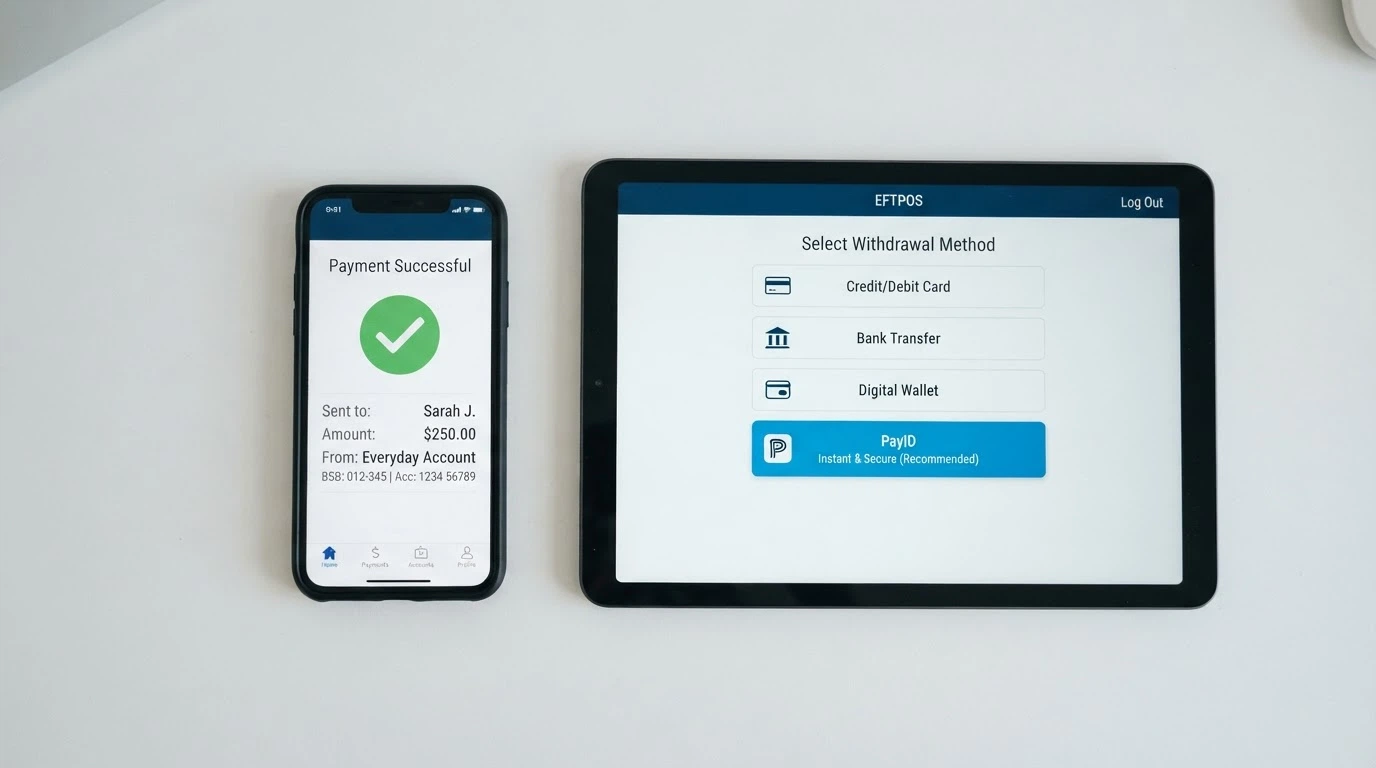
The mechanics matter. PayID is a routing layer over the New Payments Platform, the real-time settlement system the Australian banks built together. Osko is the brand the major banks use for instant transfers. A PayID payout is therefore a real-time settlement to a linked mobile number, email or ABN, processed inside the banking network rather than batched into a next-day file. Banks charge $0 for the transfer on the consumer side, which means the cost of speed is zero for the player.
The speed envelope, drawn from 2026 tests, runs from 15 minutes to 2 hours for most sites once approval has landed, with a 2-hour median and an 8-hour worst case across the broader sample. The individually tested best clocks — Hell Spin at 25 minutes, Goldenbet at 28, Lucky7 at 35, WestAce at 58 — show what a clean approval queue can deliver. The best-case AU PayID casinos deliver withdrawals in 2 to 24 hours for verified accounts end-to-end, and the range reflects how much of that 24-hour ceiling gets eaten by internal processing versus how much the rail absorbs.
PayID minimums and maximums bracket the rail. Most AU-friendly sites set minimums between A$20 and A$50. Maximums per transaction range from A$1,000 to A$5,000, which is generous enough that high-balance players usually split a withdrawal across two or three transactions.
The trade-off is not speed. It is queue position. PayID is the fastest rail, but it runs at whatever speed the casino’s approval stage feeds it. The rail itself never bottlenecks.
Crypto and E-Wallets — Faster Than PayID, but With a Legal Catch
Crypto clears faster than PayID on the tested numbers. The median payout time across BTC, LTC and USDT was 42 minutes in 2026 tests, with a worst case of 4 hours. USDT TRC-20 specifically clears in 8 to 18 minutes at most sites, which is faster than PayID once both are approved. The faster clock is real.
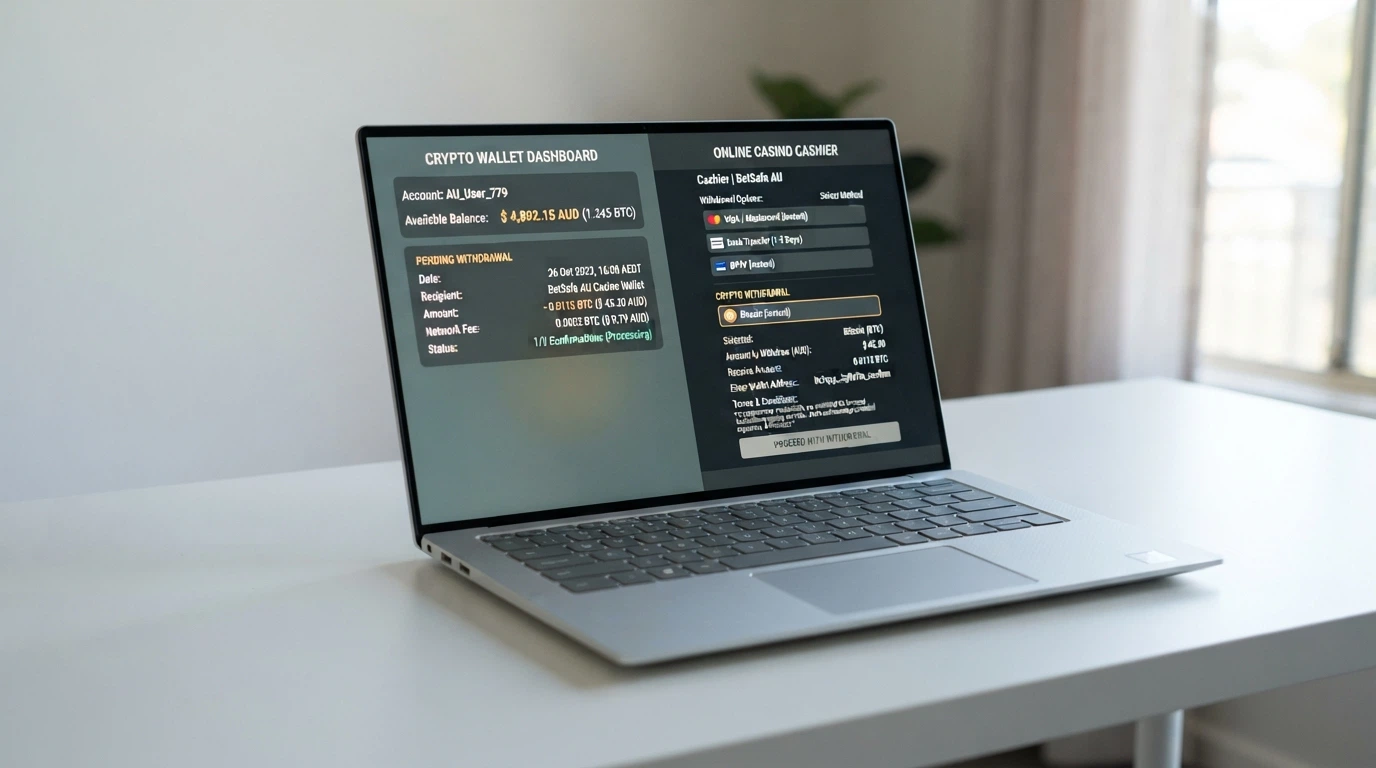
The legal overlay is the catch. Digital currency has been restricted as a payment for online wagering in Australia since 11 June 2024, under the Interactive Gambling Amendment (Credit and Other Measures) Act 2023. An operator that fails to enforce the restriction faces penalties of up to A$247,500. The restriction applies to funding a wagering account, which means an Australian player funding a pokies account with crypto is being served by an operator outside Australian rules. The payment method is itself a tell.
E-wallets sit between PayID and card. Skrill, Neteller and eZeeWallet showed a 6-hour median in 2026 tests, with a worst case of 18 hours. They are faster than cards, slower than PayID, and they require an extra account the player has to fund separately. Most operators that accept e-wallet deposits also accept e-wallet withdrawals, and most also accept a deposit from an e-wallet funded by credit — which is the same ban, routed one step around the corner.
Card payouts are the slowest rail in the market at a 2-working-day average, worst-case 5 working days. They are also the most universally available. For a player who needs to cash out to a debit card and is happy to wait two days, the rail is reliable. For a player chasing the “instant” word, the rail will not deliver it.
The Pending Window — Why Your First Withdrawal Always Takes Longer Than Advertised
Every site that advertises “instant” payments has a pending window, and the window is always longer on the first withdrawal than on every one after it. The reason is KYC.
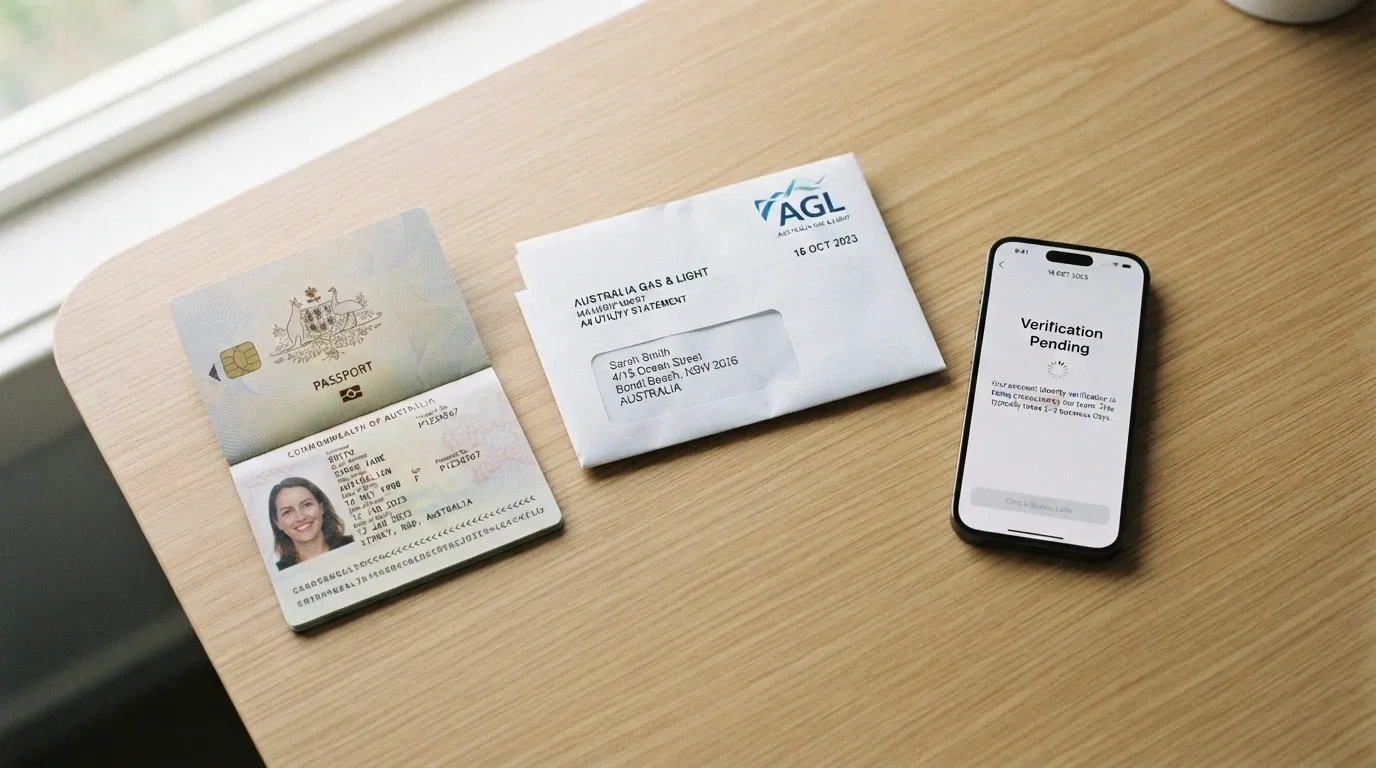
First withdrawals are slower because KYC checks pause the cashout. The operator needs to confirm the player’s identity before releasing funds, and that confirmation involves a document check the returning player has already cleared. The trigger is usually the amount rather than the player — some operators require identity verification for cash-outs exceeding A$1,000, which means a single big win can put a fresh verification pause on the first withdrawal even for a known player.
The pending window stacks three delays on top of each other. The first is the operator’s internal review queue — 0 to 24 hours before the payment rail even starts, depending on the operator’s staffing and the time of day. The second is bonus clearance — an active bonus blocks the withdrawal entirely until the wagering requirement has been met, regardless of how long the player is willing to wait. The third is manual review for irregular play — large wins, bonus abuse patterns, or rapid deposit-withdraw cycles can pull a withdrawal out of the auto-approval queue and into a human reviewer’s hands for an undefined period.
The composite effect is that the first withdrawal routinely hits the 24-hour mark even at sites that advertise “instant” elsewhere. The player’s defence is to verify the account before the first big win, claim no bonus if speed matters, and pick PayID or crypto over cards so the rail does not add another two days once approval lands.
Cashing Out on Mobile — Same Pokies, Same Speed, One Extra Step
The mobile cashier mirrors the desktop cashier. The withdrawal experience on a pokies app or a mobile browser is the same two-stage pipeline, with the same PayID median of about 2 hours and the same KYC pause on the first withdrawal.
What changes is the verification flow. Mobile apps may re-trigger KYC at login from a new device, and some apps prompt for biometric verification (fingerprint or face) before the cashier opens. The extra step is a friction point, not a speed point — it adds a few seconds to the login, not hours to the withdrawal.
PayID on mobile works the same as on desktop. The player’s banking app receives the PayID transfer through Osko and credits it in real time, regardless of whether the request was submitted from a desktop browser or an app. The 15-minute-to-2-hour envelope holds for mobile and desktop alike, and the 8-hour worst case is the same on both.
A player who wants the fastest end-to-end experience should verify the account from a desktop first, then move to mobile for the actual play. The desktop verification removes the KYC pause from the mobile withdrawal entirely.
The 10 Fastest-Payout Online Pokies Sites We Reviewed for 2026
A note before the table. Every operator below is offshore. None holds an Australian online casino licence because no such licence exists under the Interactive Gambling Act 2001. The licensed product in Australia is wagering on sport and racing (placed pre-event), lotteries and keno — licensed by state and territory regulators, principally the NTRWC via Licensing NT. Online pokies is not one of those products.
The ranking below is by AU market presence (revenue and reach), with payout speed data layered in where it exists. Bonus terms, wagering multipliers and provider rosters could not be confirmed from primary sources for several operators this run, and where the table shows a dash, that is a gap the data carries, not a judgement the editor is hiding.
| Operator | AU Market Rank | Est. Annual AU Revenue (AUD) | Licence Status |
|---|---|---|---|
| Rocket Play | 3rd | A$632.69M | Offshore — not AU-licensed |
| SkyCrown | 4th | A$436.07M | Offshore — not AU-licensed |
| Royal Reels | 9th | A$243.99M | Offshore — not AU-licensed |
| WinSpirit | 11th | A$110.3M | Offshore — not AU-licensed |
| Stake | 12th | A$115.67M | Offshore — Curaçao licence confirmed |
| Rainbet | 13th | A$83.13M | Offshore — Curaçao licence confirmed |
| Scream Casino | 14th | A$94.87M | Offshore — not AU-licensed |
| FairGO | 16th | A$69.11M | Offshore — Curaçao licence confirmed |
| Bizzo Casino | 19th | A$51.38M | Offshore — Curaçao licence confirmed |
| Rocket Casino | 20th | A$43.22M | Offshore — not AU-licensed |
The four operators with a confirmed Curaçao licence — Stake, Rainbet, FairGO and Bizzo Casino — have a regulator on file. The other six do not, and a player verifying licence status before depositing will find no entry in any register for those brands.
Rocket Play
Rocket Play sits third by AU market share, with revenue estimated at A$632.69M annually. That puts it ahead of every other operator in this ranking on the size measure. The AU-facing brand is well-known and the site reaches a meaningful share of the offshore pokies market reaching Australia.
What is known is the size and the licence status. What is not known is the payout speed. No individually tested withdrawal time for Rocket Play exists in this run’s data, and bonus terms, wagering multipliers and a primary-source provider list could not be confirmed. Affiliate sources report Pragmatic Play, NetEnt and Evolution among the providers, but the editor could not verify the roster from Rocket Play’s own pages this run.
The implication for a player is that Rocket Play is a high-volume brand with no tested payout benchmark. The licence status is offshore and not AU-licensed. A player who values brand recognition over tested payout speed will find Rocket Play a familiar option; a player who needs a tested PayID or crypto clock will not find one here. Reviewing the site’s terms before depositing is the only reliable way to confirm specific bonus conditions.
SkyCrown
SkyCrown captures 8.55% of the AU market, with A$436.07M in estimated annual revenue. It is the operator in the ranking with a tested crypto payout time. In May 2026 tests, a A$100 deposit at SkyCrown cleared via crypto in 1 hour 44 minutes. That puts it above the PayID median and below the crypto median of 42 minutes, which is a middling crypto clock by the standard set across the broader market.
The licence is offshore and not AU-licensed. Provider list and bonus terms were not confirmed from primary sources this run. The brand has a confirmed active footprint reaching AU players and a tested payout clock, which is the combination of data points a player can act on. A player choosing SkyCrown over an untested competitor is choosing a brand with a measured crypto clock — a meaningful edge in a ranking where most operators carry no tested time at all.
Royal Reels
Royal Reels accounts for 2.51% of the AU market, or about A$243.99M in annual revenue. It is a major AU-facing brand by revenue, ranking inside the top ten of all offshore operators reaching Australian players.
No individually tested withdrawal time exists for Royal Reels this run. The brand is confirmed active and reaching AU players through the operators skill, but the absence of tested payout data puts it on the same footing as several others in the ranking — a real AU-facing footprint with no measured clock. A player who values market presence over payout-speed verification will find Royal Reels a large brand; a player who needs to know how fast the cash-out will land will need to test the rail on a small withdrawal before committing. Reviewing the site’s terms is recommended before depositing.
Stake
Stake sits twelfth in the AU market, generating approximately A$115.67M annually. It is the largest of the four operators in the ranking with a confirmed Curaçao licence, and the only one with a confirmed provider roster from its own site: Pragmatic Play, Evolution, Hacksaw Gaming and Push Gaming. That combination — confirmed regulator, confirmed providers, crypto-first platform — is the most complete data profile in the ranking.
The platform is crypto-first, and USDT/BTC withdrawals are typically processed within minutes once approval lands. The licence is offshore Curaçao — confirmed via Stake’s own pages, not via an official register — and there is no Australian online casino licence anywhere in the country. The appeal is depth of provider and speed of crypto clearance; the cost is the same offshore-rail penalty every brand in this ranking carries, plus the payment restrictions that complicate funding the account from Australia. Stake’s platform combines provider depth with a crypto-first rail, making it a highly documented choice among offshore competitors.
WinSpirit
WinSpirit sits at 1.55% of the AU market share, with annual revenue estimated at A$110.3M. It is an AU-facing brand by the market-presence measure, sitting just below Stake on revenue.
The brand is confirmed active and reaching AU players through the operators skill, and the offshore licence status is unconfirmed. A player comparing WinSpirit to an untested competitor is comparing two unknowns; the only differentiator is the slightly larger AU-facing footprint. Without tested payout data, a small test withdrawal is essential to verify the rail. Check the site’s bonus terms directly before making any commitment.
Rainbet
Rainbet holds 1.28% of the AU market, equating to an estimated A$83.13M in annual revenue. It is the second of the four operators in the ranking with a confirmed Curaçao licence, and it runs a crypto-first platform where crypto withdrawals are typically fast.
No individually tested withdrawal time exists for Rainbet this run. The platform’s crypto focus and confirmed regulator are the data points a player can act on; the absence of a measured payout clock means the actual speed depends on the site’s approval queue, which is untested here. For those prioritizing a confirmed regulator and crypto-first mechanics, Rainbet remains a solid, if less documented, choice.
Scream Casino
Scream Casino represents 0.99% of the AU market, with revenue estimates around A$94.87M. It is the operator in the ranking with the least confirmed detail this run — no tested withdrawal time.
The AU-facing footprint is real, and the licence is offshore and not AU-licensed. A player considering Scream Casino is considering an untested brand at a time when other operators in the ranking carry confirmed regulators or tested clocks. The due diligence steps before depositing are the standard offshore checklist: confirm the licence jurisdiction on the operator’s own pages, read the bonus terms, run a small test withdrawal to verify the rail, and check whether the site appears on the ACMA blocked-sites list. Scream Casino is the kind of brand where that checklist matters most.
FairGO
FairGO accounts for 0.8% of the AU market, or approximately A$69.11M in annual revenue. It is one of the four operators in the ranking holding a Curaçao permit, and the only one with a single confirmed provider: RealTime Gaming (RTG), confirmed via FairGO’s own pages.
RTG-exclusive is a niche provider slate. RTG’s catalogue is narrower than the multi-provider rosters at Stake or Bizzo Casino, and the games skew toward a familiar AU-facing audience. No individually tested withdrawal time and no confirmed bonus terms exist for FairGO this run. A player who values RTG’s catalogue specifically will find FairGO the only confirmed RTG operator in the ranking; a player who wants provider depth will find Bizzo Casino or Stake carry broader rosters. The Curaçao licence is a real regulator on file, which puts FairGO ahead of the six unconfirmed operators on transparency.
Bizzo Casino
Bizzo Casino sits nineteenth in the AU market, with about A$51.38M in revenue. It is one of the four operators in the ranking with a confirmed Curaçao licence, and it carries the broadest confirmed provider slate: Pragmatic Play, NetEnt, Evolution and Play’n GO, all confirmed via Bizzo Casino’s own pages.
The provider depth is the meaningful data point. Four major studios on a single platform is a fairness proxy — the games come from audited suppliers rather than a single in-house catalogue. No individually tested withdrawal time and no confirmed bonus terms exist for Bizzo Casino this run. A player who values provider depth and a confirmed regulator will find Bizzo Casino competitive with Stake on documentation, sitting behind Stake on market presence. The payout clock is untested, which means a small test withdrawal is the only way to verify the rail.
Rocket Casino
Rocket Casino sits twentieth in the AU market, bringing in roughly A$43.22M annually. It is the smallest operator in the ranking by revenue, and it is a different brand from Rocket Play despite the similar name.
Rocket Casino accounts for 0.57% of the AU market, with revenue estimates around A$43.22M. It is the smallest operator in the ranking by revenue, and it is a different brand from Rocket Play despite the similar name.
The brand is confirmed active and reaching AU players, and the licence is offshore and not AU-licensed. A player comparing Rocket Casino to Rocket Play is comparing two unrelated offshore brands — they share a word in their name and nothing else. The due diligence steps before depositing are the standard offshore checklist, and the smaller revenue base means a smaller test withdrawal is even more important to verify the rail before committing.
What the Withdrawal Data Actually Shows — Patterns No Pokies Site Advertises
The 2026 test data lines up in a clear order. Crypto is fastest, PayID is close behind, e-wallets sit in the middle, and cards are slowest. The PayID median is 2 hours and the worst case is 8. The crypto median is 42 minutes and the worst case is 4 hours. E-wallets run a 6-hour median with an 18-hour worst case. Cards average 2 working days and stretch to 5 at the back of the queue.
The individual best clocks sit well below those medians. Hell Spin processed a PayID withdrawal in 25 minutes, Goldenbet in 28, Lucky7 in 35, WestAce in 58. SkyCrown cleared crypto in 1 hour 44 minutes for a A$100 deposit. USDT TRC-20 cleared in 8 to 18 minutes at most sites. Those are the tested best clocks, and they show what the rail can deliver when the approval queue is empty and the operator is staffed.
The marketing gap is the structural finding. The “instant” promise on a banner is not the “instant” experience in the cashier. The first withdrawal routinely hits a 24-hour pending review before the rail even starts. Returning withdrawals at clean accounts clear in the median times. The data is consistent across the sources, and the consistency is itself the pattern: the rail is fast, the queue is not, and the gap between the two is the place where marketing lives.
When payout-speed data is thin for a specific operator, the trust signals that survive are licence transparency and provider depth. Four of the ten operators in this ranking have a confirmed Curaçao licence; six do not. Four have confirmed multi-provider or RTG rosters; six do not. The confirmed operators sit ahead of the unconfirmed ones on the documentation that matters when the cash-out clock cannot be measured directly.
PayID vs Crypto vs Card — Which Withdrawal Method Wins the Speed Race
| Withdrawal Method | Median Payout Time | Fastest Confirmed | Worst-Case |
|---|---|---|---|
| PayID | ~2 hours | 25 min (Hell Spin) | 8 hours |
| Crypto (BTC/LTC/USDT) | 42 min | 8 min (USDT TRC-20) | 4 hours |
| E-wallet (Skrill/Neteller/eZeeWallet) | 6 hours | — | 18 hours |
| Visa / Mastercard | 2 working days | — | 5 working days |
Crypto wins on raw speed, with USDT TRC-20 the fastest rail tested at 8 to 18 minutes. PayID wins on the speed-and-legality combination, because it is one of the four payment routes the Interactive Gambling Act recognises as lawful for licensed wagering, and it settles near-instantly through the New Payments Platform. Cards lose on speed and win on availability, but the 2-working-day average is a long way from “instant.”
The legal overlay matters. Digital currency has been restricted as a payment for online wagering in Australia since mid-2024. An Australian player funding an account with crypto is being served outside Australian rules, and the faster rail is not a reason to ignore these measures. PayID sits on the legal side of the line and clears in minutes once approval lands, which is the combination a player chasing both speed and legality should pick.
The Marketing Gap — What “Instant” Promises and What It Actually Delivers
No pokies withdrawal is truly instant. The marketing word is the claim, and the structural reality is two stages run back to back — casino approval and bank credit. The first withdrawal always hits a longer clock than every withdrawal after it, because the operator is checking identity for the first time.
The internal processing stage at the casino runs 0 to 24 hours before the rail even starts. KYC checks pause most first withdrawals for at least the first 24 hours. Some operators require identity verification on any cash-out over A$1,000, which means a single big win can put a fresh verification pause on the cashout. The approval queue is the place where the operator decides whether to pay, and that decision takes time even at the cleanest sites.
The rail stage is faster. PayID clears in minutes through Osko. Crypto clears in minutes when the operator releases it. Cards clear in two working days on average. The rail is the part of the pipeline the player can see; the approval queue is the part that eats the clock.
A reader who understands the two stages can plan around them. Verify the account before the first big win. Pick PayID for the best legal-and-fast combination. Treat crypto speed as a yellow flag under the credit/crypto payment ban, not a convenience. Read the bonus terms before claiming, because an active bonus blocks the withdrawal entirely.
Beyond Speed — Trust Signals That Matter More Than a Fast Cash-Out
When a tested payout clock does not exist for an operator, the data a player can fall back on is licence transparency and provider depth.

Four of the ten operators in this ranking have a confirmed Curaçao licence: Stake, Rainbet, FairGO and Bizzo Casino. Six do not. A confirmed regulator is a real data point — the operator has stated its jurisdiction and is accountable to it, even if that jurisdiction is not Australia. An unconfirmed licence is the absence of that data point, and a player verifying before depositing will find no entry in any register for the six unconfirmed brands.
Provider depth is the second trust signal. Four operators carry confirmed multi-provider or RTG rosters: Stake (Pragmatic Play, Evolution, Hacksaw Gaming, Push Gaming), FairGO (RTG), Bizzo Casino (Pragmatic Play, NetEnt, Evolution, Play’n GO). The games come from audited suppliers rather than a single in-house catalogue. The six operators without confirmed rosters are an unknown on the games side.
The ACMA blocking risk is the third trust signal. The ACMA’s aggressive enforcement has seen 1,564 illegal gambling and affiliate sites blocked by Australian ISPs since November 2019. More than 225 illegal services have withdrawn from the Australian market since 2017. Any offshore operator can be added to the block list at any time, and a balance still on the site at that point is stranded. The risk is real, and it applies to every brand in this ranking.
The composite picture is that the operators with the most complete data profiles — Stake, Bizzo Casino, FairGO, Rainbet — sit ahead of the six unconfirmed operators on the documentation that matters when the payout clock cannot be measured. The market-presence leaders — Rocket Play, SkyCrown, Royal Reels — sit ahead on size, but trail on documented payout speed or regulator transparency.
Online Pokies Are Illegal in Australia — Here’s What That Means for Your Money
The Interactive Gambling Act 2001 prohibits the provision of online casino games, online pokies and in-play sports betting to persons in Australia. No licence for these products exists anywhere in the country — not federally, not in any state or territory. The licensed products in Australia are wagering on sport and racing (placed pre-event), lotteries and keno.
The prohibition is structural, not cosmetic. Every site in this ranking is offshore, and every site reaching Australian players is operating outside Australian rules. The IGA targets the provider, not the player — individual players are not prosecuted under the Act. But the practical consequences for the player are real, and they reshape every withdrawal conversation on this page.
The IGA Prohibition — Online Pokies Are Not Licensed Anywhere in Australia
Online casino games and online pokies are prohibited to persons in Australia under the Interactive Gambling Act 2001. There is no licence for them anywhere in the country. The 2017 amendment to the Act closed the offshore loopholes and gave the ACMA its enforcement and site-blocking powers.
What is licensed is wagering on sport and racing placed before the event begins, lotteries and keno. Operators such as SportsBet, bet365, Ladbrokes and Tab hold Northern Territory wagering licences for those products. The Northern Territory Racing and Wagering Commission, via Licensing NT, is the principal regulator for licensed Australian wagering. The licensed product is pre-event wagering. Online pokies is not one of the licensed products.
The minimum age for all commercial gambling in Australia is 18. The IGA targets the provider, not the individual player — players are not prosecuted. The provider faces civil penalty proceedings and ISP blocking of its services.
ACMA Enforcement — 1,564 Sites Blocked and Counting
The Australian Communications and Media Authority is the federal regulator enforcing the online prohibition. The ACMA investigates complaints, issues formal warnings and civil penalty proceedings, and directs Australian ISPs to block illegal services.
The enforcement track record is the headline. Since its first blocking request in November 2019, the ACMA has directed ISPs to block 1,564 illegal gambling and affiliate websites as of March 2026. More than 225 illegal services have withdrawn from the Australian market since enforcement was strengthened in 2017. The block list is updated regularly, and any offshore operator can be added to it at any time. A player with a balance on a site that gets blocked has no Australian body to complain to.
The 2026 Reform — What Changes on 1 January 2027
The Interactive Gambling Amendment (Gambling Reform) Bill 2026 passed Parliament on 19 August 2026. The measures commence on 1 January 2027.
The new powers activate in stages. Banks and payment providers gain express authority to block transactions to illegal gambling operators from 1 January 2027, which means the payment rails offshore operators currently use can be cut off at the bank level. Wagering advertising on broadcast is capped at three ads per hour between 6 am and 8:30 pm, with a live-sport blackout running from 15 minutes before a live event until 5 minutes after it ends. Athletes, celebrities and influencers are barred from promoting wagering products, and wagering ads are banned inside sports venues and on player and official uniforms.
Direct marketing of inducements is prohibited for 14 days after a customer signs up and indefinitely for customers identified as at risk of gambling-related harm. From 1 January 2027, the reform also strengthens BetStop, banning inducement marketing for three months after a person deregisters from the register.
The credit and crypto payment restrictions are already in force. Digital currency has been restricted as a payment for online wagering in Australia since 11 June 2024. An operator that fails to enforce the restriction faces penalties of up to A$247,500.
Offshore Operators — Every Protection You Lose When You Play Outside the System
The practical cost of using an unlicensed site is the absence of every Australian protection:
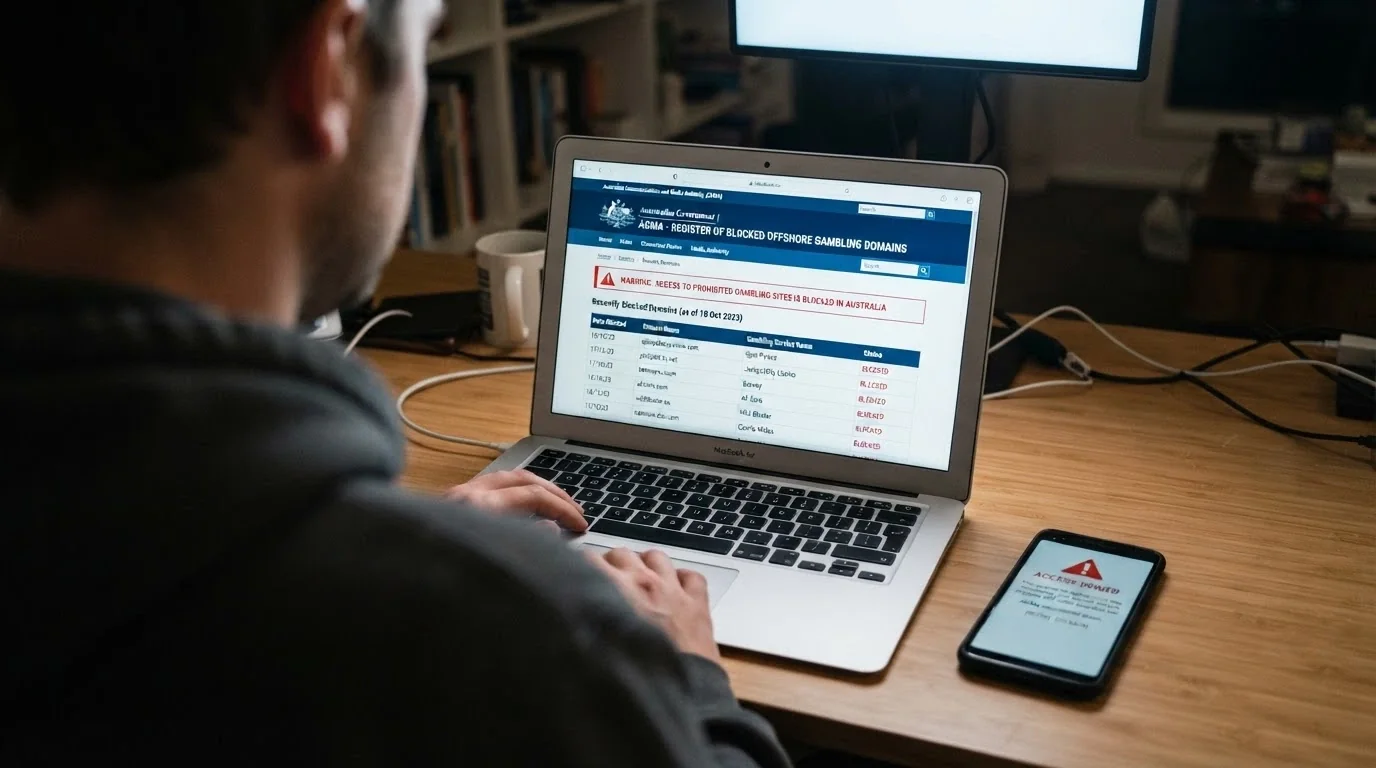
- No ACMA complaint recourse. The regulator enforces the prohibition against providers, but it does not arbitrate disputes between players and offshore operators. A refused withdrawal at an offshore site has no Australian body to complain to.
- No BetStop coverage. BetStop binds only Australian-licensed wagering services. An offshore casino is not connected to the register, and a self-excluded person can still deposit and lose at offshore sites.
- No Australian consumer-protection body. The state and territory consumer-protection agencies do not have jurisdiction over offshore operators. A dispute over a voided win or a delayed withdrawal has no Australian forum.
- DNS blocking risk. The ACMA’s aggressive enforcement has seen 1,564 illegal gambling and affiliate sites blocked by Australian ISPs since November 2019. Any offshore operator can join that list at any time. A balance still on the site at that point is stranded, with no Australian body to recover it.
- Credit and crypto as tells. A site asking for credit card or crypto deposits from an Australian player is operating outside Australian rules. The payment method is itself a tell. The ban has been in force since 11 June 2024, and the penalty for non-compliance is up to A$247,500.
The individual player is not prosecuted under the IGA. The provider faces civil penalty proceedings and ISP blocking. The trade-off a player makes when using an offshore site is speed and access for protection and recourse.
Staying in Control When the Cash-Out Chase Takes Over
The responsible-gambling infrastructure Australian players can actually use sits inside the licensed system, and the offshore gap is the place where that infrastructure breaks down.
BetStop is the national self-exclusion register, live since August 2023. One registration excludes a person from every Australian-licensed online and phone wagering service. As at 31 July 2026, BetStop had 67,480 registrations in three years of operation, of which 41,290 exclusions were still active — more than 60% of everyone who ever registered. 78% of registrants were under 40, and 38% chose lifetime exclusion.
The National Gambling Helpline is 1800 858 858. It is free, confidential, and staffed 24 hours a day. Online chat and counselling are available through Gambling Help Online at gamblinghelponline.org.au.
BetStop — The Self-Exclusion Register and Its Offshore Blind Spot
BetStop works. One registration excludes a person from every Australian-licensed online and phone wagering service. The registration numbers — 67,480 total, 41,290 active — show that the tool reaches the players it was designed for, and the demographic profile — 78% of registrants under 40, 38% choosing lifetime exclusion — shows the tool is being used by the cohort most at risk.

The offshore blind spot is the critical limitation. BetStop binds only Australian-licensed wagering services. An offshore casino is not connected to the register and will continue accepting a self-excluded person’s money. A player who has registered with BetStop and then plays at an offshore pokies site has the registered protection at the licensed sites and no protection at the offshore ones. From 1 January 2027, the 2026 reform strengthens BetStop’s operation and bans inducement marketing for three months after a person deregisters from the register, but the offshore gap remains.
Deposit Limits, Activity Statements and Cooling-Off — The Tools That Actually Work
There is no federal deposit, loss or stake ceiling for online gambling in Australia, because the product those ceilings would govern is banned outright. The legal deposit routes for licensed Australian wagering are debit card, bank transfer, PayID/Osko and BPAY. The licensed wagering operators offer customer-set deposit limits, activity statements and take-a-break or cooling-off periods under state and territory conditions that vary by jurisdiction.
The gap is at the offshore operators. Some offshore casinos offer deposit-limit and activity-statement tools. Some do not. The licensed system has a regulatory floor for these tools; the offshore market has no equivalent floor. While licensed operators are required to offer these protections as a condition of their licence, offshore sites provide them only at their own discretion.
When the Cash-Out Chase Becomes a Problem — Warning Signs and Where to Get Help
About 2.1% of Australian adults — roughly 430,000 people — experience problem gambling. The Australian Institute of Health and Welfare put high-risk gambling at 1.8% in 2022. The cash-out chase is a specific pattern: the player is not playing for the enjoyment of the game but for the relief of withdrawing, and the size of the withdrawal has become the measure of the session’s success.

The warning signs are the same as for any gambling-related harm — chasing losses, playing longer than planned, hiding play from family, borrowing to fund play, neglecting responsibilities. The cash-out chase adds a specific tell: the player is checking the cashier as often as the reels, and the size of the pending withdrawal has become a source of anxiety rather than a routine transaction.
The help is free and immediate. The National Gambling Helpline is 1800 858 858, free, confidential, and staffed 24 hours a day. Online chat and counselling are available through Gambling Help Online at gamblinghelponline.org.au. BetStop is the self-exclusion tool for licensed services — it does not cover offshore sites, and that limitation is itself a reason to register before play becomes a problem.
How We Selected and Ranked These Pokies Sites
The ranking above is built from four data sources. The operators skill provided AU market presence data — rank, revenue, brand confirmation. The regulation skill provided the IGA and ACMA framework, payment restrictions and responsible-gambling infrastructure. WebSearch queries to Pokiesaustralia.com, Betsquare.org and Payidplay.com provided tested withdrawal times for individual operators and aggregate speed data. Operator own websites confirmed licence jurisdiction and provider rosters where the data was on file.
The official check is the NTRWC/Licensing NT register. It confirms that no Australian online casino licence exists. Every operator listed in this ranking is offshore because no AU online casino licence is available to hold.
The ranking criteria, in order of weight, are payout speed where tested, AU market presence by revenue, withdrawal method availability and licence transparency. Payout speed is the head criterion when the data exists. Market presence is the secondary criterion when speed data is thin. Licence transparency is the tiebreaker that separates the four operators with confirmed Curaçao licences from the six without.
What this review does not cover is bonus terms. Welcome bonuses, free spins, wagering multipliers and bonus validity windows could not be confirmed from primary sources for any of the ten operators this run. The plan/writer phase is publishing the ranking with confirmed bonus terms absent, and a player comparing offers should read each operator’s own terms page before depositing.
The data gaps are honest ones. The table shows a dash where the data does not exist, and the prose names the gap rather than papering over it. Six operators carry no confirmed licence jurisdiction. Six carry no confirmed provider roster. The gaps are the point — they tell a player which operators have documentation and which do not.
A worked estimate helps put the numbers on this page in proportion. Big Bass Bonanza, the most-tested pokie in the AU market, runs at a default RTP of 96.71%. At a representative per-spin stake of A$1 and a typical session of 500 spins, the expected loss is 500 × A$1 × (1 − 0.9671) ≈ A$16.45. That is the statistical cost of an average session on a single title at a single stake — an estimate over many spins, not a guaranteed outcome for any single player. Some operators run lower RTP versions of the same game at 95.67% or 94.79%, which raises the expected loss on those versions. The hit frequency sits around 13% — one win every 7 to 8 spins — and reaching the 10x multiplier happens roughly once in every 3,880,481 spins. The arithmetic is the arithmetic of a high-volatility game at a single stake; the player’s session will not match it, because variance is what high volatility means.
Your Next Withdrawal — What to Do Differently After Reading This
Verify the account before the first win. KYC is the universal brake on the first withdrawal, and a player who has submitted ID, proof of address and payment-method verification before the first big cash-out removes the 24-hour pending review from the queue. The submission is a one-time cost that pays back every withdrawal after it.
Pick PayID for the best legal-and-fast combination. PayID is one of the four payment routes the Interactive Gambling Act recognises as lawful for licensed wagering, and it settles near-instantly through the New Payments Platform. Crypto is faster on paper and slower in practice at sites that require manual approval before release, and it sits on the wrong side of the credit/crypto payment ban for Australian players funding wagering accounts.
Treat crypto speed as a yellow flag. A site asking for crypto deposits from an Australian player is operating outside Australian rules. The faster rail is not a reason to fund an account through a payment method the law has banned.
Check the licence before depositing. Four of the ten operators in this ranking have a confirmed Curaçao licence: Stake, Rainbet, FairGO and Bizzo Casino. Six do not. The confirmed operators sit ahead of the unconfirmed ones on documentation; the unconfirmed operators require a closer read of the terms page.
Cross-check the ACMA block list periodically. Since November 2019, the ACMA has directed ISPs to block 1,564 illegal gambling and affiliate websites. Any offshore operator can join that list. A balance on a blocked site has no Australian body to recover it.
Set a deposit limit before the first session. The licensed wagering operators offer deposit limits as a condition of the licence. The offshore market has no equivalent floor. A player who sets a deposit limit at signup and treats it as a hard ceiling is using a tool that works regardless of the operator’s jurisdiction.
Register with BetStop if pokies play is harming you — and know it only covers licensed services. The register is free, takes minutes, and excludes the registrant from every Australian-licensed wagering service. It does not cover offshore casinos. A player who needs the offshore coverage does not have it from BetStop, and that is the gap the 2026 reform does not close.
Frequently Asked Questions
What’s the difference between “instant withdrawal” and actually getting your money straight away?
“Instant withdrawal” describes the rail after approval — PayID through Osko, USDT TRC-20, an e-wallet push. The clock that matters is the approval queue in front of it, which runs 0 to 24 hours at most operators and stretches past 24 hours on the first withdrawal while KYC checks run. A returning withdrawal at a verified account with no active bonus can land in 15 minutes to 2 hours. A first withdrawal routinely hits the 24-hour mark before the rail even starts.
Why is my first pokies withdrawal always slower than the site promised?
The operator needs to confirm identity before releasing funds, and that confirmation involves a document check the returning player has already cleared. The trigger is usually the amount rather than the player — some operators require identity verification on any cash-out over A$1,000, which means a single big win can pause the withdrawal even for a known player. The defence is to verify the account before the first win and submit ID, proof of address and payment-method verification at signup.
Are gambling winnings taxable in Australia?
Gambling winnings are not assessable income under section 6-5 of the ITAA 1997, and gambling losses are not deductible under section 8-1, unless the person is carrying on a business of betting or gambling. Recreational players keep their winnings tax-free and cannot offset their losses against other income. Professional gamblers who meet the ATO’s business-of-betting test are treated differently, but the recreational default is clear.
What can I do if an offshore casino refuses to pay my withdrawal?
The short answer is: not much through Australian channels. The ACMA enforces the prohibition against providers, but it does not arbitrate disputes between players and offshore operators. The state and territory consumer-protection agencies do not have jurisdiction. A player with a refused withdrawal at an offshore site has no Australian body to complain to, which is the practical cost of using an unlicensed site. The defence is to test the rail on a small withdrawal before committing real bankroll.
Is it safe to use a credit card or crypto to deposit at online pokies sites?
No. Credit cards, credit-related products and digital currency have been banned as payment for online wagering in Australia since 11 June 2024. An operator that accepts those payment methods from an Australian player is operating outside Australian rules, and the ban is itself a tell. A site asking for credit card or crypto deposits is a site that is not bound by any Australian consumer protection or responsible-gambling requirement. The legal deposit routes for licensed Australian wagering are debit card, bank transfer, PayID/Osko and BPAY.
What is the 2026 gambling reform and when does it start?
The Interactive Gambling Amendment (Gambling Reform) Bill 2026 passed Parliament on 19 August 2026, and its measures commence on 1 January 2027. Banks and payment providers gain express authority to block transactions to illegal gambling operators. Wagering advertising on broadcast is capped at three ads per hour between 6 am and 8:30 pm, with a live-sport blackout from 15 minutes before to 5 minutes after a live event. Athletes, celebrities and influencers are barred from promoting wagering products. Direct marketing of inducements is prohibited for 14 days after sign-up and indefinitely for at-risk customers. BetStop is strengthened, with an inducement marketing ban for three months after deregistration.