
Live Blackjack Online Casino Australia — How the Offshore Tables Actually Work in 2026
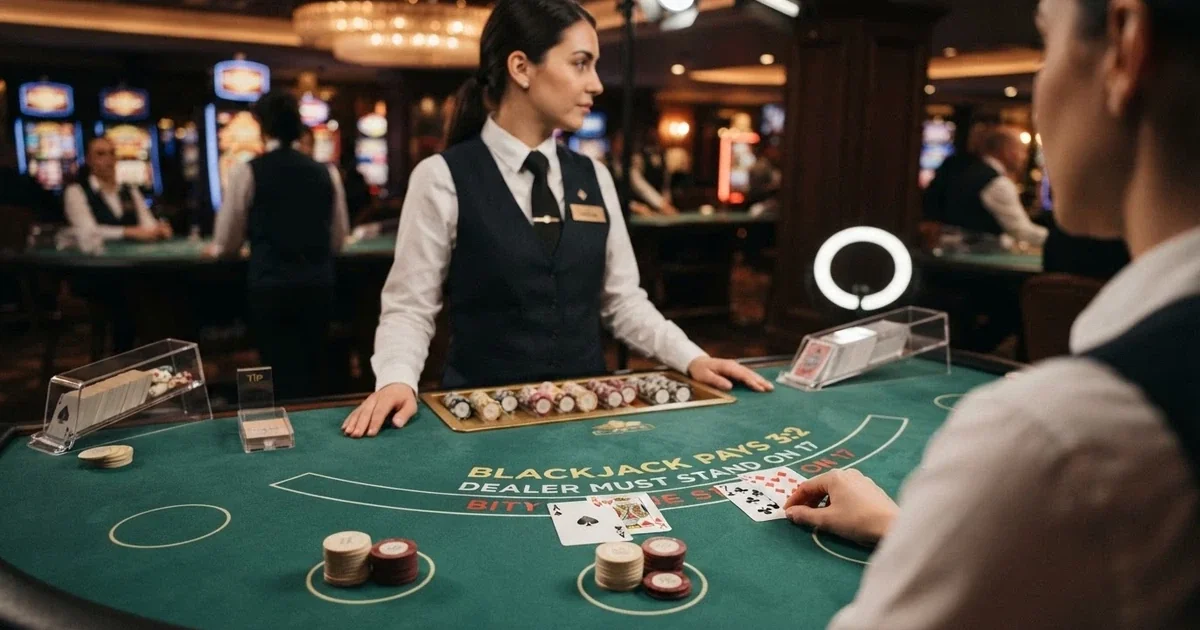
Live dealer blackjack is the closest thing to a casino floor that an Australian player can reach through a screen. The dealer is real, the cards are real, the shoe holds six or eight decks and the bets go down in Australian dollars from a studio in Riga, Malta or Manila. Yet every site offering that experience is licensed somewhere else. The Interactive Gambling Act 2001 prohibits the supply of online casino games to anyone in Australia, and there is no Australian licence for online blackjack — not federally, not in any state or territory. The Act draws its line at the operator, not the player. What follows is the landscape Australians actually access: offshore casinos running on Curaçao or Malta Gaming Authority licences, streaming live blackjack tables around the clock.
Current as of 22 November 2026 against the ACMA register, the Curaçao eGaming public licensee list, and the Malta Gaming Authority public register.
Table of Contents
- What Online Blackjack Looks Like for Australian Players in 2026
- Why Live Dealer Blackjack Feels Nothing Like a Computer Game
- How Blackjack Actually Works — Rules, Hands and Your First Real Seat
- The Strategy That Cuts the House Edge to Almost Nothing
- The 10 Live Blackjack Casinos Australians Are Playing at in 2026
- SkyCrown
- Neospin
- GoldenBet
- Ricky Casino
- GoldenCrown
- RocketPlay
- Kinbet
- Kingmaker Casino
- Stake
- Wild Tokyo
- Why Your 2026 Blackjack Bonus Is Smaller Than the Headline Says
- Getting Real Money In and Out of an Offshore Blackjack Table
- Bitcoin, Ethereum and Litecoin at the Live Blackjack Table
- The Numbers Behind Every Hand — House Edge, Odds and Why 3:2 Matters
- What You Are Actually Looking at on a Live Blackjack Table
- Beyond Classic Blackjack — the Variants Worth Your Time
- Where Australian Law Actually Draws the Line on Online Blackjack
- Playing Smart — Limits, Loss-Chasing and Where to Get Help in Australia
- How We Evaluated Every Live Blackjack Casino on This Page
- Your 2026 Live Blackjack Game Plan — What to Do Next
- Frequently Asked Questions
What Online Blackjack Looks Like for Australian Players in 2026
The Australian online blackjack market in 2026 is offshore-only and live-dealer-led. That single fact shapes everything else on this page: which payment methods work, which regulators sign off on the licence and what recourse a player has if a dispute opens. The Interactive Gambling Act 2001, strengthened by the Interactive Gambling Amendment Act 2017, makes it an offence to provide online casino games — blackjack, pokies, roulette, baccarat — to a person physically in Australia. There is no AU licence for online casino anywhere in the country. The Act targets the provider, not the player; an individual using an offshore site is not prosecuted. Australia draws its line at the operator, not the player — every site on this page is licensed somewhere else.
That legal shape forces a particular commercial shape. The operators competing for Australian players are not start-ups testing the market; they are established offshore brands running on Curaçao eGaming or Malta Gaming Authority licences, with Evolution Gaming and Pragmatic Play Live as the dominant studio providers. Live dealer blackjack dominates Australian search because it answers a fairness question that an algorithm cannot: a real dealer handles real cards in front of a camera, and the player can watch the shoe empty hand by hand. RNG blackjack exists at most of these sites, but the live floor is what they sell.
What “Online Blackjack” Actually Means in 2026
“Online blackjack” in the Australian context means an internet-connected version of the table game played against the dealer, where the player bets real money and the goal is to reach a hand total closer to 21 than the dealer’s without going over. It is distinct from pokies — slot machines — in every way that matters to a player thinking about house edge. A standard 8-deck live blackjack game where the dealer stands on all 17s and blackjack pays 3:2 operates at a fixed mathematical return to player of roughly 99.50%, with a house edge of approximately 0.50%. That figure, achieved under basic strategy and a favourable rule set, is the lowest of any casino game available to Australian players, live or otherwise.
The spread of variants at AU-facing casinos runs wider than it did five years ago. Classic seven-seat tables, Infinite Blackjack with unlimited players, Speed Blackjack with decisions in eight seconds, Lightning Blackjack with multiplier cards, Free Bet Blackjack with no-cost double-downs, Power Blackjack with doubling on any two cards, Salon Privé VIP tables with private-room access — all of these sit beside one another on the same operator’s lobby. The choices a player makes about variant and table limit have a real effect on long-run cost, because each variant carries its own RTP and its own house edge.
Why Live Dealer Blackjack Feels Nothing Like a Computer Game
A live dealer blackjack game is a real table in a real studio, with a trained dealer handling real cards from a multi-deck shoe, and a camera feed streaming the action to a player’s screen in real time. Optical character recognition translates every card the moment it leaves the shoe, so the on-screen betting interface stays in sync with the physical table. A player’s decisions — hit, stand, double down, split, surrender — go back through the same interface, and the dealer acts on them. That loop is what separates a live dealer game from an RNG game, where a certified random number generator decides the outcome of every hand without a camera, a shoe or a person.
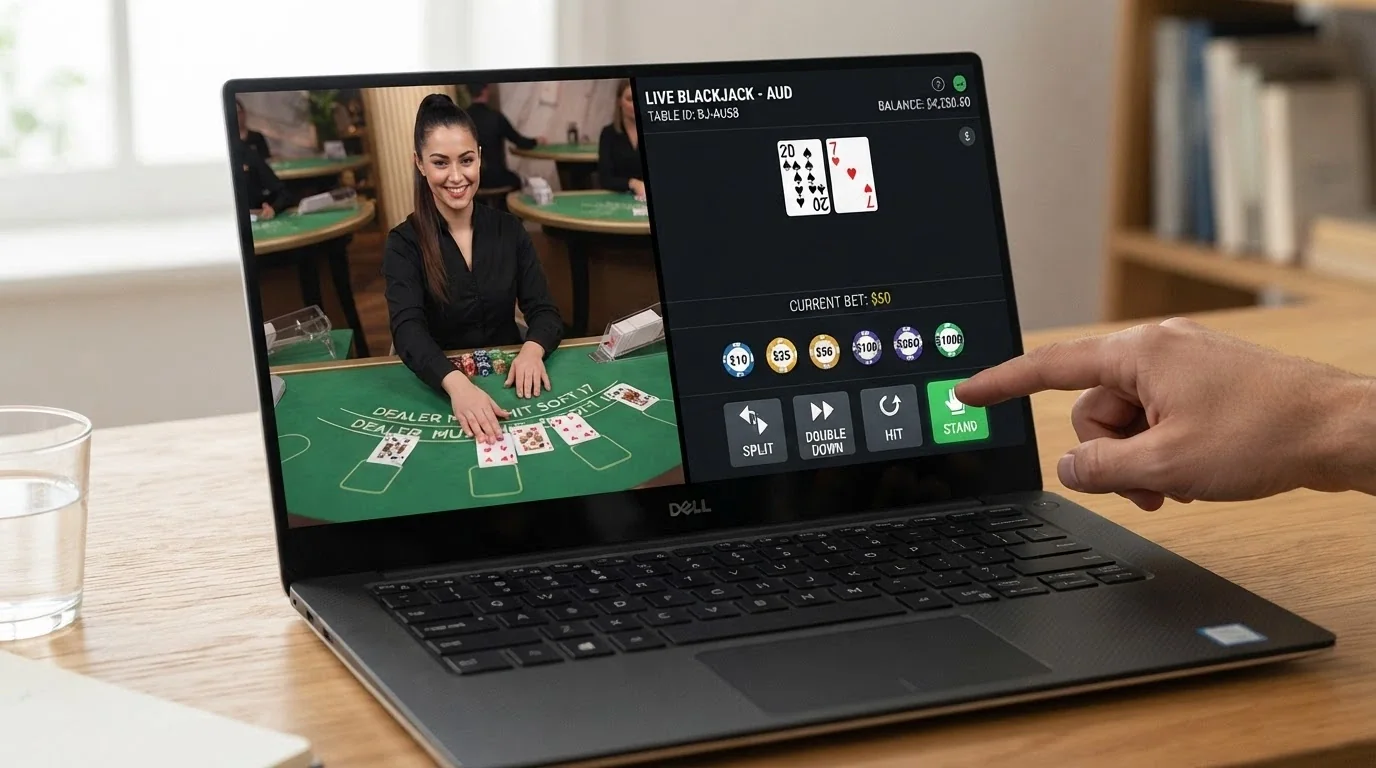
Live dealer blackjack dominates AU-facing casinos because it solves a trust problem that has dogged online gambling since the earliest days of browser-based play. A player can count cards visually if they want to — the shoe is right there on the feed. A player can watch the dealer shuffle. A player can see the cards leave the shoe and land in front of every seat. RNG blackjack cannot offer that, because there is nothing to see.
What a Live Dealer Blackjack Game Actually Is
A live dealer studio is a purpose-built room with multiple blackjack tables, professional dealers, lighting rigs and the cameras that feed the stream. Evolution Gaming operates studios in Latvia, Malta, Georgia, Romania, Canada and the United States; Pragmatic Play Live runs studios in Bucharest and other locations. The dealers are trained on the specific studio’s procedures — how they shuffle, how they offer insurance, how they handle disputes — and most operators run their tables 24 hours a day. Australian players typically connect to the European or Asian studios, with table language set to English.
A player’s screen shows the betting grid on one side and the live video feed on the other. Cards leaving the shoe appear instantly on the grid through the optical recognition system. Chips are placed by clicking or tapping the bet amount, and the dealer’s actions appear on the grid within a fraction of a second of the physical hand. Decisions transmit through the same interface — hit is a button, stand is a button, double and split appear when the rules allow. The dealer cannot see a player’s identity or hand; only the betting interface does.
Live Dealer vs RNG Blackjack — Why the Difference Matters
The two formats answer different player needs. RNG blackjack is faster — a hand can resolve in a couple of seconds, the player can play hundreds of hands an hour, and the table never closes. The mathematical model is identical: a standard 8-deck game with S17 and 3:2 payout produces the same ~99.50% RTP whether the cards come from a shoe or a number generator. The trust model is different. A player who believes a site is honest accepts the RNG; a player who wants to see the cards accepts the live feed.
Pace is the other axis. Live dealer hands play out at the dealer’s rhythm, with a typical decision window of 15 to 20 seconds; Speed Blackjack at Pragmatic Play Live compresses that to roughly 8 seconds; Lightning Blackjack and Power Blackjack run at standard live tempo with rule variations layered on top. RNG blackjack runs as fast as a player clicks, which makes a difference to the rate at which a bankroll can move in either direction. A live dealer table is closer to a real casino visit; an RNG table is closer to a spreadsheet with a betting button.
How to Choose a Live Blackjack Table That Works for You
Three filters do almost all the work in picking a live blackjack table: the minimum and maximum bet, the seat availability, and the variant. Live dealer minimums at AU-facing casinos generally run from AU$5 to AU$25 depending on the provider and table type, with lower floors at Infinite-style tables. Classic seven-seat tables run AU$5–AU$25 minimum and AU$2,500–AU$5,000 maximum; Infinite Blackjack runs AU$1–AU$5 minimum and up to AU$2,500 maximum; Speed Blackjack runs AU$10–AU$50 minimum and AU$5,000 maximum; VIP Blackjack runs AU$50 minimum and AU$10,000 maximum; Salon Privé runs AU$1,000 minimum and AU$50,000 maximum.
Seat availability matters because a classic seven-seat table fills up at peak hours, and a player who logs in may have to wait. Infinite Blackjack solves that problem by allowing an unlimited number of players to bet on the same dealt hand — each player’s decision is independent, but the cards the dealer draws are shared. For a player who does not want to wait, Infinite is the practical answer; for a player who wants the table to themselves, Salon Privé is the answer and the price is the AU$1,000 minimum.
The variant choice affects house edge. Lightning Blackjack at Evolution runs at 99.56% RTP — the highest researched figure among major variants — but its multiplier mechanic raises variance. Free Bet Blackjack at Pragmatic Play Live runs at 98.90% RTP, lower than classic, because the free double-down and split mechanic is funded by the dealer-22-push rule. A player who wants the lowest mathematical cost per hand picks the variant whose RTP sits closest to 99.50% and accepts the trade-off in variance or novelty.
How Blackjack Actually Works — Rules, Hands and Your First Real Seat
Blackjack’s rules govern every hand the same way: card values are fixed, the dealer plays a defined protocol, the player controls the bet and the decision. The numbers come from a standard configuration, but small rule variations move the house edge in measurable ways. A player who knows the rules knows what is being paid for.
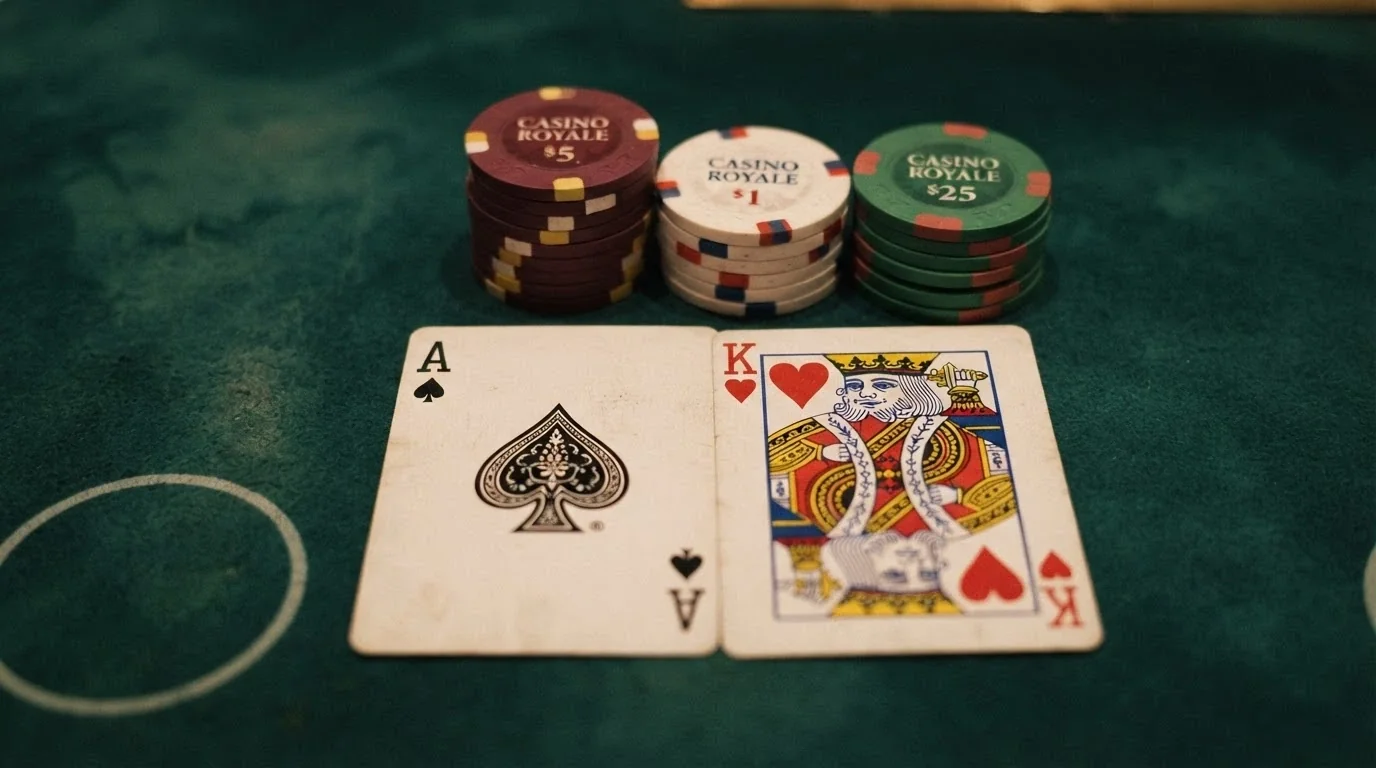
A standard live blackjack game uses eight decks shuffled together and dealt from a shoe. Number cards carry their face value, face cards — Jack, Queen, King — count as 10, and the Ace counts as either 1 or 11 at the player’s option. The dealer stands on every total of 17 or higher — “S17” in the rule shorthand — and hits on 16 or lower. A natural blackjack — an Ace plus a ten-value card on the first two cards — pays 3:2 at standard tables and 6:5 at tables to avoid. Under those rules with basic strategy, the game operates at approximately 99.50% RTP. That figure is not theoretical — it is the long-run average across millions of hands under the same rule set, and it is the same number an audited RNG game produces and a live dealer game produces when the rules are identical.
Your First Hand — Step-by-Step Through a Round of Live Blackjack
A live blackjack round begins when the betting window opens. The player places chips in the betting circle on the interface. The dealer draws two cards for every position and one card face-up for themselves; the second dealer card — the hole card — sits face-down until the dealer’s turn. Each player now has a decision to make: hit, stand, double down, split, or surrender, depending on the rules and the hand.
A hit takes another card; a stand keeps the hand as it is. Double down doubles the bet, takes exactly one more card and ends the player’s turn; it is usually offered on a hard total of 9, 10 or 11. Split turns a pair — two cards of the same value — into two hands, each with its own bet, and the player plays them independently. Surrender forfeits half the bet and ends the hand; late surrender — offered after the dealer checks for blackjack — reduces house edge by roughly 0.07%–0.08% on the hands where it applies.
The dealer then plays their hand against a fixed protocol: hit on 16 or lower, stand on all 17s. A player wins at 1:1 when their hand beats the dealer without busting, wins at 3:2 on a natural blackjack, and pushes — the bet returns — on a tie. Side bets like 21+3, which pays 9:1 on a suited three-card poker hand made from the player’s first two cards and the dealer’s up-card, and Perfect Pairs, which pays 25:1 on a suited pair, sit beside the main bet and resolve independently.
The Strategy That Cuts the House Edge to Almost Nothing
Basic strategy is a fixed decision for every combination of player hand and dealer up-card. It is not opinion, not intuition, not a tip from a forum — it is the mathematically optimal play derived from the rule set, and a chart of it is freely available from every serious blackjack source. Live blackjack with basic strategy has a house edge of just 0.50–0.71% — for every AU$1,000 wagered, a player loses only AU$5–AU$7 on average. Staking about 1% of a bankroll per hand keeps variance survivable, since even flawless play averages a loss near 50 cents per AU$100 wagered.
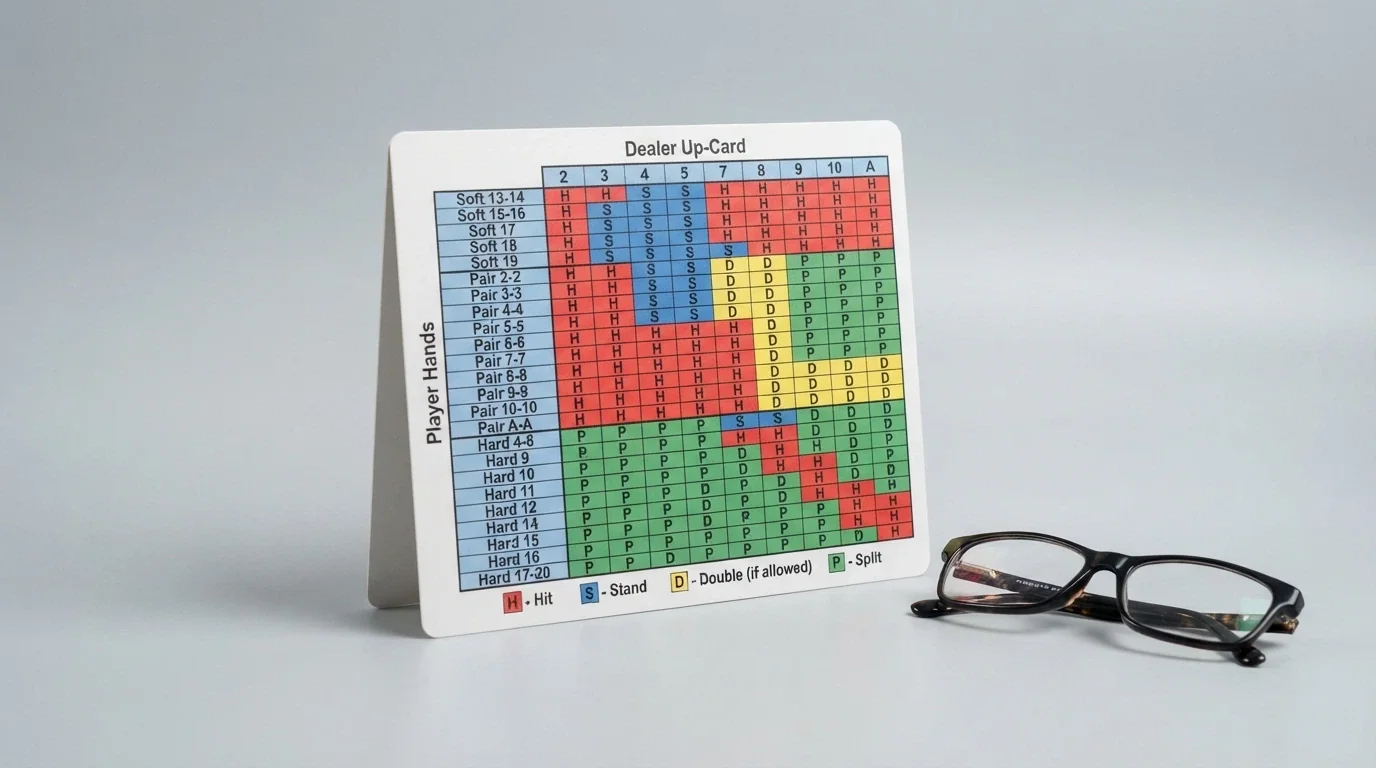
The chart does not change because the cards are live. Basic strategy is built on the rule set, not the delivery format. The same chart that gives the correct play at an RNG table gives the correct play at an Evolution live table, provided the rules — S17 versus H17, DAS allowed or restricted, surrender offered or not — match. A player who knows the chart and sticks to it sits at the lowest house edge available in any casino game online.
Basic Strategy in 30 Seconds — the Chart Every Player Needs
A basic strategy chart is a colour-coded grid with the player’s possible hands running down one side and the dealer’s up-cards running across the top. Each cell carries the correct decision for that pairing: hit, stand, double down or split. The chart assumes a specific rule set — most published charts assume S17, DAS allowed and late surrender offered — and the chart shifts when those rules change. A table where the dealer hits on soft 17 — “H17” in the shorthand — adds +0.22% to the house edge compared to S17, and the chart reflects that with different decisions on a handful of soft-hand pairings.
A player does not need to memorise the entire chart on day one. The handful of decisions that come up most often — stand on hard 17 or higher, hit on hard 11 or lower, double on 10 or 11 against a dealer 2 through 9, split 8s and Aces against anything — cover the majority of hands. The rest of the chart fills in over weeks of play.
The 10 Live Blackjack Casinos Australians Are Playing at in 2026
| Operator | Live Blackjack Tables | Min Bet | Max Limit | Welcome Bonus |
|---|---|---|---|---|
| GoldenBet | 200+ | AU$1 | A$25,000 | — |
| Kingmaker Casino | 110+ | — | — | — |
| SkyCrown | 90+ | AU$1 | AU$10,000 | AU$8,000 + 400 spins |
| Neospin | 80+ | AU$1 | AU$10,000 | AU$10,000 + 300 spins |
| Kinbet | 60 | AU$1 | — | AU$4,500 + 350 spins |
| GoldenCrown | 35+ | AU$1 | — | AU$15,000 + 300 spins |
| Ricky Casino | 25+ | AU$5 | AU$10,000 | AU$7,500 |
| RocketPlay | — | AU$1 | AU$10,000 (VIP) | — |
| Stake | — | — | — | — |
| Wild Tokyo | — | — | AU$10,000 | — |
The casinos on this list are all offshore operators; none is Australian-licensed, because no Australian licence for online casino exists. The table ranks by live blackjack table depth, provider quality and maximum table limit — the three numbers a player comparing live-floor options cares about most. The columns where research carries no figure for a given operator are blank, by design: a fabricated figure would read as certainty the source does not support.
SkyCrown
SkyCrown runs the deepest live blackjack catalogue among AU-facing operators on a single brand name, anchored by Pragmatic Play Live and Evolution Gaming. The lobby lists 90+ live blackjack tables powered by Pragmatic Play, with the broader live table count climbing past 100 once Evolution’s tables are added. RNG blackjack sits at under 10 titles — the brand is built around the live floor, not the algorithm.
The minimum bet on the live tables runs from AU$1 on Infinite-style formats up to AU$10,000 on the highest-tier VIP tables. The welcome package is an AU$8,000 + 400 free spins deposit match, and a 10% weekly live dealer cashback runs on net losses at the live blackjack tables specifically — a structure that targets the live-floor player rather than the slots player. The Curaçao eGaming licence is confirmed from the operator’s own footer and consistent with industry reporting.
For an Australian player whose priority is live-table depth and a cashback structure that returns something on a losing week, SkyCrown is the most concentrated offer on the page. The 400 free spins attached to the welcome package read as pokie value rather than blackjack value — the spin count is large, but blackjack bets do not contribute the way pokies do.
Neospin
Neospin runs four live-provider studios under one roof: Evolution Gaming, Pragmatic Play Live, Winfinity and LiveVegas. The live dealer blackjack floor lists 80+ tables, organised across VIP, Speed, Golden and Grand Bonus tiers, with betting limits that scale up to AU$10,000. The variety of providers is the differentiator: a player who likes Winfinity’s presentation or LiveVegas’s dealer style finds both here, beside the bigger-name Evolution and Pragmatic Play Live tables.
The welcome package is an AU$10,000 + 300 free spins deposit match, with a 20% daily cashback structure that returns more frequently than a weekly cashback but at a lower rate. The Curaçao eGaming licence is confirmed from operator reviews.
For a player who wants provider choice within a single account — and who prefers a daily cashback cadence to a weekly one — Neospin is the closer match. The 20% daily figure looks generous next to SkyCrown’s 10% weekly, but the daily basis also resets the calculation every 24 hours, and the practical return depends on the volume of play.
GoldenBet
GoldenBet runs the highest confirmed live blackjack maximum at any AU-facing operator: A$25,000 on dedicated AUD Playtech VIP tables. The broader live floor lists 200+ tables across Evolution, Pragmatic Live, Ezugi and Playtech — the widest multi-provider spread on the page. The 3:2 blackjack payout is confirmed, which means GoldenBet’s standard tables are paying the right ratio on a natural rather than the 6:5 some operators default to.
Welcome bonus terms were not confirmed in the research for this run. The minimum bet on the standard floor sits at AU$1, and the Curaçao eGaming licence is confirmed from operator reviews. Withdrawal times average 1–2 hours.
For a high-stakes player who needs a table limit that does not appear anywhere else on this list, GoldenBet is the obvious answer. The four-provider structure also makes it the most resilient against a single studio going offline — a busy Friday night can spill across Evolution and Playtech without either bottlenecking.
Ricky Casino
Ricky Casino runs a curated live blackjack floor with Evolution Gaming and Pragmatic Play Live as the two providers, listing 25+ live tables at any given time. The variant mix is the differentiator: Classic Live Blackjack, Speed Blackjack with an 8-second decision window, Infinite Blackjack, Lightning Blackjack with multipliers up to 25x, and VIP tables at AU$250–AU$10,000 per hand.
The welcome bonus is AU$7,500, the minimum bet on the live floor runs from AU$5, and the maximum climbs to AU$10,000 on the VIP tier. The licence was not confirmed this run.
For a player who wants the variant — Speed Blackjack for pace, Lightning for variance, VIP for limit — without the catalogue depth of a 200-table floor, Ricky Casino is the right fit. The 25+ live tables are a smaller number than SkyCrown or GoldenBet, but the variant spread covers most of what an AU player is searching for.
GoldenCrown
GoldenCrown lists 35+ blackjack tables with live dealer across multiple providers, with an AU$1 minimum bet at the entry level and an AU$15,000 + 300 free spins welcome package — the highest headline figure on this page. The provider names were not specified in this round of research, so the catalogue should be read as multi-provider breadth without a confirmed studio list.
For a player who weights the welcome package over the table-floor depth, GoldenCrown’s AU$15,000 + 300 spins reads as the largest headline figure among the ten. The 35+ table count is mid-range, the AU$1 minimum is consistent with the broader market, and the bonus structure carries the same blackjack contribution caveats as every other welcome package on this list — the headline figure is deposit match, and blackjack bets count at a fraction of the rate pokies do.
RocketPlay
RocketPlay runs a tiered live blackjack structure: standard games start around AU$1–AU$5 and scale up to roughly AU$500–AU$2,000, while VIP tables reach A$10,000 per hand. Evolution Gaming is referenced as a provider, though the full studio list is not confirmed this run.
The minimum bet of AU$1 places RocketPlay at the entry-friendly end of the market, and the VIP ceiling matches SkyCrown and Ricky Casino at AU$10,000. Welcome bonus terms and licence status were not confirmed in this research pass.
For a player whose bankroll sits at the AU$1–AU$500 end and who wants a clear upgrade path to higher limits, RocketPlay’s tier structure reads cleanly. The catalogue depth is the open question — research confirms tiers and limits but not the table count.
Kinbet
Kinbet runs a balanced live and RNG blackjack catalogue: 60 live blackjack tables and 30+ RNG blackjack games, with AU$1 minimum bet and an AU$4,500 + 350 free spins welcome bonus. The provider list is not specified this run, so the read is “multiple providers, mid-tier catalogue depth”.
The 60 live tables sit between SkyCrown’s 90+ and Ricky Casino’s 25+, which places Kinbet in the middle of the spread. The 30+ RNG titles are the broadest RNG catalogue on the page, and that matters for a player who wants to mix live dealer play with faster RNG sessions. Welcome bonus terms carry the usual blackjack contribution caveat — 350 free spins attached to a deposit match reads as pokie-side value unless the bonus terms explicitly weight blackjack differently.
Kingmaker Casino
Kingmaker Casino lists 110+ live blackjack tables, one of the largest live catalogues among the featured operators. Provider names, minimum bet and maximum limit are not confirmed this run — the read is catalogue breadth without a confirmed studio breakdown.
The 110+ figure puts Kingmaker near SkyCrown’s 90+ and ahead of Ricky Casino’s 25+ on table count alone, which is the meaningful number for a player who wants the broadest possible variant and limit selection under one account. The limits and providers are the open question, and the operator write-up stops where the research does.
Stake
Stake holds a Curaçao eGaming licence and sits at a 1.28% market share among AU-facing operators. The platform is crypto-native — deposits and withdrawals are built around Bitcoin, Ethereum, Litecoin and other digital assets, with on-chain settlement rather than card processing. The live blackjack table count, provider list, minimum bet, maximum limit and welcome bonus are not confirmed this run.
For a player whose priority is a crypto-native cashier and a brand that names itself in the AU-facing market, Stake is the fit. The live-floor specifics are the gap in the research — the 1.28% market share and the Curaçao licence are confirmed, the catalogue details are not.
Wild Tokyo
Wild Tokyo lists Evolution Gaming and Pragmatic Play Live as confirmed providers, with Speed Blackjack and Power Blackjack in the variant mix. Pragmatic Play Live table maximums run AU$5,000–AU$10,000 — consistent with the standard Pragmatic Live ceiling — and the table count, minimum bet and welcome bonus are not confirmed this run.
Power Blackjack is the differentiator on the variant side: it allows doubling on any two cards rather than the standard hard 9, 10 or 11, with the cost built into a higher house edge of roughly 0.9%. For a player who likes the doubling freedom and accepts the trade-off, Wild Tokyo’s variant mix is the reason to be there.
Why Your 2026 Blackjack Bonus Is Smaller Than the Headline Says
A blackjack bonus headline and a blackjack bonus reality are two different numbers. The gap between them comes from three terms in the fine print: the wagering multiple, the game contribution rate and the expiry window. Each one moves the actual cost of clearing the bonus by an order of magnitude. Blackjack typically contributes 5–10% toward wagering requirements at AU-facing casinos, where pokies contribute 100%. Blackjack’s low house edge makes casinos nervous — they offset this by slashing contribution rates to 5%, 10%, or occasionally 20%.
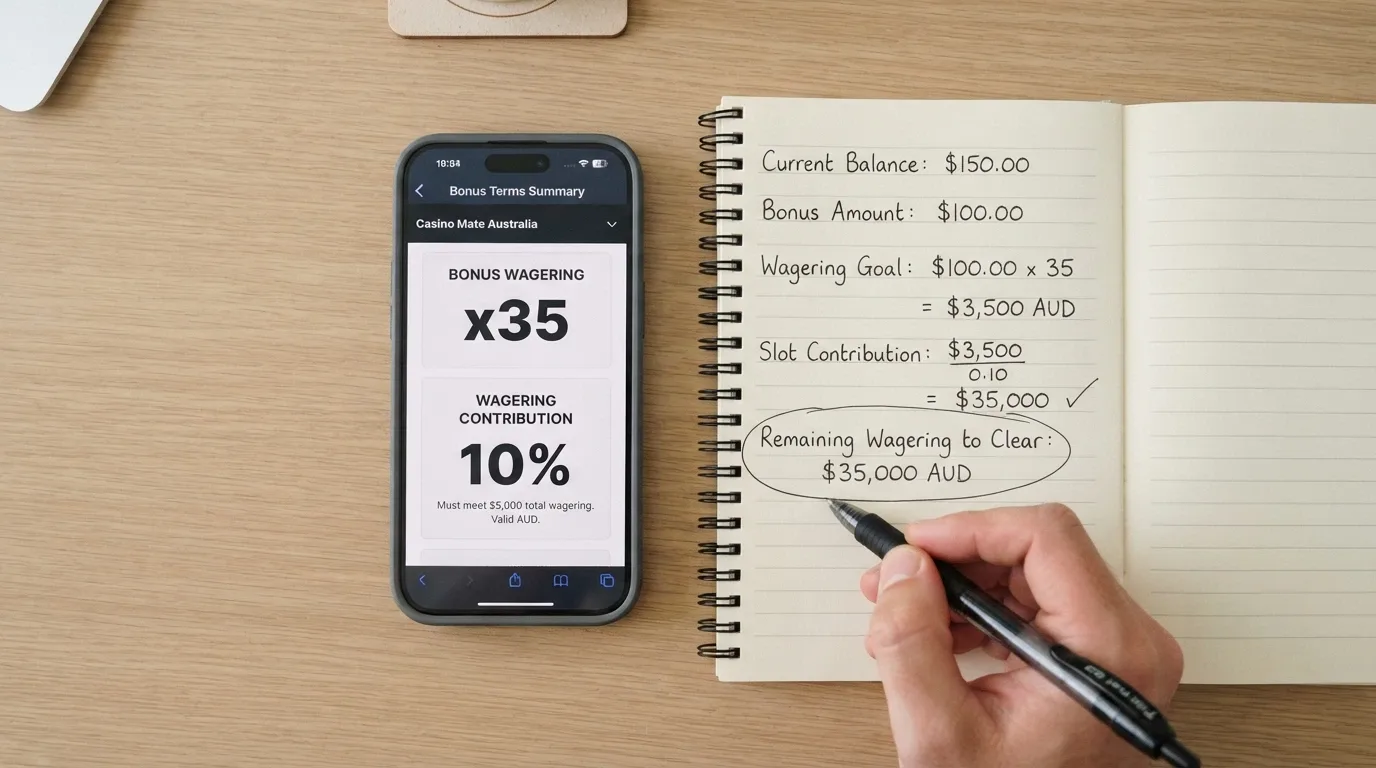
A AU$10 bonus with 50x wagering and 10% blackjack contribution means AU$5,000 in blackjack bets to clear. That is the worked example: the headline says “free AU$10”, the terms say “turn over AU$5,000 of blackjack at 0.5% house edge to withdraw the AU$10”. The expected loss from clearing the wagering requirement at a 0.5% house edge sits around AU$25 — a player is statistically more likely to lose AU$25 clearing a AU$10 bonus than to walk away with the bonus intact.
The calculation: a AU$10 no-deposit bonus with 50x wagering requires AU$10 × 50 = AU$500 in total turnover; at a 10% blackjack contribution rate, the required blackjack turnover becomes AU$500 ÷ 0.10 = AU$5,000. At an AU$1 stake per hand and a 5-second interval between live-dealer hands, AU$5,000 in bets translates to 5,000 hands, taking roughly 5,000 × 5 ÷ 3,600 ≈ 6.9 hours of continuous play. Assuming only the bonus amount is wagered, the expected loss at a 0.5% house edge sits at AU$5,000 × 0.005 = AU$25 — more than double the bonus itself. That is the cost of clearing the offer.
Welcome Bonuses and Why Blackjack Players Get a Raw Deal
A welcome package is a deposit match — the operator matches a percentage of the player’s first deposit up to a cap, with the match released as bonus funds that must be wagered before withdrawal. A AU$10,000 welcome package sounds substantial until the contribution rate enters the maths. At 5–10% blackjack contribution, the AU$10,000 in bonus funds effectively requires AU$100,000–AU$200,000 in blackjack turnover before it converts to withdrawable cash. At a 0.5% house edge, that is AU$500–AU$1,000 in expected loss to clear a bonus the player deposited half of.
A realistic blackjack welcome bonus is the offer whose contribution rate, wagering multiple and game weighting give a player a real chance to clear the bonus without losing more than the bonus is worth. Most AU-facing welcome packages are not designed for that.
No-Deposit Offers — Small Print, Smaller Payouts
A no-deposit bonus sounds like free money: the operator credits a small amount — AU$10 to AU$50 — to a new account without a deposit required. The wagering requirements on these offers typically run 40x to 60x at AU-facing casinos, the maximum cashout is capped at AU$50–AU$100, and the expiry window sits between 24 hours and 14 days — most offers giving 3–14 days. Free spin counts on no-deposit offers typically sit between 20 and 50, with some platforms offering up to 100 spins, but the cashout cap remains AU$50–AU$100.
A no-deposit offer is a qualifier, not a payout. A player who takes one is buying a test of the site at the cost of expected losses driven by the wagering requirement, with the upside capped at a small maximum withdrawal. The arithmetic favours the operator, and the player who treats it as bonus income rather than a demo is reading the wrong line.
Getting Real Money In and Out of an Offshore Blackjack Table
The payment methods that actually work from Australia to an offshore blackjack casino fall into three camps: PayID for fast deposits, cards and e-wallets with caveats, and bank transfer for withdrawals that need to clear in days rather than hours. PayID deposits process in under 60 seconds, 24 hours a day, 7 days a week. Visa and Mastercard deposits have roughly a 60% success rate at AU-facing offshore casinos due to bank-side blocks. E-wallet withdrawals clear in 4–8 hours on average; bank transfers stretch to 3–5 business days.
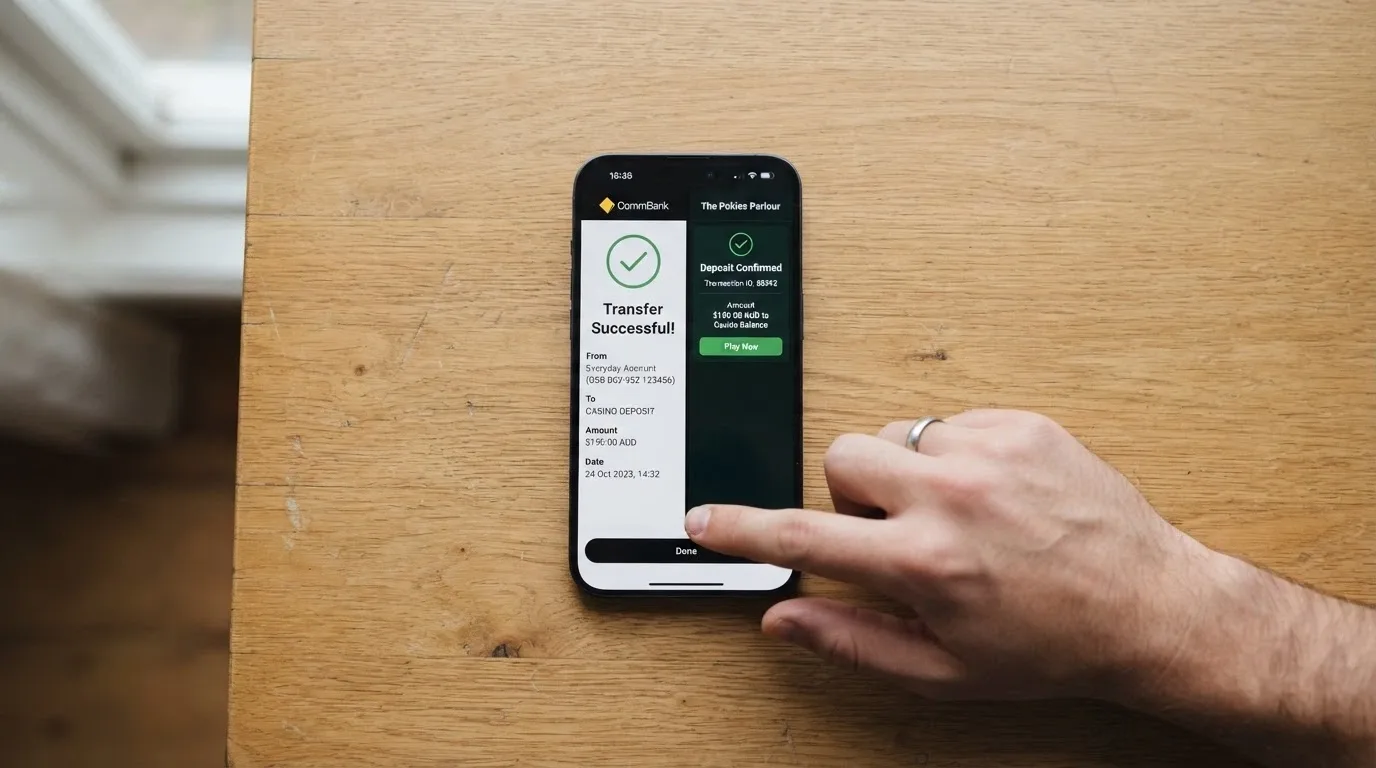
The credit-card ban that came into force on 11 June 2024 under the Interactive Gambling Amendment (Credit and Other Measures) Act 2023 covers any credit card, credit-related product or digital currency used as payment for online wagering. The ban applies to licensed Australian wagering operators; an offshore casino is not bound by it, but Australian banks apply the block at their end regardless. That is why a debit card deposit fails roughly 40% of the time — the issuing bank flags it as gambling-related and declines.
PayID — the Fastest Way to Fund an Offshore Blackjack Account
PayID is the AU banking system’s instant-transfer rail, tied to a phone number, email or ABN rather than a BSB and account number. Minimum deposits at PayID casinos run from AU$10 to AU$30, PayID transfers are fee-free, and the funds land in the casino account in under 60 seconds, around the clock. For a player who wants to fund an account and sit at a live table within the same minute, PayID is the fastest route available from an Australian bank account.
PayID cash-outs are rarely supported at AU-facing casinos — the operator pays out through crypto (2 to 60 minutes), eWallets (up to 24 hours) or bank transfer (1 to 3 business days). The deposit half of the journey is instant; the withdrawal half runs through a different channel.
Cards, E-Wallets and Bank Transfer — What Actually Works from Australia
The credit-card ban effective 11 June 2024 closed the credit-card route entirely for online wagering; the Interactive Gambling Amendment (Credit and Other Measures) Act 2023 also captures credit-related products and digital currency. Debit cards remain technically usable, but Visa and Mastercard debit deposits have roughly a 60% success rate at AU-facing offshore casinos due to bank-side blocks — a transaction that goes through at one bank may decline at another, and the same bank may approve today and decline tomorrow.
E-wallets — Skrill, Neteller, MiFinity, and similar services — sit between the player’s bank and the casino, with the e-wallet account holding the balance. E-wallet withdrawals clear in 4–8 hours on average, faster than bank transfer and slower than crypto. Bank transfers stretch to 3–5 business days, the slowest route, but the most universally available. A player who needs speed picks crypto or e-wallet; a player who needs reliability picks bank transfer and accepts the wait.
Bitcoin, Ethereum and Litecoin at the Live Blackjack Table
Crypto deposits confirm in 10–30 minutes at AU-facing casinos, and crypto withdrawals clear in 2 to 60 minutes — the fastest payout route available. Bitcoin and Litecoin are the most commonly accepted, with Ethereum, USDT and a handful of other tokens appearing on the larger operators. The funds move on-chain, the casino’s hot wallet credits the player’s balance on confirmation, and the player can be at a live blackjack table within half an hour of initiating the transfer.
The legal status of crypto as a gambling payment is a contradiction. The Interactive Gambling Amendment (Credit and Other Measures) Act 2023 banned digital currency as payment for online wagering in Australia from 11 June 2024 — but the ban applies to licensed Australian wagering operators, not to offshore casinos. An Australian player using Bitcoin at an offshore blackjack site sits in a gap: the AU bank cannot block the transfer the way it blocks a credit-card transaction, the ACMA cannot enforce the wagering ban against the offshore operator, and the player is not prosecuted for using crypto to fund a gambling account. The protection the player loses in this gap is consumer recourse — there is no AU body to appeal to if the offshore operator refuses a withdrawal.
The 2026 reform changes the picture from 1 January 2027: banks and payment providers gain express authority to block transactions to illegal gambling operators. The implementation will determine how aggressively Australian banks close the crypto route — some may refuse to on-ramp to a casino-linked wallet, others may not. The legal framework is in place; the practical enforcement is the question that will be answered in 2027.
The Numbers Behind Every Hand — House Edge, Odds and Why 3:2 Matters
Blackjack has the lowest house edge in the casino — but only when the table rules keep it there. A standard 8-deck live blackjack game where the dealer stands on all 17s and blackjack pays 3:2 operates at a fixed mathematical RTP of roughly 99.50%, which means a house edge of approximately 0.50%. Live blackjack with basic strategy holds a house edge of just 0.50–0.71% — for every AU$1,000 wagered, a player loses only AU$5–AU$7 on average. That is the lowest house edge of any casino game available to Australian players, and it is achievable without card counting, without a system, without anything other than basic strategy and a favourable rule set.
The “favourable rule set” part is the lever. Every rule variation moves the house edge in a measurable direction. The 6:5 blackjack payout adds +1.39% to the house edge compared to the standard 3:2 — a 3:2 game has approximately 0.5% house edge with basic strategy, while 6:5 pushes the house edge above 1.9%. Dealer hits on soft 17 (H17) adds +0.22% compared to standing on soft 17. Double after split (DAS) restriction adds +0.14%; re-split aces (RSA) restriction adds +0.08%; late surrender reduces house edge by 0.07%–0.08%. Each of these is a small number on its own; stacked together, they can move the edge by 1% or more.
Why the House Always Wins — the Mathematics of the Casino Edge
The house edge is the mathematical gap between the true odds of a bet and what the casino pays out when the bet wins. It is not a rigged game — it is the casino’s structural advantage, baked into the rules of every game on the floor. In blackjack, the edge comes from the dealer acting last: a player busts on their own decision, and the dealer wins by default without having to play their hand. If both player and dealer bust on the same hand, the player loses — the dealer does not have to draw to compete.
Basic strategy narrows the gap by reducing the number of hands a player plays badly. A player who hits on hard 17, who stands on hard 11 against a dealer 6, who splits 10s against a dealer 5 — every one of those plays costs a fraction of a percent. A player who knows the chart and sticks to it gives back only the structural edge, which under favourable rules sits at approximately 0.50%. That is the floor; no system, no counting method, no progressive bet moves the house edge lower than the rules allow.
3:2 vs 6:5 — the Payout Rule That Doubles Your Losses
The 3:2 versus 6:5 payout is the single most expensive rule on a blackjack table. A natural blackjack pays 3:2 at standard tables — a AU$10 bet returns AU$15 on a winning natural. A 6:5 table pays AU$12 on the same AU$10 bet. The difference sounds small. The mathematics is not. The 6:5 payout adds +1.39% to the house edge compared to the standard 3:2 payout — a 3:2 game has approximately 0.5% with basic strategy, while 6:5 pushes the house edge above 1.9%.
A player who sits at a 6:5 table is paying roughly four times the house edge of a 3:2 table, on a rule that the casino can change by posting different felt graphics. The check is one sentence on the table layout or in the rules screen — and skipping that check is the most expensive avoidable mistake in the live lobby.
The other rule variations shift the edge by fractions: H17 adds +0.22%, DAS restriction adds +0.14%, RSA restriction adds +0.08%. Late surrender is the only rule that moves the edge in the player’s direction, by 0.07%–0.08%. A player who reads the rules panel before sitting down knows exactly what they are paying for the hand.
What You Are Actually Looking at on a Live Blackjack Table
A live blackjack screen is two halves: the betting interface on one side, the video feed on the other. The video feed shows the table — green felt, the betting circles painted in front of seven seats, the shoe on the dealer’s left, the discard tray on the right, the camera mounted above to read the cards. The dealer’s actions — shuffling the new shoe, cutting the cards, dealing the first round, working through the player decisions, drawing to their own hand, settling the bets — play out on the feed in real time.
The betting interface mirrors the physical table. Each seat has a circle; the player clicks or taps to drop chips, and the chips stack on the circle visually. Side bet positions appear beside the main circle when the variant supports them — Any Pair, 21+3, Hot 3, Bust It on Infinite Blackjack, Perfect Pairs and 21+3 on Free Bet Blackjack. The dealer sees only the chips and the player’s decision; the player’s identity, account balance and stake history are not visible.
Standard Evolution tables at AU operators run AU$1–AU$5,000; Salon Privé VIP tables have AU$5,000+ minimums with private table access. Infinite Blackjack offers unlimited seats, a AU$1 minimum, four side bets and the Six Card Charlie rule — a hand that wins automatically if drawn to six cards without busting. The felt layout and the betting circles are the same from one Evolution studio to the next; the dealer and the studio backdrop change.
How the Dealer, the Shoe and the Camera Feed Shape Every Decision
The dealer’s rhythm sets the pace. A typical live dealer hand takes 30–45 seconds from bet placement to settlement, with 15–20 seconds for the player decision and 10–15 seconds for the dealer to draw and pay out. Speed Blackjack at Pragmatic Play Live compresses the player decision window to 8 seconds, with the dealer skipping to the next player when the window closes. Standard tables at Evolution and Pragmatic Live run at the dealer’s natural pace, which sits between the two.
The multi-deck shoe is the dealer’s primary tool. A standard 8-deck game with dealer stands on all 17s operates at RTP ~99.50% under basic strategy. The shoe is reshuffled after roughly 50–75% of the cards have been dealt, depending on the operator’s shuffle point — a deeper deal favours a card counter, a shallower deal cuts variance. The camera feed shows the shoe emptying hand by hand; the optical character recognition reads each card as it leaves the shoe and posts it to the on-screen grid within a fraction of a second. The system is accurate enough that the player’s screen and the dealer’s table stay in sync through every hand of a session.
Beyond Classic Blackjack — the Variants Worth Your Time
| Variant | Provider | RTP | House Edge | Standout Rule |
|---|---|---|---|---|
| Lightning Blackjack | Evolution Gaming | 99.56% | ~0.44% | Random multiplier cards up to 25x on winning hands |
| Infinite Blackjack | Evolution Gaming | 99.47% | ~0.53% | Unlimited player seats; six-card Charlie rule |
| Always 6 Blackjack | Evolution Gaming | ~99.35% | ~0.65% | First card dealt to player is always a 6 |
| Speed Blackjack 1 | Pragmatic Play Live | 99.28% | ~0.72% | Decisions in 8 seconds; one hand per shoe, played in turn order |
| Power Blackjack | Evolution Gaming | ~99.1% | ~0.9% | Double down on any two cards; H17 rules |
| Free Bet Blackjack | Pragmatic Play Live | 98.90% | ~1.10% | Free double-down on hard 9/10/11; free split on most pairs; dealer-22 push rule |
The six variants in this table carry researched RTP data. Lightning Blackjack has the highest RTP on the list — its multiplier mechanic raises variance but does not move the house edge above classic blackjack’s 0.50% baseline. Power Blackjack and Free Bet Blackjack trade favourable player rules for a higher house edge: Power Blackjack’s any-two-cards doubling costs ~0.4% over standard, Free Bet Blackjack’s free double-down and split mechanic costs ~0.6% and adds the dealer-22-push rule. A player who picks by RTP alone sits at Lightning or Infinite; a player who picks by gameplay preference picks the variant whose trade-off matches their style.
Blackjack Switch, Blackjack-Themed Slots and the Rest
Blackjack Switch is the variant that lets a player play two hands at once and swap the top cards between them — a rule change that sounds bigger than it is, because the dealer pushes on 22 and the natural blackjack pays even money rather than 3:2, both of which drag the RTP well below the standard configuration. Research did not return an RTP figure for Blackjack Switch this run; the rule structure alone tells a player it sits outside the favourable end of the spectrum.
Blackjack-themed pokies — branded slots built around a blackjack theme — are pokies in disguise. They are not table games, they do not run a basic-strategy chart, and their house edge sits in the 3–6% range typical of pokie mathematics. A player who searches for “blackjack” and lands on a blackjack-branded pokie is reading a marketing message rather than the table game’s RTP. The distinction is worth keeping clean.
Where Australian Law Actually Draws the Line on Online Blackjack
Australia draws its line at the operator, not the player. The Interactive Gambling Act 2001 makes it an offence to OFFER online casino games to anyone in Australia — blackjack, pokies, roulette, baccarat, all of them — which is why no casino is licensed here for any of those games, and why every site on this page is licensed somewhere else. The Interactive Gambling Amendment (Gambling Reform) Bill 2026 passed Parliament on 19 August 2026, with its measures commencing 1 January 2027. The Australian Communications and Media Authority (ACMA) enforces the online prohibition.
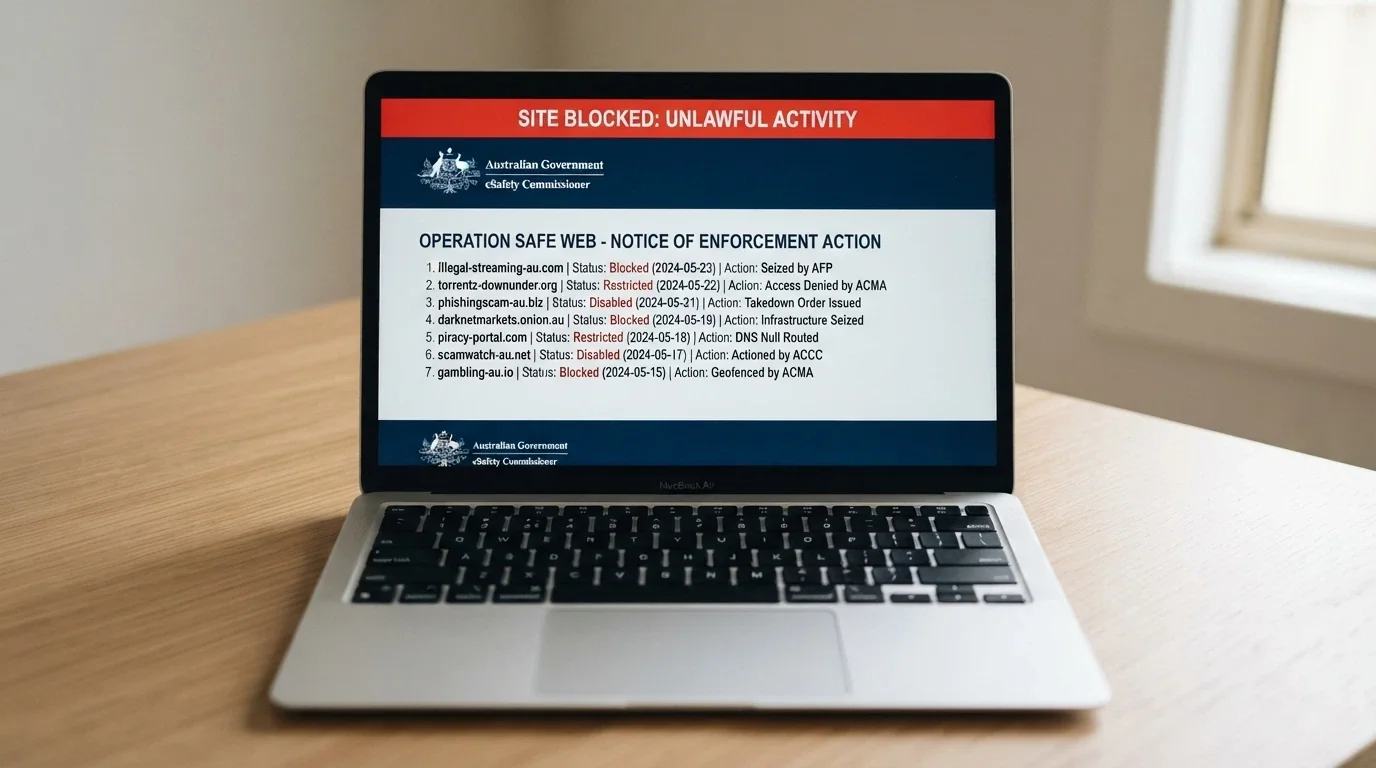
The enforcement record is concrete. Since November 2019 the ACMA has had 1,564 illegal gambling and affiliate websites blocked by Australian internet service providers. More than 225 illegal services have withdrawn from the Australian market since enforcement was strengthened in 2017. ACMA referred 109 unlicensed sites to internet service providers for blocking between January and March 2026 alone. The blocking is DNS-level: the ISP redirects the request and the page does not load. A player whose account sits with an operator that gets blocked mid-session can find the site unreachable while a balance is still on it.
Offshore Casinos, Curaçao Licences and Where Your Protections Sit
All casinos in the top AU-facing blackjack rankings hold a Curaçao eGaming licence or Malta Gaming Authority licence. A Curaçao eGaming licence — the common 8048/JAZ or OGL/2024/161/0191 references — provides some oversight: the operator must segregate player funds, must offer dispute resolution, and is subject to audits. A Malta Gaming Authority licence is held to a higher standard, with stricter reporting and a more rigorous player-complaints process. Neither is Australian regulation. Neither gives a player the protections an AU-licensed operator would.
What an Australian player does not have at an offshore casino: no AU consumer protection body that can recover money, no AU complaints mechanism, no BetStop coverage, no recourse if the operator refuses a withdrawal or voids a win. What an Australian player does have: the licence authority’s own complaints process, which works at the speed and to the standard of that authority — fast and rigorous for MGA, slower and less consistent for Curaçao. The site can be blocked at any time, with a balance still on it. Every offshore player accepts that trade, whether or not anyone spelled it out at sign-up.
What the 2026 Reforms Change for Australian Blackjack Players
The 2026 reform changes the frame around Australian gambling, but it does not change the prohibition on online casino. Online blackjack remains prohibited. The reform’s measures commence 1 January 2027, and they affect the licensed wagering market — sports and racing — not the offshore casino market. From 1 January 2027: wagering advertising on broadcast television is capped at no more than three ads per hour between 6:00 am and 8:30 pm, with a live-sport blackout from 15 minutes before a live sporting event until 5 minutes after it ends. From the same date, athletes, celebrities and influencers are barred from promoting wagering products, and broadcasting sporting odds is banned outright.
Direct marketing of inducements is prohibited for 14 days after a customer signs up and indefinitely for customers identified as at risk of gambling-related harm. The 2026 reform also strengthens BetStop’s operation: the inducement ban extends three months after a person deregisters from the register. From 1 January 2027, banks and payment providers gain express authority to block transactions to illegal gambling operators. The mechanics of that authority — which transactions get blocked, how aggressively — are the question that the first months of 2027 will answer.
Playing Smart — Limits, Loss-Chasing and Where to Get Help in Australia
Gambling harm affects a significant slice of the Australian population, and the numbers are worth knowing before sitting at a live table. As of March 2026, 13.0% of the Australian population — an estimated 2,857,000 people — were experiencing some form of gambling harm from their own gambling behaviours. Approximately 5.4% of the Australian population (1,177,000 people) are experiencing gambling harm from other people’s gambling, bringing the total to 15.1% (3,320,000 people) experiencing some form of gambling harm. About 2.1% of Australian adults — roughly 430,000 people — experience problem gambling, and the Australian Institute of Health and Welfare put high-risk gambling at 1.8% in 2022.

These figures are not background. They are the reason a session limit and a stake ceiling matter before the first hand is dealt. The mathematics of basic strategy gives the lowest house edge in the casino; it does not protect a player from playing past the point where the entertainment value has gone. The structural edge of 0.50% is small, and over hundreds of hands it adds up — a player who plays AU$1,000 a session at basic strategy loses AU$5 on average, but a player who plays AU$1,000 a session for fifty sessions loses AU$250 on average, and the swings around that average are wide enough to empty a bankroll on a bad week.
BetStop, the Helpline and What Actually Reaches an Offshore Table
BetStop — the National Self-Exclusion Register — launched on 21 August 2023 and binds every Australian-licensed online and phone wagering service. One registration excludes a person from the entire licensed market: a person on BetStop cannot log in, deposit or bet with any AU-licensed operator. As of 31 March 2026, 59,830 people had registered to self-exclude from all licensed online and phone wagering providers in Australia, with 37,247 active exclusions. 78% of BetStop registrants were under 40, and 38% chose lifetime exclusion. The register is the most comprehensive self-exclusion tool available in Australia, and it works — but only against the licensed market it covers.
BetStop binds Australian-licensed wagering services only — an offshore casino is not licensed in Australia, is not connected to the register, and will keep accepting a self-excluded person’s money. That is the gap. A person who has registered on BetStop to stop gambling and then opens an account at an offshore casino has not stopped gambling — the offshore site does not see the registration, does not see the exclusion, and processes deposits and bets the same way for a self-excluded person as for anyone else. The helpline — the National Gambling Helpline at 1800 858 858 — is free, confidential and staffed 24 hours a day, 7 days a week, with online chat and counselling through Gambling Help Online at gamblinghelponline.org.au. The helpline reaches offshore players in a way BetStop does not.
How We Evaluated Every Live Blackjack Casino on This Page
The ranking on this page is built around four filters: live blackjack table depth, provider quality, table limits and payment methods that support Australian players. Table depth is the primary signal — a casino with 200 live blackjack tables has a wider variant and limit selection than one with 25 — and provider quality sets the floor on production. Evolution Gaming and Pragmatic Play Live are the two providers whose presence is treated as a quality marker; Playtech and Ezugi appear in some catalogues and add range, with Playtech carrying the highest confirmed maximum at AU$25,000 on GoldenBet’s high-roller tables.
The licence check sits behind every row. Each operator was checked against the ACMA register and state licensing records: no casino listed here holds an Australian casino licence, because no such licence exists for online play. The licence references are Curaçao eGaming or Malta Gaming Authority, drawn from the operators’ own footers and confirmed against industry reporting. Where a licence was not confirmed for an operator this run, the column reads “licence not confirmed this run” rather than a fabricated authority.
Payment-method coverage shaped the ranking’s weight on practical usability: PayID availability, debit card success rate, e-wallet and crypto support. The payment section of this page draws the same conclusions — PayID for deposits, crypto for the fastest payouts, e-wallets for a middle path, bank transfer for the universal fallback.
Your 2026 Live Blackjack Game Plan — What to Do Next
The numbers on this page point to a clear sequence of decisions for any Australian player who has decided to play live blackjack online. First, accept the legal shape: every site on this list is offshore, licensed somewhere other than Australia, and outside the reach of BetStop and the ACMA’s complaints process. Playing at an offshore casino is a conscious choice with a real trade-off — wider tables and limits, no Australian consumer protection.
Second, learn the chart. Live blackjack with basic strategy has a house edge of just 0.50–0.71% — the single biggest factor a player controls. A player who plays basic strategy pays roughly 0.50% of every wager to the house; a player who plays by feel pays 1.5–2.0%. The chart is free, the chart is correct, and the difference compounds across every session.
Third, read the bonus terms before claiming. Blackjack typically contributes 5–10% toward wagering requirements — a AU$10 no-deposit bonus with 50x wagering and 10% contribution means AU$5,000 in blackjack bets to clear, with an expected loss of roughly AU$25 in the process. The headline figure is rarely the real figure. Lightning Blackjack at 99.56% RTP is the highest researched RTP among variants — a player who picks by RTP sits at the table with the lowest mathematical cost per hand.
Fourth, fund the account through PayID. PayID deposits land in under 60 seconds, fee-free, around the clock, with minimum deposits of AU$10–AU$30 at most AU-facing casinos. For withdrawals, crypto clears in 2 to 60 minutes — the fastest payout route available — with e-wallets at 4–8 hours and bank transfer at 3–5 business days as the fallbacks.
Fifth, set a session limit before opening a table. The mathematics gives the lowest house edge in the casino; it does not protect a player from a losing week or a losing month. Staking about 1% of the bankroll per hand keeps variance survivable; a session stop-loss and a session stop-win keep a player inside the entertainment budget rather than chasing losses into the next day.
If gambling stops being entertainment — if the session limit gets crossed, if the chase starts, if the bankroll keeps emptying — the National Gambling Helpline is 1800 858 858, free, confidential and staffed 24 hours a day, 7 days a week, with online chat and counselling at Gambling Help Online. BetStop covers Australian-licensed wagering services only; the helpline covers everyone.
Frequently Asked Questions
How do I deposit at an online blackjack casino using PayID?
PayID deposits process in under 60 seconds, 24 hours a day, 7 days a week, with minimums of AU$10–AU$30 at most AU-facing casinos and no transaction fees. Open the casino’s deposit page, select PayID, enter the deposit amount, and the funds appear in the casino account within a minute. PayID cash-outs are rarely supported — withdrawals go through crypto, e-wallets or bank transfer.
Does BetStop cover me when I play at an offshore blackjack casino?
No. BetStop binds Australian-licensed wagering services only — an offshore casino is not licensed in Australia, is not connected to the register, and will keep accepting a self-excluded person’s deposits and bets. The National Self-Exclusion Register does not reach any offshore operator on this page. The National Gambling Helpline at 1800 858 858 does.
What are the best blackjack variants available to Australian players?
Lightning Blackjack at Evolution Gaming carries the highest researched RTP at 99.56%, with random multiplier cards up to 25x on winning hands. Infinite Blackjack runs at 99.47% RTP with unlimited seats and a AU$1 minimum. Free Bet Blackjack at Pragmatic Play Live offers free double-downs and splits but runs at 98.90% RTP — the trade-off for the player-friendly mechanic.
What is the house edge on live blackjack?
A standard 8-deck live blackjack game with the dealer standing on all 17s and blackjack paying 3:2 runs at approximately 99.50% RTP under basic strategy, which is a house edge of approximately 0.50%. Live blackjack with basic strategy holds a house edge of 0.50–0.71% across favourable rule sets — the lowest of any casino game available to Australian players.
How much do you really get from a blackjack welcome offer?
The headline figure is rarely the real figure. A AU$10 no-deposit bonus with 50x wagering and 10% blackjack contribution requires AU$5,000 in blackjack bets to clear, with an expected loss of roughly AU$25 from clearing the wagering requirement at a 0.5% house edge. The arithmetic favours the operator, and a player who treats the bonus as income rather than a qualifier is reading the wrong line.
Is a real dealer on camera fairer than a computer shuffling cards?
A live dealer game answers a trust question that an RNG game cannot — the player can see the shoe, the cards and the dealer’s actions. The mathematical model is identical under the same rules: a standard 8-deck S17 game at 3:2 produces the same ~99.50% RTP whether the cards come from a shoe or a certified random number generator. Live dealer is the format a player who wants to see the cards picks; RNG is the format a player who wants pace and lower minimums picks.