
Casino Dice Games in Australia: The House Edge, the Offshore Reality, and the Law That Says No
There’s a sentence that runs ahead of every dice article written for an Australian reader, and it begins with “but”. A page promising a ranking of the best places to play online dice games has to acknowledge the same fact in 2001 when the Interactive Gambling Act passed: there is no licensed Australian online casino, no AU regulator hands out an online craps licence, and every operator in the rankings that follows is a brand that is illegal to provide its product in this country. This page does the work anyway — the maths, the operator survey, the legality backbone, the protection gap — because the player who lands here is going to either understand the maths or get taken by the marketing. Dice is the cleanest casino game to learn that lesson on.
Current as of 22 November 2026 | verified against the ACMA public register and the Interactive Gambling Act 2001.
Table of Contents
- Casino Dice Games — The House Always Has an Edge, but Not All Edges Are Equal
- Craps — The One Casino Game Where You Can Bet at True Odds
- Where Australians Actually Play Dice Games in 2026
- Is It Legal? What the Interactive Gambling Act Really Says About Dice Games
- Playing Safe — Tools, Limits and the Help That Exists
- How We Selected and Ranked These Operators
- What the Numbers Say — Your Next Move as a Dice Player in Australia
- Frequently Asked Questions
Casino Dice Games — The House Always Has an Edge, but Not All Edges Are Equal
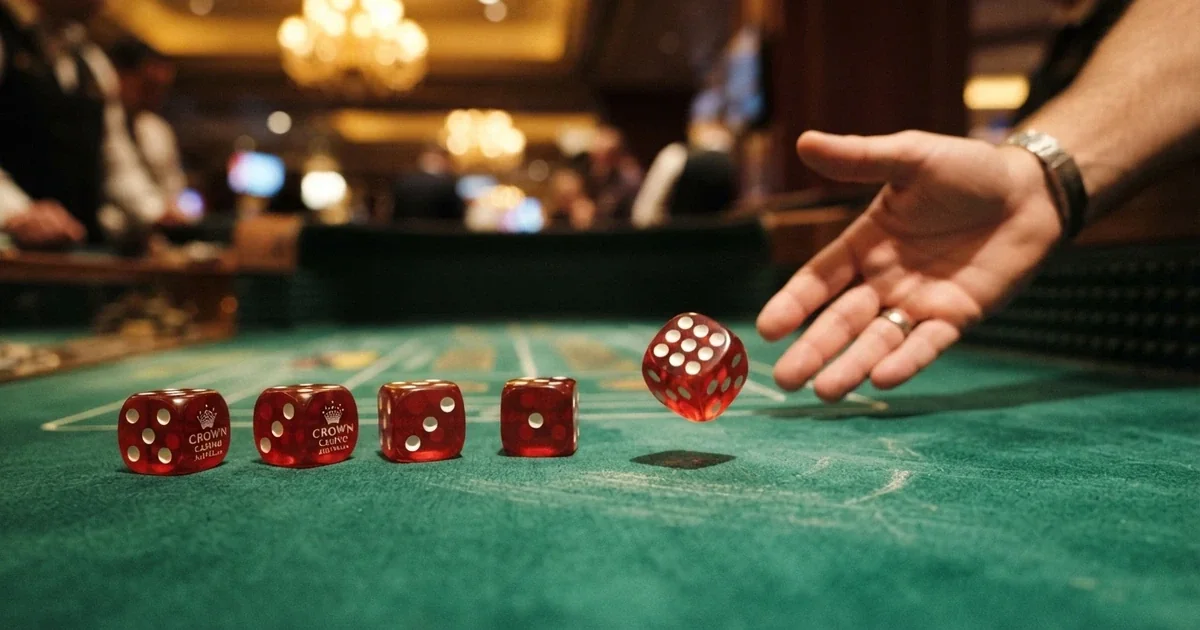
Walk into any Crown or The Star table in Sydney or Melbourne and a craps layout is one of the few games where the casino wears its disadvantage on its sleeve. Some bets on the felt charge the casino nothing. Others charge the player more than sixteen per cent of every dollar wagered. That spread, from zero to over a sixth of every bet, is the single fact a dice player should leave this page knowing. Every other figure sits beside it.
This is a guide for Australians who want to understand what a casino dice game actually is, how it works under the felt, and what the operator landscape in front of them in 2026 looks like. The guide is built on the maths of dice, not the marketing.
What Is a Casino Dice Game — and What Isn’t
A casino dice game is any table or live-dealer game where the outcome that settles the bet is the result of a dice roll. Craps is the two-dice Western classic. Sic Bo is its three-dice Asian cousin, played across Macau and the Philippines since the last century and now standard in every Evolution studio. Lightning Dice, Boom City, Dice City, Super Sic Bo and MONOPOLY Roll ’em are the live-dealer reimaginations, hosted by a presenter in front of a camera rather than dealt by a pit boss on green felt. Same physics, different theatre.
What’s not a dice game matters as much. A slot that shows dice on its reels is a slot, and its outcome is decided by a random number generator rather than a roll. A baccarat variant with dice-themed artwork is still baccarat. The defining feature is the dice themselves as the randomising element. If the game resolves a wager by the face values shown after a shake or a drop, it belongs to this category.
The games this page covers all share one mechanical property: the player bets, the dice are thrown, the bet is resolved. There is no dealer decision, no second draw, no community cards. The come-out roll in Craps is decided by the dice and only the dice; a Lightning Dice drop is decided by the dice falling through a tower of pegs and only that. Strip that physics away and the game is something else.
How Dice Games Work at the Table — the Rules That Don’t Change
Every dice game on a casino floor runs on the same five-step loop. A player places a wager before the outcome is known. The dice are rolled or dropped by some mechanism — a stickman’s push, a tower of pegs, a presenter’s shaker. The result lands on a number or a pattern. The wager either wins at the posted odds or loses to the house. The casino takes a percentage of every losing bet, and that percentage is the house edge.
Two mechanics make dice different from cards. The first is that the randomising element is fully visible and physical. A craps shooter stands at the table and rolls two dice into a padded wall; the dice themselves decide the outcome, no algorithm between them and the felt. In a live-dealer stream, a tower of clear plastic pegs shakes the dice into a result the player watches live. The second is that the bet has to land before the roll. There is no second decision after the dice are in motion.
The maths that drives every dice game is combinatorial, and combinatorial maths is one of the few things in a casino that doesn’t lie. With two six-sided dice, the number 7 can be rolled in six ways out of thirty-six — the most common result, which is why a Pass Line bet wins on a natural 7 and a Don’t Pass wins when the shooter sevens out before making the point. With three six-sided dice, as in Sic Bo, the distribution stretches from a triple 1 to a triple 6, with totals of 9, 10, 11 and 12 dominating because they can be assembled from more combinations. The game is a wrapper around that distribution. Every wager on the felt is a bet on which combination or which total the dice will produce.
House Edge and RTP — Why the Maths Matters More Than the Roll
A slot can be honest or it can be engineered to feel honest. A dice game is honest by construction. The dice have no memory, the casino cannot change their faces between rolls, and the payout on every bet is set against a probability that any first-year maths student can compute. That transparency is what makes dice the cleanest game on the floor to evaluate, and what makes the marketing surrounding it the easiest to puncture.
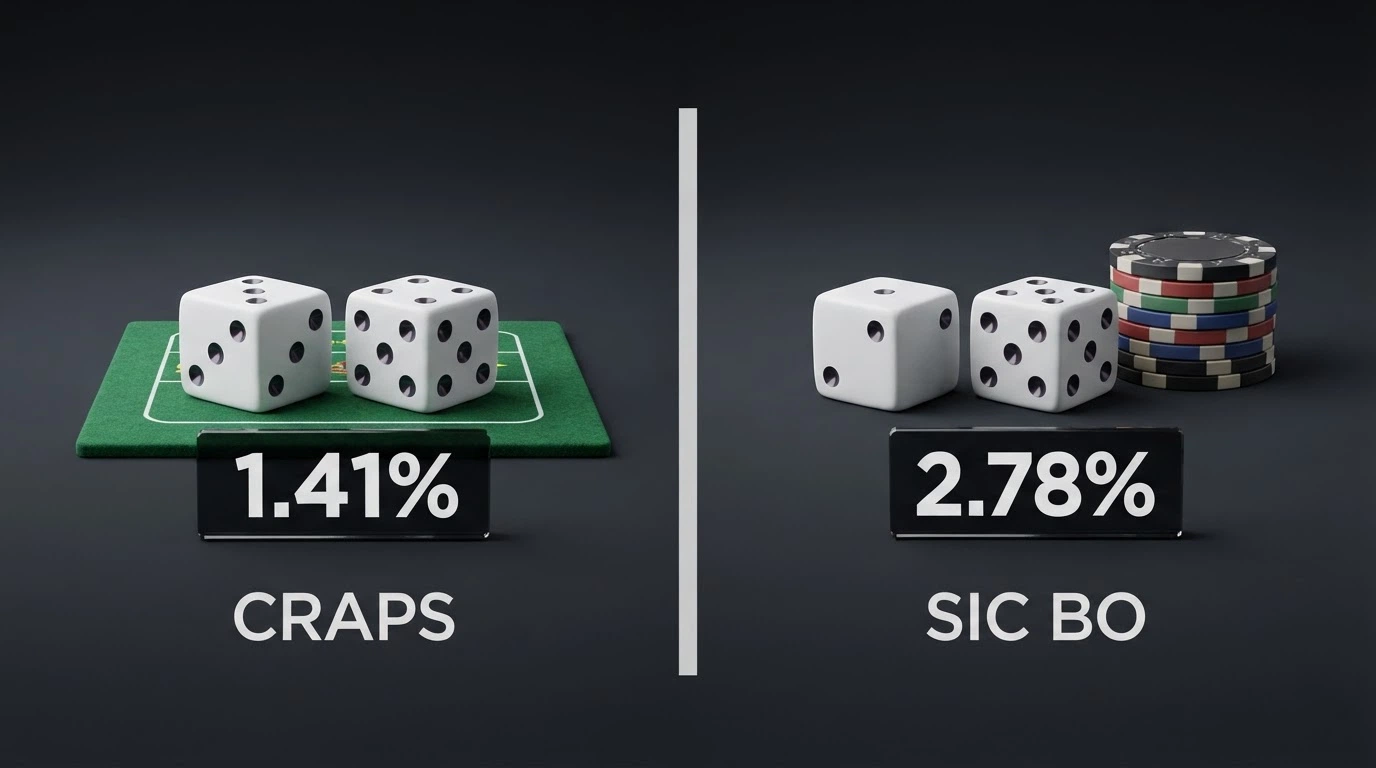
The figures below are taken from Wizard of Odds and the game publishers’ own specifications. They are not ranges and they are not optimistic. They are what the house charges.
In Craps, the Pass Line and Come bets carry a house edge of 1.41 per cent. Don’t Pass and Don’t Come sit at 1.36 per cent — slightly better, because the bet wins on the roll of 2 or 3 and pushes on a come-out 12 rather than losing. The Odds bet, placed behind a Pass or Don’t Pass wager once a point is established, has a house edge of exactly zero. The casino charges nothing on the Odds portion of a wager, which is the only time in any casino game anywhere that the payout matches the true probability of the result.
Move to the proposition bets at the centre of the craps layout and the maths turns ugly. Any Craps — a one-roll bet that the next throw is 2, 3 or 12 — has a house edge of 11.11 per cent. Any Seven — a one-roll bet on the most likely total — charges the player 16.67 per cent. Place 6 and Place 8 sit at 1.52 per cent. The 1.36 of Don’t Pass and the 16.67 of Any Seven are both bets on a craps table, made at the same moment, in the same room. The gap between them is the gap between a session that costs a player a few dollars per hundred and one that costs them sixteen.
Sic Bo lives in the same range but at a higher floor. The Big and Small bets — that the three-dice total will be high (11–17) or low (4–10) excluding triples — sit at 2.78 per cent, with a 48.61 per cent win probability. The total bets for 10 and 11 charge 12.50 per cent. The Domino bet, which pays for a specific two-face combination, charges 16.67 per cent — the same number Any Seven charges at the craps table, for the same reason: the payout doesn’t match the probability.
The live-dealer titles carry their own numbers, and these are Return to Player percentages rather than house edges. Lightning Dice reports an RTP of 96.21 per cent, which is a 3.79 per cent house edge including the random multipliers. Boom City reports 96.43 per cent, or a 3.57 per cent edge. MONOPOLY Roll ’em reports 96.97 per cent, or a 3.03 per cent edge. Super Sic Bo’s RTP is set by the studio with multipliers of up to 1,000x. These are not bad numbers relative to slots, which routinely sit in the 92 to 96 per cent band, but they aren’t zero either, and the dice game that looks most generous on the screen is still extracting an average cut over every spin.
Craps, Sic Bo and the Traditional Table — Two Dice vs Three
The two foundational dice games on any casino floor are Craps and Sic Bo, and they are worth comparing side by side.
- Craps runs on two dice and a layered betting layout. The come-out roll settles the first decision; the point becomes the target until the shooter either matches it or sevens out. The best bets on the table are Don’t Pass at 1.36 per cent and Pass at 1.41 per cent; the Odds bet behind either carries zero house edge.
- Sic Bo runs on three dice and a simpler grid. The player picks a total range, a specific total, a single face, a domino, or a triple. The best bets are Big and Small at 2.78 per cent, because the probability of those is closest to even money. Everything else drifts toward double-digit edges.
- The table itself tells the story. Craps has a stickman running a dozen active wagers at once, with players leaning over the felt to lay Odds behind each Pass Line bet. Sic Bo has a single bet per round, a dealer who taps the layout, and a dice shaker that does the rest.
- Best-bet logic differs in shape. In Craps, a player takes Don’t Pass plus full Odds to get as close to a zero-edge session as a casino will allow. In Sic Bo, a player who can find the Big/Small line stays there and avoids every other wager; the temptation is the high-payout triple bet, which the maths doesn’t reward.
The two games share one structural feature the live titles below don’t: the dice are visible and the maths is auditable. A player who learns one combinatorial distribution has learned both.
Lightning Dice, Boom City and the Modern Live-Dealer Wave
The live-dealer dice titles Australians actually see promoted in 2026 are the ones that turned dice into a televised event. Lightning Dice, hosted by Evolution, drops three dice down a clear plastic tower while the presenter calls out randomly assigned multipliers ranging from 50x to 1,000x on one or two of the standard totals. The RTP sits at 96.21 per cent, the minimum bet is A$0.20, the maximum is A$2,000, and the multipliers can lift a one-dollar chip into a thousand-dollar payout if the dice and the multiplier align. The game reads as a game show, which is what Evolution wanted it to read as.

Boom City is a Pragmatic Play title built on a six-reel board with three dice and three bonus zones, an RTP of 96.43 per cent, min bets of A$0.10, max bets of A$5,000, and a 20,000x max-win headline that lives in the bonus features rather than the base game. Dice City is a live-dealer variant without an RTP figure in the public record. Super Sic Bo keeps the standard three-dice Sic Bo layout and adds the same multiplier mechanic Lightning Dice uses — random boosts of up to 1,000x assigned before each round — without changing the underlying Sic Bo probability. MONOPOLY Roll ’em, also Evolution, sits at 96.97 per cent RTP, with a bet range from €1 to €15,000 and a 300x max win.
The pattern across the live-dealer titles is the same: a familiar casino game wrapped in multipliers, a host, and a presentation that hides the underlying maths. A 96.21 per cent RTP is a 3.79 per cent house edge. The multipliers give the game its visual peak; the RTP does the quiet work of taking the player’s cut.
Strategy Basics for Dice Players — Bets Worth Making and Bets Worth Skipping
The decision framework a dice player needs is short enough to fit on a single chip.
In Craps, take the Don’t Pass or Pass Line bet at 1.36 to 1.41 per cent, and stack as much as the table allows behind it on the Odds bet at zero per cent. Every other proposition wager at the centre of the layout is a long-run donation to the house. Any Seven at 16.67 per cent, Any Craps at 11.11 per cent, the Horn bets at similar levels, the hardways — these are the bets that fill the layout and cost the player the most. Place 6 and Place 8 at 1.52 per cent are an acceptable compromise when a player can’t take the Odds bet.
In Sic Bo, the Big and Small bets at 2.78 per cent are the only wagers a steady player should be making. The total bets at 10 and 11 charge 12.50 per cent and look tempting because their payouts hit 6:1; the maths doesn’t support them. The Domino bet at 16.67 per cent and any triple-specific bet at similar levels are sucker bets dressed as long shots.
In live-dealer titles, the only strategic decision the player makes is how much to wager and when to stop. The RTP is fixed by the studio and the multiplier mechanic is assigned before the roll. There is no decision tree that improves the odds; there is only a stake size that controls the rate at which the house edge is extracted.
Bankroll management is the one strategy that survives every game. A flat stake of one or two per cent of session bankroll per round, no progression after losses, no chase of multipliers — that is what keeps the edge from compounding faster than the maths already compounds it.
What a Welcome Bonus Really Costs — A Worked Example
The arithmetic gets sharper when the bonus number meets the wagering number. Take Rocket Play’s headline offer: 100 per cent up to A$1,000 on the first deposit, with a 40x wagering requirement on the bonus amount and an assumed target game of Lightning Dice at 96.21 per cent RTP. With a 40x requirement on a A$1,000 bonus, the player must run A$40,000 of bets through the wagering before the bonus clears. At Lightning Dice’s 96.21 per cent RTP, the expected house take across that turnover is roughly A$1,516 — the bonus’s real cost, presented as a statistical average across many sessions rather than a guaranteed outcome for any one of them. The figure assumes only the bonus amount is wagered, with no further deposits, and that the average house edge holds over the full A$40,000. It also leaves aside the A$5,000 max-win cap on the Rocket Play bonus, which converts a theoretical larger outcome into a fixed ceiling.
What the number makes clear is what the marketing does not. A “100 per cent bonus up to A$1,000” reads to most players as the casino handing them a free thousand. The wagering requirement converts that into an A$1,516 expected cost before the player has touched the bonus itself, and the cap limits the upside that would balance it. Every welcome offer described in this article should be read through that lens: the bonus is not the gift, the wagering requirement is the cost.
Playing Online vs Walking onto a Physical Casino Floor
Crown Melbourne and The Star Sydney operate craps tables under state-issued licences, and a player who walks onto those floors plays under Australian consumer law: the odds are posted, the dice are physical, the payouts are paid at the table, and if a dispute arises there is a regulator in the same state to escalate it to. That is the licensed, state-supervised experience.
The online experience in 2026 is different. No Australian licence exists for online casino, including dice games. The brands Australians reach through search results — Rocket Play, Skycrown, Royal Reels, Stake, Rainbet, Bizzo, WinSpirit — are Curaçao or Kahnawake-licensed, hold no Australian authorisation for the product they sell, and operate under their own house rules. ACMA has had 1,564 illegal gambling and affiliate websites blocked by Australian ISPs since November 2019 and over 225 services have withdrawn from the AU market since 2017. A site that holds a real player’s balance can be blocked tomorrow.
A live-dealer stream of craps or Lightning Dice uses the same physics as the Crown floor: the dice are real, the camera is the only thing between the player and the felt. The probability of the roll is identical. What changes is everything around it — the consumer protection, the withdrawal guarantee, the recourse if a payout is refused. The player who plays at the Crown floor pays the same 1.41 per cent on a Pass Line bet as the player on the offshore site. The Crown player can take the dispute to the VGCCC; the offshore player has no equivalent.
Craps — The One Casino Game Where You Can Bet at True Odds
Craps earns its own section because it contains the single most counter-intuitive feature in any casino game. Every other bet on any other felt on any floor pays less than the true odds of the event, because that gap is what funds the casino. Craps carries a bet — the Odds bet — where the casino charges nothing. The payout on the Odds portion of a wager matches the actual probability of the dice landing the point. That is not a marketing claim; it is a structural feature of the game, and it is the reason experienced craps players take as much Odds behind their Pass or Don’t Pass bet as the table will allow.
How a Round of Craps Plays Out — the Come-Out Roll to the Point
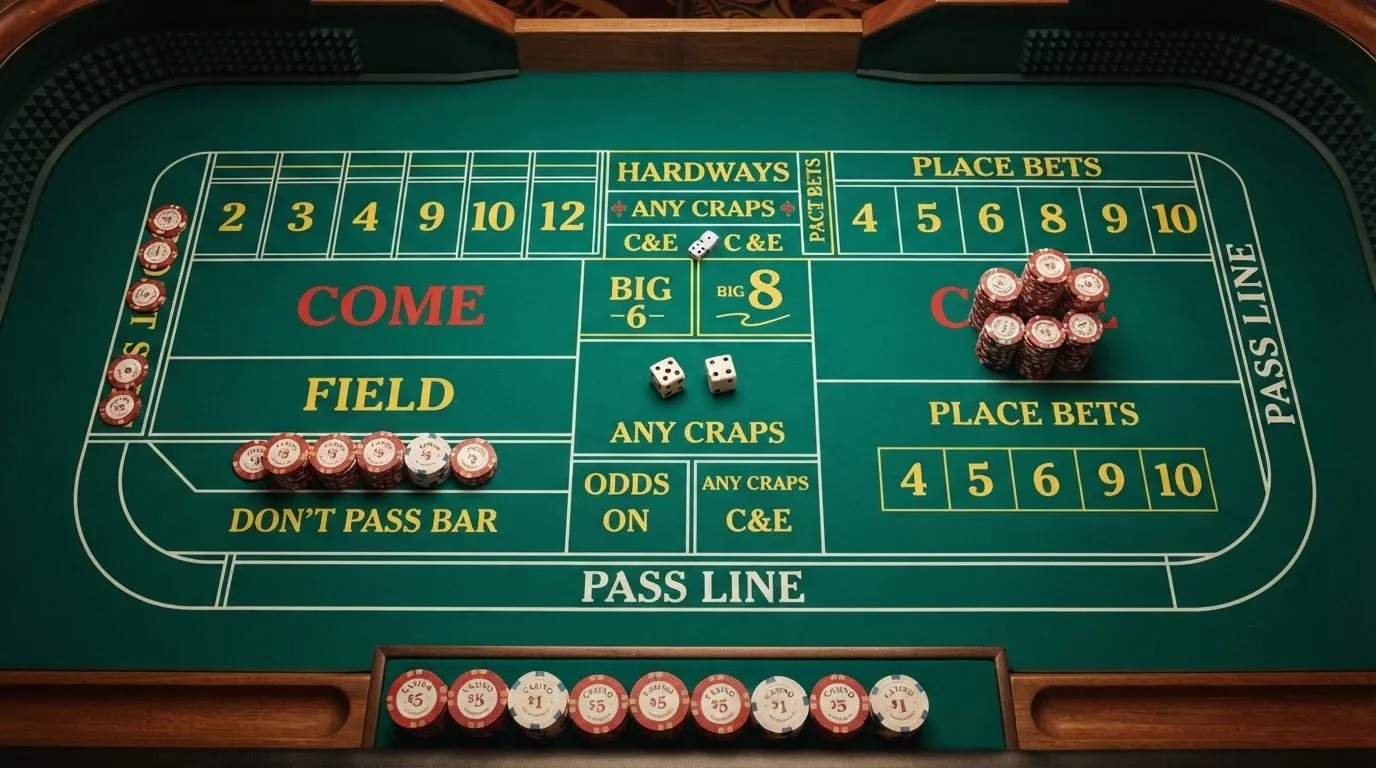
A round of craps opens with the come-out roll. The shooter takes the dice and throws them down the table. If the dice show 7 or 11, the Pass Line wins — that’s a natural. If the dice show 2, 3 or 12, the Pass Line loses — that’s craps. Any other total (4, 5, 6, 8, 9 or 10) becomes the point. The dealer flips a marker to the point number on the layout and the round enters its second phase.
In the point phase, the shooter keeps rolling until either the point comes up again or a 7 shows first. If the point comes up before the 7, Pass Line bets win. If the 7 comes up first, Pass Line bets lose. A Pass Line bet that wins on the come-out doesn’t even reach the point phase — the natural settles it. A Don’t Pass bet is the mirror: it wins on craps (2 or 3), pushes on the come-out 12, and wins the point phase if a 7 comes up before the point.
The Odds bet enters after the point is established. The player can place additional chips behind the Pass or Don’t Pass line, and the casino pays the Odds portion at true odds: 2:1 on a point of 4 or 10, 3:2 on a point of 5 or 9, 6:5 on a point of 6 or 8. The maths works out so the casino keeps nothing on the Odds portion. Every cent that comes back is the player’s.
Evolution’s Live Craps offers an Easy Mode with a simplified layout and a built-in tutorial, which makes the game readable for a player who has never seen a craps table in person. The maths doesn’t change in Easy Mode — only the layout does.
Best and Worst Bets at the Craps Table — Where the House Edge Lives
The craps table is the clearest argument for reading the layout before sitting at it. The bets below are ranked from lowest to highest house edge. A session of Pass Line and Odds looks nothing like a session of Any Seven, even though both happen on the same felt.
| Bet type | House edge | Payout | Notes |
|---|---|---|---|
| Odds (behind Pass/Don’t Pass) | 0.00% | True odds | Only wager in any casino game with zero house edge |
| Don’t Pass / Don’t Come | 1.36% | 1:1 | Best flat bet on the table; pushes on come-out 12 |
| Pass / Come | 1.41% | 1:1 | The standard line bet; the round’s most common wager |
| Place 6 / Place 8 | 1.52% | 7:6 | Reasonable compromise when Odds aren’t available |
| Crapless Craps (shooter) | 5.38% | varies | A variant that strips the natural craps from the come-out |
| New York Craps | ~5.00% | varies | A regional variant with limited wagering menu |
| Any Craps | 11.11% | 7:1 | One-roll bet on 2, 3 or 12 |
| Any Seven | 16.67% | 4:1 | Highest house edge on a standard craps layout |
The gap between the best and worst craps bet is wider than most casino games manage across their entire bet menu. A $100 wager on the Odds bet behind a Pass Line costs the player nothing on the Odds portion. A $100 wager on Any Seven costs them, on average, $16.67. Same table, same round, same dice. The only difference is which box on the felt the chip landed in.
Where Australians Actually Play Dice Games in 2026
The legal context has to come first, so here it is again: online casino is illegal to provide in Australia under the Interactive Gambling Act 2001. There is no AU-licensed online casino, no ACMA-issued dice-game licence, no state-issued online craps permit. Every operator in the table below is either an offshore casino offering an unlicensed product in this market, or an NT-licensed wagering operator selling a legal product that stops at the sportsbook. The “where do Australians actually play” question has a real answer — these brands — and a real answer about the consumer protection each one offers, which is the protection of whatever jurisdiction they’re licensed in, not Australia.

| Operator | Licence status | Welcome offer | Wagering requirement | Dice game providers |
|---|---|---|---|---|
| Rocket Play | Offshore (Curaçao — not AU-licensed) | 100% up to A$1,000 + 100 FS (1st dep) | 30x–40x bonus | Evolution, Pragmatic Play, others |
| Skycrown | Offshore (Curaçao — not AU-licensed) | 100% up to A$500 + 50 FS (1st dep); A$8,000 + 400 FS across 4 deps | 40x bonus / 30x FS winnings | Evolution, Pragmatic Play, others |
| Royal Reels | Offshore (not AU-licensed) | 100% up to A$500 + 50 FS (1st dep); A$2,500 + 50 spins across 3 deps | 30x–35x bonus | RTG |
| Stake | Offshore (Curaçao — not AU-licensed) | Not confirmed this run | Not confirmed this run | Evolution, Pragmatic Play, Hacksaw, others |
| Fair Go | Offshore (not AU-licensed) | A$10 no-deposit chip | 60x no-deposit / 30x deposit match | RTG |
| Rainbet | Offshore (Curaçao — not AU-licensed) | 250% up to $2,100 + 60 FS across 3 deps | 40x deposit + bonus | Pragmatic Play, others |
| Bizzo Casino | Offshore (Curaçao + Kahnawake — not AU-licensed) | 100% up to €100 + 100 FS (1st dep); 50% up to €300 + 50 FS (2nd dep); 20 FS no-deposit | 40x bonus | 80+ studios inc. Evolution, Pragmatic Play |
| WinSpirit | Offshore (not AU-licensed) | 100% up to $1,000 + 100 FS (1st dep); 200% up to $1,000 (2nd dep) | 40x welcome/deposit | Evolution, Pragmatic Play, others |
| SportsBet | NT-licensed wagering operator | n/a (no casino product) | n/a | None — sports and racing only |
| Bet365 | NT-licensed wagering operator | n/a (no casino product) | n/a | None — sports and racing only |
Rocket Play
Rocket Play is a Curaçao-licensed offshore casino whose first-deposit offer is the 100 per cent match up to A$1,000 plus 100 free spins. The wagering requirement is reported variously at 30x to 40x the bonus amount depending on the source page, the bonus validity is short at five days, and a max-win cap of A$5,000 applies. The minimum deposit is A$30. The dice-game catalogue comes through Evolution and Pragmatic Play, which covers Lightning Dice, Boom City, Super Sic Bo, MONOPOLY Roll ’em and the rest of the live-dealer set.
The verdict here is numerical. An A$1,000 bonus with a 40x wagering requirement at a 96.21 per cent RTP target game generates roughly A$1,516 of expected loss through the bonus alone, before the player touches their deposit. The five-day validity makes the wagering feel tight, and the A$5,000 cap means a player who runs hot on the bonus will see the ceiling before they see a withdrawal.
Skycrown
Skycrown runs a four-deposit welcome pack worth up to A$8,000 plus 400 free spins. The first deposit is 100 per cent up to A$500 with 50 free spins, the remaining three tiers scale the bonus and the spin count. Wagering is 40x on the bonus and 30x on free-spin winnings, with a 14-day validity per tier, a 10x bonus-value cashout cap on the free spins, and a minimum deposit of A$20. Evolution and Pragmatic Play carry the dice catalogue.
The verdict is comparative. Skycrown spreads its A$8,000 pack across four deposits where Rocket Play puts the same headline on the first deposit alone; a player who only intends to deposit once gets the better offer at Rocket Play, while a player who plans to stay for several deposits can stretch the bankroll further at Skycrown. The 14-day per-tier window is more generous than Rocket Play’s five-day total clock.
Royal Reels
Royal Reels runs on RTG (RealTime Gaming) software, which sets it apart from the Evolution- and Pragmatic Play-heavy operators above. The welcome pack is three deposits worth up to A$2,500 plus 50 free spins, with 30x to 35x wagering on the bonus. Minimum deposit is A$30. Bonus validity and maximum cashout figures were not confirmed against the operator’s current terms, so this write-up stops where the verified record stops.
The verdict is caveat-shaped. An RTG-only dice catalogue is narrower than an Evolution-led one, and the absence of confirmed validity and cashout numbers means a prospective player should read the bonus terms before claiming rather than after. The three-deposit structure mirrors Skycrown’s but on a smaller scale, and the RTG platform is the right fit for a player who already knows the studio’s catalogue.
Stake
Stake is a Curaçao-licensed platform with a heavy presence in the crypto and live-dealer space. The dice-game provider mix is the strongest in this set: Evolution, Pragmatic Play and Hacksaw Gaming, which covers the live-dealer titles and a number of newer dice-style games that the older catalogues don’t carry. The welcome offer, wagering requirement, validity, cashout cap and minimum deposit were not confirmed against current terms, so this write-up is intentionally narrow.
The verdict is flat. Stake’s place in this ranking comes from the breadth of its dice-game providers and the platform’s standing in the offshore market, not from bonus economics it couldn’t be verified on. A player who wants Evolution, Pragmatic Play and Hacksaw dice titles on one site has Stake near the top of a short list; verified bonus terms should be checked directly on the operator site before committing funds.
Fair Go
Fair Go runs on RTG and offers the only no-deposit entry point in the featured set: an A$10 free chip on signup, with no deposit required. The no-deposit chip carries 60x wagering, the deposit match carries 30x, and the no-deposit cashout is capped at roughly A$150 to A$180. Bonus validity was not confirmed against current terms, and the deposit-match minimum was not confirmed either.
The verdict is comparative. The A$10 free chip is the cheapest way into a real-money dice session in this set, and 60x wagering is the steepest multiplier on the page. Fair Go fits a player who wants to test a casino with their own money left untouched first, and doesn’t fit a player who needs Evolution’s live-dealer catalogue, because RTG doesn’t carry Lightning Dice or Boom City.
Rainbet
Rainbet offers the most aggressive percentage match on the page: 250 per cent up to $2,100 plus 60 free spins across three deposits, with 40x wagering on deposit plus bonus, seven-day validity, a $50 withdrawal cap on the welcome code, and a $30 minimum deposit. Pragmatic Play is the headline dice-game provider.
The verdict is numerical and the numbers don’t line up. A 250 per cent match reads large; a 40x deposit-plus-bonus wagering requirement on a seven-day clock with a $50 withdrawal cap reads tight. The bonus-clearing arithmetic makes the headline amount less generous than it appears. The $50 cap is the figure that disqualifies the welcome code for any serious play.
Bizzo Casino
Bizzo carries a dual Curaçao and Kahnawake licence, with 80-plus studios on the platform including Evolution and Pragmatic Play. The welcome pack is two deposits: 100 per cent up to €100 plus 100 free spins on the first, 50 per cent up to €300 plus 50 free spins on the second. Wagering is 40x on the bonus, the no-deposit 20 free spins come with a three-day activation window and seven-day validity, and the cashout caps are €50 on the no-deposit free spins and €10,000 on the deposit-bonus winnings.
The verdict is flat. Bizzo’s catalogue breadth is the strongest in the set, the cashout caps are unusually generous for a deposit-bonus, and the 20 free spins no-deposit is a low-cost way to test the platform. The dual licence is a margin better than single Curaçao, though neither is an AU authorisation.
WinSpirit
WinSpirit runs an offshore casino with Evolution and Pragmatic Play on the provider list. The welcome offer is 100 per cent up to $1,000 plus 100 free spins on the first deposit, then 200 per cent up to $1,000 on the second. Wagering is 40x on the welcome and deposit. Bonus validity and maximum cashout figures were not confirmed against current terms; the minimum deposit is $20.
The verdict is numerical. A 200 per cent second-deposit match is unusual — most operators scale the bonus down across tiers, not up — and it rewards a player who plans a second deposit. The unconfirmed validity and cashout figures are the gap a player needs to close before claiming.
SportsBet
SportsBet is Australia’s largest wagering brand by market share and is NT-licensed for sports and racing. It does not offer online casino games, which means it does not offer dice games. That absence is the reason it appears in a table about dice games at all: it is the licensed AU anchor that shows what a legal AU gambling product actually looks like, and the product stops at the sportsbook. A player who lands on SportsBet looking for craps or Lightning Dice will find a sports and racing platform that is regulated under Australian consumer law.
The verdict is comparative. A player who wants dice games cannot get them at SportsBet. This operator provides a fully AU-regulated wagering experience instead, complete with deposit limits, BetStop coverage and formal complaint recourse.
Bet365
Bet365 is a global wagering brand, NT-licensed in Australia, with sports and racing as its AU product line. There is no online casino in the Australian Bet365 product, and therefore no dice games. The brand earns its place in the operator table for the same reason SportsBet does: it is the second licensed AU anchor in a list otherwise made up of offshore operators. The AU-licensed product ceiling stops at the sportsbook, and that ceiling is what defines the boundary between legal and prohibited play in Australia.
The verdict is comparative. Bet365 carries the same message as SportsBet, on a different brand. A player who wants dice games is on an offshore site; a player who wants Australian consumer protection is on Bet365’s sportsbook, not its (non-existent) casino.
Is It Legal? What the Interactive Gambling Act Really Says About Dice Games
The short version is the one the page has been pointing at: online casino dice games are illegal to provide to a person in Australia. The longer version is the Interactive Gambling Act 2001, the regulator that enforces it, the 2026 reform that strengthens it, and the offshore reality that lives in the gap between the law and the players who reach the unlicensed sites anyway. This section is the legal backbone the rest of the page rests on.
The IGA Framework — What’s Prohibited and What Isn’t
The Interactive Gambling Act 2001 makes it an offence for a gambling provider to offer online casino games, online pokies and in-play sports betting to a person in Australia. The IGA does not criminalise the player; the offence is on the provider. What this means is that the tens of thousands of Australians who play dice games, slots and live-dealer titles on offshore sites are not personally breaking the law, but they are accessing a product that no Australian entity is permitted to supply to them.
The IGA was strengthened by the Interactive Gambling Amendment Act 2017, which closed the loopholes offshore operators had been using and gave ACMA explicit enforcement and site-blocking powers. ACMA is the regulator: it investigates complaints, issues formal warnings and civil penalty proceedings, and refers websites to Australian ISPs for blocking. Since ACMA’s first blocking request in November 2019, 1,564 illegal gambling and affiliate websites have been blocked. Over 225 services have withdrawn from the AU market since 2017 rather than face the enforcement action. ACMA’s most recent quarterly report (Q4 2025) recorded 23 investigations into 45 sites, 69 IGA breaches, 10 formal warnings and 133 websites referred for blocking. Of 483 complaints received that quarter, 420 were valid complaints that could be investigated under the Act.
What is permitted in Australia is narrower than the prohibited list. Pre-event sports and racing wagering is licensable, through operators licensed by a state or territory — the Northern Territory Racing and Wagering Commission is the de facto national licensor, which is why SportsBet and Bet365 carry NT-issued licences in the comparison table. Lotteries and keno are permitted. Online casino and online pokies are not. In-play sports betting is not.
The 2026 Reform — What Changes from 1 January 2027
The Interactive Gambling Amendment (Gambling Reform) Bill 2026 passed Parliament on 19 August 2026. Its measures commence on 1 January 2027. The distinction matters: a bill that has passed but not yet commenced is law on the statute book and not yet enforceable in the way the operative provisions will be when 2027 starts. Until the commencement date, the IGA’s existing provisions are the operative ones.
What changes from 1 January 2027 is several layers. The reform caps wagering advertising at three ads per hour between 6am and 8:30pm, imposes a live-sport advertising blackout, bars athletes and celebrities from promoting wagering products, and prohibits direct-marketing inducements to new sign-ups for 14 days, to anyone who has deregistered from BetStop for three months, and indefinitely to at-risk customers. BetStop’s operation is strengthened, and — most consequentially for offshore casinos — banks and payment providers gain express authority to block transactions to illegal gambling operators. A player who has been funding an offshore account through a debit card or a bank transfer may find the transaction refused at the bank level.
The reform does not legalise online casino. It does not create an AU online casino licence. It does not change the IGA’s prohibition on the product. What it does is tighten the marketing, the payment rails and the self-exclusion machinery around a prohibition that already exists.
Offshore Casinos — What You Risk When You Play Outside the Licensed System
The honest reality is that Australians access offshore casinos in large numbers. Rocket Play, Skycrown, Royal Reels, Stake, Rainbet, Bizzo and WinSpirit are not phantom brands — they hold real AU traffic and real AU revenue, and the operator set in the comparison table is the set the search engines return when an Australian types in “casino dice game”. That traffic exists in a legal gap. The IGA does not prosecute the player, but the player loses every Australian consumer protection the moment the deposit leaves for an offshore account.
BetStop, the National Self-Exclusion Register detailed in the playing-safe section below, does not reach offshore casinos. BetStop binds approximately 150 licensed Australian wagering providers; an offshore site is not connected to the register. ACMA can investigate complaints about offshore operators and refer the sites for blocking, but ACMA cannot recover money for an individual player who has been refused a withdrawal. There is no Australian consumer law that applies to a Curaçao-licensed operator’s payout terms, no Australian small-claims court that has jurisdiction over a Kahnawake-licensed brand, no AU regulator a player can escalate a complaint to.
The most concrete risk is also the simplest: ACMA can order the offshore site blocked, and the player’s balance can be sitting on a server they can no longer reach. This is not a hypothetical. It has happened to brands operating in the AU market. The protection an AU-licensed wagering operator gives — guaranteed payouts, dispute escalation, BetStop coverage — is precisely the protection an offshore site does not.
Payment Rules — Credit, Crypto and What Australians Can Actually Use
Since 11 June 2024, credit cards, credit-related products and digital currency (crypto) have been banned as payment methods for online wagering in Australia. The Interactive Gambling Amendment (Credit and Other Measures) Act 2023 brought the ban into force; an operator that fails to enforce it faces penalties of up to A$247,500. What this means in practice is that a licensed AU wagering operator cannot accept a Visa credit card, a Mastercard credit card, an Afterpay-style credit product or a Bitcoin-style crypto transfer for a sports bet, a racing bet, a keno ticket or any other wagering product.
The legal deposit routes that remain for licensed wagering are debit cards, bank transfers, PayID, Osko and BPAY. Every one of those payment methods leaves a paper trail, which is the point — the ban is a consumer-protection measure, not just a financial one.
Offshore casinos typically ignore the ban. A player who deposits at an offshore site using a credit card is, in most cases, transacting in a way the licensed Australian operator could not accept. The new layer is the 1 January 2027 commencement, at which point banks and payment providers gain express authority to block transactions to illegal gambling operators. A deposit that has been sliding through to an offshore casino through a debit card or a transfer may, from that date, be refused at the bank level. The licensed side of the AU wagering market has been building toward that infrastructure for two years.
Playing Safe — Tools, Limits and the Help That Exists
Dice games are the fastest table game on a casino floor. A round of craps resolves in seconds; a Lightning Dice drop runs on a similar clock. That speed is exactly what makes the harm-prevention infrastructure worth taking seriously — a player who can lose twenty rounds in a minute is a player who needs limits in place before the first round, not after the twentieth.

BetStop — the National Self-Exclusion Register and What It Actually Covers
BetStop is the National Self-Exclusion Register, live since August 2023 and operated by ACMA. A player registers once and is excluded from every AU-licensed wagering service for the period they choose, from a minimum of three months to a lifetime. As at 31 July 2026, BetStop had recorded 67,480 registrations, with 41,290 exclusions still active — more than sixty per cent of all registrants. Seventy-eight per cent of registrants are under 40, and thirty-eight per cent have chosen lifetime exclusion.
What BetStop covers is approximately 150 licensed Australian wagering providers. What it does not cover is offshore casinos. BetStop’s bind is to the AU-licensed network; a Curaçao-licensed brand has no obligation to honour a BetStop registration and no technical connection to the register. A self-excluded Australian can register with BetStop and still deposit at an offshore casino the same afternoon. ACMA’s own guidance on this is direct: an offshore casino is not connected to the register and will keep taking a self-excluded person’s money.
That gap is the single most important consumer-protection fact on this page. BetStop is the strongest self-exclusion tool Australia has built, and it covers every AU-licensed brand. It does not reach the operators the comparison table lists as offshore.
Help Resources — 1800 858 858, Gambling Help Online and the Numbers Behind the Harm
The harm data behind the help line is the reason the help line exists. About 2.1 per cent of Australian adults — roughly 430,000 people — experience problem gambling, a figure the Australian Institute of Health and Welfare put at 1.8 per cent in its 2022 measurement and that subsequent survey work has tracked at similar levels. As of March 2026, Roy Morgan Research measured 15.1 per cent of Australian adults — an estimated 3.32 million people — experiencing some level of gambling harm from their own or others’ gambling. 13.0 per cent — 2,857,000 people — are experiencing harm from their own gambling behaviours. Eleven per cent of Australians had gambled online in the previous six months as of the 2022 ACMA figure, up from eight per cent in 2020.
The help infrastructure sits behind those numbers. The National Gambling Helpline is 1800 858 858 — free, confidential, staffed 24 hours a day, with online chat and email counselling available through Gambling Help Online. The service is run for the Australian government and is the single most direct route to a counsellor for someone who has decided the cost is too high.
A player who is reading this page after a bad session and a worse week can call that number tonight. The call is free and the conversation is confidential, and the staff are trained for exactly the situation the reader is in.
Practical Limits for Dice Play — Deposit Caps, Reality Checks and Knowing When to Stop
AU-licensed wagering operators offer customer-set deposit limits, take-a-break options and activity statements under their state and territory conditions; the specific tools vary by jurisdiction, but the operator cannot legally omit them. A player who has an account with an AU-licensed operator can set a daily, weekly or monthly deposit ceiling inside their account settings, take a break for a defined period, and request an activity statement that lists every wagering transaction in the period.
An offshore casino may offer none of these tools. A player who wants to use them has to ask, before depositing, whether the operator offers deposit caps, session timers, take-a-break, and a clear withdrawal procedure with a published timeframe. If the answers are vague, the protection is vague.
Dice games make the limit question sharper because they resolve so fast. A bankroll that would survive an hour of blackjack can evaporate in ten minutes at a Lightning Dice table. The practical move is to set the deposit cap at the size the bankroll can actually lose, and to honour the cap before the session starts. The minimum gambling age in Australia is 18; the limit conversation only applies to players who have cleared that bar.
How We Selected and Ranked These Operators
The operator list in this article is built from the brands Australians actually reach. The selection criteria were the licence status against the IGA framework, the dice-game provider mix, and the welcome-offer terms where they were available in the public record. Each operator was checked for the dice-game studios it carries (Evolution, Pragmatic Play, RTG, Hacksaw and so on), the welcome-offer headline, the wagering requirement, and any validity or cashout caps that were confirmed in the third-party review pages.
The Curaçao and Kahnawake licence numbers on each operator’s footer were not independently confirmed against the relevant public registers. The relevant fact is not the licence number but the licence category — no AU licence exists for online casino, so an operator offering online casino to Australians is, by definition, offering a product the IGA prohibits here. Where validity and cashout figures could not be confirmed, the figures are left out rather than estimated.
No operator in the comparison table is recommended to the reader as a place to play. The page describes each operator against the verification record it carries and stops there. The decision belongs to the reader, and the choice of whether to play at all belongs to the reader first.
What the Numbers Say — Your Next Move as a Dice Player in Australia
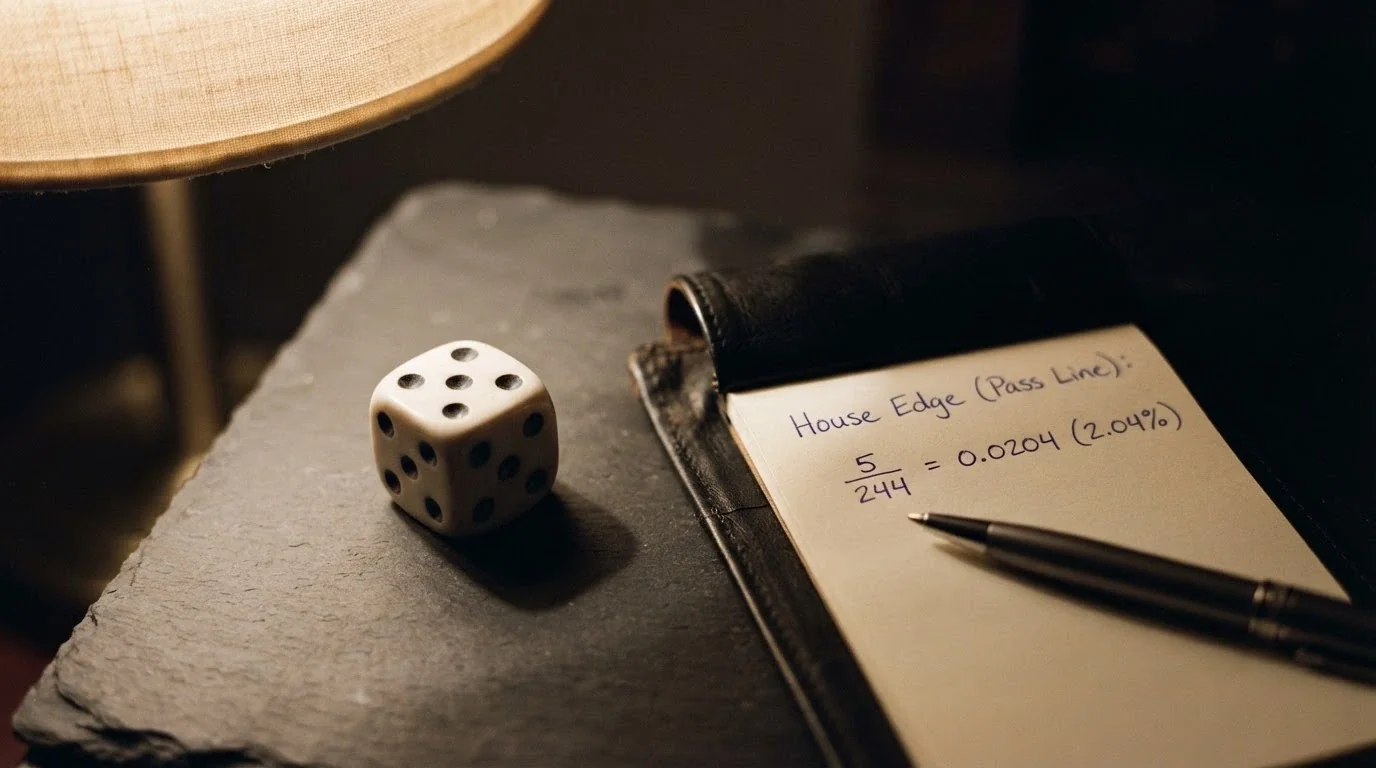
The maths of dice games is the cleanest thing on a casino floor. Craps offers a wager with a house edge of zero, and the same layout carries another wager with an edge of 16.67 per cent. Sic Bo’s Big and Small bets sit at 2.78 per cent, its Domino bet at 16.67 per cent. Lightning Dice reports 96.21 per cent RTP, which is a 3.79 per cent house edge; Boom City reports 96.43 per cent, MONOPOLY Roll ’em reports 96.97 per cent. None of these numbers are negotiable, and none of them are estimates — they are the published figures for the bets and the games.
The legal picture is just as clean. Online casino dice is illegal to provide in Australia. ACMA has blocked 1,564 illegal sites since November 2019, and the 1 January 2027 commencement of the 2026 reform adds bank-blocking powers on top. The licensed AU wagering market offers sports and racing; it does not offer craps, Sic Bo or live-dealer dice titles.
A player who reads those two facts together has the framework they need. The maths decides which bets are worth making on the felt. The law decides which side of the AU border the bet is being made from. The consumer protection infrastructure — BetStop, ACMA complaints, 1800 858 858, Gambling Help Online — covers the licensed side of that border and not the other.
The next move is the reader’s. The numbers on this page are the same numbers every other dice player will face. What each reader does with them is the part the page cannot do for them.
Frequently Asked Questions
What is the difference between Sic Bo and Craps?
Sic Bo uses three dice and a grid of bets on totals, faces and combinations; Craps uses two dice and a layered table layout with a come-out roll and a point phase. Sic Bo’s best bets are Big and Small at 2.78 per cent house edge; Craps’ best bets are Don’t Pass at 1.36 per cent and the zero-edge Odds bet behind it. The games share a transparent maths but differ on almost every other dimension.
Can I play live dealer dice games like Lightning Dice from Australia?
The live-dealer stream is reachable from Australia through the offshore casinos in this ranking, but the product is illegal to provide here under the Interactive Gambling Act 2001. No AU-licensed operator offers live-dealer dice. ACMA has blocked 1,564 illegal sites since November 2019, and the offshore casino is not connected to BetStop.
What is the house edge on casino dice games like Craps and Sic Bo?
Craps: zero on the Odds bet, 1.36 per cent on Don’t Pass, 1.41 per cent on Pass, 1.52 per cent on Place 6 or 8, 11.11 per cent on Any Craps, 16.67 per cent on Any Seven. Sic Bo: 2.78 per cent on Big/Small, 12.50 per cent on totals 10 and 11, 16.67 per cent on the Domino bet. Lightning Dice is 96.21 per cent RTP, Boom City is 96.43 per cent, MONOPOLY Roll ’em is 96.97 per cent.
What is BetStop and does it cover online dice games?
BetStop is the National Self-Exclusion Register, run by ACMA since August 2023. A single registration excludes a player from every AU-licensed wagering service for the chosen period. BetStop does not cover offshore casinos, which have no obligation to honour a BetStop registration. As at 31 July 2026, the register had 67,480 registrations and 41,290 active exclusions.
What are the best bets to make in Craps for a beginner?
Don’t Pass at 1.36 per cent and Pass at 1.41 per cent are the standard line bets. Stack as much as the table allows behind either on the Odds bet, which carries zero per cent house edge. Avoid the proposition bets at the centre of the layout — Any Seven at 16.67 per cent, Any Craps at 11.11 per cent.
Where can I get help if I have a gambling problem in Australia?
The National Gambling Helpline is 1800 858 858 — free, confidential and staffed 24 hours a day. Gambling Help Online provides 24/7 chat and email counselling. BetStop is the national self-exclusion register at betstop.gov.au. None of these services reach offshore casinos, but they all reach anyone who calls, regardless of where they have been playing.